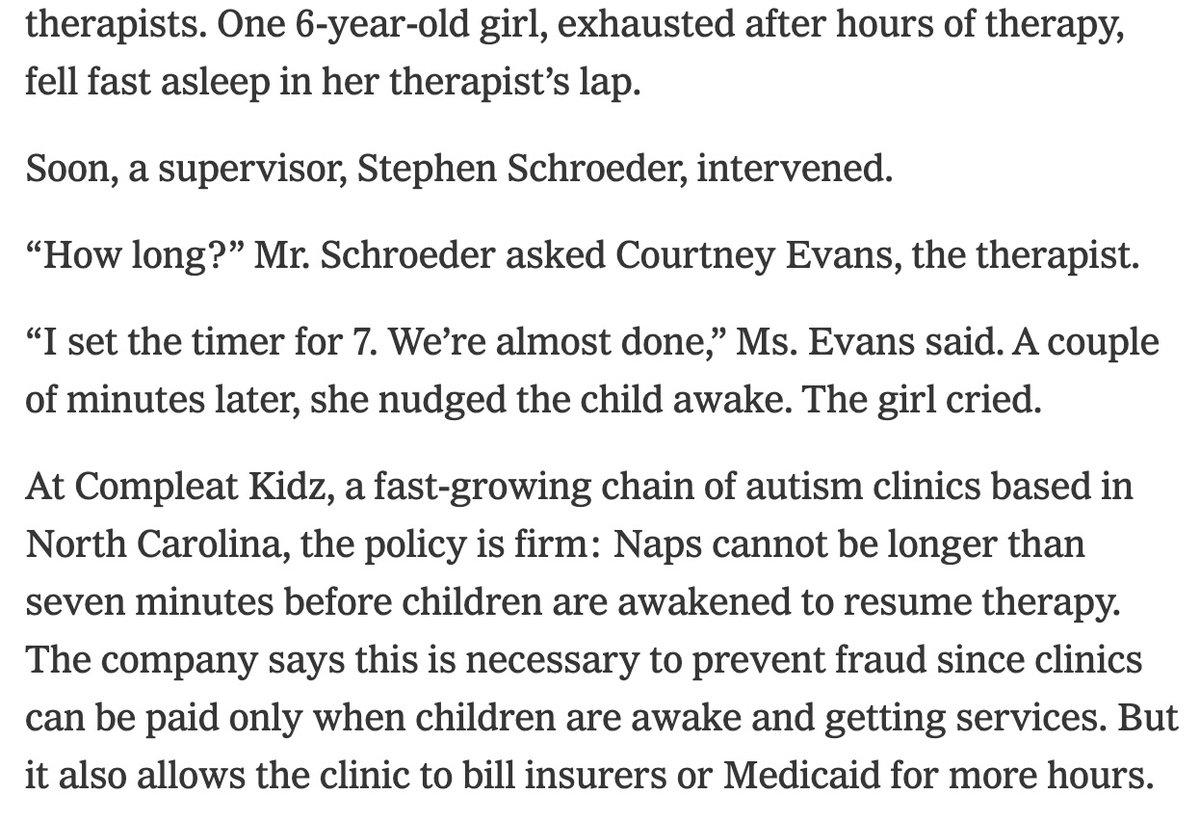
The Trump administration released new guidance Tuesday telling states they should require breaks for children in autism therapy, between long sessions of care.
Read more about that, and other ways the government wants states to better oversee autism therapy, here: https://t.co/fkdmiTjxF8
Earlier this year, @sangerkatz and I wrote about a chain of autism clinics that were limiting preschoolers' naps to 7 minutes so they could bill more to Medicaid.
Yesterday, Medicaid rolled out new guidance to states that would address this type of billing behavior.
Today @sangerkatz and I take a deep dive into Major League Baseball arbitration, how it works, and why we're seeing some very different outcomes in the health care system that Congress modeled after it.
https://t.co/8sFkbO6Y28
When Congress passed the No Surprises Act, legislators constantly described the new system as "baseball-style arbitration."
Turns out, they might have missed some key features Major League Baseball's system - and that might explain the outcomes we're seeing today.
NSA expert folks fact-check me here, but wouldn't the No Surprises Act prevent a surprise bill for air ambulance transit in a case like this??
https://t.co/OUnR7XHAUi
@ChildrenNeedUs_@JasonSm32486931@charlesornstein@nytimes I obviously can't speak to your friend (who sounds like he was very good at what he did!) but data from the Bureau of Labor Statistics suggests that the vast majority of surgical assistants make significantly less money. https://t.co/SLBPyuRYZT
Surgical assistants often earn $70,000 to $100,000 for helping doctors suture and retract.
Some are taking advantage of a consumer protection law to earn $210,000 for a single operation, we found in our new @nytimes investigation.
https://t.co/7aOs3XRivn
@DrJLozada@charlesornstein@nytimes There are issues with non-payment but hard to tell how pervasive they are since the government does not track it. We have had some plans tell us outright they do not play awards they consider "unreasonable," such as an award higher than billed charges.
@nocorporatemed Hi - want to shoot me a note? We're interested in better understanding issues with non-payment that we've heard about. [email protected].
Margot and I will be continuing to report on No Surprises Act this year. If you have a tip to share related to the law, get in touch! [email protected]
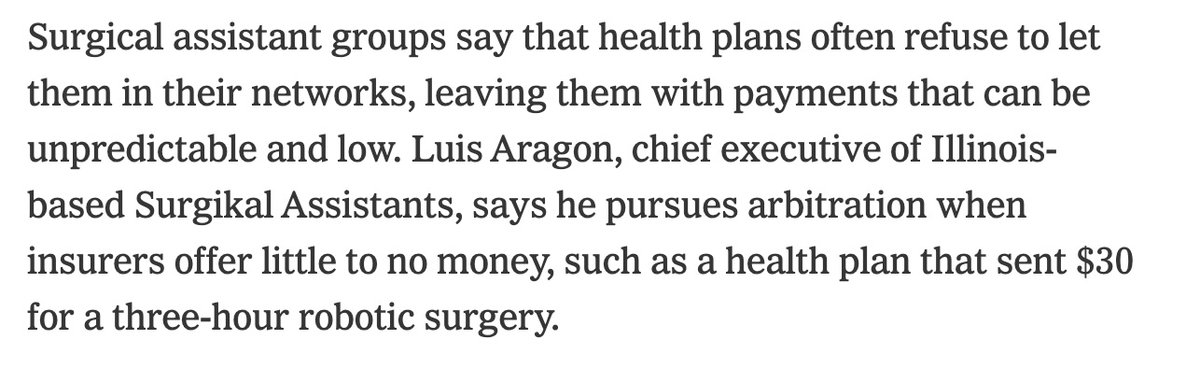
@sarahkliff In our reporting, we found numerous examples where surgical assistants out-earned surgeons by using the NSA's arbitration system. For this scoliosis surgery, the assistant won 24x the main surgeon's fee.
.@msk & I dug into what surgical assistants are earning in No Surprises Act arbitration. We found surgical assistants' earning:
—$50,000 for a prostate surgery
—$100,000 for a breast reconstruction (just right breast, not left)
—$210,000 for a facial feminization procedure
https://t.co/FUDj9uBwMK
For context, surgical assistants typically earn $70,000 to $100,000 per year.
We found that some have used No Surprises Act arbitration to earn $22,000 per hour.
.@msk & I dug into what surgical assistants are earning in No Surprises Act arbitration. We found surgical assistants' earning:
—$50,000 for a prostate surgery
—$100,000 for a breast reconstruction (just right breast, not left)
—$210,000 for a facial feminization procedure
https://t.co/FUDj9uBwMK
Doctors are winning big paydays from insurers under a law intended to protect patients and rein in high prices.
@nytimes reporter Margot Sanger-Katz @sangerkatz talked with Tradeoffs about how this is fueling higher premiums.
Listen to today's episode:
https://t.co/HGyEzxpQZy
@stuartbuck1@NYHammond@jbarro@sangerkatz It's still a bit a mystery to me fwiw - the same incentives seem to exist in Major League Baseball arbitration but the outcomes and bids are not nearly as disparate there as they are in NSA.
New York will soon be a litmus test for politicians' appetite to reform this system.
@GovKathyHochul is trying exempt Medicaid claims from this kind of arbitration. Hospitals and doctors are fiercely lobbying against it, so lawmakers have been reticent to come on board.
The big surprise of the No Surprises Act: Doctors are cashing in on the consumer protection law, getting paid $440,000 for breast reductions and $14,000 for steroid injections.
Latest investigation with @sangerkatz: https://t.co/keJwqqAeLX