Is resting-state functional connectivity (rsFC) or cortical thickness (CT) more effective at capturing sex and gender differences in the brains of preadolescents?
Check out our new preprint: https://t.co/JFxag1cxPi
After a high dose of psilocybin, the brain desynchronizes at a massive scale, causing loss of our sense of self, time, and space. This may drive the burst of plasticity caused by psychedelics. The next day, brain activity has largely returned to normal, but an echo remains – a reset of circuits critical to the sense of self.
Our study is out today in @Nature https://t.co/PjACA6nkAy
📢New preprint! 📢
w/ @martin_gell , @sNeuroble, Tim Laumann, @stevenmnelson
Check out our overview and perspective:
“Psychiatric Neuroimaging Designs for Individualised, Cohort, and Population Studies”
https://t.co/5JPRkPO0pr
🧵
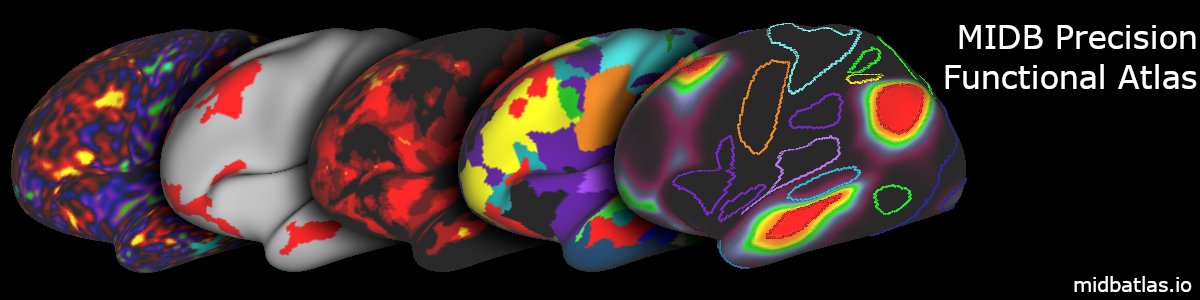
Our paper “A Precision Functional Atlas of Personalized Network Topography and Probabilities” is out now in @NatureNeuro! The MIDB Precision Brain Atlas is a collection of individualized neural network maps from n~10,000 and probabilistic atlases (1/8) https://t.co/TzT2yBKIyk
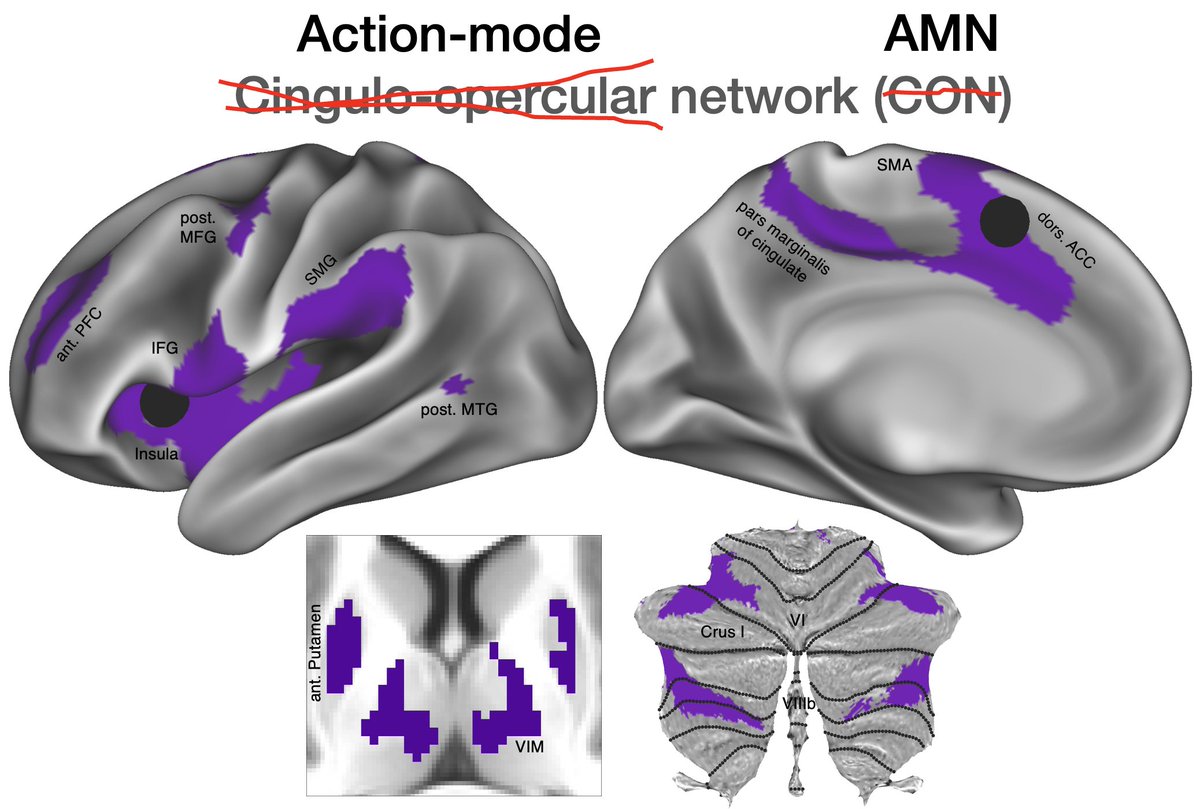
Introducing the Action-Mode Network – AMN. Better late than never! 17 years ago, we clumsily called this the Cingulo-opercular Network (CON) based on its anatomy (we weren’t exactly sure what it does). Now we’ve finally got the evidence to give it the functional name it deserves: the Action-mode Network (AMN). Find our arguments here: https://t.co/z8290fmmVB with the peerless Marc Raichle and the brilliant @gordonneuro. 🧵 ↓
How to find massive motor plasticity effects in the subcortex? Find out in our preprint. https://t.co/KuEJGxfFJ8 Turns out these new findings change our understanding of #Parkinson disease and some #sleep processes. Let me unfold it
With @ndosenbach @gordonneuro @dillannewbold
We’ve parcellated the neonatal cortical surface based on abrupt changes in functional connectivity, resulting in a set of 283 highly homogenous cortical surface parcels in a sample of n=261 neonates.
Preprint now available!
https://t.co/2kTbB4tslY
Now available at @NatureComms !
When do adolescents reach adult levels of executive function? We used FOUR independent datasets (N>10,000), behavioral data from 17 distinct EF tasks, and nonlinear modeling to address this and related questions.
https://t.co/OOLT7nKBEm
1/5. Wanna know the RSFC behavioral prediction comparison between parcellations🧠 and gradients🌈? Our paper is officially out https://t.co/kMIbLjBc9Y
We predict behavioral measures in HCP and ABCD datasets with optimized resolutions for different approaches.
Have a look at our Matters Arising in @nature.
https://t.co/Tc6xp430z2
We take a deeper dive into multivariate #BWAS (Brain-Wide Association Studies) reproducibility with additional methods that further emphasize the need for large sample sizes for BWAS
Ever wondered if your interesting brain-behavior correlation was affected by head motion, but were afraid to ask? We’ve created a motion impact score for detecting spurious brain-behavior associations. Excited to share my 1st preprint on Science Twitter! https://t.co/3gDH7zSb8K
The good news is that frame censoring does a fantastic job of reducing false positive motion impact score. That means if you motion censor your data after standard processing then you are much less likely to get spurious results due to motion. Highly recommend trying it!
@vdcalhoun You've articulated a key assumption underpinning motion impact score, and a potential obstacle to using this for fMRI involving a motor task. However, for resting-state, we think it's safe to assume second-to-second variation in FD is unrelated to a behavioral trait's FC.