We scraped 180 critic reviews in 21 languages and 321k+ player reactions during GTA 6 launch week.
The split is wild:
🐝 95% positive across 304k PS/Xbox store ratings
🐝 5.5/10 user score on Metacritic (29% zeros vs 34% tens)
🐝 The storyline tops both the most praised AND most hated lists
How we collected the dataset without burning credits:
https://t.co/gpDXu97owL
A web browser is a remarkable piece of engineering. When you need visual rendering, user interaction, and layout calculation, nothing else comes close.
Booting all of that machinery just to pull strings of text off a page is a different story.
Think about two versions of the same site displaying a list of quotes and authors.
On the classic server-rendered version, the markup arrives complete. The quote text and author names sit directly inside the initial HTML payload. You fetch it with a basic HTTP client, parse the tree, and move on. The compute cost is practically negligible, and a massive chunk of the web still functions this way.
On the dynamic version, the exact same GET request returns an empty shell. You get a clean 200 response code, but the target <div> is completely blank. The actual data might be embedded inside a bundled script or waiting on an internal API call, but nothing has executed yet.
The shape is the same. The markup is a mounting point, and the content only appears once the JavaScript has run. And that phrase, 'once the JavaScript has run', is what people mean by hydration.
If web scraping engineers had a horror movie, the title would be "CSS Text Obfuscation."
What makes this technique such a nightmare, and how do you handle it in production?
We broke down the most common obfuscation tactics and tested ways to bypass them, complete with code experiments and live demos:
https://t.co/NRvxFbIhBE
Mmm. Nothing like a fresh CAPTCHA first thing in the morning. Rate limits with lunch. Getting your IP banned right before a deadline...
Yeah. Nobody says that.
Empowering thousands of developers to build without the hassle of managing scraping infrastructure.
Now, we’re proud to build as part of https://t.co/VAUIKwFMt2 – a data ecosystem for a world built on intelligence.
Still us. Just a wider horizon. 🔍
Learn more: https://t.co/AhXwWE4U5r
Today, a browser can render anything, and that's why it feels like the safe default. But let's be precise about what we are actually launching.
A browser is not a library you call. We're talking about an entire operating system that you boot.
Because today, a browser brings a lot of stuff, like a process scheduler, its own memory allocator, audio-video codecs, a lot of IPs, and of course, its network stack.
Chromium today is around 35 million lines of code, which is in the same order of magnitude as the Linux kernel.
The most expensive line of code in a scraping task is the one that launches the browser.
Not because it's slow, but because of what it costs you on every single page. And a scraping task is not one page, it's often hundred thousands a day.
What you spend loading one, you spend again every time, until it stops being a technical details, and it becomes how many machines you need to rent.
Every scrape is a bet between cost and success. Bid too low and you hit a block; bid too high and you overpay for simple HTML.
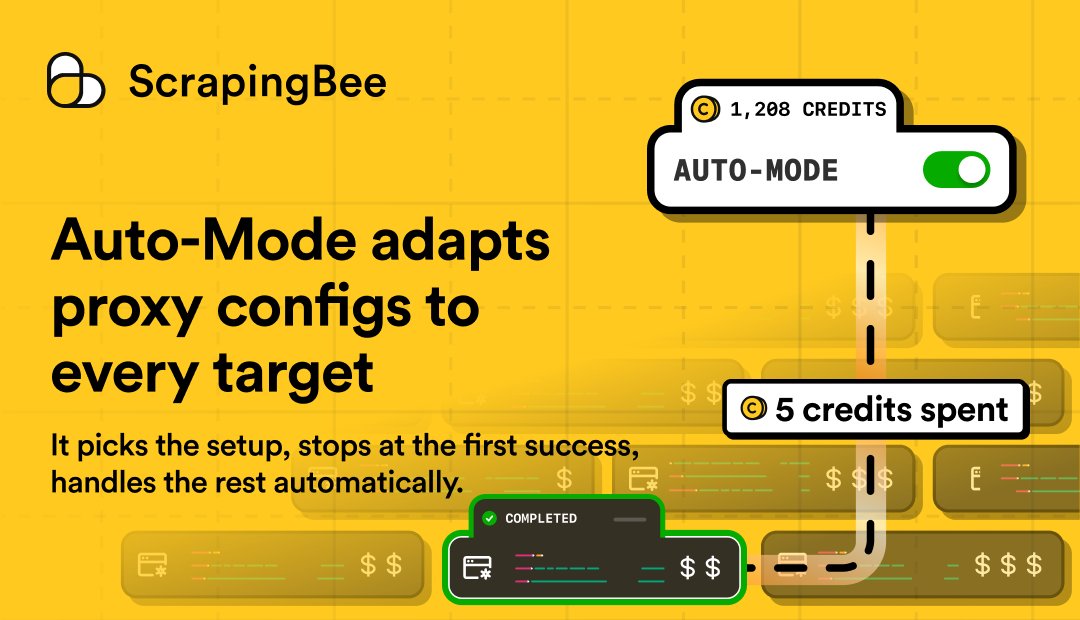
At Extract Summit in Austin, our developer Kostas Jakeliūnas delivered a quick lightning talk on how Auto-Mode automates this balance:
• Climbs from 1-credit fetches to stealth proxies only when needed
• Inspects DOM content instead of relying on fake 200 OKs
• Charges only for the tier that delivers data (0 credits on failure)
• Keeps budgets safe with max_cost
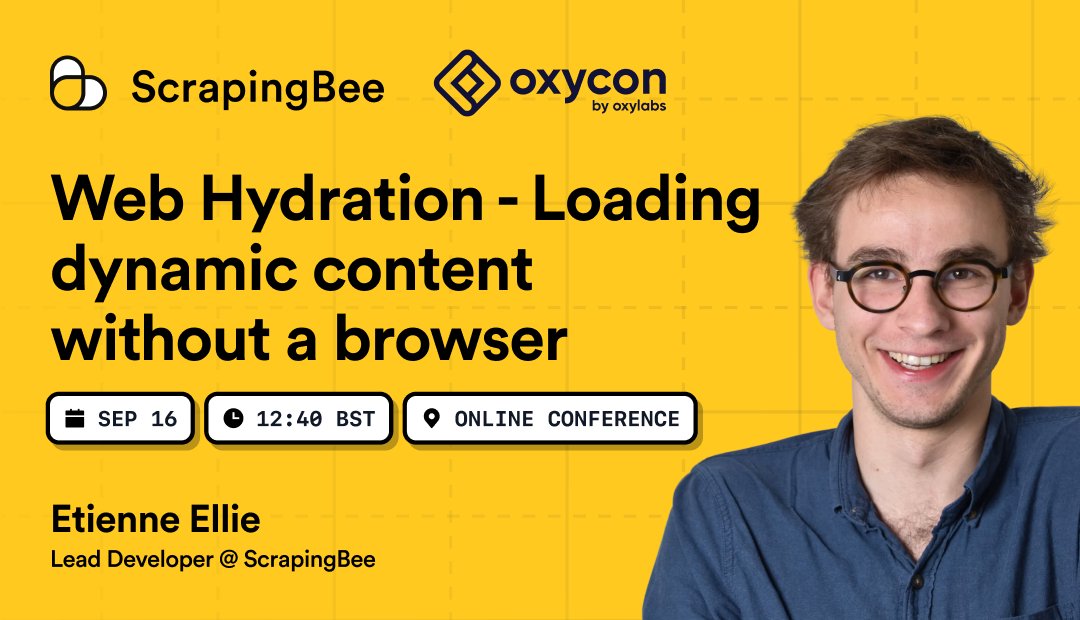
What actually happens under the hood during Web Hydration? Our lead engineer, Etienne Ellie broke this down live at OxyCon, and the demo repo is now public
https://t.co/1petODuYkX
If web scraping is core to your work, keep this on your radar. Tomorrow at OxyCon® 2026, our Lead Engineer, Etienne Ellie, presents Web Hydration: Loading Dynamic Content Without a Browser.
Register for free: https://t.co/fEqJzCOV5h
#oxycon
Need to find data analysts in France, software engineers in Portugal working for US firms, or Fortune 500 CTOs?
Skip setting up complex search filters. With our Agentic Employee Search, describe who you need in a plain English prompt and get structured profiles back in seconds.
Docs linked below 👇
https://t.co/xDFSswVnys
From Brazil to Australia, our classic proxies now support 42 countries.
Testing localized content in Tokyo? Tracking prices across European markets? Scraping geo-specific data from Canada? Just pick your country from the dropdown.
The full list of supported countries is right this way https://t.co/WkC29ZNbSm
Fresh from the hive: Auto-Mode is live.
The problem? Every scraping target behaves differently. One blocks standard proxies. Another needs JS rendering. A third requires premium infrastructure.
Auto-Mode solves this. Add mode=auto and it tests configs automatically, starting simple and escalating only when needed. Stops at first success.
Set max_cost to cap how far it goes. Check sb-auto-cost to see what worked.
Manual mode stays for full control. Auto-Mode is for when you want extraction to just work.