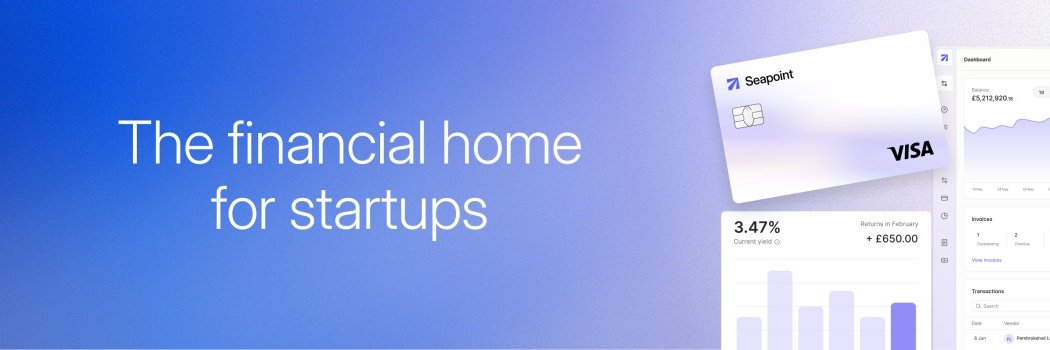
Today is a big day for @seapointhq - we've raised €7.5M, and Seapoint is now open to every startup founder in the UK and Ireland.
Full story here: https://t.co/JYYahQH2hd
Running startup finances is a lot more complicated than it needs to be.
So we fixed it.
Here’s our Product Lead Youssef on how @SeapointHQ makes finance ops simple in just 30 seconds.
The short version:
→ It’s one place to run bookkeeping, payroll, treasury and more
→ Connect your bank accounts, inbox and Xero in under five minutes
→ Sit back and watch us handle your business finances for you, so you can get on with actually running your business
Unpopular pov: I believe AI will actually be good jobs.
The internet is obsessed with the doomsday view. But the data doesn't support it. And historically, technical innovation drives growth, not decline.
My argument in 🧵
Full essay here: https://t.co/1HilstZjK5
Was great to join the guys at @etnshow today and talk about Stripe's OpenRouter acquisition and how we're using this technology at @SeapointHQ
Full video here: https://t.co/QdmgVsu9bS
Seapoint CEO @seanmullaney who served as Stripe's EU CIO tells us the OpenRouter acquisition is a natural evolution for the company:
"First of all, it makes a lot more sense for Stripe than it does for Ramp because Stripe have always sold to developers".
"They've been like the gold standard for developer APIs and developer experiences and they're just universally loved by developers."
"Now developers are facing a new choice which is: how do I actually access the world's AI models and inference providers? And it's the same structural work that Stripe had to do with payments."
"So structurally Stripe is just like—it's in their DNA how to build this business".
@edzitron I ran local payments engineering at Stripe before starting @SeapointHQ . Here's my take on the acquisition, and its not about the singularity!
https://t.co/5wfyDM1QTI
Why would @Stripe pay a reported $7bn for @OpenRouter? I led the team that built local payments at Stripe, alongside many of the @SeapointHQ team. Here's my inside take, and it's not just about tokens and AI.
My team at Stripe and I built and ran 40+ local payment methods worldwide, processing over $100bn a year. Each one took around a year of partnership negotiations, engineering, integration, testing and certification. It took a lot of clever design to abstract away all that complexity and variation behind a single API, and then operate it at high scale and >99.99% reliability.
In a single global checkout, Stripe would route each transaction to the local payment method most likely to convert that shopper into a customer. A merchant integrated once, sold globally, and made more money. The integrations were the moat. The routing was the product.
Stripe's own framing is about tokens. The new currency of AI, scarce compute, helping businesses spend it efficiently. That's the strategic story, and it's true.
I think the real reason is simpler. OpenRouter is structurally the same company as Stripe, just with models instead of payment rails. Both need clean abstractions, hundreds of integrations, routing and reliability at scale. And there is no shortcut to the hard work of building this. But whoever does the work to simplify that complexity will win the developers and get paid a premium for it, because developers will always pay to move fast and never think about what's underneath. That's what developers pay Stripe for.
The other half of this is the customer. Stripe won developers with the first router. OpenRouter's customers are developers making the same call for the same reasons. So this isn't Stripe buying into a new market, it's a second router sold to the buyer it already has.
And it genuinely works. We use OpenRouter on Seapoint's transaction enrichment and invoice reconciliation pipelines, running hundreds of A/B tests to find the model, prompt and workflow combinations that score best against our own eval datasets. It moved several workflows off Claude onto Gemini Flash, which was faster, cheaper and higher performing. Often the winner isn't one model at all, it's two combined, each doing the part it's good at.
I also use it daily as a panel of experts. Half a dozen reasoning models critiquing my thinking and arguing with each other beats one model agreeing with me.
Congrats to both teams. Very excited to see what you build together. Seapoint are very happy Stripe and OpenRouter customers!
If you're running models in production, are you routing across several or committed to one?
I ran the team that built local payment methods globally at Stripe. What we developed was a router for payments.
A big part of why Stripe won is that it abstracted away the complexity of 40+ local payment methods behind a single API, then routed each transaction to the rail most likely to convert them.
So now Stripe is buying OpenRouter to build the router for LLMs. Abstract every model behind one clean API and optimise for intelligence instead of payment conversion.
I wrote a more in depth post on the announcement here: https://t.co/vqFW3QrBYw
Congrats to both teams. @SeapointHQ are very happy Stripe and OpenRouter customers!
Why would @Stripe pay a reported $7bn for @OpenRouter? I led the team that built local payments at Stripe, alongside many of the @SeapointHQ team. Here's my inside take, and it's not just about tokens and AI.
My team at Stripe and I built and ran 40+ local payment methods worldwide, processing over $100bn a year. Each one took around a year of partnership negotiations, engineering, integration, testing and certification. It took a lot of clever design to abstract away all that complexity and variation behind a single API, and then operate it at high scale and >99.99% reliability.
In a single global checkout, Stripe would route each transaction to the local payment method most likely to convert that shopper into a customer. A merchant integrated once, sold globally, and made more money. The integrations were the moat. The routing was the product.
Stripe's own framing is about tokens. The new currency of AI, scarce compute, helping businesses spend it efficiently. That's the strategic story, and it's true.
I think the real reason is simpler. OpenRouter is structurally the same company as Stripe, just with models instead of payment rails. Both need clean abstractions, hundreds of integrations, routing and reliability at scale. And there is no shortcut to the hard work of building this. But whoever does the work to simplify that complexity will win the developers and get paid a premium for it, because developers will always pay to move fast and never think about what's underneath. That's what developers pay Stripe for.
The other half of this is the customer. Stripe won developers with the first router. OpenRouter's customers are developers making the same call for the same reasons. So this isn't Stripe buying into a new market, it's a second router sold to the buyer it already has.
And it genuinely works. We use OpenRouter on Seapoint's transaction enrichment and invoice reconciliation pipelines, running hundreds of A/B tests to find the model, prompt and workflow combinations that score best against our own eval datasets. It moved several workflows off Claude onto Gemini Flash, which was faster, cheaper and higher performing. Often the winner isn't one model at all, it's two combined, each doing the part it's good at.
I also use it daily as a panel of experts. Half a dozen reasoning models critiquing my thinking and arguing with each other beats one model agreeing with me.
Congrats to both teams. Very excited to see what you build together. Seapoint are very happy Stripe and OpenRouter customers!
If you're running models in production, are you routing across several or committed to one?
Why would @Stripe pay a reported $7bn for @OpenRouter? I led the team that built local payments at Stripe, alongside many of the @SeapointHQ team. Here's my inside take, and it's not just about tokens and AI.
My team at Stripe and I built and ran 40+ local payment methods worldwide, processing over $100bn a year. Each one took around a year of partnership negotiations, engineering, integration, testing and certification. It took a lot of clever design to abstract away all that complexity and variation behind a single API, and then operate it at high scale and >99.99% reliability.
In a single global checkout, Stripe would route each transaction to the local payment method most likely to convert that shopper into a customer. A merchant integrated once, sold globally, and made more money. The integrations were the moat. The routing was the product.
Stripe's own framing is about tokens. The new currency of AI, scarce compute, helping businesses spend it efficiently. That's the strategic story, and it's true.
I think the real reason is simpler. OpenRouter is structurally the same company as Stripe, just with models instead of payment rails. Both need clean abstractions, hundreds of integrations, routing and reliability at scale. And there is no shortcut to the hard work of building this. But whoever does the work to simplify that complexity will win the developers and get paid a premium for it, because developers will always pay to move fast and never think about what's underneath. That's what developers pay Stripe for.
The other half of this is the customer. Stripe won developers with the first router. OpenRouter's customers are developers making the same call for the same reasons. So this isn't Stripe buying into a new market, it's a second router sold to the buyer it already has.
And it genuinely works. We use OpenRouter on Seapoint's transaction enrichment and invoice reconciliation pipelines, running hundreds of A/B tests to find the model, prompt and workflow combinations that score best against our own eval datasets. It moved several workflows off Claude onto Gemini Flash, which was faster, cheaper and higher performing. Often the winner isn't one model at all, it's two combined, each doing the part it's good at.
I also use it daily as a panel of experts. Half a dozen reasoning models critiquing my thinking and arguing with each other beats one model agreeing with me.
Congrats to both teams. Very excited to see what you build together. Seapoint are very happy Stripe and OpenRouter customers!
If you're running models in production, are you routing across several or committed to one?
I ran the team that built local payment methods globally at @stripe. What we developed was a router for payments.
A big part of why Stripe won is that it abstracted away the complexity of 40+ local payment methods behind a single API, then routed each transaction to the rail most likely to convert them.
So now Stripe is building the router for LLMs. Abstract every model behind one clean API and optimise for intelligence instead of payment conversion.
Congrats to both teams. @SeapointHQ are very happy Stripe and OpenRouter customers!
On 15 September we'll start charging for @Seapoint for the first time.
Before we set a single price, we wrote down five pricing principles and made every decision against them.
https://t.co/Ha4tc4QeWC
That means we charge the least to the companies most likely to grow into our biggest customers. We'd rather be there from the start.
The five principles, and decision-making behind them: https://t.co/Ha4tc4QeWC
The decisions those principles forced:
→ The free plan stays free - a plan, not a trial
→ Pre-seed founders get our top plan for £100/mo, normally £300
→ No admin fees, no surcharges - the monthly fee is the fee