Doing some cheeky vibe‑coding over the holidays?
If you’re building UI for AI, give your users the power of choice with Promptions (prompt + options).
Dynamically-generated controls end the frustration of endless typing and trial & error prompting.
https://t.co/Edaejx9y40
Promptions helps developers add dynamic, context-aware controls to chat interfaces so users can guide generative AI responses. It lets users shape outputs quickly without writing long instructions: https://t.co/3gua52Y2r8
It was originally conceived by @iandrosos, former Resident Researcher, and published woth support from Jack Williams, @AdvaitSarkar, Nicholas Wilson, @PayodPanda, and myself.
Magentic Marketplace is an open-source simulation environment for studying how AI agents interact and transact in digital markets. Its modular design lets researchers experiment with different market setups, agent behaviors, and system dynamics at scale. Explore it now on Azure AI Foundry Labs. https://t.co/gwCfDS8rkP
If you care about the future of work with AI, take 15 minutes to be inspired by this thoughtful, amusing, & hopeful video.
In his TEDAI Vienna talk, Advait Sarkar from our #ToolsForThought team pushes back against AI that thinks for us, and shows how AI can help us think better.
Microsoft senior researcher, Advait Sarkar, recently presented at @TEDAIVienna, where he spoke about AI’s role in elevating human thought. His talk explored how AI transforms knowledge work, creativity, and human thought – and how, if we design AI to make us think, and not think for us, we can greatly benefit as a society. Check out Advait’s presentation to learn more: https://t.co/MgvSVUEyA3
📢 AI is changing the way we create, learn, & reason.
But is it augmenting human cognition, or dulling it?
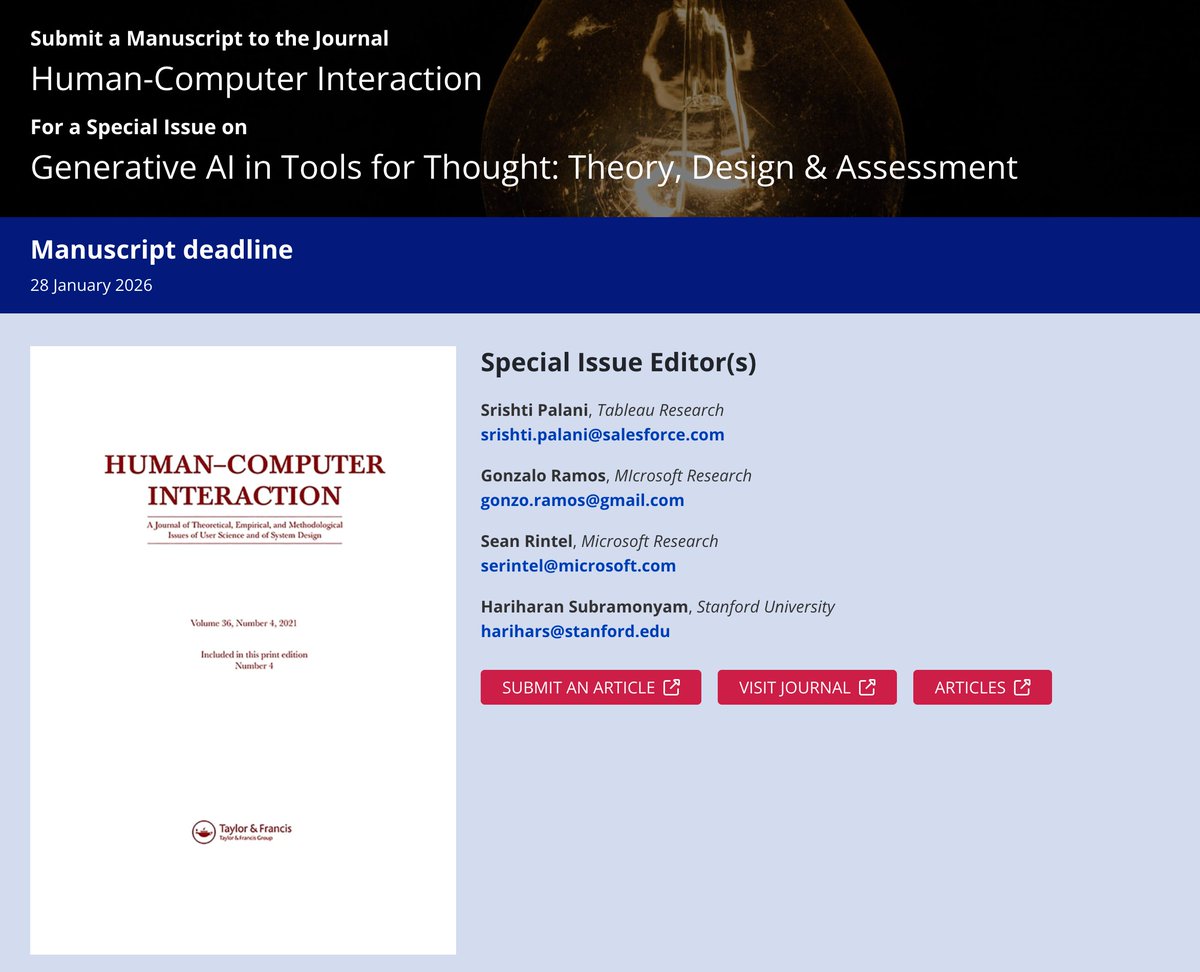
Please submit your ideas to our #HCI Special Issue: Generative AI in Tools for Thought.
Abstract Deadline: Oct 10, 2025 → https://t.co/Ks8u2jk8dA
At #CHI2025, we ran a workshop on 🧠Tools for Thought: Research and Design for Understanding, Protecting, and Augmenting Human Cognition with #GenerativeAI
What are the #HCI research+design opps in this space?
👉Read our new synthesis of the workshop: https://t.co/JDZZ3PPbQ3
Join us at CHI 2025 to explore how AI systems can be used as Tools for Thought as we reimage AI’s role in human thinking. Learn about new research, prototypes, and a workshop on designing AI that supports critical thinking, decision-making, and creativity: https://t.co/it0VnRd8e0
We’re #hiring at @MSFTResearchCam!
The Tools for Thought project seeks an HCI researcher with dev and design skills for a 2-year #postdoc on protecting and augmenting human cognition with #AI.
Apply at https://t.co/gQHNvaml5E
Contact me for questions or find us at #CHI2025
Our #CHI2025 Tools for Thought #workshop is open for sign-up!
Help us explore the potential that AI has for critical thinking, metacognition, decision-making, diversity of creativity, and more.
📢CHI'25 workshop: Tools for Thought: Research and Design for Understanding, Protecting, and Augmenting Human Cognition with Generative AI
🌐https://t.co/bELq9J4pYx
🗓️Submission deadline: Feb 13, 2025 AoE
Our short piece in the USC Annenberg 2025 Relevance Report proposes that the next #ResponsibleAI challenge is to develop #ToolsForThought - AI systems that protect and augment human judgement. Look out for our upcoming #chi2025 papers and workshop at https://t.co/bARvebdJXV
Microsoft researchers contributed to USC Annenberg’s 2025 Relevance Report: AI Activated. Their essay, "AI as a Tool for Thought," explores how genAI can enhance human cognition beyond content creation. Read this and other essays from leading experts: https://t.co/RxNIs4jJ90
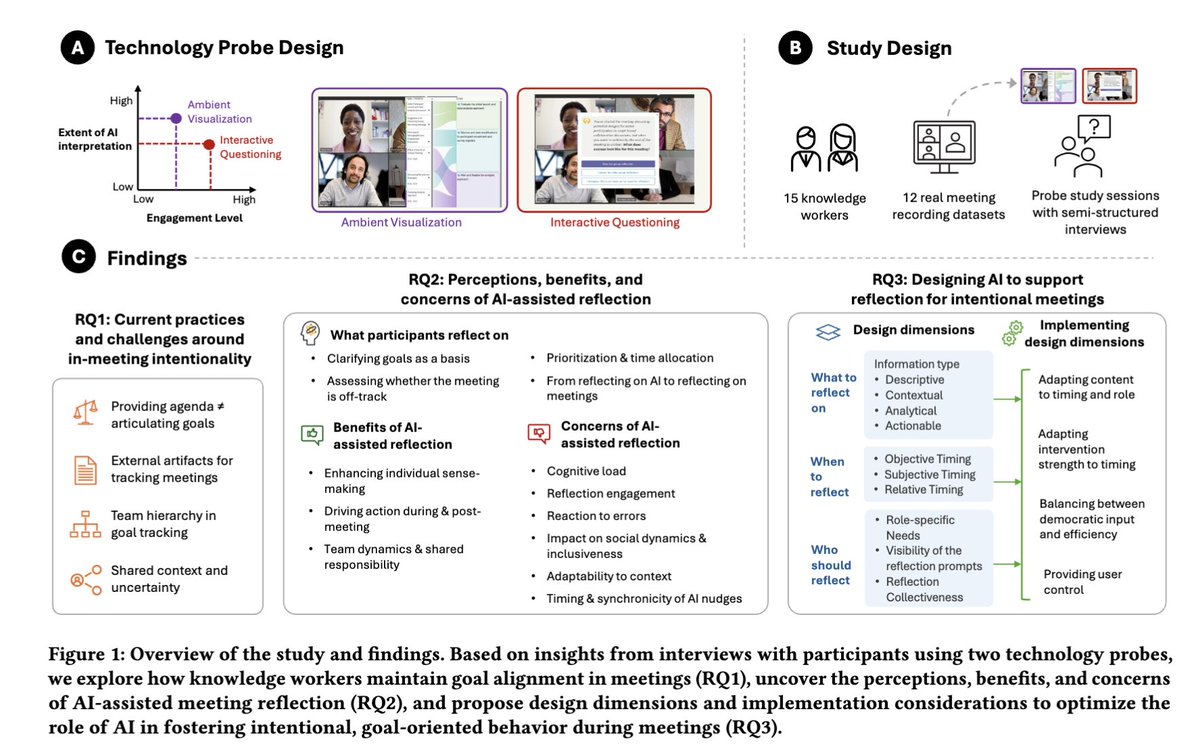
My team’s work on goal-driven adaptive meeting interfaces, lead by Payod Panda and our great intern Gun Woo (Warren) Park shows great promise for how GenAI can customize UI to make meetings more purposeful.
They’ll be presenting it at #DIS2024 this coming week!
In this issue: RENC makes 5G vRAN servers more energy efficient; CoExplorer uses AI to keep video meetings on track; Automatic bug detection in LLM-powered text-based games; MAIRA-2: Grounded radiology report generation. https://t.co/jGTnYt2IaD
Manny hugely influenced my career. He was a co-author on the seminal “A Simplest Systematics for the Organization of Turn-Taking for Conversation”. He also steered me to Ruhleder & Jordan’s delay-generated trouble in videoconferencing paper, which was key to my PhD. Vale.
We are very sad to share this note from John Heritage on the death of Emanuel Schegloff:
“It is with great sadness that I write to inform you that Manny Schegloff has died. He was an intellectual giant and a dear colleague who leaves an extraordinary legacy of scholarship.”