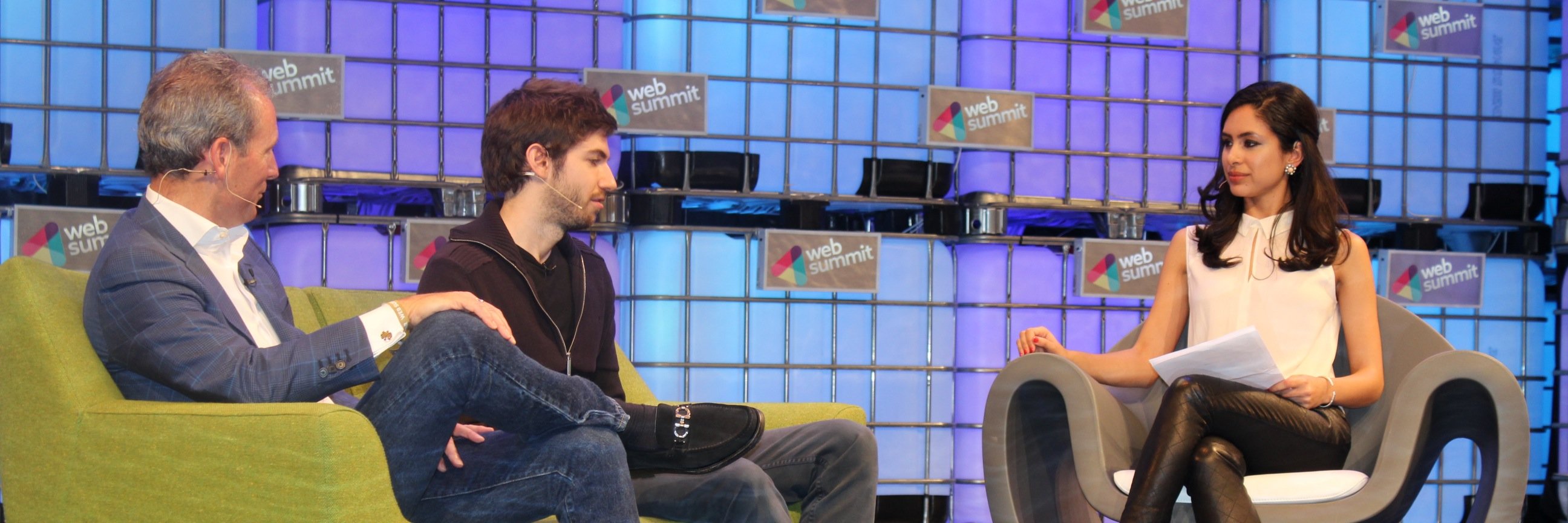
Alex Karp’s CNBC interview is going to be widely discussed and debated.
My initial take on it:
Some will call Alex’s comments self-serving but there is an underlying argument he makes which I think is worth taking seriously: AI has three layers. Compute. Model. Application.
He argues that critical infrastructure doesn’t run on a model alone, that it needs an application layer sitting on top.
I think he’s right about the stack. I made a version of this argument in my recent letter to TechM’s shareholders this year: AI is like today’s smartphone: remarkable technology, but indispensable only because of the apps and experiences built on top of it. The ecosystem determines who creates lasting value, not the chip or the model underneath.
To be clear, I still believe India should pursue sovereign frontier model development. But if Karp’s hypothesis is right, and the model layer is commoditising, then the verticalization of the compute, models and applications needs to happen at the same time.
For AI services, from his arguments, it appears the more durable commercial and strategic edge is the application layer: model-agnostic, built on whichever open model fits best, carrying decades of enterprise workflow knowledge that no model provider owns.
As Karp says, the application layer “takes a large language model & makes it safe and precise…Everyone gets to ask the basic questions: who owns the data, where is it cashed, are the prompts secure, is this being transferred to you?” And “critical infrastructure does not run these models without an application layer.”
And this criticality is where the stakes are highest: defence, classified programs, regulated industries, where control over data, auditability and governance is non-negotiable, whichever model happens to sit underneath.
The application also has to enable business enterprises to preserve their ‘alpha.’
That’s where I truly believe AI service companies have the edge. Not necessarily in owning the model, but in owning what sits above it.
I’m keen to hear other reactions to his interview…
Karp’s comments highlight even more reasons why enterprises will increasingly feel pressure to move away from the big labs.
He’s saying the labs will eat your IP and charge you to do it. And use it to train their next models. And you’ll get nothing defensible in return.
All of this adds even more fuel to the transition to the Rebel Alliance stack, enabling enterprises to both save money and control their own destiny.
Every CEO should watch this video on risks of losing their inventions and business processes to frontier models. Alex Karp is saying out loud what few will say. Yes, Palantir benefits from this, but seeing @AnthropicAI behavior, seems legit to me.
$PLTR CEO Alex Karp was outstanding on Squawk Box this morning. A vision of what AI looks like in the real world. Forward deployed on an application layer that addresses security and governance. 💪🏻
Karp tells us CEOs are frustrated by the cost of AI tokens and the inability to keep their data in-house, creating the risk that frontier AI labs could ultimately replicate their businesses. His solution: an American-built, secure, open-source model $pltr
https://t.co/NrMiyAVnsK
A pleasure to have Palantir CEO Alex Karp join us on @SquawkCNBC this morning. He did not hold back.
"“Are we really going to outsource the battlefield of this country to the consensus view in Silicon Valley? That is effing insane.” $PLTR
I've been shouting about this for over a year….
The Frontier models need to win the application layer and they're going to do that by giving free tokens to startups and discounted ones to large companies in order to steal their IP, innovations, and businesses
The only way to fight this is to use open source software
Gas turbines are the real AI infrastructure bottleneck - not nuclear, not renewables. GE Vernova's order book is full through 2029, now booking into 2031. One turbine costs >$250M. Prices up 300% in 3 years. Microsoft bought 7 for 2.7GW in Texas. xAI Colossus and OpenAI Stargate are already running GEV turbines. 20% of GEV's gas power order book is now AI/data centers. The nuclear headlines are noise. Gas is what actually powers the build right now. @SeemaCNBC https://t.co/wOp6Hkou5M
We're hearing from two sources that Spacex's inclusion into the Nasdaq 100 could be announced as early as tonight $SPCX $QQQ $NDAQ
Full story here on what could mean for the stock:
https://t.co/XOTqKj4RmI
Here’s what we know about SpaceX’s debt deal
-went to market to raise $20b
-saw incredibly strong demand from bond investors with nearly $90b in orders
-at the end of the day SpaceX decided to upsize the amount it raised to $25b (with short and long term maturities)
$spcx
Today @elonmusk took @SpaceX public, 16 years after taking @Tesla public on the Nasdaq. Here’s what Musk changed this time around: https://t.co/K6SsWQOcGj $spcx $tsla
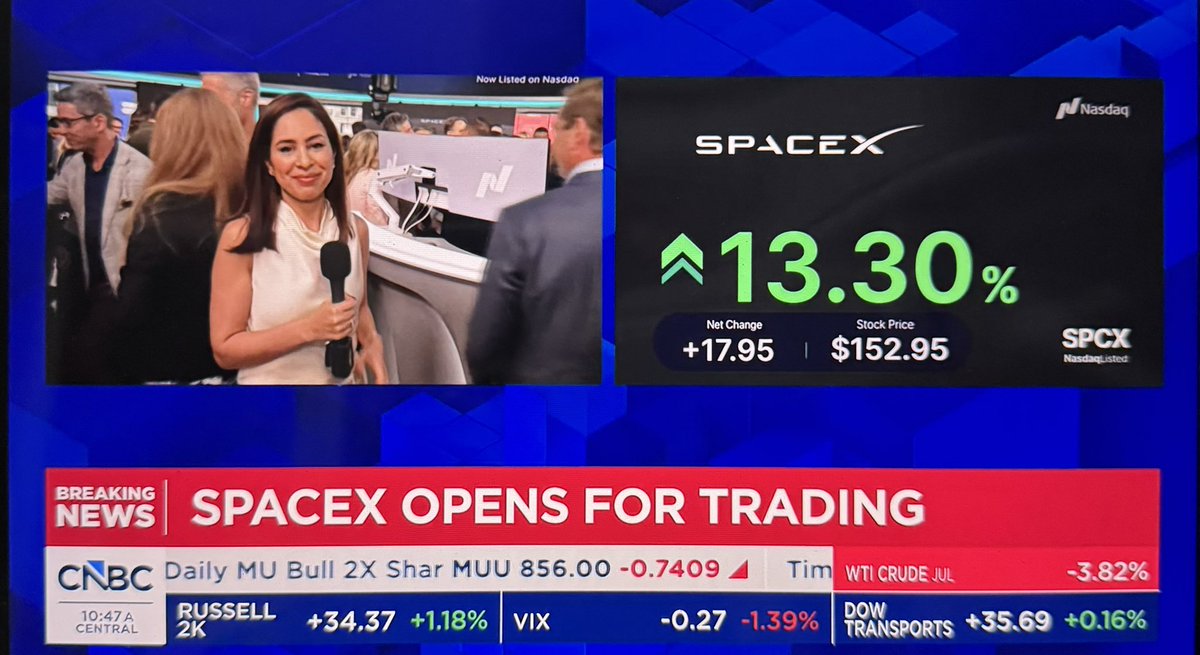
Historic day to be at the Nasdaq following the opening trade for $SPCX @SpaceX@nasdaq president Nelson Griggs tells me SpaceX is on track to join the Nasdaq 100
Retail brokerages are reinforcing their anti-flipping policy ahead of #SpaceX's IPO
Fidelity: if you try to sell within the first 15 days, you'll likely be banned from participating in IPO deals for 6 months.
Second attempt: banned for 1 year.
Third: indefinite ban
$SPCX
@bgurley investors can always sell...there are just penalties that Fidelity and others are enforcing to discourage selling in the first 15 days of trade $spcx
My exclusive with Datadog CEO Olivier Pomel on the company's latest AI capabilities and why he says its crucial to securitize agents. $ddog
https://t.co/ELGkKT96aU
Ahead of the #SpaceX IPO, we analyzed the performance of companies with big one-day pops, and here is what we found. Spoiler alert: blockbuster debut on first day tends to be a warning sign.
https://t.co/FfNqkDVmvA