With warming winter temperatures, the safety of lake ice is a growing concern. “It’s only a matter of three to five days where you can go from safe ice conditions to totally unsafe,” Prof Sapna Sharma tells @AP | @Sharmalab@YorkUScience https://t.co/5JVQYzAzz0
Why doesn’t flowing water freeze at the same temperature as still water? Listen to #YorkU Postdoctoral fellow Josh Culpepper answer that CBC Quirks & Quarks listener question. Hint: moving water mixes things up https://t.co/BuAE48Qtmc @YorkUScience@jaculpepper@Sharmalab
“What we’re seeing and what we’re predicting is that climate change is contributing to more white-ice conditions,” #YorkU Prof Sapna Sharma tells @SN_Explores. Which can lead to unsafe lake ice conditions, adds Postdoc Joshua Culpepper. @Sharmalab https://t.co/g5gXFxBWkm
Celebrating the Inaugural UN World Lake Day by sharing our thoughts on water security and freshwater conservation.
@YorkUniversity@YorkUScience
Opinion: Let’s both celebrate – and worry about – our Great Lakes on World Lake Day /via @globeandmail https://t.co/teEuRJzTM5
Counterintuitive finding: in small lakes most vulnerable to low under-ice dissolved oxygen concentrations, shorter winter ice cover was associated with expansion of bottom-water hypoxia.
https://t.co/TBjnOjJpKT
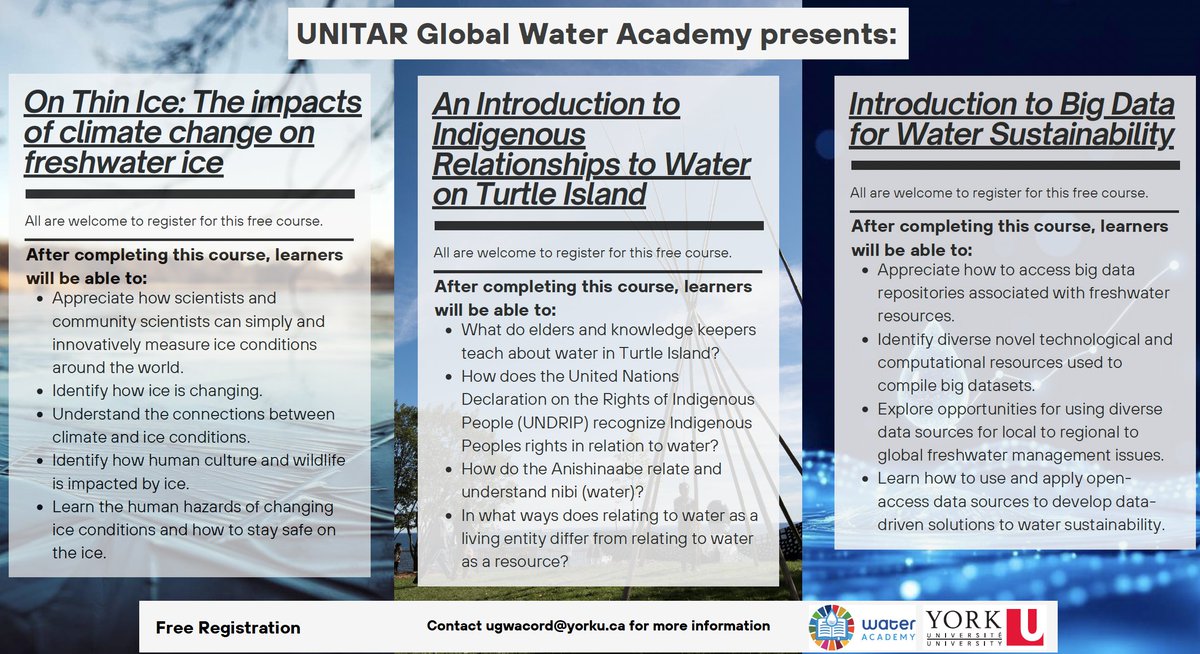
Today on #World Environment Day, we’re launching 3 FREE courses on water sustainability: i) Climate change impacts on ice; ii) Indigenous relationships to water, and iii) Big data analytics. Enrol here: https://t.co/8fqyHRNvqc
@UNITAR Global Water Academy and #YorkU launch three new, FREE courses about water today – #WorldEnvironmentDay2025 to raise awareness and foster action on UN Sustainable Development Goal 6: Clean Water and Sanitation @Sharmalab
https://t.co/fOoi8ijP9l
Our study "Global dominance of seasonality in shaping lake-surface-extent dynamics" is now published in @Nature. We reveal how seasonal rhythms govern the dynamics of ~1.4 million lakes globally.
🔗 https://t.co/0ZQYFJpIJd
#ClimateChange#RemoteSensing#Hydrology#LakeDynamic
The burden of the climate crisis will be felt more by younger generations than older generations, according to a paper in @Nature. https://t.co/j60cmz9KhH
Please RT! If you/someone in your lab is still looking for a PhD for Fall 2025 due to having an offer rescinded, etc. I have funding for up to 2 PhD students in my lab at @Mizzou. Contact me if you're interested in studying California quail social behavior https://t.co/RTBOVcFSYA
Earlier this month, I was pleased to represent #YorkU, the academic lead of the @UNITAR Global Water Academy, on a UNITAR-led virtual panel discussion about the barriers to women’s participation in water governance. Learn more: https://t.co/ROAfa4AGPW | #SDGMonthCanada
💧Join us for a crucial World Water Day discussion!
Water insecurity disproportionately affects women & marginalised communities, yet their voices remain underrepresented in water governance & leadership. It’s time for change.
🔗 To register: https://t.co/1Ab5Z1LosK
#WWD2025
My data comes from NOAA and the people who work there. The NOAA Great Lakes Environmental Research Lab (GLERL) is the reason we have ice records dating back to the 1970s. #NOAA#GreatLakes