Left Investment Bank 2006. Launched BankToTheFuture 2010. Spoke at 1st Bitcoin conference & published 1st #Bitcoin book 2011. Angel Investor 100+ #BTC Companies
@GloriousPurpo5e Why do you associate all Jews with the state of Israel and then assume analysing Israel as a MIC & TIC node means somebody hates Jews?
That’s more than disingenuous.
🇨🇳🇮🇷🇸🇦 FOLLOW THE OIL RECAP
Chinese seaborne crude imports have fallen to around 7m barrels per day from around 10.5m before the Iran war.
Iranian flows have shrunk from around 1–1.5m barrels per day to a fraction of that.
China accumulated an estimated 1–1.4 BILLION barrels of oil reserves prior to the war. , while prices were lower
That gives China enormous optionality when oil prices spike.
Instead of desperately bidding against everyone else for scarce barrels, China can draw inventories, cut refinery runs, reduce product exports and selectively replace Iranian crude with oil from Iraq, UAE, Brazil and Canada.
That’s the DEMAND side of the Hormuz story.
Now look at the SUPPLY side.
Saudi has been moving crude from Ras Tanura, through Hormuz, then transferring it off Sohar for delivery into Asia while its East-West pipeline recovers.
Saudi is finding ways to keep a suppressed supply moving.
China is finding ways to temporarily remove demand from the market.
Both suppress the price shock that would otherwise come from disrupting one of the most important energy corridors in the world.
Meanwhile US-Iran negotiations have moved onto something much more concrete.
Hormuz itself is now the bargaining chip.
Iran is proposing a phased reopening of the Strait in exchange for the US lifting its blockade, potentially alongside access to frozen Iranian assets and a broader regional ceasefire.
So watch Hormuz.
Watch the ships.
Watch China’s reserves.
Watch oil.
Then watch bond yields.
Bond yields determine when the Fed is forced to respond.
But the Fed can print dollars.
It can’t print oil.
The deal on the other side of this sets the world order.
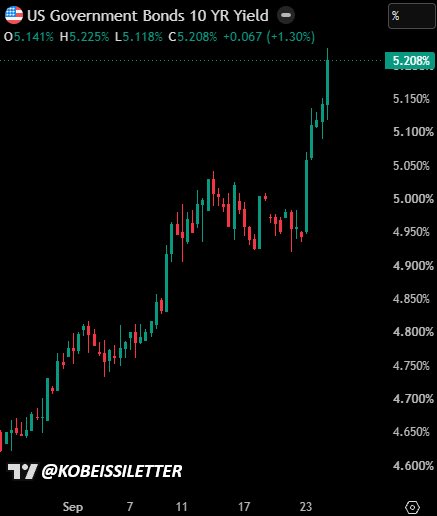
🇺🇸 10Y Note Yield touched 5.20% for the first time in 19 years.
Mortgage rates are back above 7%.
That’s a lot of government, corporate, commercial real estate & household debt that will eventually have to refinance at significantly higher rates.
The Fed controls the short end.
The bond market is now imposing discipline at the long end.
Higher yields mean higher debt-service costs, larger deficits, more Treasury issuance and potentially even more pressure on yields.
That’s the debt-based monetary system tightening its own noose.
Watch the refinancing wall.
🇨🇳🇮🇷🇸🇦 FOLLOW THE OIL RECAP
Chinese seaborne crude imports have fallen to around 7m barrels per day from around 10.5m before the Iran war.
Iranian flows have shrunk from around 1–1.5m barrels per day to a fraction of that.
China accumulated an estimated 1–1.4 BILLION barrels of oil reserves prior to the war. , while prices were lower
That gives China enormous optionality when oil prices spike.
Instead of desperately bidding against everyone else for scarce barrels, China can draw inventories, cut refinery runs, reduce product exports and selectively replace Iranian crude with oil from Iraq, UAE, Brazil and Canada.
That’s the DEMAND side of the Hormuz story.
Now look at the SUPPLY side.
Saudi has been moving crude from Ras Tanura, through Hormuz, then transferring it off Sohar for delivery into Asia while its East-West pipeline recovers.
Saudi is finding ways to keep a suppressed supply moving.
China is finding ways to temporarily remove demand from the market.
Both suppress the price shock that would otherwise come from disrupting one of the most important energy corridors in the world.
Meanwhile US-Iran negotiations have moved onto something much more concrete.
Hormuz itself is now the bargaining chip.
Iran is proposing a phased reopening of the Strait in exchange for the US lifting its blockade, potentially alongside access to frozen Iranian assets and a broader regional ceasefire.
So watch Hormuz.
Watch the ships.
Watch China’s reserves.
Watch oil.
Then watch bond yields.
Bond yields determine when the Fed is forced to respond.
But the Fed can print dollars.
It can’t print oil.
The deal on the other side of this sets the world order.
🇸🇦🇮🇷 SOMETHING VERY INTERESTING IS HAPPENING IN THE STRAIT OF HORMUZ
Reuters reports Saudi Aramco loaded around 14 MILLION barrels of crude onto seven VLCCs at Gulf terminals on Sunday.
Satellite images reportedly show seven tankers around Ras Tanura.
Why is this interesting?
🇸🇦 Saudi Arabia’s East West pipeline was attacked and shut down.
That pipeline exists specifically to allow Saudi crude to bypass Hormuz and reach the Red Sea.
So what happened next?
Saudi dramatically increased crude exports THROUGH Hormuz.
And Reuters reports Aramco has sold around 60 million barrels from Ras Tanura for September and October with cargoes intended for ship to ship transfers at Sohar.
🇴🇲 Oman.
So the emerging route looks like:
🇸🇦 Ras Tanura
Strait of Hormuz
🇴🇲 Sohar
🇨🇳🇰🇷🇮🇳🇯🇵 Asian buyers
Now it gets interesting.
🇮🇷 Iran has been restricting shipping through Hormuz.
🇮🇷🇴🇲 Iran and Oman have simultaneously been negotiating a temporary navigation corridor, mine clearance, information sharing, traffic management and eventually a longer term framework for the Strait.
And now millions of barrels of Saudi crude are moving through Hormuz towards Oman.
I have NOT found evidence yet that Iran gave Saudi Arabia permission or that these tankers are part of an Iran Saudi agreement.
That distinction matters.
But the question now becomes unavoidable.
If Iran controls the threat environment around Hormuz, Oman is negotiating the navigation architecture and Saudi is dramatically increasing crude movements through the Strait, exactly how are these tankers being deconflicted?
Who is guaranteeing passage?
🇮🇷 Iran?
🇴🇲 Oman?
🇺🇸 The US?
Or some combination negotiated behind the scenes?
This is what I’m watching.
Because if evidence emerges that Iran is knowingly facilitating Saudi crude passage while Oman acts as the intermediary and transshipment node, that would be much more significant than seven tankers.
It would be another piece of the regional architecture I believe is emerging as the Forever War winds down.
Don’t follow the rhetoric.
Follow the oil.
Let’s see.
🇺🇸 10Y Note Yield touched 5.20% for the first time in 19 years.
Mortgage rates are back above 7%.
That’s a lot of government, corporate, commercial real estate & household debt that will eventually have to refinance at significantly higher rates.
The Fed controls the short end.
The bond market is now imposing discipline at the long end.
Higher yields mean higher debt-service costs, larger deficits, more Treasury issuance and potentially even more pressure on yields.
That’s the debt-based monetary system tightening its own noose.
Watch the refinancing wall.
🚨 Bitget crypto exchange confirms $351.6m stolen in a major hack.
Interesting timing.
Just 7 days ago Bitget published Proof of Reserves showing a 135% reserve ratio.
They say the hack only affected hot/warm wallets, cold storage is secure and their $464m Protection Fund is sufficient to cover the entire loss.
Withdrawals are currently suspended.
So now we get a real-time stress test of Proof of Reserves + their Protection Fund.
Bitcoin wasn’t hacked.
A custodian was hacked.
Let’s see whether Bitget’s reserves and Protection Fund perform as advertised.
🇪🇺 That subjects fully reserved stablecoins to fractional-reserve banking risk.
If 60% of the reserves sit as deposits inside commercial banks, the stablecoin may be 100% backed on its own balance sheet, but 60% of that backing is now exposed to bank counterparty risk.
We already saw the problem when USDC lost its peg during the Silicon Valley Bank collapse.
This is exactly the problem we faced when we tried to create a full-reserve bank.
We could never get the Bank of England banking licence we needed.
You can create a full-reserve stablecoin, but if regulators force the reserves back into commercial bank deposits, you put fractional-reserve banking underneath it.
Full reserve stablecoin.
Fractional reserve bank underneath it.
🇺🇸🇨🇳 Trump met Xi's plane on the tarmac himself, something no president has done for anyone since 1962.
Symbolic.
Meanwhile Iranian officials land in NY for the UN Assembly.
Optics say everything in geopolitics.