CRYPTO MARKET JUST SECURED ITS BIGGEST WIN OF 2026
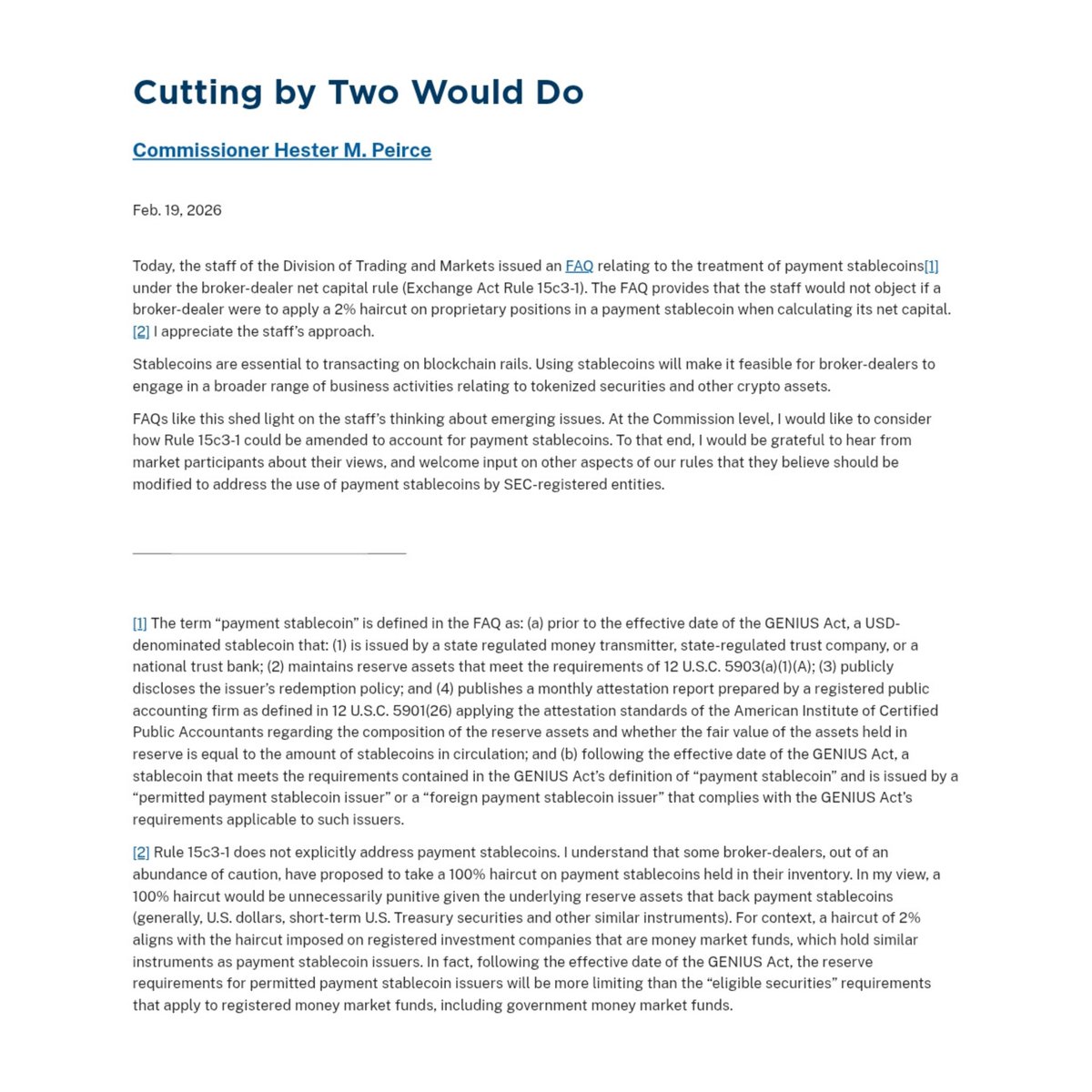
The SEC has changed the rules, which forced Wall Street to need $2 million in capital to hold $1 million in stablecoins.
TradFi broker dealers must follow capital rules. When they hold an asset, they must set aside capital based on how risky regulators think that asset is.
Stablecoins were being treated with a 100% haircut. That means if a broker dealer held $1M in stablecoins, regulators treated that entire $1M as unusable for capital purposes. To stay compliant, the firm effectively had to keep another $1M of its own capital locked up.
So holding $1M in stablecoins locked up about $2M of balance sheet capacity. That made stablecoins inefficient and unattractive for regulated institutions.
Now, the SEC clarified the haircut should be 2%, similar to money market funds.
Now firms only need to set aside a small buffer instead of freezing the full amount. This is a major shift.
Broker dealers can now hold stablecoins without damaging their capital ratios.
They can use stablecoins for settlement, collateral transfers, tokenized treasuries, and other on chain transactions without a massive capital penalty.
And this is where crypto benefits.
If stablecoins are balance sheet friendly, institutions can actually integrate them into daily operations. More usage means more demand.
More demand strengthens the role of stablecoins as core financial infrastructure. Stablecoins are the bridge between traditional finance and crypto markets.
Wall Street can hold and use them efficiently, adoption accelerates. And it'll lower the biggest barrier that was keeping stablecoins out of institutional finance.
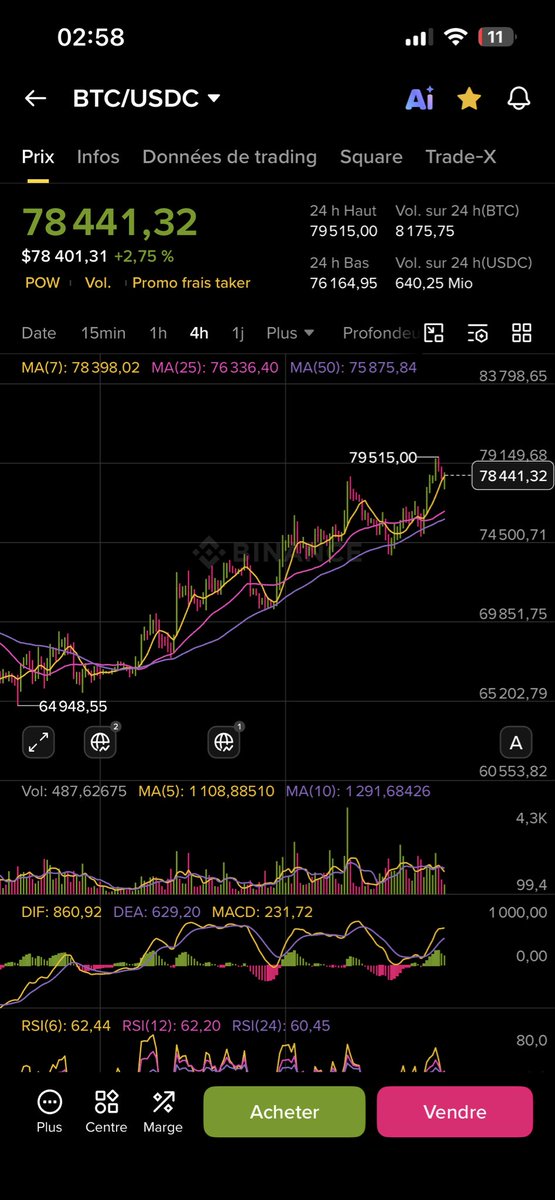
Bitcoin is currently mirroring the same weekly price action seen in tech stocks since 2025.
Bitcoin’s current level should hold if the tech-stock fractal continues to play out.
Les périodes calmes ou de baisse en crypto ne sont pas des échecs. Ce sont souvent les meilleures opportunités pour ceux qui savent attendre. Accumuler quand tout le monde doute, c’est souvent ce qui paie le plus… surtout quand les fondamentaux n’ont absolument pas changé et que la liquidité revient à grand pas…
🇦🇪 Lancement du premier stablecoin dollar régulé par la Banque centrale des EAU.
Le USDU est supervisé par l’ADGM et la Banque centrale, sécurisant sa place comme moyen de règlement officiel pour les transactions numériques aux Émirats.
Notre article 👇
https://t.co/cMloTSbGN4
🇺🇸 Paul Atkins, président de la SEC, juge que le contexte est désormais favorable à l’intégration des cryptomonnaies dans le marché des retraites 401(k) évalué à 12 500 milliards $.
La structure de $BTC reste bullish en daily malgré ces derniers jours de correction. Si BTC clôture au dessus de la MA50 aujourd’hui, la journée de demain s’annonce intéressante 😌🚀
🚨BREAKING: Bitcoin dumped $1,800 and liquidated $80 million worth of longs in just 90 minutes.
But then it pumped $1,400 and liquidated $20 million worth of shorts in the next 15 minutes.
Leverage hunting in crypto continues.
💧 2026 : le retour massif de la liquidité
Beaucoup regardent le court terme. Peu regardent ce qui se met en place en arrière-plan.
➜ Dette américaine colossale à refinancer
Les États-Unis doivent refinancer plusieurs trillions de dollars entre 2025 et 2027. À taux élevés, c’est intenable → pression énorme pour baisser les taux.
➜ Cycle monétaire classique
Après une phase de tightening agressif (2022–2024), l’histoire montre toujours la même chose :
ralentissement → stress → retour des injections de liquidité.
➜ Le dollar au centre du jeu
Le système mondial repose sur le dollar. Quand ça craque quelque part (marchés, banques, géopolitique), la réponse est presque toujours la même :
plus de dollars injectés, sous une forme ou une autre.
➜ Ce que ça implique pour les marchés
Plus de liquidité =
• actifs risqués favorisés
• compression des rendements réels
• rotation massive vers actions, crypto, commodities
2026 n’est pas une date magique.
C’est simplement le moment où les contraintes forceront le système à relâcher la pression.
La liquidité ne prévient pas.
Elle arrive quand plus personne n’y croit.
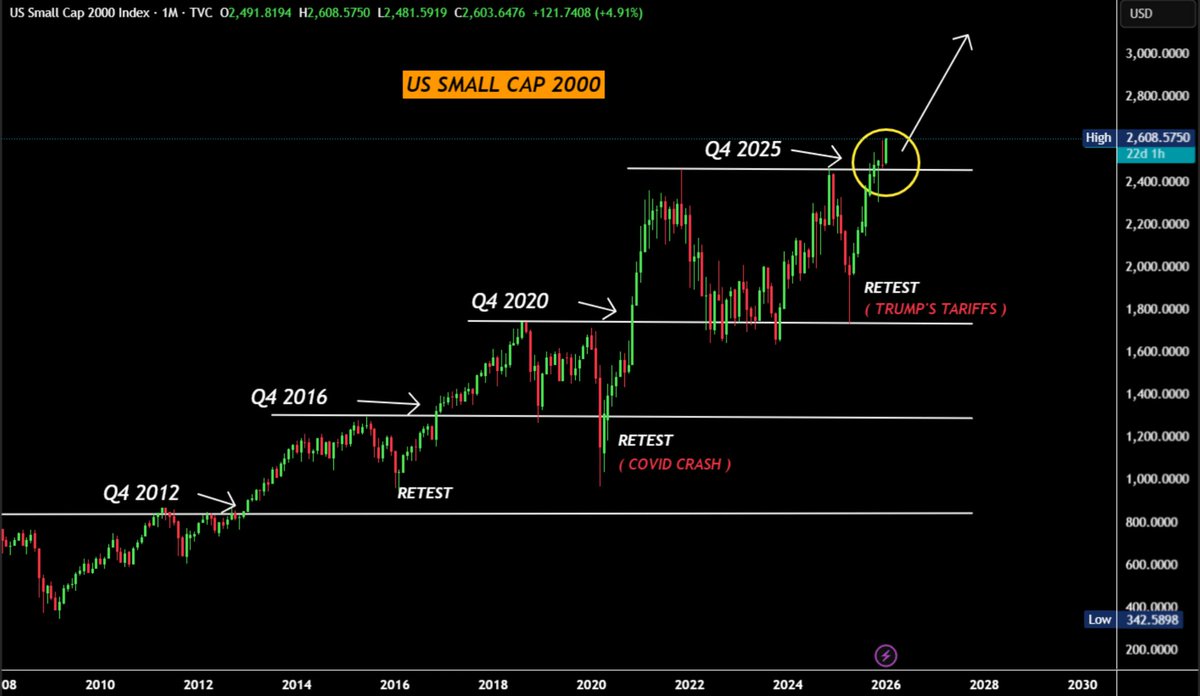
🚨BREAKING: Russell 2000 Index has broken above 2600 for the first time ever.
This is the biggest sign yet that liquidity is returning and risk appetite is back.
The Russell 2000 tracks small-cap US companies. These are the highest-risk part of traditional markets. They only lead when money is flowing back into the system and investors are willing to take risk again.
Now connect this with what is happening on the liquidity side:
• The Fed is already buying back T-bills → That adds liquidity to the system.
• Trump has ordered $200B in mortgage bond purchases → That injects more liquidity through the housing market.
• The Treasury is still releasing funds from the TGA → More money is entering financial markets.
• Trump is talking about tariff dividends → Direct cash into households.
• Trump is talking about tax cuts and tax refunds → More disposable income.
All of this is liquidity and Russell 2000 moving first is normal.
Historically, whenever the Russell 2000 entered a strong uptrend, ETH and altcoins followed in the months after.
Because money flows from:
Small caps → high risk → even higher risk → crypto.
Now look at what’s happening in crypto:
• Crypto has been in a downtrend for 3 months
• The October 10th crash flushed leverage and confidence
• Order books are thinner
• Most weak hands are already gone
At the same time, Q1 2026 brings the CLARITY Act, which will lead to less manipulation, better regulations, and more institutional interest.
Even Binance’s CZ is talking about a possible super cycle.
Not just because of hype, but because liquidity + structure + risk appetite are aligning.
So when the Russell 2000 breaks 2600, it is not just a normal thing, it's a sign of what's coming next for crypto in 2026.