A couple hours ago, the White House released its AI Executive Order.
It's mostly a cybersecurity & procurement order, engagement with frontier-model developers is voluntary, and it bars any government licensing of AI.
Our 8-min visual breakdown 👇 https://t.co/WgYB5sfnkd
seeing an increase in usurious and unethical billing from law firms working with first time founders, in some cases 50k+ bill claiming 20 hours of partner time on legal which w 1 SAFE and 2 side letters is a whopping 12 pages of template legal
give me the AI lawyers now jfc
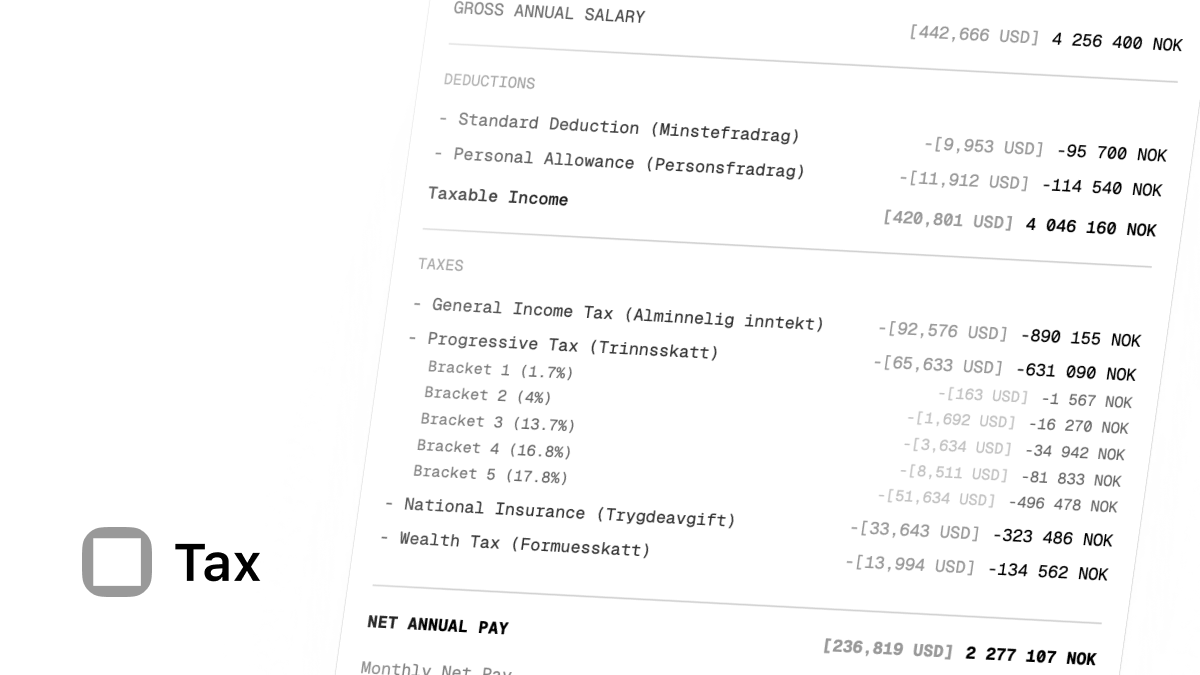
wanted a simple way to understand my taxes, so i built it.
bare bones for now. norway only.
next: compare taxes across countries and regions, and see how where you live compounds over time
Big news: Skala is now mobile-friendly!
The key things you can already do: chat with our AI lawyer, check your registered company details, and quickly scan your upcoming deadlines.
What should we build next in mobile? Entity and trademark registration? Document generation and signing? Or maybe nobody actually needs this on mobile and we shouldn’t bother?
Your feedback shapes our roadmap.
Founder of one such AI-native law firm here. Super biased of course, so take it as such.
I believe most startup legal workflows are still better handled via traditional step-by-step interfaces. This applies to incorporation, trademarks, legal templates, and e-signs — which cover 80% of early-stage startup legal needs. (Already built this.)
AI is great for express contract review (red flag checks on NDAs and MSAs) and high-level legal advice. But for this to really work, the user needs at least basic legal judgment — which isn't common and frankly shouldn't be expected from early-stage founders.
That's why on top of the existing platform we're building AI-empowered fractional general counsel: human lawyers super fluent in AI, delivering at AI speed.
We can’t promise you a jury verdict against Google, but we can get you incorporated and have your trademark registered.
But before you can become the next @EpicGames, you actually have to exist. That's why we built Skala for GameDev.
👇
Building a game studio is hard enough without worrying about jurisdiction logic, IP assignment, or compliance frameworks. You want to ship your game, not drown in admin.
That's why today, at @skala_io, we are launching a suite of legal tools for the GameDev industry.
We are replacing the patchwork of legal solutions with a complete "business-in-a-box" stack designed specifically for game founders.
Whether you are building a AAA console title or a crypto game, we’ve standardized the legal and launch infrastructure so you don't have to.
Here is the GameDev Legal Stack by Skala:
Incorporation: We map you to the right jurisdiction — Delaware/California or UAE for PC & console studios, or BVI/Panama for Web3 & crypto-native projects.
Fundraising: Raise your first checks instantly. We provide built-in SAFEs and signature tracking. For those of you in crypto, use Token Warrants and SAFTs.
IP Protection: Secure your code and art from Day 1 with NDAs and IP assignment templates.
Compliance: Ready to scale? We include tailored EULA and Privacy Policy templates designed for global reach.
The Publishing Toolkit: Access free guides for platform releases, age ratings, and open-source licensing.
The templates and guides are free. Incorporation packages are priced transparently.
See how simple your GameDev setup can be 👇
The 'Delaware Default' has been the standard for decades, but we are seeing a tangible uptick in founders weighing Texas as its home.
As @bgurley noted:
"I’ll say it again - boards that don’t move could be sued in Delaware for staying - and exposing shareholders to uncapped securities claims."
https://t.co/AxY0EGOz2B
This morning I read that Texas’ population is booming, while traditional hubs like New York and Los Angeles continue to shrink.
By lunch, a @skala_io user submitted an order to incorporate a company in Texas.
Coincidence? I don’t think so.
We are seeing a genuine surge in demand for the Lone Star State. For years, Delaware was the "factory setting" for startups. But over the last two years, founders have started looking South.
Why?
It comes down to three factors: (1) Delaware’s short-sightedness, (2) a push from financial giants (BlackRock, Citadel, etc.), and (3) the Texas government’s aggressive reforms.
1. What happened in Delaware?
It all started in January 2024 with Tornetta v. Musk, where Judge McCormick struck down Elon Musk’s $55.8B performance award for his role as Tesla’s CEO.
Important caveat: the payout wasn’t cash. It was Tesla stock, meaning Musk’s stake would increase through proportional dilution of other shareholders. It was not a cash-out for him, but rather more skin in the game.
The judge held that the award was excessive and that Tesla’s board, when approving it back in 2018, wasn’t fully independent or properly informed.
Corporate lawyers know that a defective board decision can be cured through stockholder ratification. Musk’s team did exactly that. They put the award up for another vote and secured approval from over 75% of shareholders.
But not so fast. In January 2024, Chancellor McCormick intervened again, voiding that ratification and the award itself.
That’s when big capital stepped in.
2. Enter BlackRock & Citadel
In June 2024, the biggest U.S. financial institutions (BlackRock, Citadel Securities, Charles Schwab, Fortress) announced the creation of the Texas Stock Exchange (TXSE), investing $120M into the venture.
The timing couldn’t be better:
– Six months after the Musk ruling
– A few months before Trump’s election
– And right as Tesla formally re-domiciled from Delaware to Texas (its HQ moved in 2021, but legally it remained a Delaware corporation until June 2024)
Launching a new exchange isn’t fast. The SEC approved TXSE on September 30, 2025, and trading will begin in Q1 2026.
A few weeks ago, J.P. Morgan joined the party with an additional $250M investment.
3. The Texas Response
Texas didn't just sit back; they overhauled their legal framework to shed the "oil and ranch" image and welcome tech:
𝖢̲𝗈̲𝗋̲𝗉̲𝗈̲𝗋̲𝖺̲𝗍̲𝖾̲ ̲𝖱̲𝖾̲𝖿̲𝗈̲𝗋̲𝗆̲𝗌̲: Major amendments to the Texas Business Organizations Code (TBOC), codification of the Business Judgment Rule (SB 29), limits on management’s personal liability (SB 2411), and higher ownership thresholds for submitting shareholder proposals (SB 1057).
𝖩̲𝗎̲𝖽̲𝗂̲𝖼̲𝗂̲𝖺̲𝗅̲ ̲𝖲̲𝗒̲𝗌̲𝗍̲𝖾̲𝗆̲: Launch of the Texas Business Court (Sept 2024), a specialized court for complex commercial disputes ($5–10M+). Judges are appointed for expertise, not elected. Texas also created a new appellate court, the Fifteenth Court of Appeals.
𝖳̲𝖺̲𝗑̲𝖾̲𝗌̲: No franchise tax for small businesses under $2.47M in revenue; up to 50% tax credits for major investors building in Texas (JETI Act).
𝖱̲𝖾̲𝗀̲𝗎̲𝗅̲𝖺̲𝗍̲𝗂̲𝗈̲𝗇̲: The Texas Regulatory Consistency Act, eliminating the “patchwork” of local rules and ensuring businesses operate under a unified, predictable
Since then, several public companies — including Chevron — and hundreds of private companies (e.g., KFC / Yum! Brands) have moved to Texas.
According to Governor Greg Abbott, the state now has 3 million registered business entities, double the number a decade ago.
That’s the story.
Can Texas challenge Delaware and even compete with New York’s exchanges?
Absolutely. Nothing lasts forever.
With the backing of financial giants and a steady stream of companies following Musk’s lead, the momentum is real. Just this week, Coinbase announced it is re-incorporating in Texas.