China is already living in the 2050s 😳
Coffee-maker robots deployed in Shanghai's Hotel Shangrila. #RoboticCoffee
This video was shared by our student from Odisha who is now working in China as an interior-designer & stays with her husband who works as a research professional.
Dear @CMO_Odisha, Odisha Govt may consider negotiating with automobile companies to lease cars & two-wheelers for govt departments and police instead of purchasing them outright.
This can significantly reduce upfront expenditure.
1/7
Look what I got today as a memory from Google Photos.
17 years ago, our first overseas project.
We had No money, no identity.
I still remember those days, sitting in our small office, unsure how long we could keep going, but still believing something would work out.
We quoted around ₹20,000 just to get the work, and the payment came through PayPal in foreign currency.
That ₹20,000 changed everything. We were almost about to shut down, with barely enough for one month’s rent and nothing to pay salaries.
My wife was the chief designer and our students helped us complete the project as we had no proper team then.
Looking at it now, it still feels quite contemporary.
Even back then, I had this thought to make Bhubaneswar the Design Capital of the East. #entrepreneurship #entrepreneurlife
Odisha - "Unlike Anywhere Else"
I was away for a few days, caught up with work and staying out of the noise. But this discussion around Odisha’s branding pulled me back.
Not to argue. Just to say something simple.
If we are speaking about international travellers, they are not chasing slogans. They are chasing places that feel real, layered, and worth coming back to.
And Odisha quietly offers that, all through the year.
You arrive by the coast, and before you realise it, you are at Chilika Lake watching dolphins cut through still waters. Come winter, the same waters turn into a haven for migratory birds, often called Siberian guests, filling the skies and wetlands with life. Travel a little further and the landscape shifts into the mangroves of Bhitarkanika National Park where crocodiles move silently through the creeks.
Move again and you find yourself in the calm hills near Deomali, where everything slows down.
It never feels like the separate destinations. It feels like one continuous journey.
Then there is wildlife. Not just variety, but rarity. Forests like Similipal Tiger Reserve are home to tigers moving through dense landscapes. Rivers and conservation zones have seen the revival of species like the Gharial. Along the coast, the mass nesting of Olive Ridley sea turtle is something few places in the world can offer.
And then comes the coast again, but this time through its flavours. Fresh seafood, from crabs to prawns, brings another side of Odisha to life. Simple, local, and full of character.
And in between all this, life continues in its most natural form.
You walk through village markets and see communities living as they always have. Farming, forest produce, handlooms, and everyday practices that have not been redesigned for visitors. The making of Handia, the preparation of Mahuli, the collection of kendu leaves, all part of a rhythm that has continued for generations.
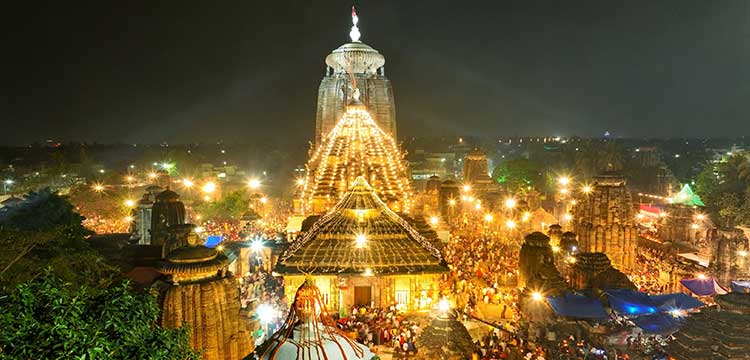
You step into Jagannath Temple and realise faith here is not distant. It lives with people. It eats, rests, celebrates, and moves with them.
Then you stand before Konark Sun Temple and quietly understand that this land has always known how to combine art, science, and imagination.
And just when you think you have seen enough, Odisha reveals another layer.
Its handlooms.
From intricate Ikat to traditional weaves, these textiles carry stories in every thread. Long before formal trade routes took shape, European traders were already drawn to the richness of these fabrics. Even today, they remain rare, detailed, and deeply rooted in tradition while adapting to contemporary taste.
Nothing here feels seasonal.
Nothing feels limited.
There is always something to experience.
And that is what makes Odisha special for a global traveller. A place you can return to, in different seasons, and always find something new.
Odisha does not try to impress.
It simply stays true to itself.
And somewhere along the journey, that truth stays with you.
That is why,
Odisha: Unlike Anywhere Else
@odisha_tourism@PravatiPOdisha
Received a citation from the Odisha Corporate Foundation for contributions to engineering skill development and ecosystem development.
The work has focused on practical training, institutional engagement, and industry alignment, which remain critical to Odisha’s long term economic capacity.
Committed to continuing this work with the same focus and responsibility.
Big development for Odisha.
JSW Steel and POSCO are coming together for a 6 MTPA steel plant in the state.
If this actually breaks ground on time and starts production within a fixed timeline, this could turn-out to be a masterstroke move by CM Mohan Charan Majhi.
Economic impact is straight-forward
• Large investment inflow
• Job creation on ground
• Strong push to Odisha’s position as a steel hub
But the bigger question is what we build around it.
We should not stop at steel again.
Regions like Mayurbhanj and Keonjhar have the potential to become an automotive and manufacturing cluster.
Raw material is here
Industry is coming
What is missing is planning
We should push for
• Auto and ancillary ecosystem
• Downstream manufacturing
• A fast freight-corridor to Dhamra Port
That is how value is created. That is how jobs multiply.
Otherwise we will again remain only a raw material state.
Good announcement. Now execution and vision will decide everything.
https://t.co/Ieua4CiHcc
Maha Bishuba Sankranti… Pana Sankranti… Odia New Year 🌼
Wishing all my fellow Odias, wherever you are in the world, a very warm Subha Nababarsha 🙏
This day always feels different. It is not just about a new date or a festival. It feels like a reset. A reminder that time moves on, seasons change, and we also get another chance to start fresh.
From the Pana we prepare at home to the small rituals around Tulsi, from visiting temples to just sitting with family and sharing simple moments… everything has a meaning. Even something as simple as Pana in this heat teaches us how our traditions were always connected to nature and care for people around us.
This day carries a quiet strength of our culture. No show off, no noise. Just belief, balance, and a sense of grounding.
And no matter how far we go, or where life takes us, somehow this day brings us back home… even if just in our thoughts.
May this year bring some clarity, some stability, and a little more happiness for all of us.
Subha Pana Sankranti to everyone 🤍
#OdiaNewYear
#MahaBishubaSankranti
Odisha has now moved to a full 50% reservation in higher and technical education.
22.5% for ST
16.25% for SC
11.25% for SEBC
On paper, it looks like a major step towards inclusion. But step back for a moment and ask a more uncomfortable question.
Is this really what Odisha needs right now?
Because the reality on the ground is very different.
We are already living through a time where getting a degree no longer guarantees a livelihood. Where young people study for years, only to find themselves struggling to secure even basic stability. We see engineers working in shopping malls as sales representatives. We see doctors putting up hoardings and running digital campaigns just to attract patients. These are no longer rare stories. They are becoming the norm.
So the real issue was never just about access to seats. The real issue has always been about what happens after those seats are filled.
And that is where this policy begins to feel disconnected.
It is Gen Z who will live through the consequences of this. A generation already dealing with uncertainty is now being pushed into a system where competition may slowly shift from capability to categorisation. Instead of moving forward together as one Odia community, there is a genuine risk that young people begin to look at each other differently.
Not as peers, but as rivals shaped by policy.
At the same time, jobs are not increasing. Government vacancies are limited. Private sector growth is still not strong enough to absorb the talent we are producing every year.
So what exactly changes?
If opportunities remain the same, then redistributing seats does not solve the problem. It only reshapes it.
There is also something else we need to be honest about. Policies like these often create hope. A belief that things will improve quickly. But when that improvement does not come, when jobs are still scarce and stability is still uncertain, that hope can turn into frustration.
And that frustration will not belong to one group. It will belong to an entire generation.
We have seen enough examples across the country where politics gradually shifts from development to identity, where short term optics take priority over long term economic strength. The result is not immediate collapse, but a slow erosion of opportunity, rising dependency, and a generation that keeps waiting for stability that never fully arrives.
Odisha has so far avoided that path.
The question now is whether we continue building on growth, jobs, and real opportunity, or allow ourselves to drift into a model where redistribution replaces expansion.
Because without employment, without industry, and without a clear economic roadmap, no percentage, no policy, and no promise can secure the future that young people of this state are working towards.
#Odisha #GenZ
ବନ୍ଦେ ଉତ୍କଳ ଜନନୀ 🙏
Utkala Dibasa is a reminder of a long and patient journey. Odisha was not formed in a moment. It was shaped over decades by people who protected our language, built institutions and united society with a clear vision.
There was a time when Odia language itself was under threat in schools and administration. Fakir Mohan Senapati stood firm through his writings and textbooks and ensured Odia survived. Alongside him, Radhanath Ray strengthened Odia literature and gave it recognition and dignity.
This cultural foundation slowly turned into an organised movement. Madhusudan Das founded the Utkal Sammilani in 1903 and gave a clear direction to unite all Odia speaking regions. Nilakantha Das and Godabarish Mishra carried this vision through writings, public life and legislative efforts.
At the same time, social awakening was equally important. Gopabandhu Das through the Satyabadi movement and education built a sense of unity and responsibility among common people.
And this journey was never only led by men. Women of Odisha played a silent yet powerful role in taking this vision to the grassroots.
Rama Devi Choudhury travelled across villages, mobilised women and connected society to the larger movement. Sarala Devi worked for women’s education and social reform, strengthening the foundation of an aware society. Malati Choudhury dedicated her life to rural upliftment and national consciousness, ensuring participation from the last mile.
Finally, when the moment came to give shape to all these efforts, Krushna Chandra Gajapati led the final phase that resulted in Odisha becoming a separate state on 1 April 1936 by bringing together Odia speaking regions from different provinces.
This is how Odisha was built. Through language, movements, institutions and equal participation from both men and women.
In later years, leaders like Biju Patnaik contributed to the growth and pride of Odisha in their own time. That contribution is part of our journey as well.
But today is also a day to remember the deeper roots. The story feels more complete when every contributor finds a place in it.
Jai Jagannath 🙏
#UtkalaDibasa #OdiaAsmita #KnowOurHistory
Yesterday, in my office in Bhubaneswar, a 20 year old mechanical diploma holder stood before me with folded hands and moist eyes.
At twenty, most young men speak about ambition. He spoke about self respect.
He had completed his diploma in mechanical engineering in 2025 from a Government Polytechnic in Odisha. He was campus selected for a manufacturing company in Tamil Nadu. His family celebrated. His neighbours congratulated him. He boarded the train believing his life had begun in the right direction.
He imagined machines, production lines, technical drawings and the dignity of being called an engineer.
The factory looked impressive when he reached. There was a tour. Managers spoke confidently. Rooms were arranged nearby. Within a few days he joined his department on probation.
Then the routine started.
Wrapping boxes. Sticking labels. Measuring containers. Cleaning work tables. Loading and unloading shipments.
He waited. He convinced himself that this must be the beginning phase. He believed engineering exposure would follow. Weeks passed. Nothing changed.
He quietly compared his salary with what a daily wage worker could earn back home.
He and three or four other boys from Odisha spoke among themselves. None of them felt angry. They felt small. They felt that something inside them was shrinking. Finally, they decided to return. Not because the work was hard, but because they felt it was against their self esteem to continue like that.
He came to meet me ten days after returning from that so called job.
He stood there and said, “Sir, please guide me. Let me forget everything. I am ready to start from zero. I want to become an engineer in the true sense. I will study for one year if needed. If nothing works, I will join https://t.co/W2Uc51Mluf in 2027.
But I do not want to feel like this again.”
He was not blaming anyone. He was not demanding anything. He was asking for direction.
For nearly two decades I have been in this profession, and I have heard variations of this story more times than I wish to admit. Different batches, different companies, same quiet disappointment.
As he left my office, one thought stayed with me.
When a twenty year old from Bhubaneswar, after completing technical education and getting campus selected, returns home within months and asks to begin again from zero, what does that say about the journey between education and employment?
I am still thinking about it.
#SkillDevelopment #YouthEmployment #Odisha
“Industrialisation Needs Capability, Not Just Capital.”
Odisha is building downstream manufacturing clusters.
Textile parks are being announced.
Food processing hubs are being planned.
Industrial estates are being developed.
On paper, this looks like the beginning of a strong manufacturing decade.
But let me tell you what I see when I step back and observe the entire structure.
Most Odias still live in rural Odisha.
Most of our labour force originates from villages.
Most of our raw material comes from rural belts.
Most of our young engineers and diploma holders are first-generation learners from small towns and panchayats.
Yet, where is our skill development machinery located?
Mostly in district headquarters.
Mostly in towns.
Mostly far from the bottom of the pyramid.
Clusters are coming up near towns that already struggle with infrastructure.
Meanwhile, villages have unused land.
Panchayat offices have underutilised space.
Young people travel out daily in search of work.
And slowly, informal settlements begin forming around industrial pockets.
Villages empty.
Towns congest.
The system strains.
Now comes the deeper issue.
Modern textile and food processing units are not traditional factories.
They require machine calibration knowledge.
They require quality control discipline.
They require digital inventory management.
They require maintenance technicians trained on modern systems.
Without this level of skill depth, clusters cannot operate at full capacity.
Machines can be installed.
Buildings can be inaugurated.
But productivity depends on capability.
Every year, thousands of engineers and diploma holders graduate in Odisha.
But where is the applied innovation layer connecting them to industry?
Where are the small R&D cells inside ITIs?
Where are the 3D prototyping labs helping students solve real manufacturing problems?
Where are the cluster-linked training centres operating within a 5–10 km radius?
We are building industrial land.
We are producing degrees.
But we are not building the bridge between them.
If this alignment does not happen, three things will follow:
Industries will import skilled manpower.
Local youth will remain under-employed.
Public investment will deliver below potential returns.
This is not about criticism.
It is about structure.
Industrialisation is not only about attracting investment.
It is about building a decentralised ecosystem where land, labour, skill and innovation move together.
Imagine a different model.
Every district ITI equipped with a prototyping lab.
Every cluster linked with a skill and R&D centre.
Every Panchayat maintaining a live skill database.
Students solving real factory-level problems before they graduate.
That is how sustainable manufacturing ecosystems are built.
Not by land allocation alone.
But by capability creation.
If Odisha wants its clusters to succeed, skill and innovation must grow alongside them and not years later after establishing everything.
Otherwise, we may build the infrastructure…
but never unlock its true capacity.
#Odisha #ଓଡ଼ିଶା
On the Eve of Maha Shivratri – My Journey of Faith
Today, on the eve of Maha Shivratri, I find myself revisiting the earliest memory that shaped my understanding of faith.
I was about five years old when my right heel was severely injured while sitting pillion on a neighbour’s bicycle. My heel was split open. The veins were cut. There was blood everywhere.
I remember crying uncontrollably.
And then I fainted.
I was just a little boy.
On the way to the hospital, my father kept prompting me to chant:
Om Namah Shivaya
Om Shri Ram Jay Ram Jay Jay Ram
At that age, I did not understand theology or devotion.
I only understood pain and fear.
Yet, in that painful moment, those two chants became my anchor.
Even today, when I recall that incident, I do not remember the hospital clearly. I do not remember the bandages vividly.
What I remember and cherish are those two sacred sounds.
That was the beginning of my connection with God.
Not inside a temple.
Not during a festival.
But in vulnerability.
As I grew older, that connection evolved naturally.
Every year, I would urge my mother to take me to Ram Mandir, Bhubaneswar on Ram Navami. I waited eagerly for that day, the prayers, the festive atmosphere, and the simple khichudi prasad which felt special in a way only a child can understand.
By the time I was in Class IV, around eight years old, I had another strong desire to ride my own BSA SLR bicycle. I used to see one of my classmates ride it daily and I dreamt of owning one myself.
When I finally received my first BSA SLR, I began visiting Maa Bhuvaneshwari Temple, Kharvela Nagar regularly. Sometimes, I even skipped my Monday school classes just to sit there quietly and pray to Lord Shiva.
Looking back now, I see a clear progression in my life:
At five, I prayed to endure pain.
At eight, I prayed with aspiration.
As I matured, I prayed for strength and direction.
Faith for me was never imposed.
It was experienced.
It grew from injury.
It strengthened through longing.
It matured through gratitude.
And perhaps that is why it never left me.
On this sacred occasion of Maha Shivratri, as I reflect on my journey, I feel compelled to share a humble thought.
Odisha is a land of devotion. Thousands seek blessings every day at sacred places like:
- Shree Jagannath Temple, Puri
- Shree Lingaraj Temple, Bhubaneswar
Yet, unlike many South Indian temples where free Anna Prasad is systematically offered to all devotees, we do not have a structured mechanism ensuring that every devotee receives dignified darshan along with Anna Prasad as a matter of spiritual hospitality.
With utmost respect, I propose to @CMO_Odisha that a transparent fund or institutional mechanism be established to provide free Anna Prasad in every ancient temple across the state, beginning with Puri and Lingaraj.
This is not a criticism.
It is a prayer in policy form.
And as a personal commitment, I vow to contribute ₹1,00,000 from my own pocket the moment such a fund is formally established by the State Government.
Because the chants that steadied me as a frightened five-year-old still steady me today:
Om Namah Shivaya
Om Shri Ram Jay Ram Jay Jay Ram
Har Har Mahadev.
🙏
#MahaShivaratri
“The State That Sits on $1.3 Trillion… Yet Counts Only 493 Crorepatis.”
That’s the number of people in Odisha earning ₹1 crore or more annually.
Let that settle.
Maharashtra – 1,24,800
Uttar Pradesh – 24,050
Delhi – 20,500
Tamil Nadu – 6,288
Gujarat – 3,540
And Odisha?
Only 493
Now let me remind you all once again, our poor people's Odisha has:
• ~50% of India’s iron ore
• ~90% of chromite
• ~24% of coal
• Major bauxite reserves
• ~480 km coastline
• 3 operational ports
Estimated resource value in terms of US Dollars:
~$1.3 Trillion (as per current price basis).
And we haven’t even fully extracted it.
So here is the uncomfortable question:
In a mineral-heavy economy,
who is actually capturing the wealth?
Is it:
• Local engineers building global firms?
• Odia entrepreneurs scaling manufacturing?
• Agricultural innovators moving up the value chain?
• Youth-led tech founders?
Or is most wealth concentrated in:
• Mining-linked contracts (Rich Miners)
• Raw extraction networks (National level miners backed by powerful politicians)
• Trading margins (Marwari & Gujarat based trading cartels)
• License-linked businesses (Liquor, Metals, etc.)
How many first-generation Odia entrepreneurs have risen from rural districts into national-scale industrial leadership?
How many local youth are part of high-value manufacturing ownership?
If resources are abundant in multiple regions of Odisha,
why is broad-based income concentration so narrow?
This is not about any identity.
It is about participation.
When a state exports raw ore instead of exporting finished value, the ownership layer becomes thin.
When value addition happens elsewhere, income compounding happens elsewhere.
And that’s where the frustration lies.
For decades we were told:
“Extraction means development.”
But extraction without local ownership
creates revenue in the current fiscal only, not real prosperity for the people of Odisha.
$1.3 Trillion under the soil.
493 high-income earners above it.
The real question is not who is rich.
The real question is:
Why hasn’t a wider base of Odias climbed into high-income brackets?
Why is upward mobility not accelerating despite resource advantage?
Until mineral wealth translates into:
• Manufacturing depth
• Entrepreneurial ecosystems
• Skill-linked capital growth
• Local industrial ownership
this gap will remain.
The geology gave us leverage.
The ecosystem never fully empowered participation.
And that is the question that must be asked calmly, but firmly to every so-called Politician who rose to fame from Odisha, the Central Govt whom we gave stability to stay in power for decades without going to the streets with our just demands, the Corrupt Bureaucrats who have milked thousands of crores in "Black Money" from our Never Questioning attitude to powerful chairs.
I am in search of that #OdiaAsmita which we have buried deep under the earth for decades
#Odisha
Kerala has announced free education up to graduation.
Think about that.
A student there can study without worrying about fees.
Without parents taking loans.
Without families selling land.
Without dreams being postponed.
One policy.
Thousands of lives changed.
Now look at Odisha.
We proudly talk about our talent.
We celebrate toppers.
We post success stories.
But we stay silent about the thousands who disappear after Class 12.
The girl who wanted to be an engineer.
The boy who dreamed of becoming a doctor.
The student who chose daily labour over college.
Not because they were weak.
Because education became unaffordable.
And what do we offer instead?
Freebies.
₹800 per month under schemes like SUBHADRA.
Let us be honest.
₹800 cannot pay college fees.
₹800 cannot buy books.
₹800 cannot fund a degree.
At best, it pays for phone recharges, small shopping, or a beauty salon visit.
Is this how we value our daughters and sisters?
Small handouts manage poverty.
Education destroys it.
There is a difference.
#Kerala chose classrooms.
We chose cash.
Imagine an Odisha where education is free, universal, and dignified.
Any stream. Any college. Any background.
Where doctors serve villages because the state supported them.
Where engineers build Odisha because Odisha built them first.
Where talent stays because opportunity exists here.
That is real development.
Not slogans.
Not vote-bank schemes.
The #OdiaAsmita movement changed a government.
Because people started asking uncomfortable questions.
Maybe it is time we ask another one:
Do we want a generation dependent on freebies,
or a generation empowered by education?
Because once talent is lost,
no scheme can bring it back.#MakeOdishaGreatAgain
@CMO_Odisha@SecyChief@MohanMOdisha@_anugarg
https://t.co/xTXZv20oH5
Bhubaneswar’s “148% housing return” headline may create excitement among many Odias. It may also please those in power corridors who benefited from rising land prices and real-estate speculation. But on the ground, this so-called growth does not match the real economic strength of the city.
Those of us who studied here between 2003 and 2007 saw what real growth looked like. Food joints were always crowded. Coaching centres were full. Hostels were packed. Engineering colleges were buzzing. Between 2010 and 2015, this ecosystem expanded further. Students, teachers, shopkeepers, landlords, and small businesses created a strong #LocalEconomy. Money circulated within the city. That was organic growth.
Between 2010 and 2019, big brands arrived, malls expanded, startups showed promise, and Bhubaneswar felt aspirational. People spent because their incomes were improving and opportunities were visible. This was not hype. It was backed by education, youth energy, and rising confidence.
Then things changed.
The so-called “Smart City” phase created more publicity than productivity. Today, many engineering colleges exist only to conduct exams. Students work in low-paying jobs elsewhere and come back only during semesters. Coaching centres have disappeared. Hostels are half empty. The education engine that once powered this city has quietly collapsed.
Look at our malls now. Weekend crowds for movies, near-empty corridors on weekdays. Many old stores have closed. Restaurants remain 80 - 90% vacant most of the year. A city where ₹30 - 40 momos dominate food culture is not prosperity. It reflects weak purchasing power and fragile #UrbanDevelopment.
This is no longer a consumption-driven city. It is becoming a survival economy.
Meanwhile, property prices keep rising.
Not because local incomes are rising. But because of land speculation, political-bureaucratic investment, and conversion of unaccounted money. Unlike Bengaluru, Hyderabad, Pune, or Gurgaon, Bhubaneswar does not have strong export-oriented industries or a solid private-sector income base.
Most families depend on government salaries, IT migrants working outside Odisha, and Gulf remittances. This remittance-based model is risky. It does not create long-term economic stability.
High housing prices combined with low local incomes is bad economics. Serious investors look at productivity, skills, and affordability. When real estate becomes expensive without matching job growth, businesses hesitate, talent migrates, and entrepreneurship weakens. That is why many new ventures avoid such markets.
Comparing Bhubaneswar with metros only on “returns” is misleading. Asset inflation is being projected as development.
Real growth means good jobs, strong private industry, quality education, research, innovation, and rising middle-class incomes. Without these, rising property prices are just a bubble.
And bubbles are vulnerable to shocks, IT slowdown, Middle-East instability, geopolitical tensions, or global uncertainty.
Bhubaneswar once had genuine momentum. Today, it risks becoming a city with expensive buildings but a weak economy. We should celebrate growth only when it is backed by real productivity and opportunity, not speculation.
Headline numbers do not build cities. People, skills, and industries do. That is the real measure of #Bhubaneswar #realestate.