Where do stablecoins actually move? @solana handles close to half of transfer volume across major chains, on a $14.85B base that ranks third by market cap.
While the timeline is busy debating the next move for $SOL, I'm looking at yield.
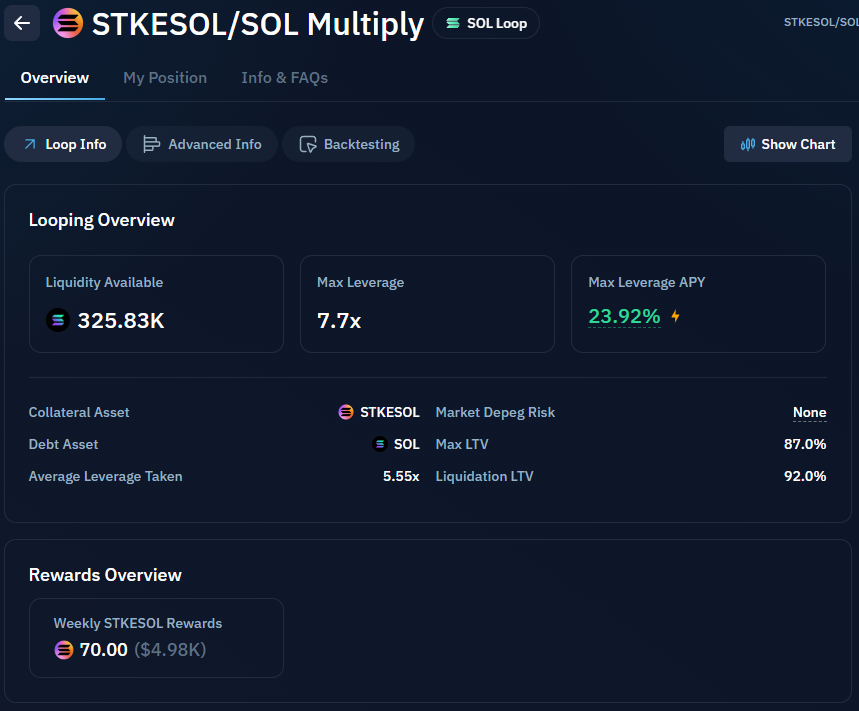
STKESOL/SOL Multiply on @kamino is currently the highest-paying SOL loop:
→ 23.92% APY at max leverage
→ 70 STKESOL in weekly rewards
When others panic sell, opportunities start showing up.
Stake.
Loop.
Accumulate.
Then let time do the heavy lifting 🫡
From processing business payroll to executing cross-chain swaps across 100+ networks, the infrastructure remains the same. Stop leaving a data trail behind your operations.
➡️https://t.co/O2oYISce1w
Privacy matters for EVERYONE.
Individuals need it.
Businesses need it.
Institutions need it.
At SOL Strategies, we’re addressing this head-on on Solana, to deliver native zero-knowledge privacy infrastructure.
Privacy solves one of crypto's biggest adoption blockers: nobody wants their full financial life on a public billboard.
Individuals need privacy.
Businesses need privacy.
Institutions need privacy.
It's not the only blocker, but it's a crucial one
BREAKING: Mastercard is introducing always-on stablecoin settlement on Solana.
3.7 billion cards. 210+ countries. One of the largest payment networks on earth, now settling onchain.
Geographic distribution is a core facet of our scoring system - this is the result.
We want a network that doesn’t all run on one server, in a single data center or in a country that may change its laws tomorrow.
🥇 @solstrategies@m_hbbrd STKESOL takes #1 on the GDI for June 2026 with a 4.56.
Geographic Decentralisation Index ranks stake pools by where their stake actually sits: country, city, network operator of every validator.
https://t.co/QoLAtNH6a5
Privacy on Solana should not be a siloed feature.
It should be infrastructure.
With Zyga, SOL Strategies is building the foundation that gives every participant, traders, LPs, protocols & institutions, the privacy they need to operate freely.
Bright spots for @Solana in May:
- Spot DEX volumes: record tokenized assets volume in May, driven by equities (pre-CLARITY, btw 😉) growing 384% since January
- Solana owns 97% of onchain spot equities volume
- Foreign tokens like BTC, ZEC, HYPE (led by @sunrisedefi) took record marketshare of Solana trading volume, with $3.8 billion
- ATH monthly close on stablecoin TVL, at $16.4 billion
- ATH in every real-world asset metric (as tracked by @RWA_xyz): TVL $2.6 billion by May end, 232,000 holders, 102,000 active addresses, $1.5 billion transfer volume
- Solana is once again the major of all onchain transactions, capturing 53% total marketshare in May
- @perps on Solana ATH volume of $76 billion, and ATH marketshare of volume against the leading platform at 38%
- ATH in staked SOL at 429 million
- $106 million of positive inflows to Solana ETFs in May, up more than 15x from April
A new Solana Improvement Document (SIMD) is in the spotlight 📄🔍
SIMD 547, by @temporal_xyz, proposes resource-based fees on Solana (with 100% of the new fee burned) to align costs with compute usage and increase SOL burns as network activity grows.
Our CEO @m_hbbrd breaks it down thoughtfully 👇
What's your take on SIMD 547?
Interesting proposal, but let's think it through:
1. SOL v Solana Economy
"turbocharge the solana economy" (in quoted post) and in the proposal: "SOL quite a terrible asset to gain exposure to network activity"
Two things here, the "Solana Economy", a concept I've been talking about regularly since last year, can be viewed akin to the economy of a nation-state. It incorporates productive assets, debts, monetary policy - it consists primarily of the apps, projects, businesses and people building on Solana, the revenue they generate, the users they bring in, how the yield or revenue from one project stimulates flow to another, etc.
This is just like a normal economy. GDP is a measure of total income, not state income (that is tax collected). SOL as the base asset on Solana is a currency, akin to the US Dollar.
Type USDEUR into Google and look at the 5y chart, then type in VT and do the same. The former is an analogy to SOL, the latter to the Solana Economy.
This proposal suggests that the monetary policy of the currency influences the performance of the economy. While there are influences and overlaps, I don't think it is entirely true. Second, the proposal suggests that the currency "should" be a mechanism to gain exposure to the economic performance of Solana.
I view SOL and the "government of Solana" more as a traditional government, it can and perhaps should run at a deficit (spend > tax revenue, in this case inflation > burn + fees collected). The issue is not inflation, but that inflation stimulates staking, which is a dead-end activity. Other than LSTs stake generally causes SOL to lie unproductive. Security does not require 68% of SOL to be staked, which takes us back to why SIMD-228 should have passed, but perhaps the answer lies in other mechanisms to unlock productivity of that asset base.
The "Solana Economy" grows when businesses on Solana derive greater revenues and profits, the economy is the GDP of all the apps, defi platforms, businesses, etc.
Lastly, the proposed figures only result, based on numbers shared on Github by @SolanaCompass, in a 0.1% reduction per annum (~650k SOL) vs current inflation of 3.8%, this isn't a significant improvement and contradicts the stated aim. I'll speak to possible other motivations further down.
2. Resource cost asymmetry
I agree with a resource-based transaction cost. I think this is a sensible approach. It incentivises network users to become more efficient, very IBRL. It also is an appropriate usage based toll or tax.
This means moving to a transaction-fee gradient, defined by usage, but the question of where the gradient sits is orthogonal. I would argue that low-usage transactions should become cheaper, with the median point on the new gradient being at or below the current base point. High usage transactions can become more expensive than current. The proposal only established a gradient above the current base point.
3. Proposal incentives
I find it interesting that the proposal explicitly calls out a specific transaction use case and appears designed around protecting that use case -> market-making and specifically propAMM style MM updates. The natural conflict being that the proposer operates a well-known propAMM on Solana.
While this doesn't necessarily mean the fundamental idea is wrong, it points to motivation. I also think we need to be very careful around designing network tokenomics around specific use cases. I'm not saying we shouldn't, but network and economic trends constantly evolve, as do network performance and bottlenecks. Any change to Solana has downstream effects.
First NFTs were the big thing and NFT mints were breaking the chain, back then it would've been argue that the network should be changed (and in some ways it did) to accommodate NFT mints. Then it was memecoins. Then it was propAMMs though that trend is now giving way to perps. This doesn't mean any of these trends become irrelevant, but the needs of the network are constantly evolving and we should be conscious of this in any design choice we make.
4. "Right" transaction cost
It is easy to say now that Solana transactions are incredibly cheap and this change isn't that impactful. But I think they should be even cheaper. Agentic activity is increasing, larger players and institutions aren't fully operating on-chain yet. We need to be able to support 100k+ tps that are a rounding error to users of the network, otherwise we cannot compete with tradfi databases or even other networks.
The USP of Solana is high speed, low cost and progammability all in one place.
Conclusion
I am not fully for or against this proposal, I think there needs to be deeper analysis of the interaction of SOL and the Solana Economy (they are not the same) and our focus should be firmly on stimulating the economy. Frankly, SOL, the token, doesn't matter that much.
If we make changes they should be sufficiently impactful, adding a new fee, potentially breaking some use cases or causing unintended downstream effects, is a major change. For a 0.1% p.a. burn that is insufficient. The pricing needs to also be appropriate to the network capacity, the network capacity when this gets implemented (if passed) will be significantly higher than it is today.
Looking forward to further discussion of this!