Somalia’s Security Transition Beyond AUSSOM: Institutional Readiness and the Pace of Drawdown
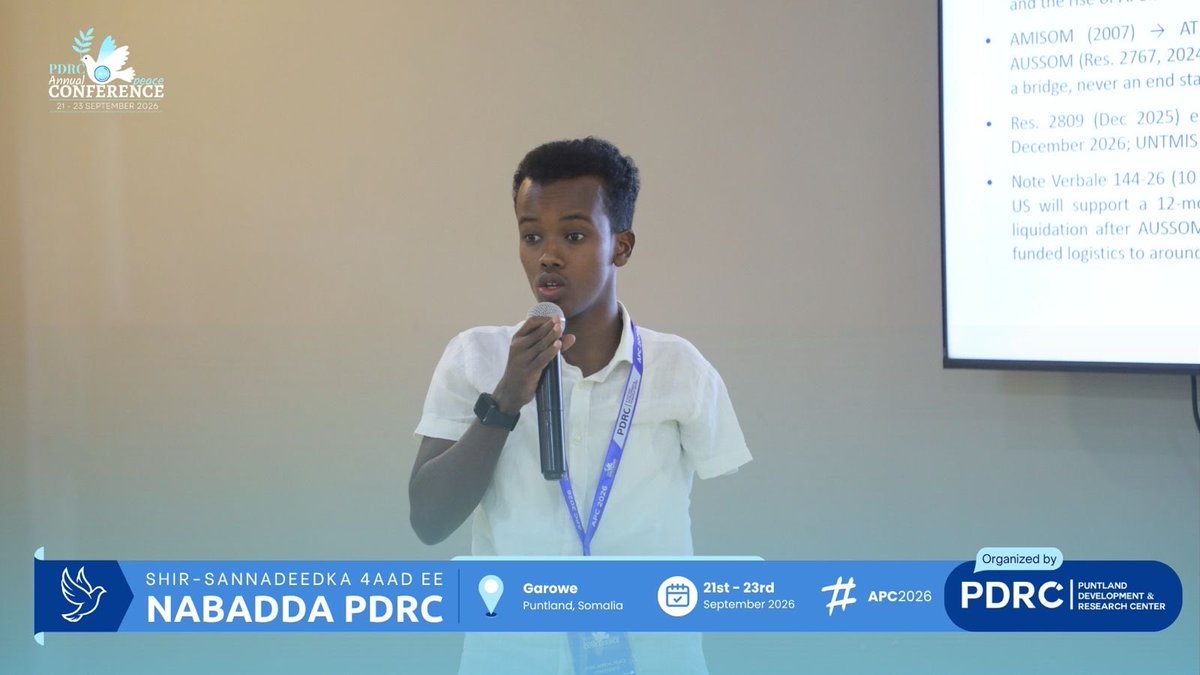
In the their paper @BalqiisInsights Deputy Director @MustafeGaboobe examines Somalia’s security transition beyond AUSSOM, focusing on institutional readiness and the pace of the drawdown.
He highlights a key concern: the funding secured for foreign forces in 2027 must be used to support the necessary transition and handover of security responsibilities.
“If the funding secured for foreign forces in 2027 is not utilized to carry out the necessary work of handing over control of the country, we will simply find ourselves facing the same turmoil and anxiety in the following year.”
#APC2026
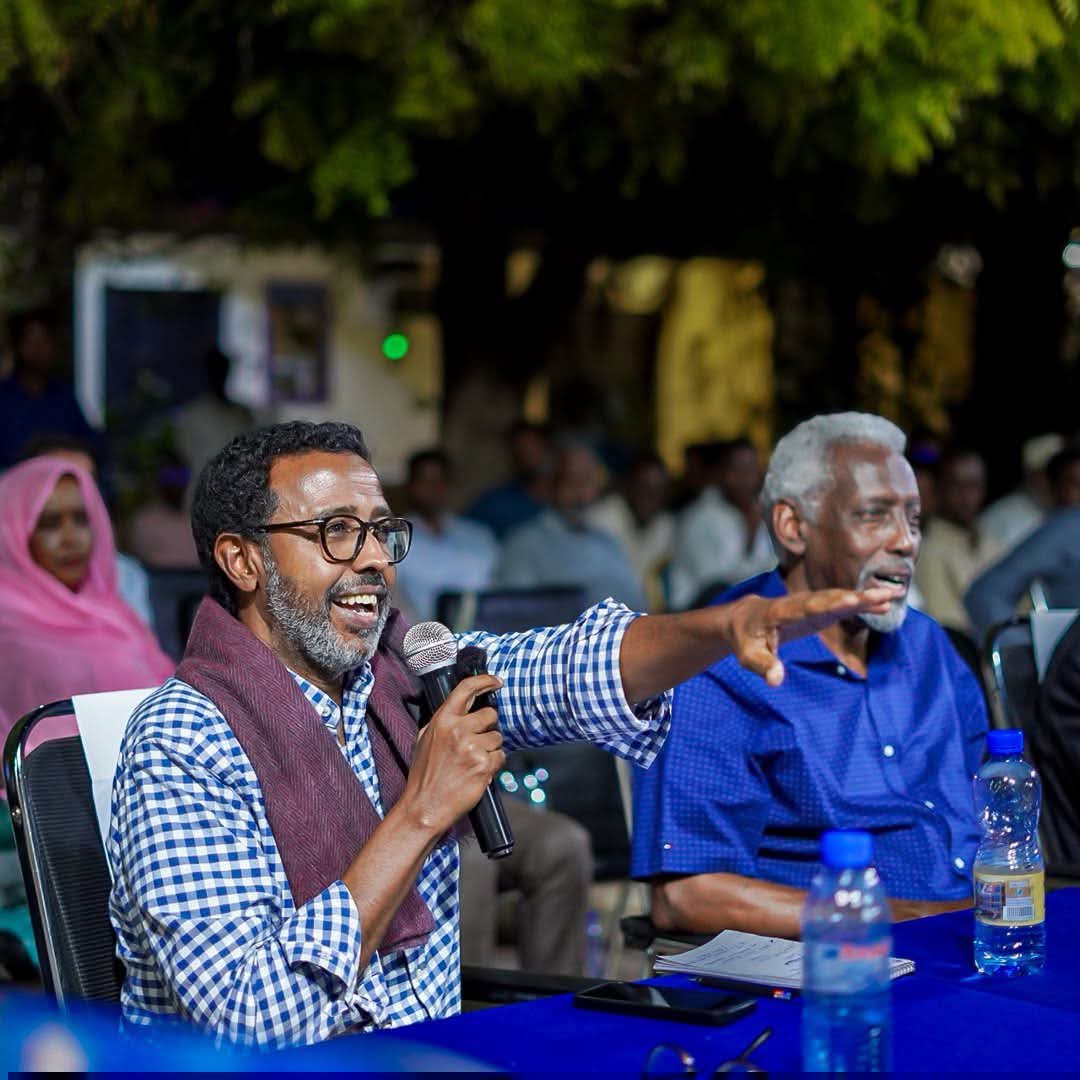
In this panel, we discuss state affordability. Understanding the challenges Somalis currently face and the preconditions for increasing revenue and taxation learning from similar contexts.
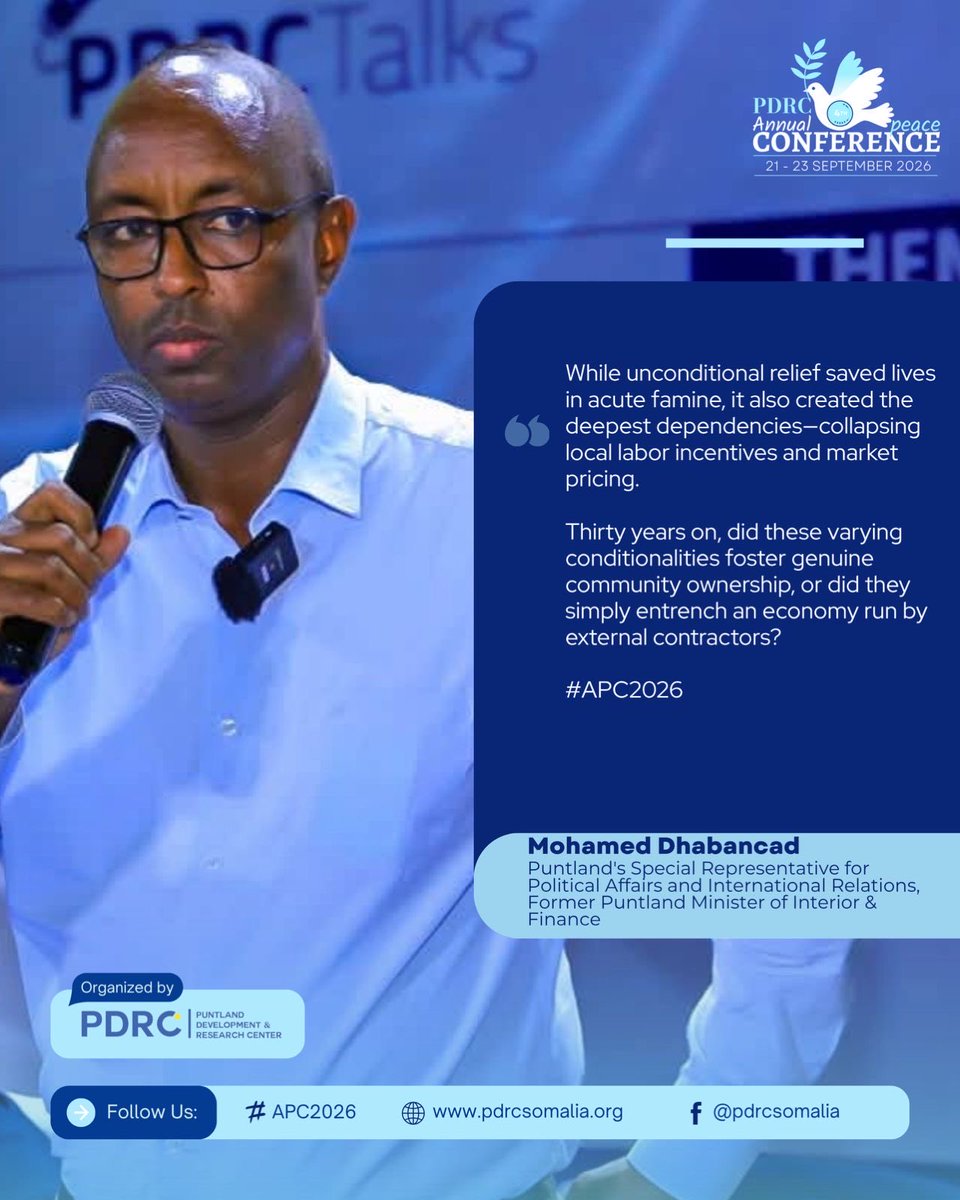
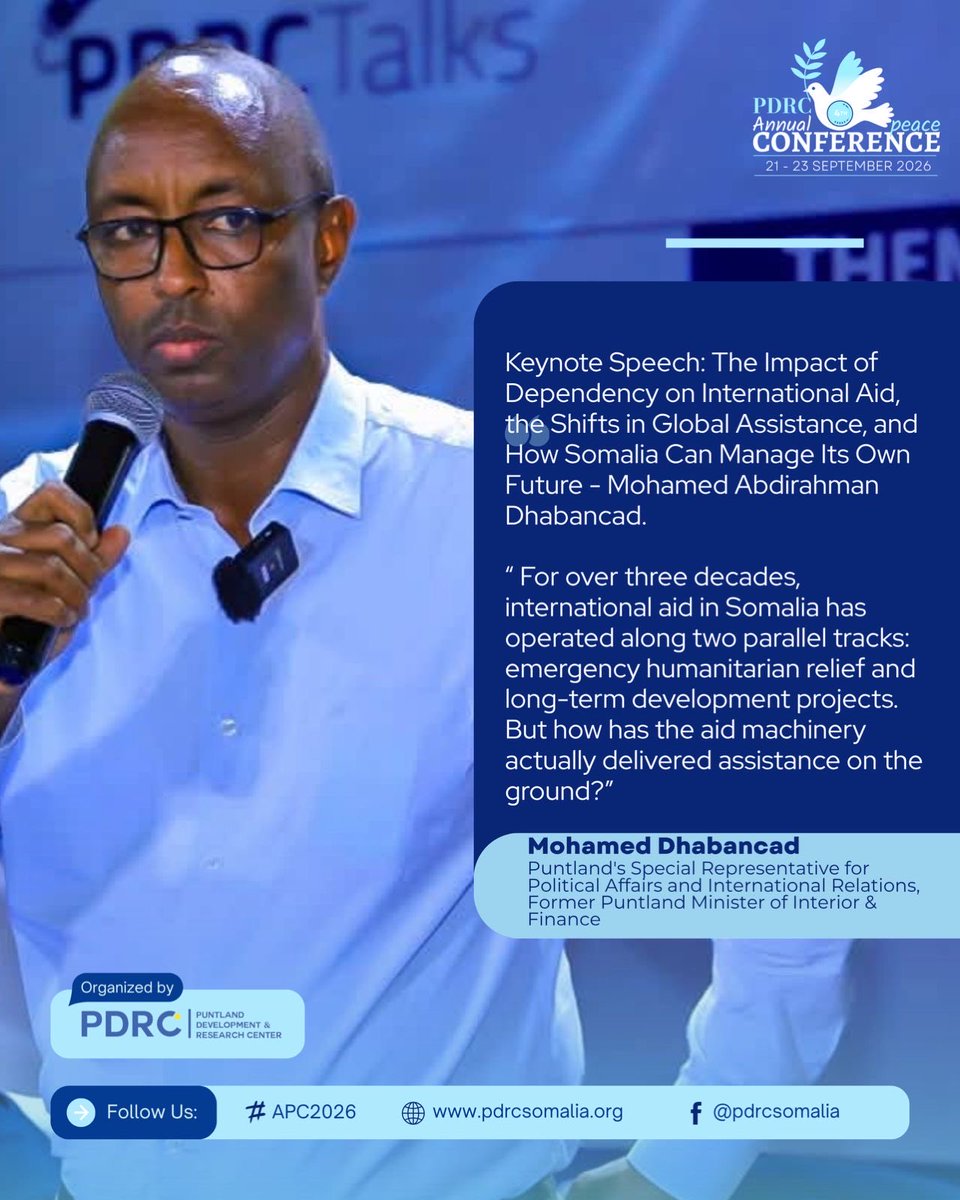
Find below the quotes from Mohamed Dhabancad keynote l. His topic was: “The impact of Dependency on International Aid, and How Somalia can Manage its own Future.”
Ali Mohamed Ali | Author Spotlight |
In his policy-oriented study, “Security Transition, Institutional Fragility and the Path to Somali-Led Stabilization: Navigating the AUSSOM Drawdown and Financing Transition,” Ali Mohamed Ali examines the structural challenges facing Somalia as international security responsibilities increasingly shift toward Somali-led institutions. The paper asks what strategies can support an effective security transition while strengthening national institutions and sustaining stabilization beyond international mission drawdown.
Drawing on qualitative, document-based thematic analysis and comparative lessons from Liberia, Mali, and the Central African Republic, the study identifies three intersecting realities: the pace of the drawdown is outpacing institutional capacity; Al-Shabaab has adapted rather than been totally defeated; and security gains have not consistently translated into governance dividends.
The paper proposes five strategies for the transition: making sequencing genuinely conditions-based; realistically resourcing force generation; anchoring stabilization in communities through civilian administration, justice and locally recruited policing; strengthening fiscal sustainability; and establishing a time-bound transition compact with measurable benchmarks. It further calls for coordinated action by the Federal Government and Federal Member States, the African Union, the United Nations and international partners, alongside greater roles for civil society and traditional leaders in stabilization monitoring and reconciliation.
#APC2026
2. Mohamud Isse Yusuf & Mustafe Abdi Ali | Author Spotlight | PDRC Annual Peace
In their empirical study, "Determinants of Public Confidence in the Judiciary: Evidence from Puntland State of Somalia," Mohamud Isse Yusuf and Mustafe Abdi Ali provide a grounded statistical diagnostic of how citizens perceive the formal judicial system. Operating in a semi-autonomous federal state where statutory courts coexist with traditional Xeer and Islamic jurisprudence, the authors address an empirical gap: while judicial reform is frequently highlighted in development programming, little quantitative research has verified what institutional attributes most directly determine public confidence.
The paper demonstrates that expanding physical court infrastructure or speeding up case hearings will fail to generate legitimacy if judicial verdicts cannot be enforced against politically connected elites or clan interests.
The authors propose four targeted reforms: establishing institutionalized operational protocols between court registries, police commands, and local executive administrations to ensure immediate verdict enforcement; instituting transparent judicial appointment processes, tenure security, and professional oversight codes to insulate judges from clan and political pressure; expanding community legal literacy initiatives tailored to youth and civic groups; and embedding strict judicial ethics mechanisms to guarantee that courts function as neutral arbiters of the rule of law. #APC2026
On the question of Ankara’s focus on Mogadishu, Amb. Aidid said: “I went to Ankara and warned of Somalia’s internal division and the need to engage all. They defended their policy of engaging and supporting the FGS. We still lack transparent facts about airstrikes.” #APC2026
On Day 3 of #APC2026, Amb. Jama Aidid (Former Ambassador to Türkiye) examines Somalia's deepening alignment with Ankara and the real score of the Ankara Process with Ethiopia. 🧵👇.
In under 24 months, Somalia–Türkiye ties expanded into every sovereign domain:
• 10-year Defense & Economic Framework (naval protection & rebuild)
• PSA with TPAO for offshore oil exploration
• SOMTURK: joint venture with OYAK to regulate all Somali EEZ fishing
He adds: “From Ankara’s side the agreements are transparent , my concern is that it is not from Mogadishu and whether they can uphold them.”
Security in a Changing Horn: Geopolitical Shifts, Emerging Partnerships, and Puntland’s Strategic Stance
When external powers redraw the security architecture of the Red Sea and the Gulf of Aden, how can federal member states preserve self-government without becoming instruments of foreign rivalry?
@somalisoul delivers a comprehensive evaluation of the rapidly shifting geopolitical and security environment confronting Somalia and the wider Horn of Africa. As maritime choke-points from the Bab el-Mandeb through the Gulf of Aden become increasingly militarized, the brief examines the fundamental transition underway: traditional multilateral peace-support architectures are winding down, while a crowded field of regional and Middle Eastern powers negotiates bilateral basing, port concessions, and maritime protection pacts. The analysis investigates the central strategic dilemma: how local communities and subnational institutions can shape their own security future when external protection is accompanied by opaque obligations, asymmetrical political leverage, and the risk of long-term dependency.
While the Federal Government in Mogadishu has anchored its maritime and defense posture in a ten-year comprehensive framework with Türkiye, the Somaliland administration has pursued ties with Israel alongside its maritime access memorandum with Ethiopia. These parallel developments illustrate the acute risks of external rivalry being imported directly into unsettled domestic politics: bilateral security commitments are entered into amid contested internal constitutional authority, without broad domestic consensus, transparent legislative oversight, or equitable distribution of risks and revenues.
In this fragmented landscape, external patrons risk subsidizing unilateral political action rather than building autonomous national capabilities.
@somalisoul sets out Puntland’s strategic path for navigating this volatile environment. Anchored in the defense of its coastal communities, vital trade routes, and constitutional self-government, Puntland articulates five internal foundations of strategic strength: professional and accountable security institutions, disciplined domestic revenue mobilization, legitimate governance rooted in public consultation, institutionalized dispute resolution, and economic resilience.
In managing external partnerships, the framework mandates clear parameters: rigorous institutional scrutiny of all agreements, diversification of partners to prevent single-patron capture, strict alignment of foreign engagement with domestic capacity-building, and cooperation grounded strictly in mutual consent and the preservation of subnational autonomy. Lasting security, she concludes, cannot be purchased through foreign alignment; it must be built upon accountable domestic institutions that ensure citizens retain a meaningful voice over their political destiny. #APC2026
3. Bravin Onditi |Author Spotlight
In his paper, "Competing Interests, Fragile Institutions: Geopolitical Rivalries and Somalia’s State-Building Trajectory," Bravin Onditi, Researcher at the HORN International Institute for Strategic Studies, analyzes how intensifying external competition across the Red Sea and Gulf of Aden intersects with Somalia’s unresolved federal architecture.
Utilizing document analysis of bilateral treaties, multilateral security resolutions, and a structured comparative framework contrasting Somalia’s fragmented gatekeeping against Djibouti’s monetized multi-alignment and Eritrea’s strategy of refusal, the paper examines why Somalia consistently fails to leverage its geographic assets.
The paper’s central finding is that "geography prices Somalia before Somalia prices its geography." Mainland Africa’s longest coastline sits beside a heavily militarized maritime corridor where the Bab el-Mandeb trade chokepoint experienced a 50% drop in traffic following late-2023 Houthi disruptions. Yet, because the allocation of constitutional authority over foreign policy, ports, and strategic agreements remains unsettled between Mogadishu and the Federal Member States, external actors engage in competitive underbidding.
Onditi introduces four original concepts to explain how external rivalry directly drives domestic division: patronage substitution (external financing allows federal and regional leaders to bypass budgetary constraints that would otherwise compel political compromise); sovereignty arbitrage (foreign entities contract with whichever Somali level of authority offers the most lenient terms); escalation coupling (quarrels among foreign patrons are imported into domestic politics); and the fragmented two-level game (multiple domestic authorities bargain internationally against one another).
This dynamic was laid bare in January 2026, when the federal cabinet's decree annulling UAE port concessions was observed where Abu Dhabi complied (Bosaso), but openly defied by Berbera and rejected by regional states.
The paper contributes five concrete institutional remedies to replace Somalia’s fragmented concessions with sovereign gatekeeping. It argues that the solution is not diplomatic alignment, but internal constitutional clarity answering three autonomy tests: who negotiates, what is disclosed, and where rents land.
The study recommends: (1) establishing an intergovernmental mechanism between the Federal Government and Member States that settles authority over international agreements, natural resources, and ports—paired with an immediate standstill on new unilateral concessions; (2) enforcing constitutional requirements for parliamentary ratification and public disclosure of all basing, port, and security agreements; (3) introducing statutory ceilings on single-partner exposure across ports, hydrocarbons, and security to prevent structural capture; (4) demanding that international partners fund transparent intergovernmental fiscal frameworks rather than transactional bilateral deals; and (5) grounding foreign policy research in empirical citizen attribution within port-adjacent communities like Berbera and Bosaso. #APC2026
Shukri Mahad Abdullahi | Author Spotlight |
In her paper, "Redefining Somali Statehood Through Transitional Justice & Inclusive State-Building Processes," Shukri examines the persistent legitimacy crisis haunting Somalia’s governance architecture. Tracing four distinct eras of unresolved trauma—state repression under the Siad Barre regime (1969–1991), the warlord period following state collapse, the rise of Al-Shabaab and militant insurgency, and civilian harms resulting from external military interventions—she argues that Somali state-building has stalled because it has repeatedly attempted to build governing institutions without settling accounts with the past.
Adopting a qualitative, document-based comparative methodology anchored in most-different-cases logic (drawing lessons from Kenya, Rwanda, South Africa, Sierra Leone, and Peru), the study investigates why formal constitutional commitments to truth and reconciliation remain dormant while institutional trust continues to deteriorate.
The paper finds that the primary obstacle to national reconciliation is not institutional design, but an acute deficit of political activation. While Article 111(i) of the 2012 Provisional Constitution explicitly mandates a Truth and Reconciliation Commission (TRC), more than a decade has passed without its establishment; similarly, the "dealing with the past" pillar of the 2019 National Reconciliation Framework remains the least implemented.
Governance indices confirm that Somalia continues to suffer from severe public trust deficits, where citizens view formal institutions as instruments of kinship patronage rather than impartial authority. Meanwhile, customary justice (Xeer) has shouldered the burden of local dispute resolution for three decades, yet its patriarchal structure systematically excludes women, youth, and minority agrarian groups (such as Somali Bantu communities), and its authority has repeatedly yielded to armed force.
By evaluating four potential pathways, the study demonstrates that a sequenced, hybrid model—coupling formal accountability with community-owned customary mechanisms—consistently outperforms either purely judicial or exclusively traditional approaches.
The paper contributes an actionable operational framework addressed to four key stakeholder groups to transition from unactivated blueprints to genuine accountability. It calls on the Federal Government and Federal Member States to enact a National Transitional Justice Framework Law with binding statutory deadlines, establish the constitutional TRC as a hybrid federal-state body with guaranteed representation for women, minorities, and religious scholars, and adopt a differentiated accountability matrix that separates senior atrocity architects from low-risk insurgent defectors.
It urges traditional and religious authorities to accept formal procedural safeguards, written case records, and appellate statutory review, while tasking civil society with establishing trauma-informed, confidential documentation channels for historical sexual and gender-based violence (SGBV). Ultimately, the study delivers a fundamental insight: transitional justice is not a luxury to be deferred until after state-building is complete, but a foundational, load-bearing pillar without which the state remains inherently brittle. #APC2026
@SeraGaid on electoral security
This should start before – while the government has mandate.
Realistically – we have to be part of the debate – impartial not neutral. Monopoly of the use of the forces by the government – if we misplace the blame by asking for reducing the provocations.
Participants safety cannot be guaranteed by the FGS then IC or joined by IC to join the meetings so that it is a security guarentee.
Every action has a counter action and perception – limitation on our sovereignty.
1- FGS says directly there is no risk and make it actual – confidence building
2 - African Union to take over
3 -Worst-case scenario the meetings to take place outside Somalia though I do not hope for it.
#APC2026 #PDRCTALKS
Prof Hassan Sh Ali:
Which one is more dominate – state or nation? In other terms the society not have the leadership are they more powerful than the leaders. If we take that formula and check in in Somalia ?
Who is dominant between FGS and FMS or are they both dominant agaist the society. All in all, there is no Somali state that is document since 1973. That was the only time we had a semblance of statehood. The second was society that was educated with similar thinking and feelings no matter where they are.
The only elections that can take place – one can lead to a leadership with legitimacy – one that the society gave the political loyalty to. The system should be fair – when we have all of that – it will lead to peace! If there is no legitimacy, justice or peace = jahwereer happens.
All in all elections is a small part of our problems (10%). On navigating competing ideas: we need all staekholders to be part of the process to find solutions. Where do we go? Find the root cause – missing a government that belongs to the citizens.
#APC2026 #PDRCTalks
Former Minister Hoosow: Do you think there is another solution?
I think it is a waste of time to discuss elections. He could have worked on this before. No matter the models, he is ok with the discussions while just staying in power. The most important was to have a semblance of legitimacy every 4 years, not to loose this small statehood. I just want a president who leaves while having the power to stay – that’s all I ask for. And a president who can accept while having the power to say no – so a president that finds a negotiated path. The double standards of the same issue but depending on the leader – the efforts being reduced. Let us be consistent in our fight. We are in a very dangerous path , as long as we have this mindset we will be there every 5 years.
#PDRCTALKS #APC2026
MP Kooshin: We have no idea where we are going? How is this different from the past? Everything we agreed upon on the past has been taken out: constitution, distribution of power
FGS is not ready for a common solution. I believe the 3rd republic died within President Hassan Sheikh's hands. We have 2 options: accept that or start a parallel process.
@MPKoshin
#APC2026 #Pdrctalks
🗣️ Dr. Cabdirashiid Ismaaciil (Scholar): "The solution, in my view, could be found in restoring the citizen's role — having someone who can carry the citizen's voice, present in Garoowe, Kismaayo, Baydhabo and Muqdisho, able to say: Somalia does not want this. And able to hold everyone accountable." #PDRCTalks #APC2026