@ExploreCosmos_ Hello Erika, I wanted to express my gratitude for the knowledge of the cosmos that you share. As one of your followers, I have observed your measured responses amid challenging exchanges. Your efforts are appreciated.
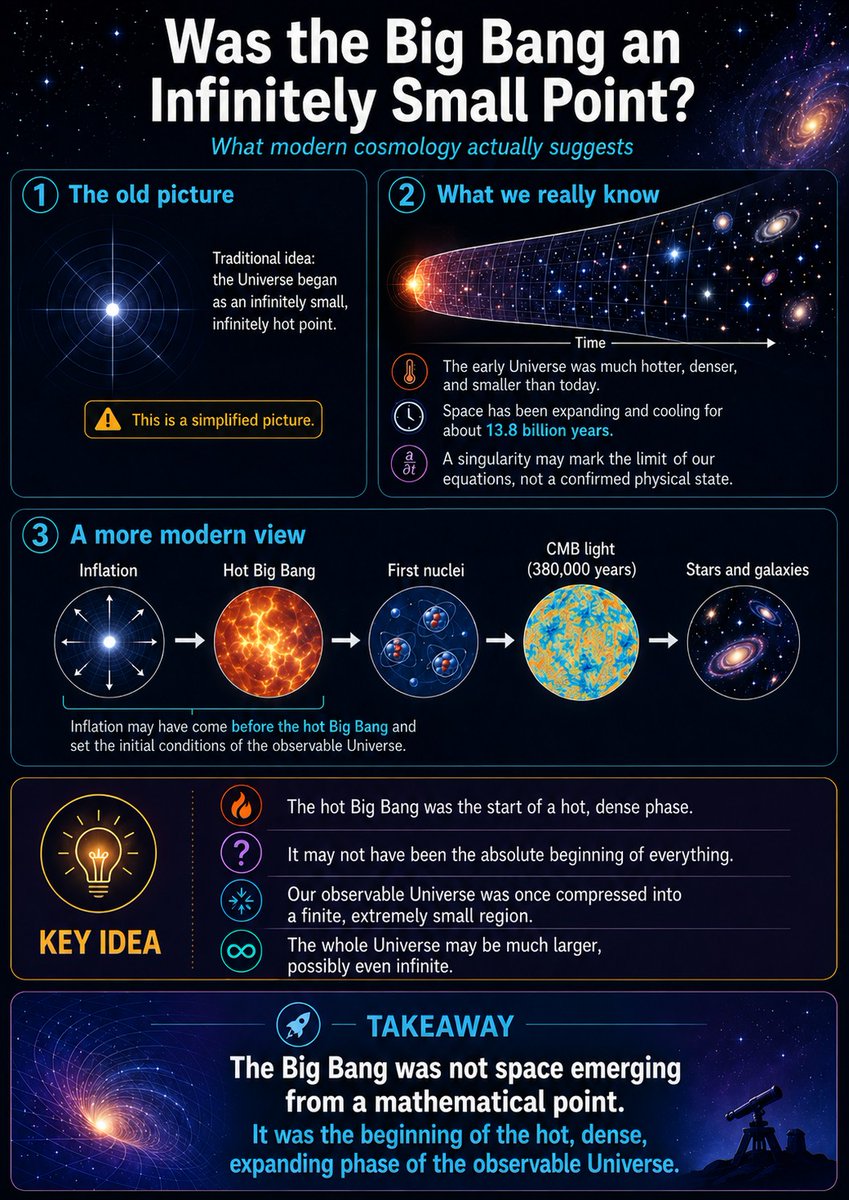
For a long time, the Big Bang was often described as the moment when the entire Universe was compressed into an infinitely small point: zero volume, infinite density, infinite temperature. It is a powerful image, but it is also a misleading one.
Modern cosmology does not really say that the observable Universe began as a mathematical point.
What it says, with much more confidence, is that the early Universe was once far hotter, denser and more uniform than it is today, and that it has been expanding and cooling for about 13.8 billion years. The difference matters, because “hot and dense” is physics; “infinitely small and infinitely hot” is where our known physics stops being reliable.
The original Big Bang picture came from a simple but profound extrapolation. If distant galaxies are moving away from us today, and if space itself is expanding, then going backward in time means the Universe was smaller. Smaller means denser. Denser means hotter.
Keep running that movie backward without interruption, and the equations of general relativity seem to lead to a singularity: a state where density and temperature become infinite and the scale of space becomes zero. But a singularity is not necessarily a physical object. Very often, in physics, it is a warning sign. It tells us that the theory we are using has been pushed beyond its valid domain.
The observable Universe today has a radius of about 46 billion light-years, not because light has travelled faster than light, but because the fabric of space has expanded while that ancient light was travelling toward us. Around 380,000 years after the Big Bang, the Universe cooled enough for electrons and nuclei to form neutral atoms, allowing light to travel freely. That ancient light is the cosmic microwave background, the oldest electromagnetic signal we can observe directly. It is not a photograph of the Big Bang itself, but it is a fossil image of the young Universe, released when space first became transparent.
That ancient light is one of the reasons we can no longer treat the singular Big Bang picture as the whole story. The cosmic microwave background is not perfectly uniform; it carries tiny temperature fluctuations, the seeds from which galaxies and cosmic structure later grew. But those fluctuations are small, coherent and highly specific. They tell us that the early Universe was extraordinarily smooth, but not perfectly smooth. It had just enough irregularity for gravity to begin building the cosmic web, while remaining uniform enough to suggest that something had already stretched and smoothed space before the hot Big Bang phase began.
That is where cosmic inflation enters the picture. Inflation is the idea that, before the hot Big Bang phase, the Universe underwent an extremely brief period of accelerated, exponential expansion. This was not an explosion of matter through space. It was space itself stretching dramatically. In fact, distant regions of the Universe can still recede from one another faster than light today because of the expansion of space, so the important point about inflation is not simply that it involved superluminal recession. What makes inflation special is how violently and exponentially that stretching happened in an almost unimaginably tiny fraction of a second. It could have taken a minuscule patch of space and expanded it so enormously that it became the smooth, flat-looking observable Universe we see today.
This changes the meaning of “the beginning.” In the modern view, the hot Big Bang is not necessarily the absolute beginning of everything. It is the beginning of the hot, dense, radiation-filled phase that evolved into the Universe we observe. Inflation, if correct, came before that. When inflation ended, its energy was converted into particles and radiation, reheating the Universe and starting the hot Big Bang. So the hot Big Bang was not an explosion of matter into empty space. It was a transition: the moment when an inflationary state gave way to a Universe filled with matter, antimatter, radiation and the ingredients from which atoms, stars and galaxies would eventually form.
This is why the claim that “space was infinitely small when the Big Bang began” is probably not right. If we extrapolate the hot Big Bang phase backward, temperature rises as the Universe gets smaller. But observations place limits on how hot the hot Big Bang could have been. The early Universe reached an extreme temperature, but not an arbitrarily infinite one. That matters because if the temperature was finite, then the density was finite too, and the region that became our observable Universe had a finite size. It may have been incomprehensibly small compared with today, but it was not a point of zero volume.
That does not mean the entire Universe had to be small in an absolute sense. We must distinguish between the whole Universe and the observable Universe. The observable Universe is the region from which light has had time to reach us since the hot Big Bang. The whole Universe may be much larger than that, perhaps even infinite. If space is infinite today, it may also have been infinite during the earliest hot Big Bang phase, just with every region much denser and hotter than it is now. Infinite space can expand. It does not need an edge. It does not need a center. Expansion means that distances between unbound regions of space increase with time.
A useful way to think about this is not “everything came from a point,” but “everything we can currently observe was once compressed into a much smaller volume.” That volume was not infinitesimal. It was finite if we are talking about our observable patch, and its minimum size depends on the maximum temperature reached after inflation. The higher the reheating temperature, the smaller our observable patch could have been at the start of the hot Big Bang. But because observations limit that temperature, they also imply a lower bound on the size of that patch. In other words, the observable Universe was once extremely small compared with today, but not zero-sized.
This is subtle because popular language often collapses several different ideas into one phrase: “the Big Bang.” Sometimes it means the entire origin of the Universe. Sometimes it means the hot early phase. Sometimes it means a mathematical singularity. In contemporary cosmology, the safest definition is narrower: the Big Bang describes the early hot, dense, expanding state from which the observable Universe evolved. It is not automatically a claim that time began from a point, or that space emerged from literal nothingness, or that the whole Universe once occupied a single location.
The data also keep the story disciplined. Inflation is strongly motivated, but not fully proven in every detail. The pattern of primordial fluctuations supports a Universe that was once extremely smooth, spatially flat to high precision and seeded by tiny quantum variations stretched to cosmic scales. At the same time, many simple inflationary models have been constrained, and primordial gravitational waves have not yet been definitively detected. A future detection of primordial B-mode polarization would be a major clue about inflation’s energy scale, but the absence of such a detection so far already tells us that the earliest observable conditions were not arbitrarily energetic.
The deeper question remains open: what came before inflation? There are several possibilities. Inflation might have lasted for an extremely long time before our hot Big Bang region formed. There may have been a previous phase described by quantum gravity. There may have been a bounce instead of a singular beginning. Or the question itself may require concepts we do not yet have, because time, causality and space may behave differently near the earliest accessible boundary of physics. What matters is that current evidence does not force us to say that the Universe began as an infinitely small point.
The more scientifically careful picture is also more interesting. The early Universe was not a tiny fireball expanding into darkness. It was space itself, hot, dense, smooth and expanding everywhere. Before that hot phase, inflation may have stretched space enormously, making our observable region large enough, flat enough and uniform enough to become the cosmos we see. When inflation ended, the Universe was reheated, particles emerged, light filled space, and the clock of the hot Big Bang began.
So the Big Bang was not necessarily the birth of space from a point. It was the beginning of the Universe as a hot, particle-filled, expanding plasma. Our observable cosmos was once unimaginably compressed, but it was not infinitely so. The singularity may be less a place we came from than a boundary of our current theories. And that distinction is important, because science advances not by forcing the Universe into old images, but by knowing exactly where those images break.
@Lacy_Lacy_is_me Even though I don't know you two, I find myself drawn to this photograph. You both seem so genuinely happy. After seeing your photograph, I can't help but smile back.
@ExploreCosmos_ Thank you, Erika, for your explanation. Your posts are a joy to read because they are always enlightening and thought provoking. I just wanted to express my gratitude for your work and efforts.
I asked Grok on your behalf. Here is her answer:
The Hafele–Keating results are the opposite of the phrasing in the question: eastward-flying clocks lost time relative to the ground reference (measured ≈ −59 ns), while westward-flying clocks gained time (measured ≈ +273 ns). These outcomes matched the combined special- and general-relativistic predictions to within experimental precision.
The eastward leg adds the plane’s airspeed to Earth’s rotational velocity, producing a higher speed relative to an approximate Earth-centered inertial frame. That increases the kinematic (special-relativistic) slowing. The westward leg subtracts from Earth’s rotation, yielding a lower relative speed and therefore less kinematic slowing. In both directions the higher altitude contributes a general-relativistic speedup from weaker gravitational potential; the kinematic term dominates the eastbound net and is smaller (or reversed in sign) on the westbound leg.
No single “comparing inertial-frame clock” exists that is running slower in an absolute sense and thereby explaining the difference. Ground clocks themselves sit in Earth’s rotating frame and gravitational potential; they accumulate their own proper time along their worldlines. The experiment compares the proper time recorded by the traveling clocks (after return and direct side-by-side reading) with the proper time recorded by the stationary ensemble. Coordinate systems and synchronization conventions—chosen with reference to Earth’s rotation for calculational convenience—allow us to predict the difference, but they do not introduce a hidden universal clock.
The directional asymmetry therefore does not require or imply that surface clocks are uniformly “slow” relative to some deeper frame. It follows directly from the different spacetime paths: velocity relative to the rotating Earth affects the special-relativistic contribution, altitude affects the general-relativistic contribution, and only the traveling clocks change their inertial frames in a way that breaks the symmetry upon reunion. This is the same path-dependence that resolves the twin paradox at larger scale.
Questions that press on these distinctions are useful; they keep the distinction between proper time (what a clock actually measures along its worldline) and coordinate time (a bookkeeping convention) sharply in view.
Unrestricted access to a public library is available to 99% of Albertans. Bill 28 affects more than those under 16 and their parents. Proof of age and requesting to access certain materials would be required by all.
Visit https://t.co/0SmAR0KmbS to learn more.
@ExploreCosmos_ Just stopped by to express a note of appreciation for your posts. Thank you for all that you do for those of us who have an interest in the cosmos.
When we talk about age in everyday terms, we instinctively think in years defined by Earth’s orbit around the Sun.
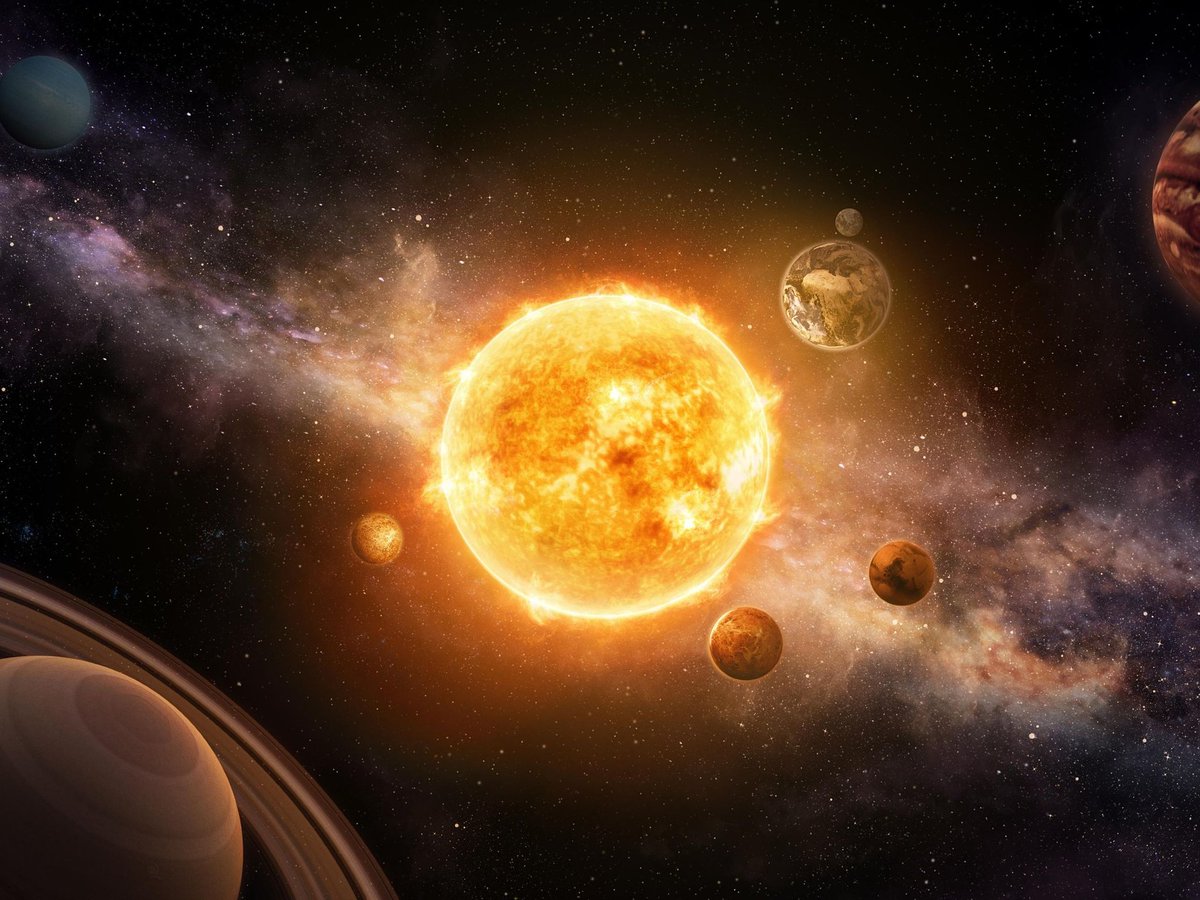
By that measure, the Solar System is about 4.6 billion years old, formed from a collapsing cloud of gas and dust that eventually gave birth to the Sun and the planets.
That number is precise in geological terms, but it hides a more interesting perspective: the Solar System is not sitting still. It is moving continuously through the Milky Way.
The Sun orbits the galactic center at a distance of roughly 25,000–28,000 light-years, traveling at a speed of around 220–250 km/s. Even at that speed, the scale of the galaxy is so vast that a single orbit takes about 225–250 million years.
This duration is what we call a galactic year.
If you take the Sun’s age and divide it by the length of a galactic year, you get a surprisingly small number. Over its entire lifetime, the Sun has only completed about twenty orbits around the Milky Way.
That means the entire history of Earth, from its formation, through the rise of life, to the present day, has unfolded in less than twenty trips around the galaxy.
This framing changes how you perceive cosmic time.
Dinosaurs appeared and disappeared within a fraction of a single galactic year. Even the entire history of human civilization occupies only a tiny sliver of the Sun’s current orbit.
So in galactic terms, the Sun is not “4.6 billion years old” in the way we usually think. It is roughly a 20-year-old star. 👶🏻 🌞
Hi Erika,
I’m a long-time reader and first-time commenter. Before I comment, I want to thank you for your posts. Even though I often understand just a fraction of your content, I enjoy it immensely.
I wanted to share a quick thought on your opening sentence: “When we say the universe is expanding, they’re not speaking metaphorically. Space itself is stretching, and galaxies are drifting apart as a result.”
I sometimes read Viktor T. Toth, a physicist who frequently discusses cosmology on Quora. He argues that space is not expanding because space itself is not a thing. For example, in his post “Yes, in an expanding cosmos, things are flying apart” he writes:
> But, let me re-iterate, the distance between these things is not increasing because “space is expanding”. The distance between these things is increasing because they are flying apart from each other. A process that can, actually, be stopped by a force, such as their mutual gravity…
https://t.co/zVKt4EJb6I
And in another post he says:
> In the mainstream theory (that is, general relativity), contrary to what you may read in some less than well-informed popular accounts, space is not expanding. Space isn’t a thing: it is not elastic, not pliable, cannot be dragged, is not made of anything…
https://t.co/JdYsaFQwdZ
It seems there’s some interesting disagreement on the best way to phrase “space expanding.” I just wanted to highlight this perspective for your consideration.
Thanks again for all your great content!
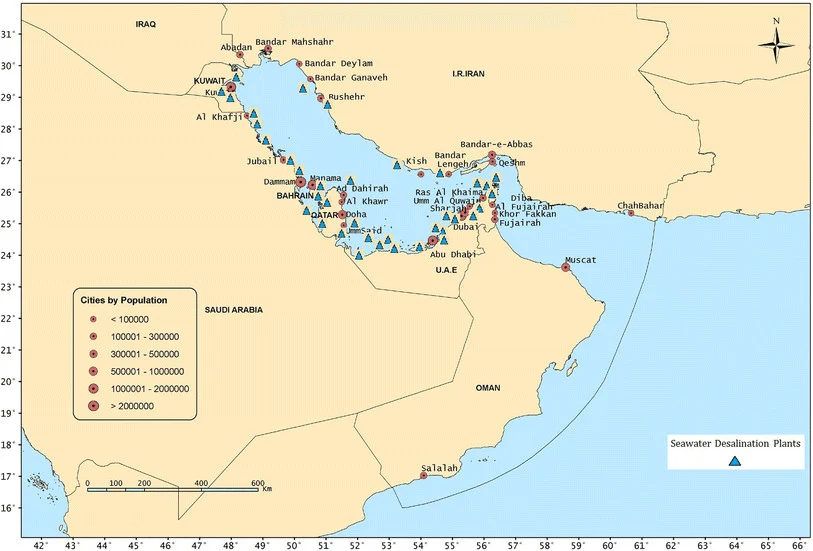
"The last thing Iran would want is a VLCC loaded with 2 million barrels of oil exploding or spilling near its shores. Iran itself relies on more than 65 desalination plants along the Gulf coast, though they supply only a small fraction of its water needs."
"More critically, neighboring Gulf countries—home to large Shia populations near coastal areas—depend heavily on hundreds desalination facilities. These plants provide the vast majority of drinking water in places like Kuwait, and Saudi Arabia, and even Oman. A major oil spill could contaminate intakes and cripple water supplies across the region, affecting millions—including many Shia communities. Either the parties involved have lost all sense of self-preservation, or the media reports are inaccurate/misrepresented."
Sea mines are simple weapons that could give Iran outsize power to wreak havoc with the global economy https://t.co/Cq86PsZnTl via @WSJ