We’d love to see humanoid helpers improving our lives soon, but AI’s first big splash will likely be in finance and software. Algorithms will soon out-trade us and might even invent financial instruments too intricate for humans to wrap their heads around.
Some thoughts
I believe a cambrian explosion of consumer ai startups is coming. AI should diffuse much faster than previous computing shifts: it runs on devices people already own and requires far less behavior change from users.
Now add the cost curve: glm 5.3 flash now matches the Intelligence Index score of opus 4.8, the #1 frontier model just 3 months ago.
opus 4.8: $5 / $25
glm 5.3 flash: $0.15 / $0.50
Both score 57 today, 30–50x cheaper tokens.
Frontier intelligence went from lab economics to seed-stage startup economics.
Faster diffusion + collapsing intelligence costs can unlock thousands of experiments that were uneconomic just 6 months ago. I firmly believe the app layer is about to explode.
Nscale has entered into a definitive agreement to acquire Anyscale, enhancing our full-stack AI cloud platform.
Together, Nscale’s vertically integrated AI infrastructure and @anyscalecompute's software would help customers move from raw compute to production AI.
Read more: https://t.co/E1NtzBESF7
"Personal superintelligence in everyone’s hands, with competing models and real data sovereignty, is a far better check on a dystopian future than self-appointed guardians who claim to be “aligned” with all of humanity."
I signed the We Must Act Now statement because I believe in pro-human AI.
The technology is moving faster than our institutions, labour markets and public conversation.
We should be thinking now about how AI can complement people, create new opportunities and make sure the benefits reach more than just a few.
Here's our statement on AI and the economy.
We Must Act Now
A Statement on AI’s Transformation of the Economy
1. AI may become radically more powerful over the next 10 years.
2. This could drive an unprecedented transformation of our economy, larger than the Industrial Revolution, but unfolding over a vastly shorter time frame. It could bring risks, including large-scale job displacement, as well as opportunities such as major gains in living standards.
3. Economists, policymakers and technology leaders must act now to understand the economics of transformative AI and to build the incentives, guardrails, and institutions needed to steer AI in a direction that complements humans and benefits society.
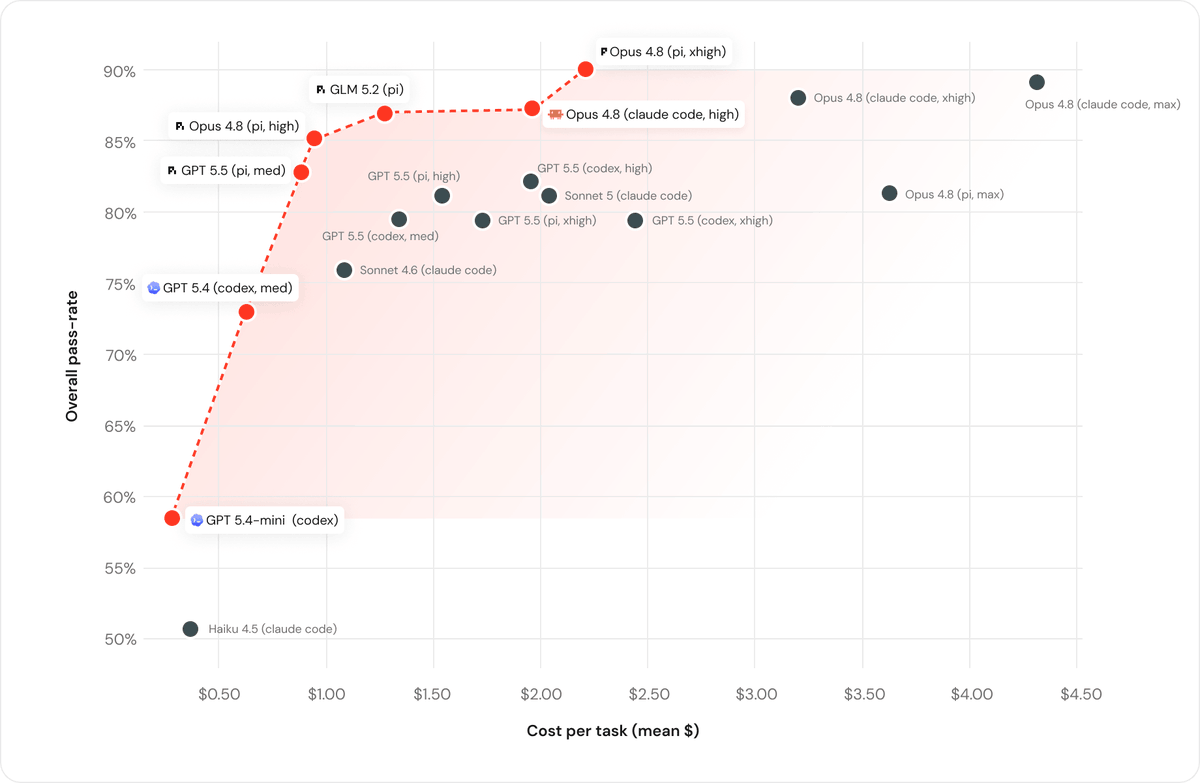
We benchmarked coding agents on our own internal tasks at Databricks and learned a lot!
There are many surprising opportunities to lower cost and increase quality, and many models including open source ones are truly competitive now. 🧵
Legacy Media types are calling this Alex Karp interview a “crash-out” so that’s your first clue that he is actually saying something extremely insightful. He is articulating what real “AI safety” looks like in the enterprise.
Not abstract alignment research or certification by a government-run DMV for AI. Real AI safety for businesses is the ability to control their own data, model weights, and compute — so a frontier lab can’t hoover up their proprietary knowledge and turn it into their next product.
As Karp explains, technical customers want “control over their compute, their models, their data stack, and their alpha. They want to know they own the means of production, and it’s not being transferred to someone else.”
Don’t think that can happen? Just look at Figma. According to The Information, Anthropic “blindsided” its then-business partner with the launch of Claude Design. Figma’s founder said Anthropic had not been “consistently honest” with them. Anthropic’s chief product officer had even served on Figma’s board until three days before the launch of Claude Design. Figma’s stock has fallen sharply this year while Anthropic’s valuation has surged.
This isn’t an isolated example. Anthropic has launched Claude Science, Claude Security, Claude Legal, and of course Claude Code — each expanding into categories previously served by companies building on top of their models. The pattern is consistent: watch where value is being created, then move in directly. Dominate the model layer, then use that position to capture the most lucrative verticals.
Dario has argued that open source models powerful enough to compete with Anthropic are “dangerous.” But dangerous to whom? Not to enterprises that want to retain control over their data and workflows. Dangerous to a business model that benefits from customers having few real alternatives at the model layer.
As Karp exposes, true enterprise safety isn’t trusting that a lab’s future roadmap won’t include your business. It’s retaining the ability to choose — at the model layer — who gets to see and use your alpha.
Exactly. I've been disseminating a similar message for years.
The concentration of power in AI and the desire for control is by far the biggest danger of AI. It could lead to a few private companies and/or countries being in control of access to information, access to knowledge, and access to the tools of economic expansion.
It's a kind of medieval obscurantism akin to the Ottoman empire banning the use of the printing press for 200 years, in part to keep control of the dogma, but also to protect the corporation of the calligraphers and scribes.
Relevant historical bits about the Internet:
1. It took a deliberate decision by Al Gore and Bill Clinton to open up access of what was then ARPAnet to commercial entities and to the public, against the desires of the entrenched telecom industry. During a public roundtable about the "information superhighway" in 1993, the CEO of AT&T told Gore and Clinton "leave it to us". Gore said no.
2. In the late 1980s, setting up an Internet presence required buying proprietary hardware with proprietary OS and software stack from Sun Microsystems, HP, IBM, or Dell. By the 2000s, all of this was wiped out by commodity hardware, Linux, Apache, and an entirely free/open software stack. This migration to open platforms was the result of market forces.
Infrastructure wants to be open.
Foundation models are becoming an infrastructure and will inevitably become commoditized.
Long term, the money is in the application layer, which is what I, Arthur Mensch, Alex Karp, and others have been saying.
With Meta and SpaceX moving into the neocloud market and offering AI compute directly to customers, my conviction around the physical layer keeps getting stronger.
The model layer is moving fast, open source models are getting close to frontier level and intelligence will become more accessible, cheaper and more widely distributed over time.
Hyperscalers and neoclouds are becoming the infrastructure layer behind the next decade of innovation.