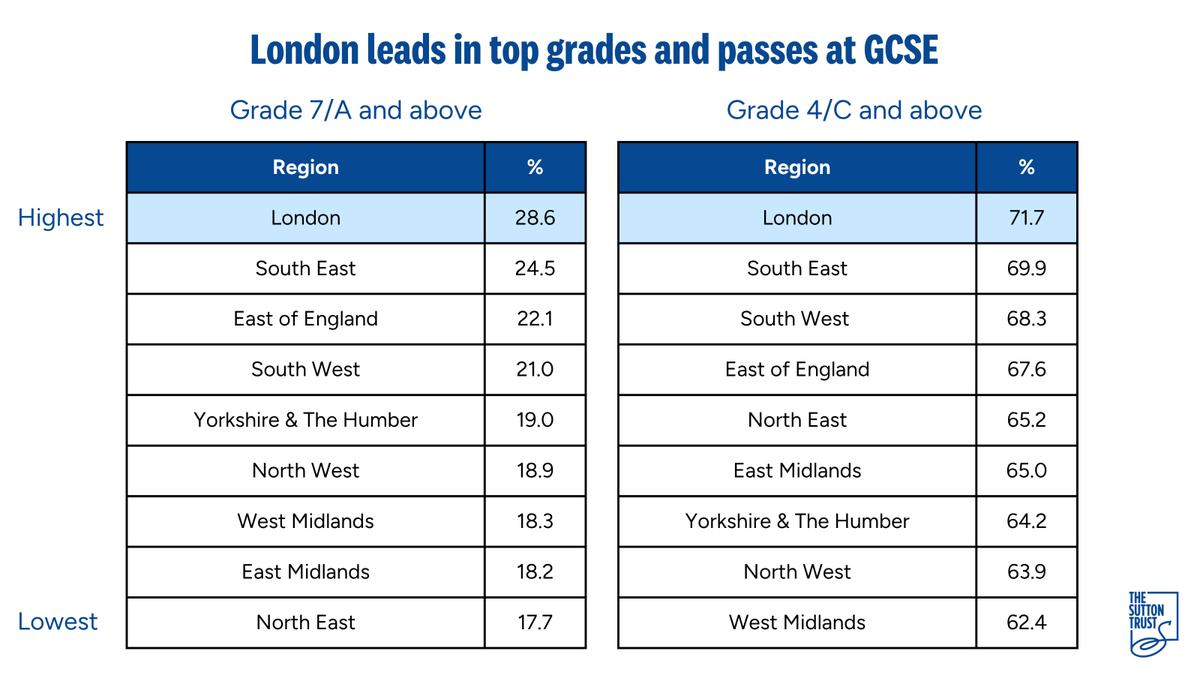
🚨 NEW: There’s been no progress in addressing regional imbalances in GCSE attainment, with the gap between London and the rest of the country continuing to grow.
Our analysis of today’s results finds that regional gaps in both top grades and passes are largely unchanged 🧵⬇️
📣 Announcing the Sutton Trust Regional Ambassadors!
We've developed an exciting new scheme to ensure our programmes reach the young people who need them most.
Our ambassadors share our passion for social mobility and breaking down barriers for disadvantaged young people ⬇️
As school leaders, they understand first-hand the challenges of closing the attainment gap and supporting progression into higher education.
Their on-the-ground insight will feed directly into our agenda-setting research, while local networks will help widen access to our life-changing programmes.
💬 "Many of the country's most influential jobs are disproportionately held by the seven per cent of the population who attended private schools."
Fantastic to see our research cited in a piece by JNews, on the "nepo baby" debate and access to creative careers ⬇️
https://t.co/R9PGi9piBz
How do disadvantaged pupils' outcomes differ by ethnicity and gender? 📊
As part of our research into how class, ethnicity, gender and place shape opportunity, we compared the school attainment of different groups of pupils on free school meals (FSM) ⬇️
Calling all school leaders!
In our latest blog, our Schools Engagement Lead shares her advice to get your new school year off to a great start and details of our free CPD offer for school staff ⤵️
https://t.co/sWePi0FhDf
How do people manage to do internships when they're unpaid? 🤔
Money is a key barrier when so many internships continue to be either unpaid or not paid the minimum wage.
We spoke to people who did an internship asking them how they funded themselves ⬇️
https://t.co/R1MpzgpgXn
✍️ "Social mobility is complex. It’s influenced by education, social capital, financial and housing security, and social norms."
Unpacking the drivers of social mobility beyond just attainment and earnings ⤵️
https://t.co/ckMZdoxnIC
Degree apprenticeships were meant to open professional careers to a wider group - but they're being monopolised by the middle classes.
New @SocialMobilityF research reported by @Independent finds they are 3.5 times LESS accessible to young people eligible for free school meals than Russell Group universities—even among those with suitable grades.
The geography is equally stark. Almost a third of positions are concentrated in ten postcodes. Blackpool has fewer than 0.4 opportunities per 1,000 young people; the City of London has 104.
Competition has reached 11.3 applications for every Level 6 place. Decentralised applications, lengthy selection processes and travel or relocation costs all favour candidates with informed support, professional networks and money behind them.
Increasing the number of degree apprenticeships will not, by itself, widen access. Employers and government should publish participation by background, spread opportunities more widely and remove the recruitment and cost barriers that screen some young people out before their ability can be judged.
@suttontrust
New analysis covered by Schools Week shows that educational outcomes vary significantly by place, even among pupils who appear similarly disadvantaged.
A stark reminder that where a young person grows up continues to shape their opportunities ⤵️
https://t.co/UiQh0Dwcb1
🗣️ "Addressing social mobility and opportunity will mean different things in different parts of the country, for different ethnic groups, and for men and women,"
Our report shows the importance of tackling challenges that face all communities across our country ⤵️
https://t.co/XYTplf2mdY
✍️ "Higher education still delivers substantial value for individuals, communities and the economy. It remains central to social mobility. But it’s not a self-sufficient engine."
Our blog looks more closely at the value of a university degree 🔍️
https://t.co/WjvtGb7tFO
🚨 Girls, and certain ethnic groups, perform strongly at school but underachieve in the labour market.
Our research shows how geography, gender, and ethnicity shape opportunities for disadvantaged young people across England ⤵️
https://t.co/g3U869RaE6
This August, we saw persistent regional attainment gaps in exam results, shared details of our upcoming programmes application windows, reflected on another successful year of UK Summer Schools, and joined TikTok.
Read more in our monthly newsletter 🔗
https://t.co/XNoC2jUu83
💬 “The Sutton Trust residential gave me an insight I wouldn’t otherwise have had.”
Fantastic to hear about such a positive experience from one of our students who recently attended our @univofstandrews Summer School ⬇️
🔗 https://t.co/lwJiiqBflZ
✍ "Young people in different parts of the country are not more or less intelligent or skilled. This is about opportunity and systemic support."
Our Research and Policy Manager, Kevin Latham, reflects on GCSE results day in @FEWeek ⬇️
https://t.co/D7CMqHTmyq
🚨 Wide disparities in GCSE attainment by region 🚨
Our analysis of GCSE results reveals more about the differences in the proportion of pupils achieving both pass grades and top grades, with London outperforming the rest of the country ⬇️
https://t.co/5eb3535xX7
🚨 Fewer 17-year-olds resitting English and maths were able to secure a grade 4 this year.
Our analysis of today's GCSE results found that only 21% of those resitting English and just 16.4% of those resitting maths achieved a pass.
https://t.co/5eb3535xX7