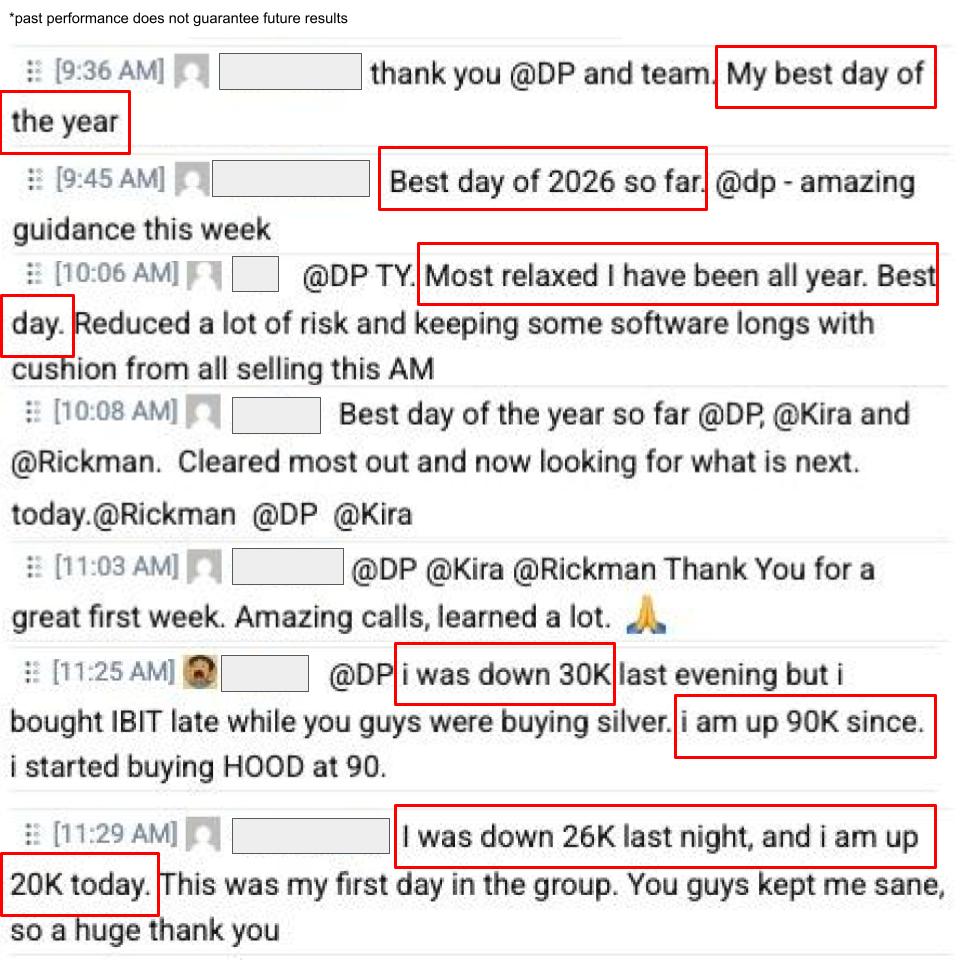
"My best day of the year"
That's how Inner Circle members are describing today after @epictrades1 put on a master class in money management for this market
As the market was melting down Thursday, DP kept everyone focused on the best risk/reward setups
That meant sizing up on $IBIT in the $36s... and trimming today above $40
Sizing up on $IGV in the $79s... and trimming today above $82
Buying $SLV as low as $60 after hours... and selling today above $69
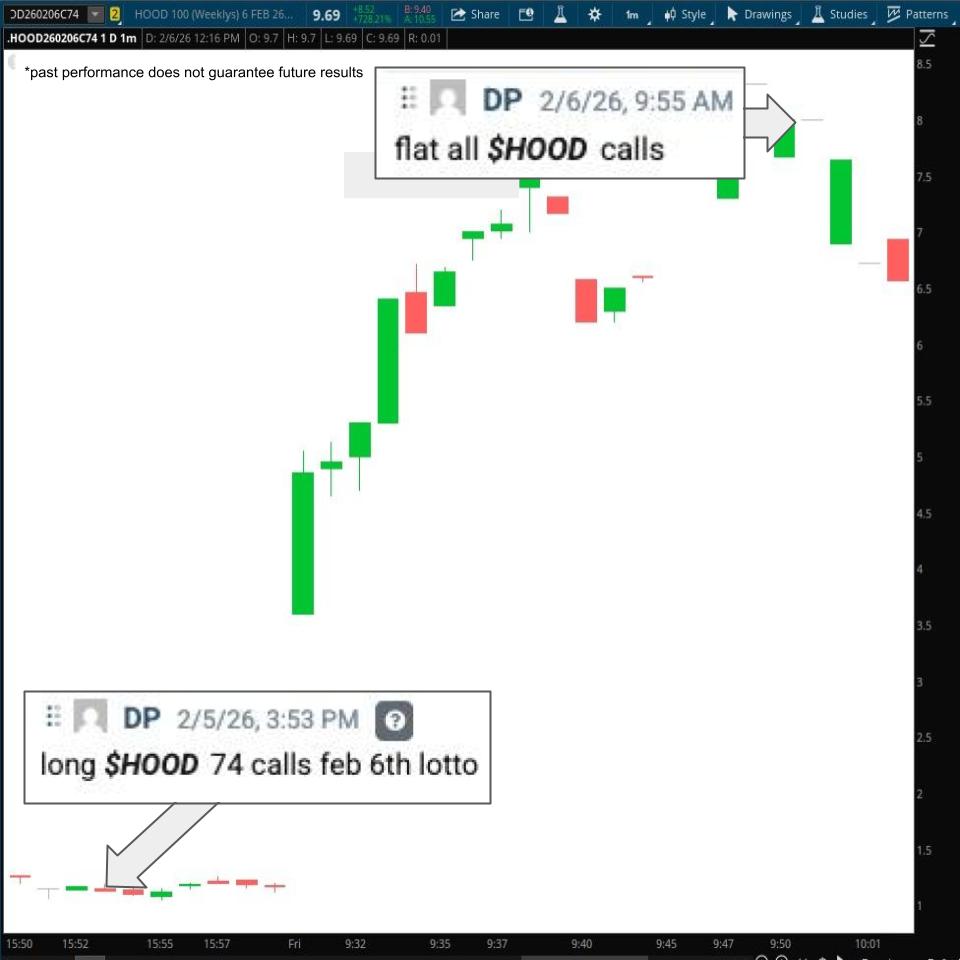
And buying $HOOD lotto calls right before the close for $1.13... and selling them this morning over $8
That's a 608% winner overnight!!
Apply to join the group now: https://t.co/zotNitfJ38
On Tap Friday 7/24
🇺🇸 US Econ: S&P Manufacturing & Service PMI, New Home Sales
🌎 Global Econ: N/A
☀️ AM Earnings: $AXP $NEE $VZ $HCA $CNI $SLB $CHTR
🌙 PM Earnings: N/A
My conversation with @andrewdfeldman, CEO of @cerebras. We started from "what is a wafer?" and built up to why the entire chip industry is reorganizing around inference speed.
00:00 Cold open & Intro
01:31 Why speed became the AI bottleneck
02:32 Tokens per second per user, explained
03:16 AI’s broadband moment and the Netflix analogy
04:35 The AI chip landscape: GPUs, TPUs, Trainium, ASICs
06:36 What is an ASIC?
08:08 Nvidia, Groq, and the fast inference war
09:16 OpenAI, Broadcom, and specialized silicon
12:10 China, power, and sovereign AI infrastructure
15:05 Is the AI infrastructure boom a bubble?
18:56 The hidden bottlenecks: HBM, CoWoS, and 3nm
22:57 Why agents are creating CPU demand
25:36 Andrew’s path from SeaMicro to Cerebras
26:13 Why Cerebras bet on AI in 2016
31:14 SRAM vs. HBM: why inference is a memory problem
33:19 What wafer-scale computing actually means
34:28 The deep-tech “Everest” problem
36:07 The moment the first Cerebras system worked
36:49 Ringing the bell and surviving deep tech
39:08 How a giant chip handles failure
41:22 Why GPUs struggle with decode
42:17 Prefill vs. decode explained
44:01 The “100 HD movies” problem in AI inference
45:04 How fast inference changes RL and training 48:08 Reasoning models and why they cost more compute
50:08 Verification, guardrails, and small models checking big models
52:37 Multimodal AI and the path to video
53:51 Cerebras’ business model: hardware, cloud, API
55:14 OpenAI’s 750MW inference deal
55:36 Why data centers are measured in megawatts
58:01 AWS Trainium + Cerebras decode
59:29 Fast tokens as a cloud product
01:00:52 Is CUDA still a moat?
01:03:53 How TSMC helped Cerebras build the giant chip
01:07:41 Why nobody cared in 2020
01:08:15 Why chip supply chains are hard to diversify
01:09:54 Why today’s AI models will be the worst you ever use
01:10:38 What fast AI could do to SaaS
$SPCX: NAILED!!!!
Sami Abusaad shorted SpaceX at $154.89 on July 7.
It broke $115 today, so Sami is now up over 25% on this short.
Learn how he became a fearless trader:
https://t.co/sJRDjNEqo1
It’s a process lower. First it has to lose the 8/21 to get active longs out. Then it loses the 50/100day. Now it’s below the 200day. There’s always time to adjust. See if it stays below $319 now
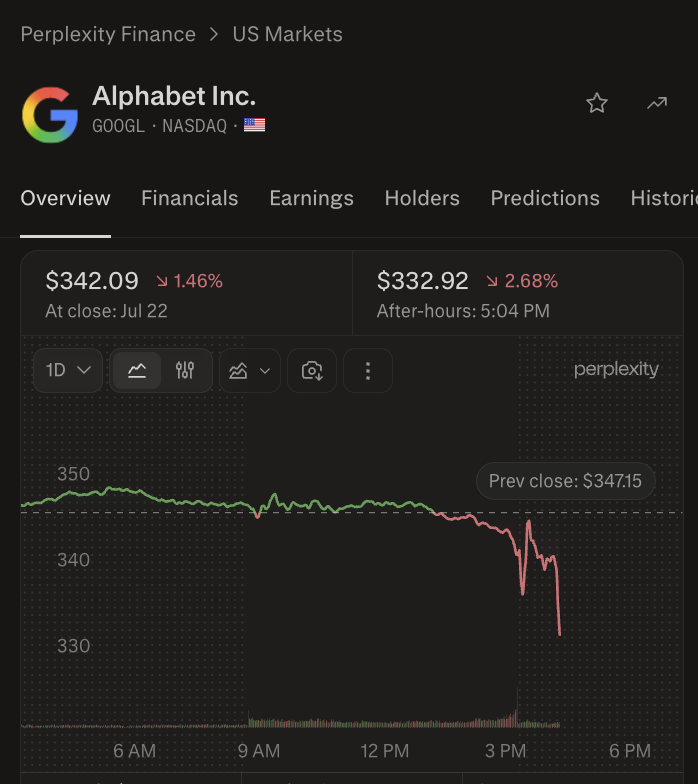
📺 CAN THE INDEXES SURVIVE $GOOGL EARNINGS SELLOFF? + $TSLA GAPPED DOWN... BUY OR STAY AWAY? + $META UPDATE AFTER $GOOGL EARNINGS
Get my newsletter FREE 2x per week: https://t.co/Rqp84Wg39F
The market is absorbing another wave of earnings volatility, but the broader indexes continue to hold up better than many expected.
For now, despite Google's sharp post-earnings decline, $SPY remains trapped in its multi-month trading range rather than breaking down.
*
For the $SPY, the key levels remain clear. The market is sitting between $744 support and $746 resistance, leaving traders in "no man's land."
The next meaningful move depends on whether buyers can reclaim resistance or whether support finally gives way.
Until then, patience remains the better strategy.
*
$QQQ is also sitting near important technical levels after last week's strong bounce from oversold conditions.
The lesson is that not every trading day offers a high-probability setup, and traders should remain selective instead of forcing positions.
*
$GOOGL earnings is the focal point today.
The stock is opening significantly lower as investors react to continued heavy AI capital expenditures.
Technically, $GOOG has already broken below a key support level and now sits between that former support and its 200-day moving average.
Rather than chasing the selloff, I would wait for the stock to establish an opening low, confirm that buyers are stepping in, and only then consider a trade if it begins filling the earnings gap.
*
$TSLA is another example of why risk management matters.
The stock has been technically weak for a while, with failed breakouts and a pattern of lower highs.
Instead of buying shares into earnings, I preferred a defined-risk call spread. While the options trade lost its premium, the loss was limited.
Holding an equivalent stock position would have resulted in dramatically larger losses after #TSLA post-earnings decline.
The focus now shifts to whether #Tesla can stabilize near key support and recover part of its opening gap before becoming an attractive trading opportunity.
*
$META presents a different story.
Unlike Google, #Meta hasn't reported earnings yet and is selling off largely in sympathy with the weakness across mega-cap technology.
That creates a potential opportunity. I already started building a small options position and plans to add only if price action confirms buyers are returning.
If Meta can establish an early low and reclaim key technical levels, it could become one of the stronger setups despite the broader weakness.
*
The biggest takeaway is that successful trading isn't about predicting earnings reactions.
It's about letting price action reveal where institutions are buying, respecting technical support and resistance, and managing risk before looking for reward.
In a market still trading sideways, discipline and patience remain the biggest edge.
*
If you found this helpful, please ❤️like and 🔁retweet
Investors Turn Bearish (for now)
The AAII Sentiment Survey shows that just 29.6% of investors are bullish.
This is well below the 37.5% long-term average.
And it's a massive decline from last week's 44.9% reading (above average bullishness).
So are investors bearish?
Kind of.
These sentiment surveys have been topsy turvy all year, so we never get any sustained bullishness or bearishness.
That reduces the predictive power of these numbers, which wasn't all that great to begin with (outside of real extremes).
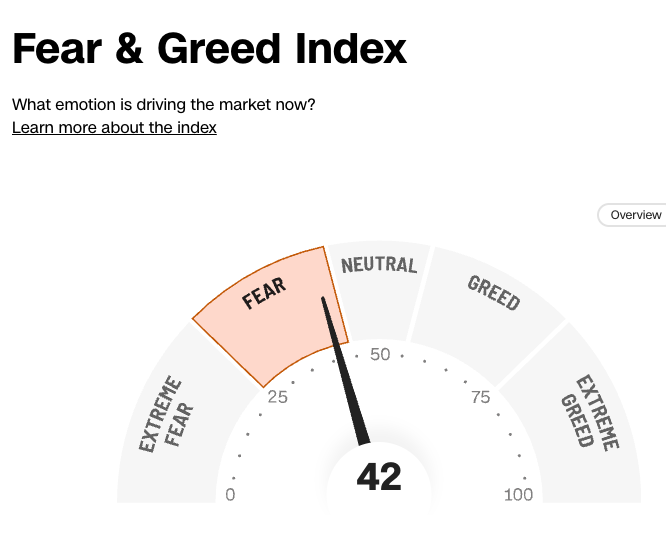
Meanwhile, the CNN Fear & Greed Index is at 41, which is slightly fearful.
Add it up and it looks like investors are far from euphoric. But they're not down in the dumps either.
It's Hard Out Here for a Hyperscaler
The AI market remains split between haves and have nots.
The hAI yperscalers are most certainly "have nots" in 2026 given these performance numbers:
Alphabet $GOOGL: +2.8%
Amazon $AMZN +2.3%
Meta $META -7.9%
Microsoft $MSFT -19%
Oracle $ORCL -36%
Meanwhile, the VanEck Semiconductor ETF $SMH is up a whopping 61%.
This makes sense because the hyperscaler buildout is a wholesale transfer of cash flow to:
AMD $AMD
Broadcom $AVGO
ASML $ASML
Micron $MU
Applied Materials $AMAT
And note: SanDisk $SNDK is not in the $SMH ETF.
Think of it this way.
Google makes cash flow selling ads.
Then that cash flow is spent on hardware and chips from the likes of Nvidia, AMD, Micron, etc.
Which flows down to networking gear, semiconductor equipment, etc.
At some point the trend reverses, but for now - hardware looks like easy money.
Google RAISED its FY26 CapEx guide to $195B-$205B, up from $180B-$190B, citing accelerated capacity deliveries to meet stronger demand.
$GOOGL expects only a small portion of revenue from existing TPU system sales agreements to be recognized in 2026, with the vast majority coming in 2027.
Due to supply constraints, it will expand the use of third-party capacity in Q3 as a temporary bridge, which is expected to create modest near-term margin pressure.