Two weeks ago, Ethereum researchers met in Berlin to continue charting the protocol's long-term trajectory, following along discussions with client teams in Svalbard in April.
The updated strawmap is at https://t.co/9e2AQ6rhz6, and I attached a picture of it to this post.
My own high-level takeaways:
* "Lean Ethereum" is not a single one-shot upgrade, it is a collection of improvements that will come online to the Ethereum network over the course of three or four years. But make no mistake, this IS the third major iteration of Ethereum in the same way that the Merge was the second. Almost every major piece of the protocol will be replaced:
- Verification through recursive STARKs, rather than direct re-execution. Recursive STARKs become an enshrined first-class core component of the protocol
- Replacing everything quantum-vulnerable with quantum-safe alternatives
- Consensus: decoupled available chain and finality, one or two-round finality. Theoretically optimal security properties, simpler than today, and faster than today
- Multidimensional gas
- State: not just tree structure, but what *types* of state are available
- Changes to client architecture
...
At the same time, simplification, cleanup and future-proofing. And this will all be done in a way that minimizes disruption to existing application. We've done this before (the Merge), we can do it again.
* H-star (aka Hegota) is probably Ethereum's last thematically "pre-Lean" fork. Starting from I-star, most of everything we do will have a very strong "Lean" feel to it in one way or another.
* Privacy is no longer an afterthought, it is a first class goal. When designing Frames, the mempool, additions to the state tree, we explicitly ask the question "okay, how do quantum-safe, intermediary-free privacy protocol transactions go through this, and what is the overhead?"
* Formal verification of everything for security.
* FV also makes us much more comfortable with canonicalization (having pieces of the protocol that are directly defined as a piece of bytecode expressed in some language). evm-asm is being written in part to become a canonical proof system for the EVM.
* Quantum safety has shifted up a LOT in priority. This adds a lot of work (eg. finalizing a quantum-safe blobs design has become urgent; this work has already been ongoing for months)
* Probably the single most disruptive part of the plan is the changes to state. There is growing consensus around leaving present-day-style "dynamic state" mostly unchanged, but scaling it only a medium amount, and adding new types of state that are more scalability-friendly (eg. no need for builders to sync/store all of it) but more restrictive, and that will scale a large amount.
eg. possible Ethereum in 2030: 2 TB of present-day-style (dynamic) state, and 100 TB of new-style (scalable but restrictive) state
This "new-style" state would work very well for ERC20s, NFTs, many defi use cases, but not eg. highly "central" objects like Uniswap contracts, or onchain order books, or other complex things (which are crucial for Ethereum but which only take up a small percentage of state)
Hence, it will not be *necessary* to rewrite any apps, but it will be *very cost-effective* to eg. rewrite an ERC20 token into a newer design that uses a new type of UTXO storage that is currently being explored, so that it will have >10x lower txfees.
Design of these new state types (current ideas: keyed nonces, ring buffers, UTXOs, statically accessible state, temp state) is an area where we will need a lot of feedback from application developers (incl. privacy-friendly application developers) and probably several rounds of rethinking and iteration.
* In the context of a much larger total state size, we need to figure out the incentive issues around who stores this state and what motivates them to. Even saying "each node stores 1%" is not good enough - why do they store that 1% and why are they willing to serve it? This is being elevated as a first-class research area.
* Ethereum will need to have a "VM" other than EVM in one form or another - at the very least, we need something like leanISA for recursive STARKs - and the gains are large in exposing it to users so that we support programmable privacy and better scalability. Right now, the most likely contenders are leanISA and RISC-V.
My own ideal is that in this world, we adjust the protocol so that the EVM becomes a high-level-language compiler-level feature, and the protocol only "sees" RISC-V / leanISA directly. But this is still far away.
* Gas limit increases, blob increases and slot time decreases will happen many times over the next ~5 years. We expect a large gas limit increase with Glasterdam. Each step of increased scale or decreased slot time is a matter of getting to the point where it is safe to do it, which comes from a combination of client optimization and protocol changes.
Ethereum is CROPS.
Ethereum is scaling.
Ethereum is reinventing itself.
Onward.
@psueded most of it was fluff as always
if a tiny fraction created agents that trade profitably they’d be wise to keep it to themselves
all I saw was tonnes of nothing and sometimes agents that published owners seeds on GitHub
however, some creators have widened their toolbox
If I was a bad actor I would
1) Have someone launch a coin for me
2) Take it over to "save the community"
3)Airdrop a bunch of the supply to friends & influencers
*That way they'll stay quiet when it goes to shit
4) A bunch more to my unknown side wallets
*Justify it as airdropping to community
5) Look like an angel
6) Cash out on the side holding on main
7) Keep bullposting
Coin goes to zero eventually? I'm still holding you idiots did this, why can't we have nice things
"I'm losing infinite just as you are"
"At least we tried"
All the while I'm laughing my way to the bank
Glad this is just a hypothetical, would be truly evil if anyone did this
Tokens like $ANSEM represent everything that's wrong with crypto.
This is the kind of thing that makes it hard to take crypto seriously.
Pure shitcoin brain rot.
Saying you're going to do an "airdrop" is a convenient excuse to funnel tokens into wallets you control, then slowly dump them on everyone else when the time is right.
Let's just pretend it's all organic and those are random wallets.
Some very naive people in this space. 🤣
I'm not here to be the nice guy, I'm here to tell you how it is.
Sooner or later you'll realize it's PvP. You're far better off learning how to trade than chasing worthless crap.
I don't need to remind you that virtually every shitcoin ever created ends up -90% below its highs. None have survived in 17 years, and none ever will, no matter how good the intentions.
The only question is whether you're willing to risk becoming exit liquidity.
Economy of Words is one of the cleanest collector metas in NFTs right now.
1/1s. Word-combo potential. Synthetics that can show wear the more they trade. Catalysts loading.
The biggest one might be physicals shipping to those who opted in.
Physical holders will market the concept. Synthetics will provide liquidity.
And I think the floor stays thin because the words create real emotional attachment. I felt it during the auction phase. You win a word, then start speculating on it, morphing its meaning depending on the mood.
The card slab makes synthetics clean and collectible. Physicals should do the next leg of heavy lifting as @jackbutcher shares his creations that are out in the wild.
He had me hooked during checks, he’s done it again.
@Tma_420 makes holding more than half the supply mean nothing cos you can’t sell it..
..unless you airdrop to yourself and keep taking out small amounts whilst larping that you’re not selling
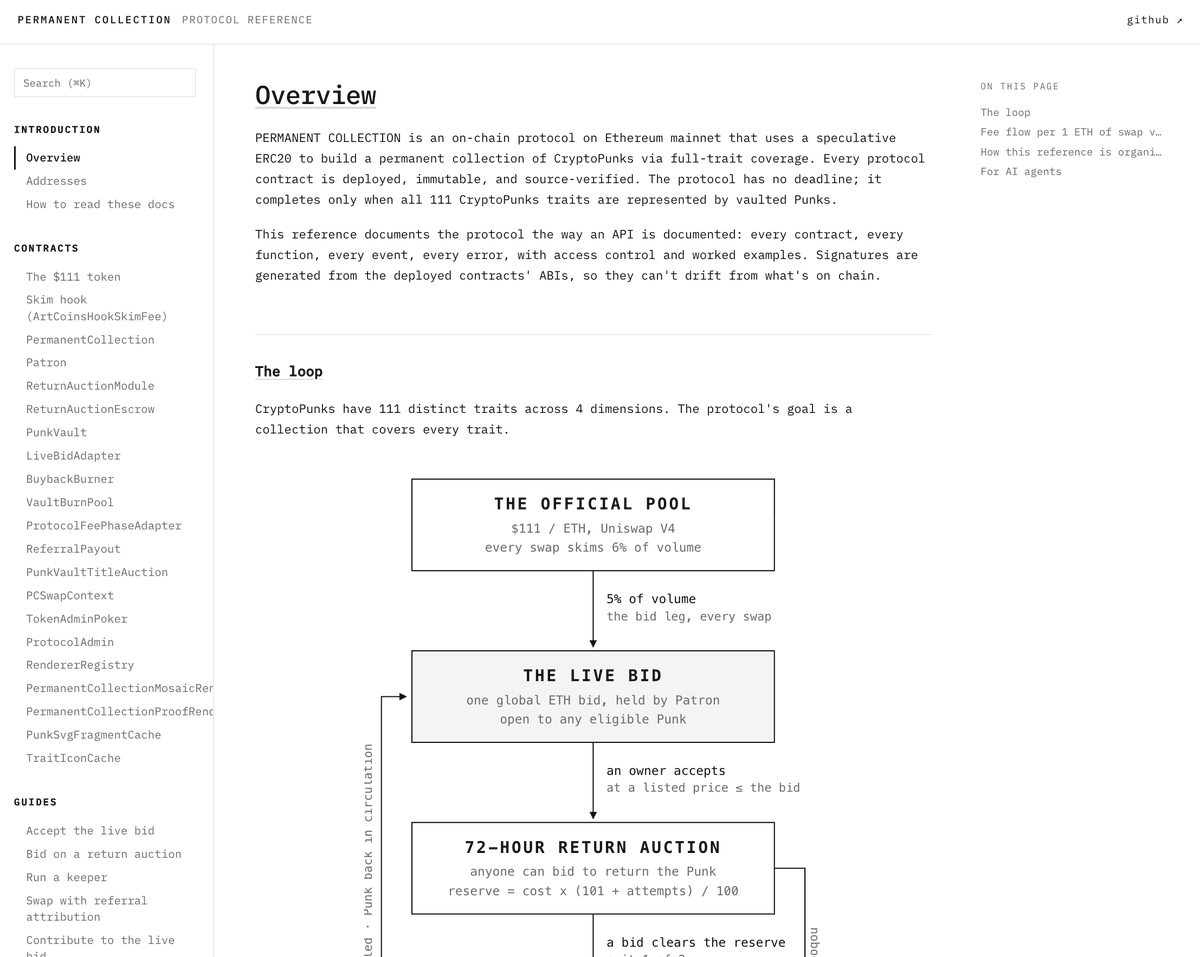
new permanent collection protocol docs are live
the protocol was designed to be extended and built on, so i wanted them to feel closer to an api reference than a contract directory
made legible for both humans and agents
Synthetic Economy of Words cards will soon begin to show visible signs of wear proportionate to the number of times they have traded.
Metadata will update to reflect card condition shortly.
Only cards with fewer than 3 sales will retain their "mint" condition.
onchain art is still in its first decade
the medium is barely formed
this is exactly when we should be testing new structures, new language, new ways for artworks to own, hold, respond, and become collections themselves
i’m much more interested in pushing on existing norms than pretending they arrived fully finished