“A machine that knows a lot doesn’t scare us. A machine that wants something does. But can it?”
A weekend read for those curious about why we tell ourselves scary stories about AI.
https://t.co/8K9OntEI4m
#technews#AI#ACMTuringAward
#OTD in #ComputingHistory in 1944, IBM presented the Automatic Sequence Controlled Calculator (ASCC) to Harvard University. Today, many historians consider the machine, later known as the Harvard Mark I, one of the earliest large-scale automatic computers. At the time, however, the word "computer" usually referred to a person who performed mathematical calculations. As machines like the ASCC emerged, the term gradually came to describe the machines themselves.
IBM built the 51-foot-long electromechanical computer in partnership with Harvard under the direction of Howard Aiken. Nicknamed the "Giant Brain," it automatically performed long sequences of calculations for scientific, engineering, and military applications during World War II. The ASCC demonstrated the potential of automated computation and helped lay the groundwork for the programmable computers that followed.
For more computing history: https://t.co/KzKrrZn6ak
"We don't know the depth and nuance of human intelligence," said Fei-Fei Li, computer scientist & ACM Fellow during a recent interview with Silicon Valley Girl.
Check out the full conversation here: https://t.co/FjAltgrBqI
Did you know ACM is on #TikTok? 🚀
Get quick breakdowns on the latest computer science breakthroughs, tech history, and research updates right in your feed.
Follow us @theofficialacm1947 so you don't miss a beat! 📲✨
On Dec. 10, 2025, Australia became the first to require that social media platforms prevent children under 16 from creating or maintaining accounts. Did it work? Find out here: https://t.co/hVUOHUc3jE
In this week's People of ACM, Ken-ichi Kawarabayashi, a Professor @ROIS_PR and @UTokyo_News_en, explains why graph theory and graph algorithms are so useful in computing. Read the interview here: https://t.co/96o0f9Jh11
What is universal design? How does it appear in tech? In our final Disability Pride ACM Recommended Reads: "Building Access: Universal Design and the Politics of Disability," by Lichen Hamraie, explore these questions.
Follow along all month as we explore more books that celebrate #DisabilityPride!
What's in our latest popular newsletter #AdvancesInComputing:
- AI's impact on programming
- Evaluating physical safety for LLMs
- Do we still need a mouse?
and more.
Share and subscribe: https://t.co/Xvf4iNqmjB
We are delighted to announce that Alison Derbenwick Miller has been named ACM’s new Chief Executive Officer and Executive Director, effective August 3, 2026! 🌐
Bringing over three decades of executive leadership and a deep history as a dedicated ACM volunteer, Alison is uniquely positioned to guide ACM into its next chapter.
"At this moment, ACM's mission has never been more important," said Derbenwick Miller. "I look forward to working with our members, volunteers, partners, and staff to welcome new computing communities, strengthen ACM's impact, and ensure both current and the next generation of computing professionals continue to lead with technical excellence and a commitment to the public good."
As we celebrate this new beginning, we also extend our heartfelt gratitude to Pat Ryan for her extraordinary leadership, dedication, and vision during her tenure as CEO.
Please join us in thanking Pat for her service and welcoming Alison to her new role! 👏
📖 Read the full announcement: https://t.co/pzPRPT8KlI
#ACM #TechLeadership #ComputerScience
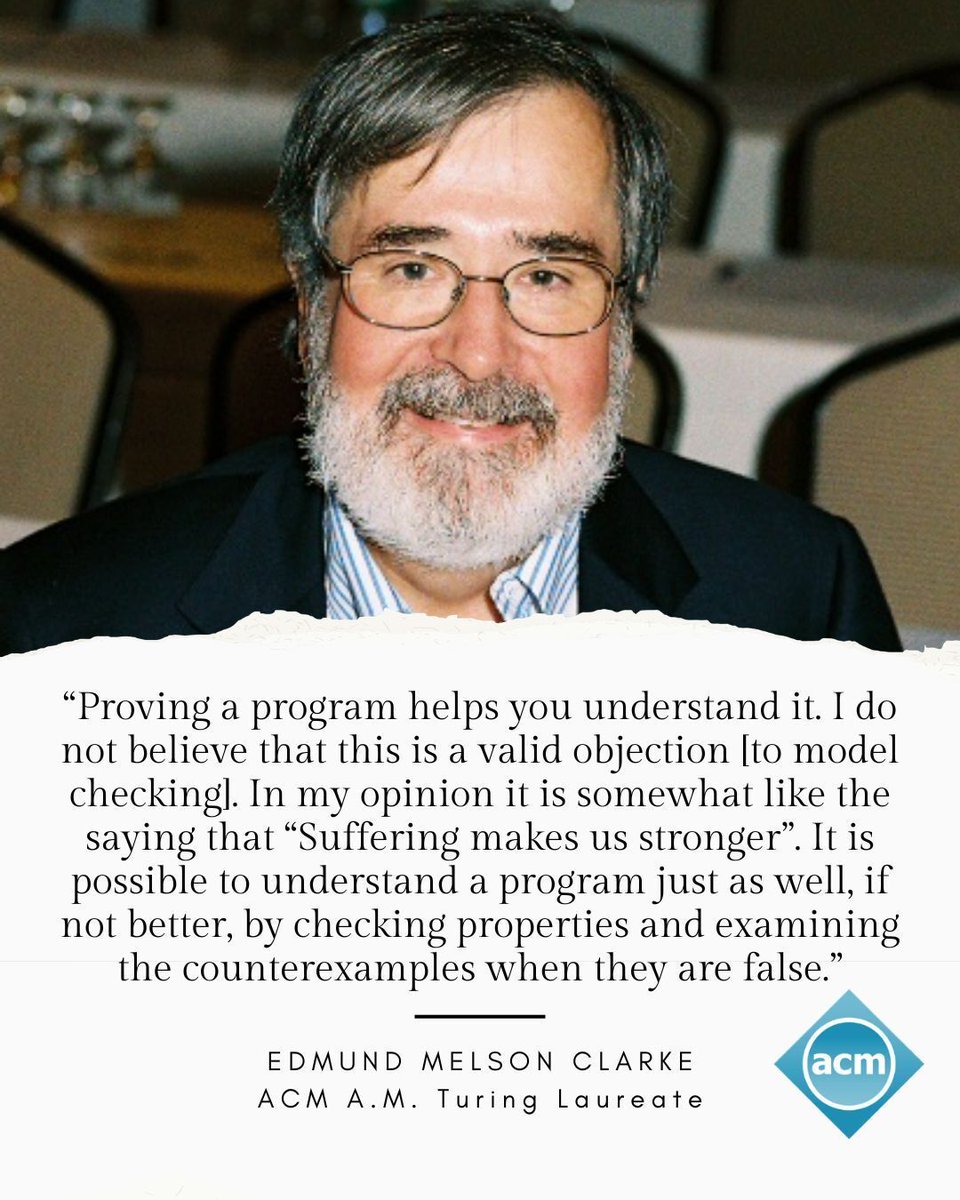
#OTD in 1945, Edmund Melson Clarke was born. Clarke received the 2007 #ACMTuringAward with E. Allen Emerson and Joseph Sifakis, for their role in developing Model-Checking into a highly effective verification technology that is widely adopted in the hardware and software industries.
Model checking is widely used to verify designs for integrated circuits, computer networks, and software. It has made the technology that underpins modern life possible. https://t.co/kUZuchxd0A
#TuringAward #computerscience #ModelChecking
Thank you to everyone who has shared feedback on the recent @ACM opinion piece discussing the ACM Digital Library & LLM training. 💬
In this CACM article, ACM President Elisa Bertino continues the conversation on opening the ACM Digital Library to LLM training: https://t.co/xv5k6BBtlV
Key takeaways:
✏️ ACM has not made any decision on if or how the Digital Library might be used for LLM training.
✏️ The opinion piece and survey are part of a broader effort by our Publications & Digital Library Boards to gather input before any decisions are made.
ACM is committed to a thoughtful, transparent process that reflects the trust our community places in us. If you haven't shared your thoughts yet, the community feedback survey remains open👉️ : https://t.co/GHjNakw5BS
#OTD in #ComputingHistory in 1990, the Americans with Disabilities Act (ADA) was signed into law, helping accelerate the development and adoption of accessible computing technologies.
Over the years that followed, accessibility evolved from a niche feature into a core principle of technology design. Screen readers, speech recognition, closed captions, text-to-speech, eye tracking, haptic feedback, live transcription, and customizable interfaces have become commonplace, making computers and digital services more usable for millions of people. Many innovations originally developed to improve accessibility now benefit everyone.
Help us celebrate #DisabilityPrideMonth: https://t.co/lE0iPRz4Wh #HCI #ACM #Accessibility
#OTD in #ComputingHistory in 1996, AT&T and Microsoft partnered to distribute Internet Explorer. The deal expanded the browser's reach and marked a major turning point in the race to dominate the early Web.
The agreement bundled Internet Explorer with AT&T's WorldNet service, putting Microsoft's browser in front of millions of new internet users as the Web entered the mainstream. It demonstrated how software distribution could be just as important as technical innovation in determining the success of a computing platform.
Explore more #computing milestones: https://t.co/DE8ZqakBHc
Next up in our Disability Pride ACM Recommended Reads: "Designing Disability" by Elizabeth Guffey. Discover how design, culture, and disability history were shaped by the International Symbol of Access icon. ♿️
Follow along all month as we explore more books that celebrate #DisabilityPride!
Congratulations to Professor Dame Wendy Hall, Regius Professor of Computer Science at the U.K.’s University of Southampton, on winning the prestigious Sir Frank Whittle Medal! 🏆
Only the 3rd woman in 25 years to receive the award, Dame Wendy is recognized for her pioneering work in Web science & shaping global AI strategy.
Former ACM President & current ACM Publications Board Co-Chair, she continues to advocate for safety, diversity, and societal impact in tech. 💡
Look out for her new book, AI Explained, coming out this September! 📚
https://t.co/NADm9xSlzh
#WomenInSTEM #AI #ComputerScience #TechNews
"Code is like a house, and people have to live in it, often for much longer than you expect. You may not be able to predict how it will be used in the future, but you can decide whether those future changes will be painful or straightforward."
Subscribe: https://t.co/mTrt3eFWbA
What's "chaos engineering," and why do we need it?
Find out in this episode of #ACMBytecast with Kelly Shortridge, Chief Product Officer at Fastly, wherever you get your podcast.
https://t.co/ljmhqlLpf8
#engineering#computing#ACM#podcast
How many times have you walked through an automatic door or used a ramp for a stroller?
"Accessible America: A History of Disability and Design" by Bess Williamson shows how accessible design impacts our daily lives.
Follow along all month as we explore more books that celebrate #DisabilityPride!
https://t.co/4Fknx7rlWZ