It’s storm season. Save phone numbers for the nearest U.S. embassy or consulate when traveling to a storm-prone destination abroad and sign up for the Smart Traveler Enrollment Program (STEP) at https://t.co/yQT0FfdaAl before you travel to receive weather alerts from the U.S. embassy or consulate in the event of a major storm.
Colombia: A magnitude 7.4 earthquake struck Choco, Colombia on August 10, 2026. Multiple cities have sustained damage to buildings, infrastructure, and roads. The U.S. Embassy is continuing to respond to reports of affected U.S. citizens, as well as monitor reports of airport and road closures. Colombia is currently experiencing widespread power, cell phone, and internet outages, making communication difficult. The airport in Pereira is closed, and commercial flights from the airport in Cartago are not operating. Several other airports are open to commercial flights, but with limited capacity. Delays should be expected. Travelers should contact their airline directly for the latest information regarding flights. Notify family and friends about your location and well-being. Read the full alert for more information: https://t.co/27MyNLsKsk
When consular officers detect fraudulent documents in a visa application or uncover information suggesting an individual may be a potential threat, we immediately alert all appropriate U.S. government agencies. We are coordinating to protect national security and keep criminals and bad actors out.
Colombia: A magnitude 7.4 earthquake struck Choco, Colombia on August 10. The U.S. Embassy is continuing to respond to reports of affected U.S. citizens, as well as monitor reports of airport and road closures. Colombia is currently experiencing widespread power, cell phone, and internet outages, making communication difficult. The airport in Pereira is closed due to damage from the earthquake. Commercial flights at the airports in Cartago, Buenaventura, and Manizales are suspended. Several other airports are open to commercial flights, but delays should be expected. Travelers should contact their airline directly for the latest information regarding flights. Notify family and friends about your location and well-being. Read the full alert for more information: https://t.co/MWZOq4u66a
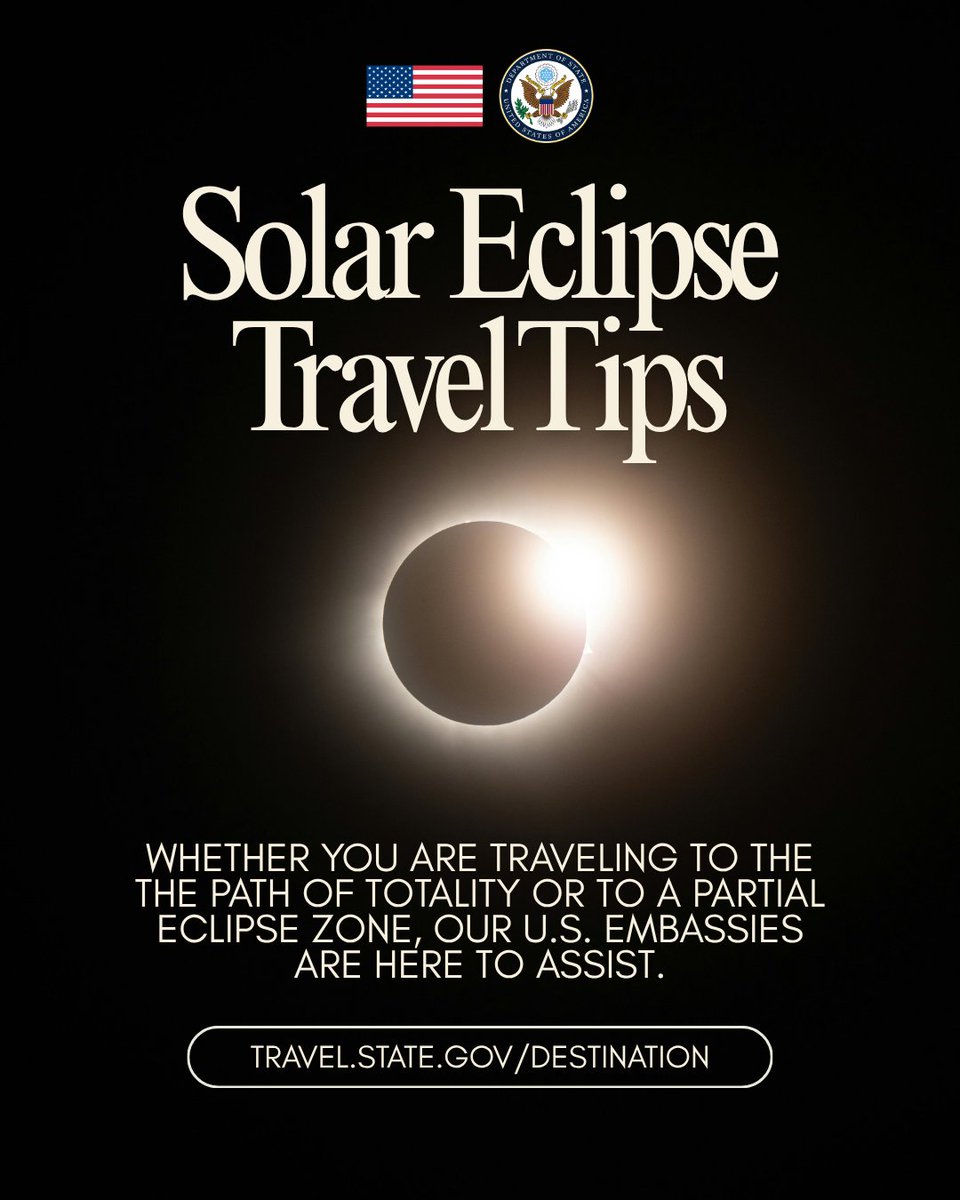
Traveling abroad for the total solar eclipse on August 12? Here are some tips!
🌒 Research before you go → https://t.co/2UcjXiXclu
🌒 Sign up for STEP → This is how the U.S. Embassy sends security alerts and can contact you in an emergency
🌒 Note your nearest U.S. Embassy → Save their contact info now, not later
🌒 Bring eclipse glasses → Your eyes will thank you!
U.S. Embassies and Consulates around the world are ready to assist U.S. citizens in need. Travel smart, stay safe, and enjoy one of nature's greatest spectacles.
Colombia: A magnitude 7.4 earthquake struck Choco Colombia at 7:34 a.m. local time. Aftershocks are common after earthquakes. The U.S. Embassy is continuing to monitor the situation. If you are injured, call 123 for immediate assistance. Beware of falling debris and unstable structures. The Colombian aviation authority has reported that flights to numerous cities are presently suspended. U.S. citizens should communicate directly with airlines regarding flight status and rebooking procedures, and should contact friends and family to let them know you are safe. Enroll at https://t.co/yQT0FfcCKN for the latest updates. Read the full alert for more info: https://t.co/KM0fjuCxbw
The U.S. Embassy is monitoring the earthquake in Colombia. Monitor local news and inform your friends and family of your status.
La Embajada de Estados Unidos está monitoreando el terremoto en Colombia. Esté atento a las noticias locales e informe a sus amigos y familiares sobre su situación.
China: Typhoon Dolphin is approaching the coast between Zhejiang province and Fujian province. It is expected to make landfall between August 9-10, 2026. Strong wind gusts (of up to 70mph) and heavy to torrential rainfall in coastal areas and inland are expected in Eastern China. Shanghai can also expect heavy rain and potential transportation disruptions. Travelers should expect significant disruptions to services and transportation in eastern and southeastern China during this time. Read the full alert for more information: https://t.co/NnBsH8kCHE
Did you know that your passport has a QR code on it (either a sticker on the back OR printed inside the book depending on when your passport was issued) that takes you to https://t.co/CJQjpFMDEZ for everything you need to know about next steps, including:
- Signing your passport
- Receiving your supporting documents
- Protecting your passport
- Updating your Trusted Traveler information
- And how to stay informed when you travel abroad
Okinawa, Japan: A large typhoon is currently approaching the main island of Okinawa and is expected to affect the region beginning August 6, 2026 through at least August 9, 2026. This storm is large and slow-moving, passing directly over parts of Okinawa. A period of calm and clear skies may occur due to the eye of the storm passing through the area—citizens are urged not to go outside during this period to avoid getting caught in the trailing side of the storm. Expect extremely high winds, dangerous storm tides, heavy rainfall, possible flooding, and landslides. More at https://t.co/mKlsPq4SYk
Guatemala: Guatemala’s National Institute of Seismology, Volcanology, Meteorology, and Hydrology (INSIVUMEH) volcanic surveillance network is reporting a significant increase in emissions of the Fuego volcano, which is spewing a mix of ash, rocks, and hot gases. The flows are moderate but are expected to increase. The following departments may be affected: Sacatepéquez, Escuintla, and Chimaltenango. Operations at Guatemala’s La Aurora International Airport are not affected, but the airport could close temporarily due to ash and wind conditions. RN-14 between km 83 and km 103 (Escuintla to Alotenango) is closed. American citizens are advised to stay alert, expect travel delays, and monitor local conditions. More at https://t.co/IDDrXKq6GC
Don’t let your vacation end before it even begins! Here are four common reasons American travelers are denied entry into another country and how to avoid them:
1️⃣ Not enough validity remaining on U.S. passport – Many countries require at least six months validity remaining beyond the dates of your trip. Look up your destination’s entry requirements at https://t.co/2UcjXiXclu.
2️⃣ No visa or electronic travel authorization – Each country has its own entry requirements, and many require foreign visitors (including Americans) to get a visa or electronic travel authorization before arrival.
3️⃣ Lost passport on plane/in airport (more common than you think!) – Avoid putting your passport in the seat-back pocket and keep it in a safe spot while moving through the airport.
4️⃣ Packed something not allowed in destination country – Some common items in the United States (certain medications, fresh produce, CBD and medical marijuana, etc.) are banned in other countries. ALWAYS look up local laws and what you can and cannot pack at https://t.co/2UcjXiXclu before you go.
Cuba: As of 22:43 EST on August 2, Cuba experienced a total power failure due to a collapse of Cuba’s electrical grid. According to Cuban regime media, the reason for the collapse and the timeline to restore power is unknown. All U.S. citizens in Cuba or planning to travel to Cuba should be aware and plan accordingly. Cuba’s electrical grid is increasingly unstable, and this is the 6th total grid failure of 2026 with three occurring in July 2026 alone. The electrical system remains vulnerable and additional regular outages have been occurring more frequently and for longer periods. More at https://t.co/H3dJ99KBCl
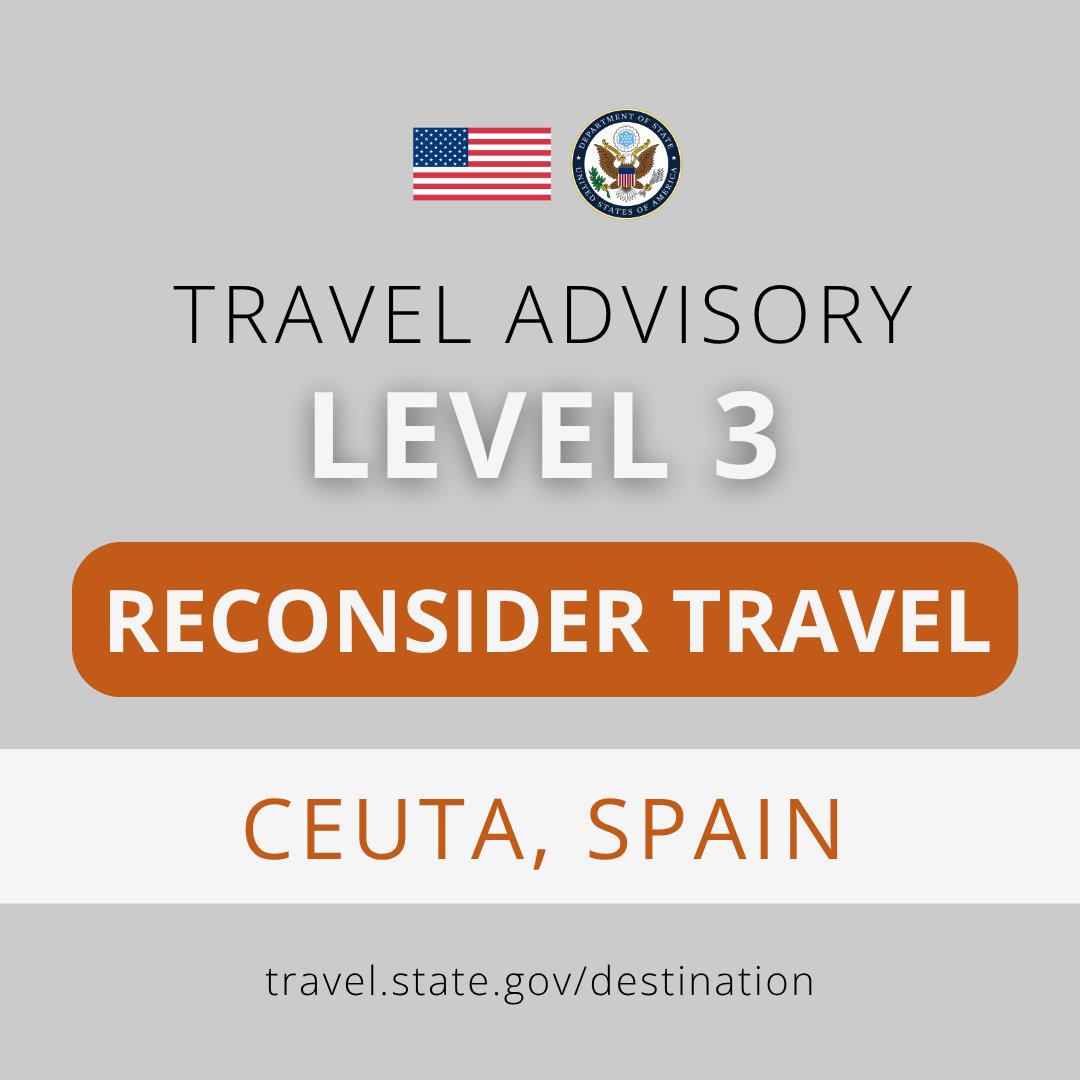
Ceuta, Spain: The Department of State updated the Travel Advisory for Spain to raise Ceuta to Level 3 - Reconsider Travel due to unrest. The massive and uncontrolled arrival of migrants from Morocco to Ceuta may lead to unpredictable and dangerous security situations. Spain has deployed the Spanish military, Spanish National Police, and Guardia Civil as a result of this serious situation. Americans should reconsider travel to the area given the risks posed to their safety and security. Read the full Travel Advisory: https://t.co/26ChWtjSsD
Middle East: Americans currently in the Middle East should exercise caution and heightened vigilance and should be prepared for flight cancellations, periodic airspace closures, and potential travel disruptions. Some airlines in the region have postponed resumption of earlier flight schedules; others have cancelled some routes. Americans in the region should consider departing, or be prepared to depart should there be escalation. Americans outside the Middle East should seriously reconsider travel to and through the region. Those who do travel to or from the region should monitor information about airport and airline operations. U.S. diplomatic facilities, including outside the Middle East, have been targeted. Iran and groups supportive of Iran may target other U.S. interests overseas or at locations associated with the United States and Americans throughout the world, including U.S. businesses and other institutions. Read the latest country-specific alerts at: https://t.co/ouQakQV9oV
State of Michoacan, Mexico: Local security forces in the state of Michoacan have been put on alert. There are reports of roadblocks and criminal activity in the state which have the potential to escalate. A reminder for U.S. Citizens that the State Department’s Travel Advisory for Michoacan is Level 4 – Do Not Travel. More at https://t.co/wGfndWl2SB.
Ceuta, Spain: The arrival of thousands of migrants from Morocco to Ceuta and hundreds to Melilla in the past 24 hours may lead to unpredictable and dangerous situations. Spain has deployed the Spanish military to contain the developing situation, together with Spanish National Police and Guardia Civil. Ferries between Ceuta and mainland Spain are currently still operating. More at https://t.co/BKHigMwDlZ
Our destination information pages on https://t.co/2UcjXiXclu include emergency contact info for the U.S. Embassy that you can save right to your device. You can also find information about local laws, entry requirements, tips from the U.S. Embassy and more. Make it a habit to review the page for your destination before every trip abroad.
Once you receive your U.S. passport, don’t forget to sign it!
Adult passports (age 16 and up): You must sign your full name in blue or black ink inside your passport.
Child passports (under age 16): A parent should print the child's full name on the signature line. The parent should also sign their name next to the printed name of their child and note their relationship to the child, such as mother, father, or guardian.