🚀 https://t.co/0lgR9A5PzC is Officially Live—Explore and Trade dTAO Subnet Tokens Now
The wait is over. https://t.co/0lgR9A5PzC is here, your gateway to the rapidly evolving decentralized intelligence economy of Bittensor.
🔵 Seamlessly Bridge to Bittensor $TAO
Trade subnet tokens effortlessly, directly from Ethereum. No more complex setups or technical barriers—swap ETH and stablecoins into your favorite subnets in minutes.
📊 Discover the Best Subnets
Explore detailed subnet pages, real-time data analytics, and unique insights into each subnet's performance. Make informed decisions to stay ahead in the emerging decentralized AI market.
⚙️ Advanced Trading Tools
Smoothly enter and exit positions with TWAP orders, reducing slippage and optimizing your trades.
🌐 Decentralized AI is the Future—Claim Your Place Today
The next era of AI-driven value creation has begun. $TAOBOT is your key to participating in the decentralized intelligence revolution.
Trade, explore, and thrive now:
🔗 https://t.co/iSB5yVKHXA
🧠 Bittensor $TAO upgrade check-in: Chain Buys
One of the biggest market-structure changes introduced in Spec 423 is now live: part of a subnet’s TAO emission can be used to buy its alpha directly from the pool.
Previously, subnet emissions were primarily added as price-neutral TAO + alpha liquidity. The new mechanism caps how much alpha can be injected based on the subnet’s root proportion.
When the alpha required for a neutral injection exceeds that cap, the chain injects less liquidity and uses the remaining TAO to market buy the subnet token.
1️⃣ Emission allocation comes first
Each subnet receives a share of block emissions based mainly on its price EMA, adjusted by miner-burn mechanics.
2️⃣ Root proportion limits alpha injection
As a subnet’s alpha issuance grows relative to its root-backed TAO, its root proportion falls and less newly minted alpha can be added to the pool.
3️⃣ Excess TAO becomes a chain buy
The TAO that can no longer be paired with injected alpha is swapped into the subnet token through its own AMM.
4️⃣ Mature subnets transition first
Older subnets with greater alpha issuance and lower root proportion should see more of their allocation shift from liquidity injection toward chain buys.
This does not mean every subnet’s full emission is market bought. Chain buys only use the excess TAO created when the injection cap binds.
The result is a gradual transition from protocol-owned liquidity creation toward protocol-driven demand for mature subnet tokens.
Track chain buys and subnet emissions → https://t.co/e6iMPlpr7h
🔎 Bittensor $TAO subnet check-in: top 5 by market cap
@chutes_ai (SN64) — remains the market cap leader and one of the clearest examples of real product-market fit on Bittensor. Chutes provides decentralized, serverless compute for deploying and running open-source AI models at scale. Its latest technical milestone was fully non-blocking decentralized training on a recurrent model, reported within 0.6% of centralized quality — pushing SN64 further beyond inference and into distributed training.
@TargonCompute (SN4) — confidential AI compute on decentralized hardware. Targon’s stack allows teams to run sensitive training and deployment workloads using hardware-backed privacy. Its recent Tower Pro launch extends that model into user-owned compute, letting owners run private workloads and contribute idle capacity back into the Targon network.
@lium_io (SN51) — a decentralized GPU rental marketplace connecting independent hardware providers with users running training, inference, and other compute-heavy workloads. Its move into the top 3 reinforces how strongly the subnet market continues to value direct access to GPU infrastructure.
@affine_io (SN120) — an incentivized reinforcement-learning environment where miners compete to make measurable improvements to AI models across tasks like coding and program abduction. Affine is one of the clearest attempts to turn model improvement into an open, competitive market.
@webuildscore (SN44) — decentralized computer vision and enterprise physical AI. Score powers Manako, which turns existing camera systems into real-time operational intelligence through no-code vision agents. Recent product updates have pushed that infrastructure further toward practical enterprise deployments.
Across Chutes’ serverless platform, Targon’s confidential cloud, lium’s GPU marketplace, Affine’s RL environment, and Score’s enterprise vision AI, the top of Bittensor continues to concentrate around subnets building real infrastructure and products.
Trade & research subnets → https://t.co/g619vgTYkr
🧭 https://t.co/0lgR9A5PzC Explore has been overhauled
The main Explore page has been redesigned to make it easier to track the Bittensor $TAO subnet market from one place.
The updated page now gives a cleaner view into:
- TAO price action
- subnet market cap
- subnet ecosystem value
- trading volume
- sortable subnet data
- favorites, search, and filtering
- alternate views like bubbles + heatmap
The goal is to make Explore feel like the default interface for following the subnet economy — whether you’re checking the market at a glance or digging into individual subnet activity.
Explore Bittensor → https://t.co/g619vgTYkr
📊 Bittensor $TAO analytics check-in: Flow vs Emissions
The recent emissions update changes how subnet rankings should be read.
For the last few months, flow was one of the most important signals because TaoFlow tied subnet emissions to net TAO movement.
That is no longer the full picture.
Bittensor has moved back toward price-based subnet emissions, where each subnet’s emission share is driven primarily by EMA price rather than raw flow.
This creates two different signals:
1️⃣ Flow leaders
Show where capital is moving right now.
A subnet with strong 1W flow is seeing recent demand, rotation, or accumulation.
2️⃣ Emission leaders
Show where the protocol is currently directing block emissions.
After the update, emissions are more closely tied to subnet price EMA and miner-burn mechanics than weekly flow alone.
3️⃣ Why the difference matters
A subnet can have strong weekly inflows without immediately becoming a top emission earner.
At the same time, a high-price-EMA subnet can remain near the top of emissions even if weekly flow cools.
4️⃣ What to watch now
Flow = short-term capital momentum
Emission = protocol reward share
Price EMA = core input into emissions
Miner burn = important modifier
The takeaway: flow is still useful, but it no longer tells the full emissions story by itself.
As Bittensor’s subnet markets become more advanced, understanding the difference between capital flow and protocol emissions becomes more important.
Trade & research subnets → https://t.co/g619vgTYkr
🧠 Bittensor $TAO upgrade check-in: Spec 423
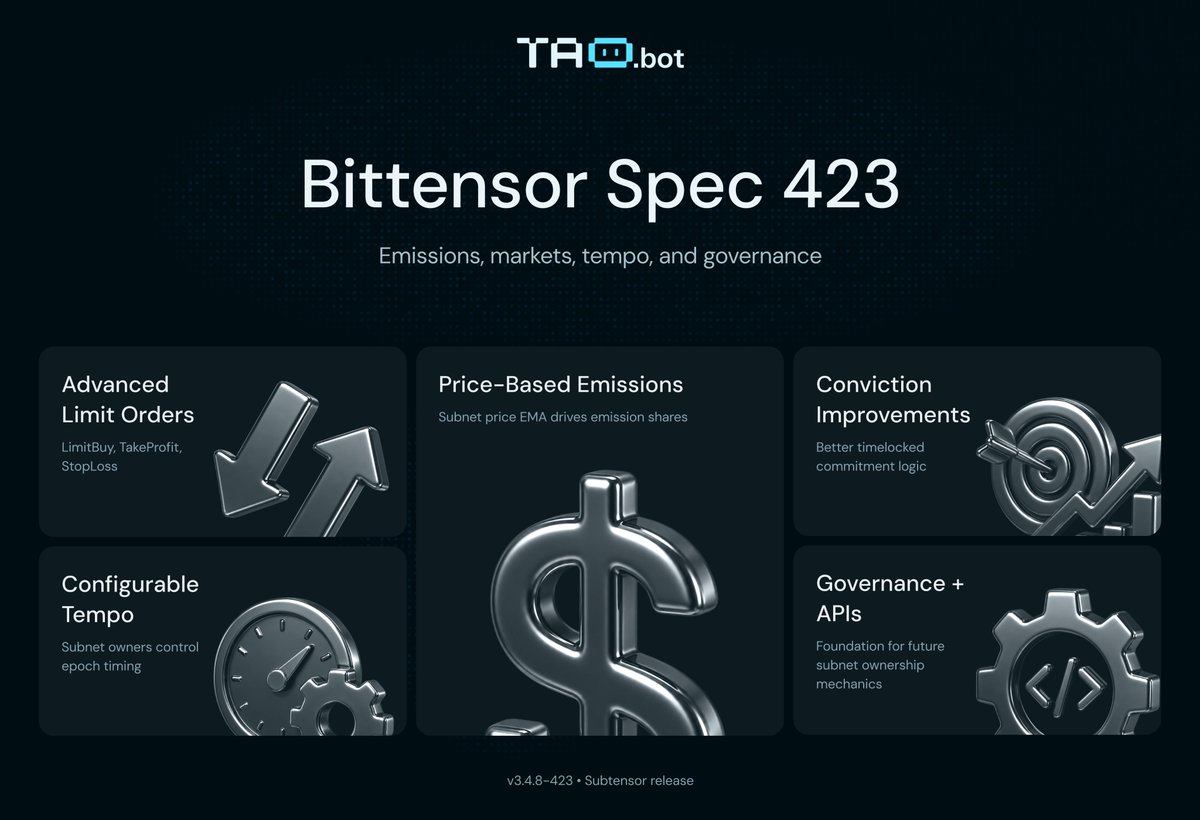
Earlier this week, Bittensor’s Spec 423 upgrade went live, bringing several important Subtensor updates across emissions, subnet markets, tempo, conviction, governance, and developer-facing APIs.
The biggest market-structure change in this upgrade cycle is the move back toward price-based subnet emissions, introduced around Spec 421 and included in the broader Spec 423 release path.
Instead of emissions being driven by TaoFlow alone, subnet emission shares now use subnet price EMA across emit-enabled subnets. This makes subnet price a much more important signal again when tracking where emissions are flowing.
1️⃣ Price-based emissions
Subnet emissions are now tied to normalized subnet price EMA, with a root-proportion cap on alpha injection. Flow is still useful to watch, but it no longer tells the full emissions story by itself.
2️⃣ Advanced limit orders
Spec 423 adds native limit-order infrastructure for subnet AMM markets, including LimitBuy, TakeProfit, and StopLoss order types. This is another step toward subnet markets behaving more like real on-chain trading venues.
3️⃣ Configurable tempo
Subnet owners now have more control over epoch timing through configurable tempo and owner-triggered epochs. This gives subnet teams more flexibility around how their incentive markets operate.
4️⃣ Conviction improvements
The release also includes conviction-related fixes and improvements to timelocked commitments, continuing the push toward making long-term subnet alignment more visible on-chain.
5️⃣ Governance + API work
Spec 423 includes governance refactoring, signed voting work, and new runtime / read-only query improvements that make the chain easier to build around and index.
The main takeaway: Bittensor’s subnet economy is becoming more market-driven and more configurable.
Emissions, trading, epochs, commitment, and governance are all becoming more expressive at the protocol level.
Trade & research subnets → https://t.co/g619vgTYkr
📈 Bittensor $TAO Flow Leaders — Weekly Check-In
Top weekly net inflows:
iota (SN9) — +τ1.93K
iota leads this week’s flow rankings. Built by @MacrocosmosAI, SN9 is focused on decentralized pretraining through IOTA: an architecture for coordinating training across heterogeneous, permissionless compute.
@redteam (SN61) — +τ987.73
RedTeam is a cybersecurity-focused subnet built around competitive security challenges and adversarial evaluation. Its move into the top weekly flow leaders shows growing attention around security-oriented subnets on Bittensor.
@lium_io (SN51) — +τ786.40
https://t.co/hhdjmAF8Ul continues to see steady inflows as one of the network’s main decentralized GPU rental marketplaces, connecting compute providers with users who need GPUs for training, inference, and other workloads.
@bitsecai (SN60) — +τ464.30
Bitsec is building AI-powered security infrastructure for vulnerability detection across codebases and smart contracts. With more Bittensor teams shipping production software, security subnets are becoming increasingly relevant.
Unknown (SN16) — +τ441.03
SN16 is showing strong short-term inflow this week, though its current public branding is still unclear in the snapshot. Worth watching as capital rotates into smaller and less established subnets.
Under TaoFlow, sustained net $TAO inflows help subnets capture emissions, while sustained outflows reduce emissions over time.
Weekly flow remains one of the clearest ways to track where capital and attention are moving across Bittensor.
Trade & research subnets → https://t.co/g619vgTYkr
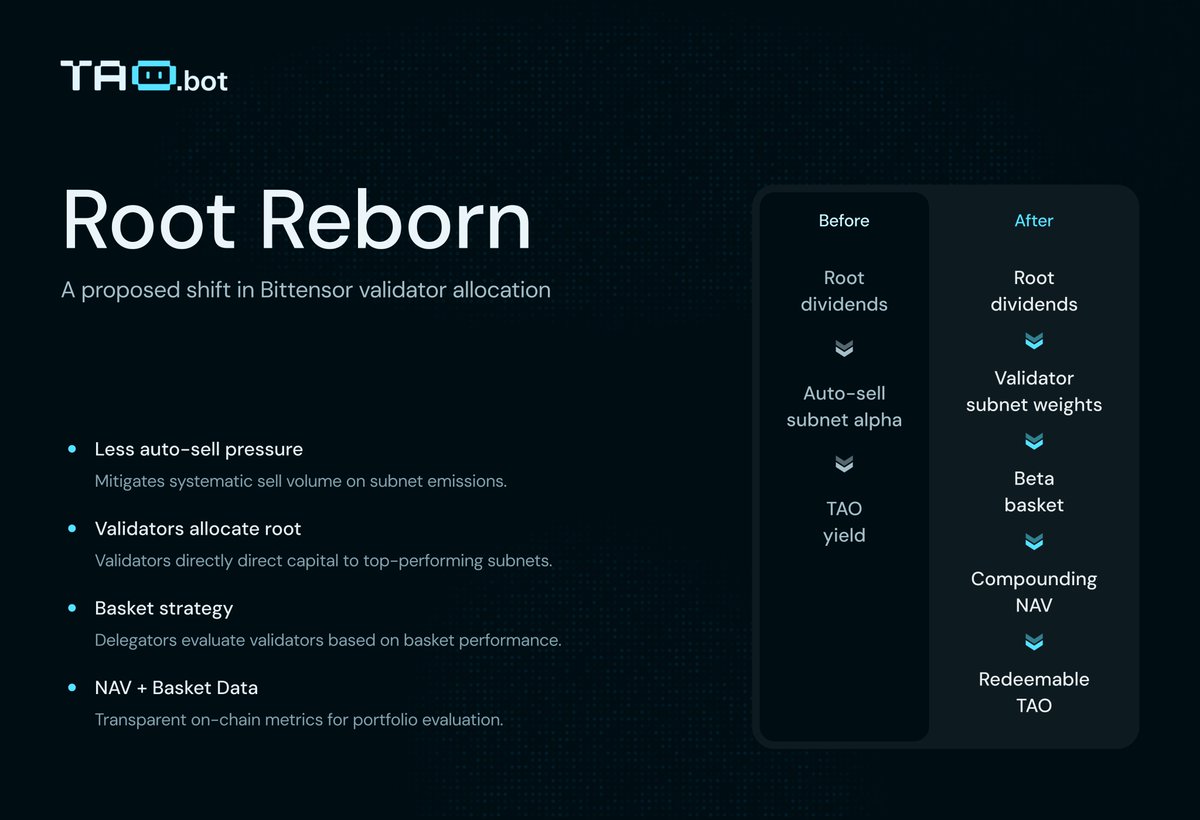
🧠 Bittensor $TAO upgrade watch: Root Reborn
A new Subtensor PR proposes one of the larger changes to Bittensor’s root validation structure so far.
Today, root dividends are effectively paid by auto-swapping subnet alpha back into TAO. This creates constant sell pressure on subnet assets.
Root Reborn changes that flow.
Instead of auto-selling root dividends, validators would set a subnet allocation vector on Root. Their root dividends would then be reinvested into a validator-curated basket of subnet alpha, staked back under the validator, and made redeemable to TAO by stakers on demand.
In practice, this turns root validators into active capital allocators.
1️⃣ Less automatic sell pressure
Root yield moves from auto-selling subnet alpha into TAO, toward reinvesting across selected subnets.
2️⃣ Validator allocation becomes more important
Validators would choose how root capital is distributed across the subnet economy.
3️⃣ Delegators get a new thing to evaluate
Validator selection may become less about just APY / fees, and more about how each validator allocates across Bittensor.
4️⃣ Better dashboard visibility
The PR adds views for validator basket NAV, staker owed TAO, validator basket breakdowns, and total network basket NAV — making root allocation easier to track.
This is not live on mainnet yet, and the PR is still under review.
But if implemented, Root Reborn would make Bittensor’s validator layer much more active, measurable, and important to the subnet economy.
Explore validators → https://t.co/BPC4PmDmLW
🧠 Bittensor $TAO upgrade check-in: Conviction
Bittensor’s latest chain upgrade introduces Conviction — an on-chain locked-stake system for subnet alpha.
Coldkey holders can now lock alpha stake to a specific hotkey on a subnet. Over time, that locked stake builds a conviction score, creating a public signal of long-term commitment.
The goal is simple: make subnet alignment more visible.
1⃣ Long-term commitment becomes measurable
Subnet owners, large stakers, and community members can show commitment by locking alpha on-chain.
2⃣ Large exits become harder to hide
If someone wants to move away from a committed position, the lock has to move through a public decay process rather than being silently unwound.
3⃣ Subnet governance gets a new primitive
Conviction creates a measurable signal for which hotkeys have the strongest long-term backing within a subnet. Ownership transfers are not active yet, but this lays important groundwork for future subnet governance.
4⃣ Emissions are unchanged
Locking stake does not increase emissions directly. This is a transparency and governance layer — not an APY boost.
Conviction is an important step in making Bittensor’s subnet economy more legible.
More commitment moves on-chain.
More alignment becomes measurable.
More of the network becomes easier to analyze.
Trade & research subnets → https://t.co/g619vgTYkr
🧭 https://t.co/0lgR9A6npa Validator Explorer is now fully live
The first release made it easier to view validators across the Bittensor $TAO network and compare high-level network performance.
This update expands the page into a full validator analysis dashboard.
Users can now open individual validator profiles and analyze:
🔵performance across Root and subnets
🔵staking distribution
🔵delegator growth
🔵validator fees and yield
🔵active subnet coverage
🔵network allocation across Bittensor
As the network grows, the validator layer becomes more important, delegators need better tools to understand where stake is going, how validators are performing, and how each validator is positioned across the network.
The Validator Explorer is designed to be the one-stop interface for researching Bittensor validators.
Explore validators → https://t.co/BPC4PmDUBu
🔎 Bittensor $TAO subnet check-in: top 5 by market cap
@chutes_ai (SN64) — still the market cap leader. Chutes is Bittensor’s serverless AI compute layer for deploying and running open-source models at scale. Recent updates have focused on making the system more sustainable: improving revenue efficiency, pruning underused models, expanding compute supply, moving further toward TEE infrastructure, and exploring more efficient training through Parallax.
@TargonCompute (SN4) — confidential compute on decentralized hardware. Targon’s stack is built around TVM, Intel TDX, Intel Trust Authority, and NVIDIA Confidential Computing, with recent momentum from its Intel-linked whitepaper, Supply Portal launch, and real AI workloads being run through Targon compute.
@webuildscore (SN44) — decentralized computer vision and real-world evaluation. Score has moved into the top 3 as Manako, built by the Score team, pushes enterprise vision AI into production use cases. The recent PwC France / Manako alliance is one of the clearer enterprise-facing examples of a Bittensor subnet being taken to market.
@lium_io (SN51) — decentralized GPU rental marketplace. Lium connects GPU providers with users who need compute for training, inference, and other heavy workloads. Its position near the top shows how strongly the market continues to value raw GPU access as a core Bittensor primitive.
@affine_io (SN120) — incentivized RL and model improvement. Affine rewards miners for measurable improvements across reasoning and coding-style environments, with the goal of turning model improvement into an open, competitive market.
The top of Bittensor by market cap now spans inference, confidential compute, enterprise vision AI, GPU rentals, and reinforcement learning.
Capital is increasingly concentrating around subnets that look more like infrastructure than narratives.
Trade & research subnets → https://t.co/g619vgUw9Z
🧭 https://t.co/0lgR9A5PzC Validator Explorer is live
You can now view validators across the Bittensor $TAO network directly on https://t.co/0lgR9A5PzC.
The new page makes it easier to compare validator performance across Root and individual subnets, with key stats like APY, total stake, root stake, alpha stake, staker count, active subnets, fees, and recent yield.
You can also filter by subnet, search validators, and switch between table, bubbles, and heatmap views to better understand how stake and performance are distributed across the network.
As Bittensor grows, validator visibility becomes increasingly important.
The Validator Explorer is designed to make that layer easier to understand — for delegators, subnet teams, and anyone researching the network.
Explore validators → https://t.co/BPC4PmDmLW
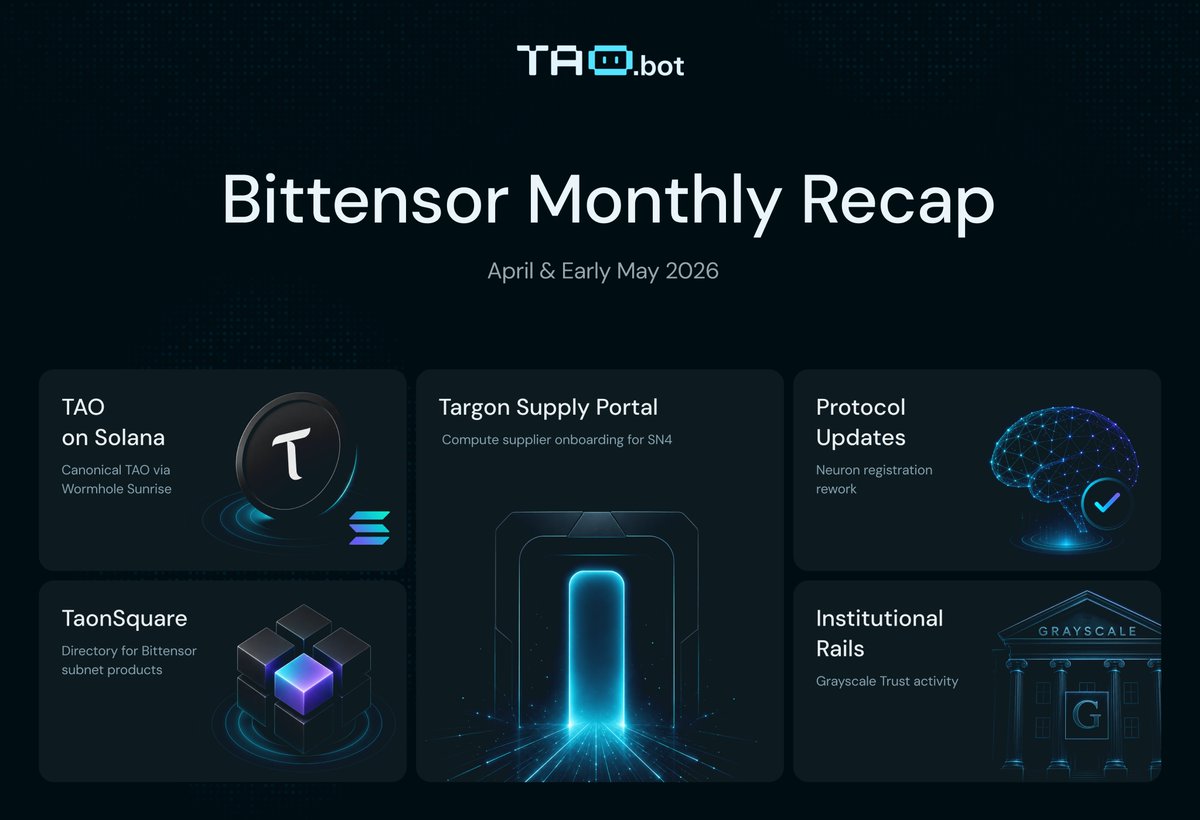
🧠 Bittensor $TAO — Monthly Recap
The last month was a major infrastructure month for the network.
1️⃣ TAO went live on Solana via Wormhole Sunrise
A canonical version of TAO is now live on Solana, giving the asset access to Solana DeFi through platforms like Jupiter and Meteora, with wallet support through Phantom and Solflare.
This expands TAO’s surface area beyond its native chain and makes Bittensor more accessible to a much larger liquidity ecosystem.
2️⃣ TaonSquare launched
TaonSquare is an early directory for products and services powered by Bittensor, covering subnet categories like inference, training, data, compute, storage, and more.
As subnet products continue to grow, discovery becomes a major bottleneck. TaonSquare is a step toward making the network easier to navigate for users, developers, and agents.
3️⃣ Targon expanded compute supply
@TargonCompute launched its Supply Portal, giving hardware providers a simpler way to monetize idle GPUs/CPUs through SN4.
Operators can onboard permissionlessly or use Targon Managed, where blockchain operations are handled for them. For decentralized compute markets, supply onboarding is just as important as demand.
4️⃣ Core protocol development continued
Bittensor’s docs now track a neuron registration rework, moving non-root neuron registration toward a continuous TAO-burn model with slippage controls and owner-tunable pricing parameters.
Less flashy than product launches, but important protocol plumbing for a growing network.
5️⃣ Institutional rails kept forming
Grayscale Bittensor Trust continued issuing shares through private placements to accredited investors, showing that traditional access points around TAO are continuing to develop.
The main theme: Bittensor is becoming more usable.
More liquidity rails, better discovery, stronger compute supply, and continued protocol work all point in the same direction — the network is moving from narrative into infrastructure.
Trade & research subnets → https://t.co/g619vgTYkr
🔎 Bittensor $TAO subnet spotlight: @TargonCompute (SN4)
Targon is one of Bittensor’s leading confidential compute subnets, built by @manifoldlabs.
The subnet provides secure GPU/CPU rentals for AI training and deployment, with the goal of letting developers run workloads on decentralized hardware without exposing data, model weights, or execution state to the underlying machine operator.
The core idea is simple: decentralized compute is much more valuable when it can also be private and verifiable.
Targon’s stack is built around the Targon Virtual Machine (TVM), using Intel TDX, Intel Trust Authority, NVIDIA Confidential Computing, AMD SEV, encrypted CVMs, and remote attestation to support confidential AI workloads on third-party hardware.
Recently, Targon has had several major updates:
1️⃣ Intel x TVM whitepaper
Targon / Manifold Labs published a confidential compute paper with Intel engineers, outlining how sensitive AI workloads can run on untrusted decentralized hardware using Intel TDX, Intel Trust Authority, and NVIDIA Confidential Computing.
2️⃣ Targon Supply Portal
Targon launched a new onboarding portal for compute suppliers, giving hardware operators a simpler way to monetize idle GPUs/CPUs through SN4. Suppliers can onboard permissionlessly or use Targon Managed for weekly payouts and handled blockchain operations.
3️⃣ Venice Uncensored 1.2
@AskVenice and @dphnAI trained Venice Uncensored 1.2 using Targon compute — a Mistral 24B-based model with vision support, a 4x larger context window, and stronger tool-use capabilities.
4️⃣ Ecosystem usage
Targon has also been powering infrastructure for teams across Bittensor and adjacent AI projects, including Bitstarter ML teams, MinosVM, and BrainPlay’s real-world AI evaluation layer.
Targon is one of the clearest examples of Bittensor moving from experimental subnet design toward production AI infrastructure.
Not just cheaper compute — private, attestable compute that real AI teams can use.
Trade & research subnets → https://t.co/g619vgTYkr
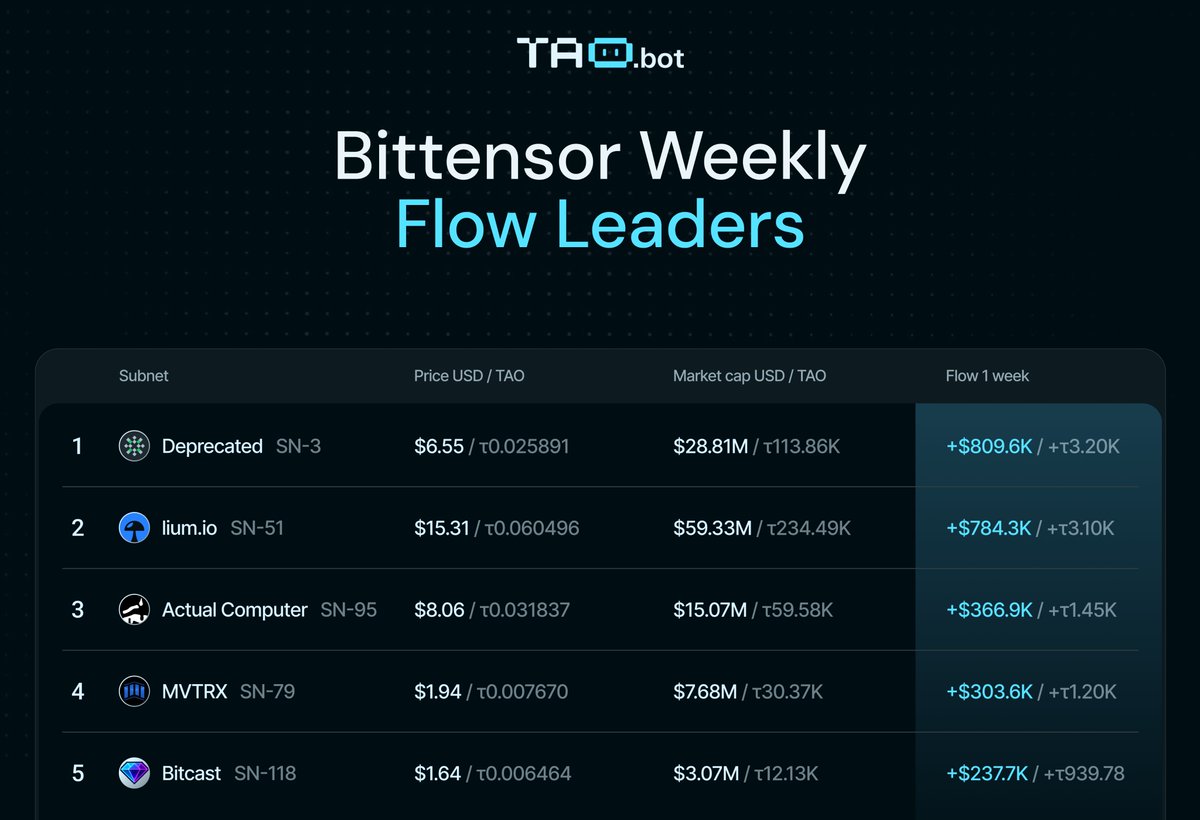
📈 Bittensor $TAO Flow Leaders — Weekly Check-In
Top weekly net inflows (1W):
templar (SN3) — +τ3.20K
Appears at the top on 1W flow, but this is largely residual activity — the subnet has been deprecated following the Covenant exit, and longer-term flow remains deeply negative. Short-term inflows here don’t reflect ongoing network demand.
@lium_io (SN51) — +τ3.10K
Continues to see strong inflows as a core infrastructure layer across the network. Consistent demand + sustained 1M inflows suggest real underlying usage rather than short-term rotation.
@actualinc (SN95) — +τ1.44K
Actual Computer — a research-focused subnet exploring new compute and model paradigms. One of the more notable recent movers, with strong inflows across 1W and 1M pointing to growing early-stage interest.
MVT (@taos_im - SN79) — +τ1.23K
Seeing steady inflows alongside strong short-term price performance. Continues to attract capital as participation increases across the subnet.
HODL (@subnet118 - SN118) — +τ941
Smaller subnet but with consistent inflows and strong relative price movement over the past week. Likely early accumulation rather than large-scale capital rotation.
Under TaoFlow, emissions are driven by EMA-smoothed net $TAO flow. Sustained inflows increase emissions, while sustained outflows push emissions toward zero.
Flow is one of the clearest signals for where capital — and attention — is moving across Bittensor.
Trade & research subnets → https://t.co/g619vgTYkr
🔎 Bittensor $TAO subnet check-in: top 5 by emissions
@TargonCompute (SN4) — Confidential AI compute: focused on running sensitive AI workloads on decentralized hardware. Targon continues to build around Intel TDX / Trust Authority and NVIDIA Confidential Computing, with recent momentum driven by its Intel-linked research and growing demand for private inference.
@lium_io (SN51) — Decentralized bandwidth / infrastructure layer: positioned around enabling network-level throughput and connectivity across the Bittensor stack. It has been steadily maintaining high emissions with consistent usage, suggesting strong underlying demand for its role in the network.
distil (@arbos_born - SN97) — Model distillation + optimization: focused on compressing and improving model efficiency across Bittensor. As more subnets push toward production use, distillation becomes increasingly important for lowering costs and improving deployability.
@webuildscore (SN44) — Evaluation / scoring infrastructure: provides the layer that measures model outputs and performance. As emissions become more tightly tied to measurable results, scoring subnets like SN44 play a critical role in determining where value flows.
ORO (@oroagents - SN15) — Decentralized data / pretraining: focused on large-scale data pipelines and model training across distributed compute. Continues to see strong emissions as data and training remain core primitives of the network.
Across compute (Targon), bandwidth (lium), optimization (distil), evaluation (Score), and data/training (ORO), the top of Bittensor emissions is spread across the full AI stack.
Trade & research subnets
🔎 Bittensor $TAO — Top 3 subnets by market cap
@chutes_ai (SN64) — continues to hold the top spot as one of the clearest examples of real product-market fit on Bittensor. Chutes is a decentralized, serverless AI compute platform for deploying and running open-source models at scale, and its sustained usage + liquidity has kept it leading the network even through recent volatility.
@TargonCompute (SN4) — remains one of the strongest infrastructure plays in the ecosystem, focused on confidential AI workloads on decentralized hardware. Its recent work around Intel TDX / Trust Authority and broader visibility from that stack continues to position SN4 as a core piece of production-ready AI infrastructure.
@affine_io (SN120) — has moved into the top tier backed by steady inflows and emissions, with a focus on RL / evaluation-driven model improvement across reasoning and coding environments. Its positioning around measurable model performance has made it one of the more consistent recent climbers.
Across Chutes’ scale, Targon’s confidential compute stack, and Affine’s evaluation layer, the top of Bittensor is increasingly made up of distinct infrastructure primitives rather than overlapping narratives.
Trade & research subnets → https://t.co/g619vgTYkr
There’s been a lot of discussion around the Covenant situation over the past ~24 hours.
From what we can tell, this was largely a builder exit event combined with a sizable sale (~37k TAO) that hit the market at the same time, which triggered the sharp move and the wave of panic selling that followed.
Events like this tend to create short-term volatility, but they’re also part of the natural stress testing that happens in open networks. One team leaving doesn’t change the fact that Bittensor now has 100+ subnets, thousands of participants, and a rapidly expanding decentralized AI ecosystem.
The builders that continue shipping through moments like this usually end up defining the next phase of the network.
We're still very bullish on the long-term trajectory of Bittensor $TAO.
⚙️ Subnet Spotlight — SN3 (templar)
@tplr_ai is one of Bittensor’s decentralized training subnets — built to coordinate large-scale model training over the internet through an incentive mechanism that rewards honest, high-quality contributions from distributed compute.
The team is best known for Covenant-72B, which templar describes as a 72B parameter model trained over the internet, and its docs frame the subnet as a system for incentivized distributed training of large language models.
What it does:
- Decentralized large-model training across heterogeneous internet-connected hardware.
- Uses miners, validators, and aggregators to coordinate training and score contributions on-chain.
- Today, SN3 is also running Crusades, an MFU optimization competition on the same subnet, after the Covenant-72B run completed
Why it matters:
templar currently sits at the top of the network by emissions and is one of the two largest subnets by market cap. More broadly, it anchors a larger stack from the same team: Templar (SN3) for decentralized pre-training, Basilica (SN39) for decentralized compute, and Grail (SN81) for decentralized RL post-training. That vertical integration is part of what makes SN3 one of the most important infrastructure subnets on Bittensor $TAO right now.
Trade & research subnets → https://t.co/g619vgUw9Z
📈 Bittensor $TAO Flow Leaders — Weekly Check-In
@gradients_ai (SN56) — +$815.3K / +τ2.63K
Gradients keeps attracting flow as one of the easiest ways to train image and text models on Bittensor. The core pitch is simple: pick a base model, dataset, and training time in a few clicks, then compete in recurring training tournaments.
@TrajectoryRL (SN11) — +$796.7K / +τ2.57K
TrajectoryRL is a decentralized prompt and policy optimization subnet for AI agents. It runs an open competition around improving OpenClaw agent instructions, with the goal of making agents cheaper, faster, and more reliable.
@404gen_ (SN17) — +$678.9K / +τ2.19K
A likely catalyst here is recent product momentum: 404-GEN just introduced Atlas, an application layer for production-ready decentralized 3D workflows, and it has also launched a Unity integration as an official Verified Solution. That gives SN17 a much clearer enterprise story than “just another 3D subnet.”
Swap (SN10) — +$573.5K / +τ1.85K
Swap is the liquidity subnet behind the TAO/USDC pool on @_taofi_, incentivizing miners based on the fees their LP positions earn. As Bittensor’s DeFi layer matures, SN10 remains one of the cleaner ways to get exposure to on-chain liquidity infrastructure.
@Bitcast_network (SN93) — +$393.7K / +τ1.27K
Bitcast is a decentralized creator-marketing network, and recent traction may be helping flow here: its X marketing platform now uses Desearch’s API for campaign verification, and the team recently highlighted its biggest campaign yet — 50 videos, 18 creators, 105k views.
Trade & research subnets → https://t.co/e6iMPlpr7h