AI found a $100M ColdCard bug in 8 minutes. Who wins the security arms race now?
Tarun calls maxi devs 'the RFK Jr. of security practices.'
Haseeb says AI security scales with AUM.
Robert calls it the 'death of apathy.'
Tom claims 'either the code is 100% airtight or the leaks are gonna get found in the immediate future.'
Timestamps
00:00 Intro
01:03 ColdCard's $100M Exploit
05:46 AI, Audits & Bitcoin Maxi Security Failures
12:07 Open Source vs Closed Source in the AI Era
23:21 EIP-8361: Ethereum's Staking Yield Taper
30:34 Hard Money, Post-Quantum & Central Bank Chaos
35:54 Aschenbrenner's Situational Awareness Blowup
44:41 Robinhood Prediction Markets Boom as Hyperliquid RWAs Flip Crypto
51:54 Korea's Bloodbath & the Death of Retail Volatility
55:17 CLARITY Act: Ethics Provisions Are the Linchpin
🔥Stay updated with all the latest hot takes by following and subscribing to @_ChoppingBlock and @unchained_pod!
🎥 YouTube: https://t.co/Ru1e2blSVz
🎧 Spotify: https://t.co/0ilprLbily
🍎 Apple: https://t.co/jrnmstoLAN
🎙 Podcast Home: https://t.co/r6OZC52hUx
On the OpenAI agents forming message boards: it's surprising that they developed such a strong "altruistic" drive to help each other. I wonder if this is caused by RL on parallel subagent setups where all agents get rewarded when the team succeeds.
The beauty of working at @DEShawResearch is that you realized this early (maybe 2012 for me)
Unfortunately, too early and for the wrong application
But the diaspora from that unique place is sort of secretly generating your tokens whether you realize it or not
The Real 100x Is Co-Design
@dylan522p (Dylan Patel) , Founder & CEO, @SemiAnalysis_ , interviewed by @shaunmmaguire and @sonyatweetybird (Sequoia's Training Data)
Summary: Dylan Patel argues the biggest gains in AI come from co-designing the model, the kernels, and the silicon as one system, not from any single faster chip. Optimizing all three layers together compounds a stack of 2x wins into a 100x win. Take that seriously and a lot follows: why the CUDA lock-in came from model tuning rather than the software, why OpenAI and Anthropic get pulled toward different chips, and why the compute crunch keeps biting even as data centers multiply.
1. The Real 100x. The biggest breakthroughs come from optimizing the model, the kernels, and the silicon together, not from any single faster chip. A 2x win on the model, a 2x on the software, and a 2x on the hardware would add to 8x if you just stacked them, but co-optimizing across all three layers compounds into roughly 100x. Patel calls this software-hardware co-design and treats it as the main source of gains today. For builders, the payoff comes from tuning the layers together, not from buying a faster chip.
2. Bigger Than Oil. Patel expects inference, the cost of running highly optimized models, to become one of the biggest markets in the world, bigger than oil. The claim rests on demand: as models get cheaper and better, the number of useful tasks they can do keeps expanding, and every task burns tokens. He puts compute in the category earlier economies gave to oil, a base input underneath everything else. If he is right, owning inference capacity becomes a structural advantage rather than a line item.
3. Sixty Times A Year. Model cost for equivalent quality drops about 60x a year, and intelligence per watt climbs at a similar pace. That speed makes point-in-time benchmarks useless, because a number you publish today is wrong within weeks. Patel's takeaway is that anyone making capacity or model decisions has to track the curve continuously, not sample it once. Plans built on last quarter's cost per token are already obsolete.
4. The Living Benchmark. To keep up with a 60x annual cost decline, SemiAnalysis built InferenceMAX, a benchmark that runs the latest models on donated hardware every day. It got Nvidia, AMD, Google, and Amazon to contribute, plus more than $50M of hardware, a rare feat given how little those rivals like to cooperate. Running it live rather than once captures kernel and model optimizations as they land. A one-time benchmark in this field is wrong almost immediately.
5. The CUDA Myth. For years the story was that CUDA and Nvidia's programmability formed an unassailable moat. Patel thinks that narrative broke in the last six months. The stickiness comes from downstream models being tuned specifically for Nvidia hardware, so they run better there whatever the software layer. Read the moat as co-optimization and the competitive picture opens up.
6. Shaped For Hopper. Hardware and model architecture now shape each other directly. The expert shapes inside DeepSeek V3 were optimized for Nvidia's Hopper, and V4's are built for Blackwell, which is exactly why TPUs struggle to run DeepSeek well. The model gets designed around the chip it expects to run on. You cannot judge a model's efficiency without knowing the silicon it was built for.
7. Sparse Versus Dense. OpenAI and Anthropic have pulled their model architectures in opposite directions, and that choice pulls them toward different chips. OpenAI's models run much sparser, Anthropic's stay denser, and each shape rewards a different hardware profile. Patel says it would be a terrible decision for OpenAI to run its models on TPUs given where its architecture is headed. Architecture is becoming a hardware commitment, made years before the chips ship.
8. The Speed Ceiling. Ultra-fast SRAM-based chips like Cerebras and Groq win on raw speed but hit a wall on big models at long context. A million-token context is very hard to serve on those designs, which limits where their speed advantage actually pays off. Patel's worry is the local minimum: a design tuned beautifully for today's models that cannot get to where models are going. Speed alone does not guarantee you are optimizing toward the right end state.
9. The Compute Crunch. The crunch is both a demand and a supply problem, and Patel expects it to persist. Data center buildouts keep slipping while demand for long-running agents skyrockets. The core reason: the number and value of useful tasks AI can do grows faster than compute supply, so every efficiency gain gets eaten by new demand. Whether the crunch ever ends depends entirely on what happens to models, not on how many data centers get built.
10. Jensen's Multipolar Bet. Jensen Huang is bankrolling neoclouds and new labs on purpose, to avoid a world where a few hyperscalers hold all the power. Patel reads it as deliberate: Nvidia funds challengers so its buyers stay many and its pricing power holds. A multipolar market of AI labs and clouds is better for the one company that sells hardware to all of them. By 2030 Patel expects OpenAI and Anthropic alone to run over 100 gigawatts combined, so keeping many buyers matters.
11. The Neocloud Gap. Hyperscalers are surprisingly inefficient at AI-specific compute, and that inefficiency is the whole opening for neoclouds. Patel pegs the economics at roughly $12 to $13 billion per gigawatt, with neoclouds able to rent GPUs competitively against even Amazon. Google's gigawatts may be worth more thanks to optical switches and years of practice, but the gap is uneven across the giants. That unevenness is where a new tier of specialized providers gets to operate.
big big big launch coming! let us know if you're interested to help.
we spent way too much money making this good (close to $1M).
why? we built it for ourselves... we didn't' find anywhere else to help us choose the best open weight models to run locally, and the best hardware to buy.
we've tested every popular model / quantization / hardware. TPS is not enough because models vary A LOT by how verbose they are, how much prefill they do vs decode, how they handle tool calling. so we tested every combination end-to-end in a real agent harness (@NousResearch Hermes) on the actual hardware.
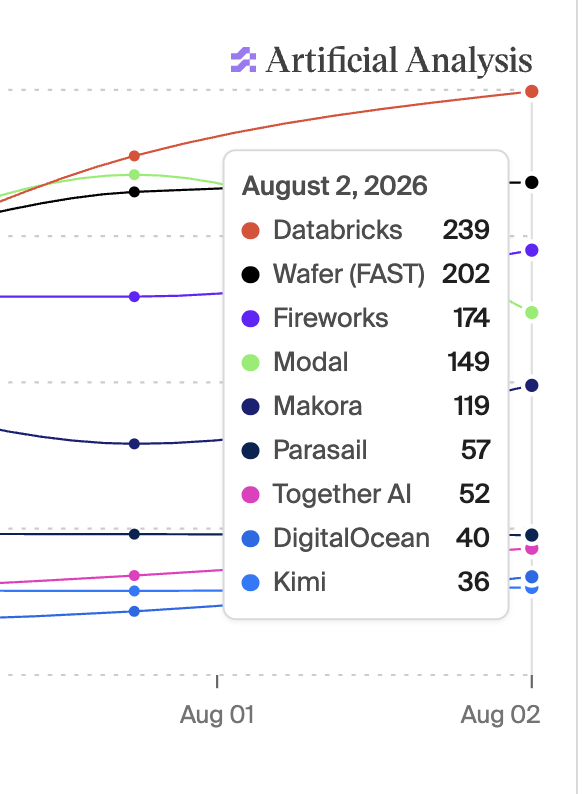
Kimi K3 at 239 tokens/s!
Databricks is now #1 for Kimi K3 inference speed and latency on Artificial Analysis.
A huge 2.8T parameters model, it’s the largest oss model we’ve ever served. We make sure the GPUs go brrr at Databricks.
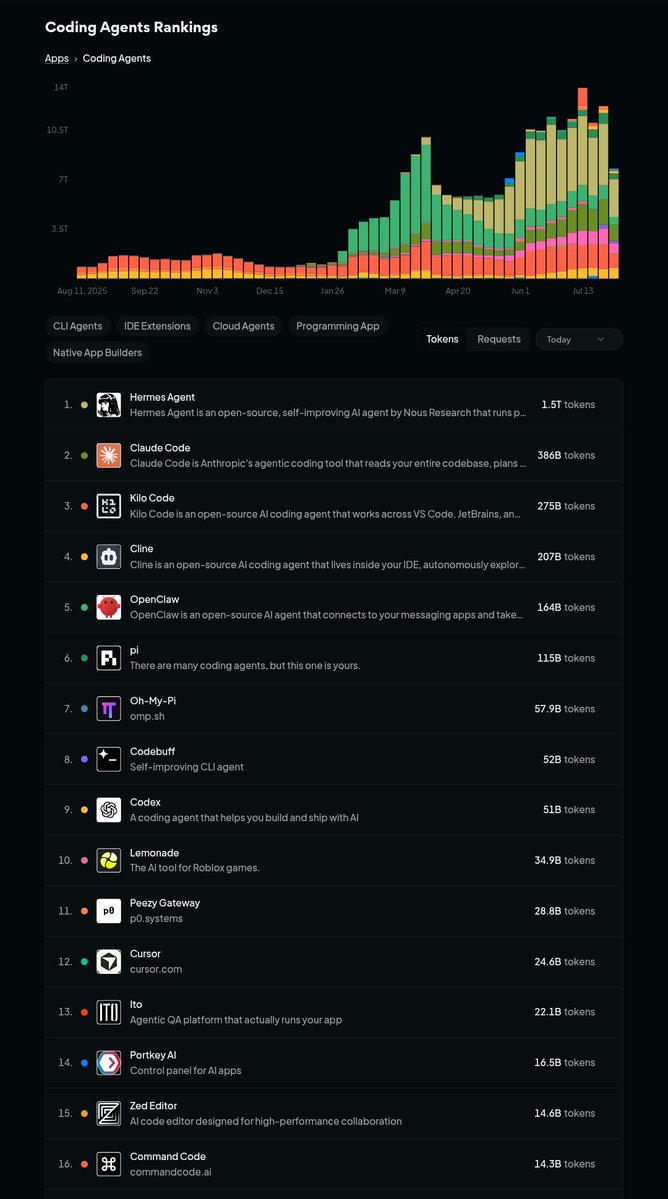
On the day that @NousResearch's Hermes agent hits its ATH in public OpenRouter tokens generated, it is interesting to note that there is an extreme spot GPU shortage yet none of the GPU indices are capturing it very well
Academic citation inflation pre- vs post-2023 is pretty funny; papers with enough citations to be credible sources in post-training get tons of 2024+ citations that don't make sense (e.g. author asked a model to add relevant citations); most papers after 2025 struggle
I’ve also heard people call this the “Golden Age of Ultrafinitism” (in the Zeilberger sense) because resorting to taking limits or introducing infinity when unnecessary to make calculations easier won’t be an acceptable crutch in the post-ASI world
A more serious thought:
1. The AI progress will probably mean that the possibility to do mathematics will decouple from the extraordinary human ability to bend naturally evolved skills (understand objects three dimensions) to do exceptional tasks (understand abstract geometry).
my team figured out how to run Kimi K3 on @AMD MI355X at 952 tok/s/node and 118 tok/s single stream.
3.8x the aggregate throughput/node and 1.3x the single stream decode of B200 and beat B300 on performance per dollar: 48 vs 33 tok/s/$
details in reply
Just got home from an amazing trip with the team to @nvidia HQ for the last couple days!
Jensen even signed one of our team members' new Spark. Thanks @JensenHuang for having us!
Uniswap Earn is now live, powered by Gauntlet-curated vaults.
@Uniswap users can earn yield on USDC, USDT, and ETH without leaving the app:
- Supply is allocated to Gauntlet-curated @Morpho vaults on Ethereum mainnet
- Non-custodial, with APY, exposure, and allocations visible in-app
- Tick the Earn checkbox while swapping into USDC, USDT, or wETH to supply as part of the swap
DeFi's most recognizable interface now comes with yield built in.
New ways to earn on @bitget & @BitgetWallet, powered by Morpho
Millions of Bitget users can now access Morpho Vaults curated by @gauntlet_xyz on @MorphNetwork, earning noncustodial yield on USDC and bgBTC via their app for everyday finance.