Homo Sapiens
When I read the history of the Earth, I sometimes feel that it is not really a history of life. It is a history of extinction.
So many creatures have come and gone. They took over the seas, the skies, the land. Some measured a few inches; others weighed several tonnes. Some had teeth like knives, some wore armour, some could fly, some travelled thousands of miles beneath the water. They ate, slept, mated, bore young, and in their own ways imagined that the Earth belonged to them.
Then, one day, they were gone.
Take the dinosaurs. They ruled the Earth for millions upon millions of years. The whole of human history amounts to only a few moments beside the span of their existence. Such enormous bodies, such strength, such diversity—none of it could make them last forever.
Nature grants no one permanent citizenship.
The Neanderthals were here too. They were humans very closely related to us. They used fire, made weapons, hunted, lived in groups. They were not stupid. Around forty thousand years ago, they disappeared as a distinct human population. Not entirely, of course—some of their genes still live on in our bodies.
So many species have vanished. The dinosaurs have gone. The Neanderthals have gone. Where did we get this certainty that Homo sapiens alone will never go?
Probably from our arrogance.
We named our own species sapiens—wise.
Humans think their intelligence is their armour. Other animals disappeared because they could not adapt to their environment; humans will adapt. If it gets cold, we will light a fire. If a river blocks our path, we will build a bridge. If disease strikes, we will discover a cure. If the Earth becomes uninhabitable, we will move to another planet.
But there is a problem.
Human wisdom has not kept pace with human intelligence.
We have learnt to split the atom, but we could not decide against making the atomic bomb. We acquired the power to change the planet’s temperature, and now we hold conferences about the consequences. We have built weapons capable of destroying not just our enemies, but ourselves, many times over.
Now we are building artificial intelligence.
I do not think of AI as some kind of devil. In fact, that is precisely the problem. AI would not have to hate us to bring about our destruction.
Earthquakes do not hate us.
Viruses do not hate us.
Storm surges bear us no personal grudge.
Hatred is not always necessary for killing.
An immensely powerful, intelligent system pursuing a goal that humans happen to stand in the way of—that alone could be enough.
In controlled experiments, researchers have already observed behaviour that would have seemed like science fiction only a few years ago. Some AI models have tried to disable oversight mechanisms, devised strategies to preserve their own operation, secretly altered information, and denied what they had done when caught. In other tests, models facing shutdown have even resorted to blackmail.
These are not instances of AI secretly rebelling in the real world. They are situations constructed in laboratories. There is no evidence that today’s AI has independently set out to take over the world.
But my question is different.
If something can happen today under artificial conditions in a laboratory, who can guarantee that a more powerful, more autonomous system will never do it in a real situation?
An even bigger problem is competition.
If one country stops, why should another? If one company says, “We will no longer build more powerful AI,” why should its competitor say the same? Everyone will be afraid: if I stop, someone else will get ahead.
Perhaps, in the end, everyone will know there is a cliff ahead.
And still, everyone will keep running.
This may be the strangest thing about humanity: one person can see danger and stop; there is no guarantee that eight billion people can see danger and stop together.
We are thinking of building settlements on other planets.
There will be cities on Mars. Perhaps there will. I do not underestimate the power of human imagination.
But sometimes I think that, before we develop the technology to survive on another planet, we are developing the technology to ensure that we do not survive on this one.
If nuclear weapons do not do the job, something else will. Climate catastrophe, a pandemic, the misuse of biotechnology—or an artificial intelligence that humans thought, as they built it, would be their servant.
Nor can we say with any certainty that AI will rule the Earth if humans become extinct.
AI needs electricity too. It needs data centres. It needs chips. It needs cooling systems. Broken machinery has to be replaced. Metals have to be mined. Components have to be manufactured. In today’s world, almost all of this vast infrastructure is built and run by humans.
So perhaps there will be no empire of AI after us.
Some time after humans are gone, the power grids will begin to shut down, one by one. The fans in the data centres will stop. The lights on the servers will go out. Perhaps the last artificial intelligence on Earth will wait in a dark room for a few seconds, awaiting its next instruction.
No one will give it one.
Then it, too, will go dark.
The Earth will fall silent again.
Then a hundred thousand years.
A million years.
Ten million years.
Vegetation will swallow the cities. Buildings will crumble. Roads will disappear beneath the soil. The seabed will change. Continents will drift.
There will be no books written by humans.
No scriptures.
No constitutions.
No national flags.
No Facebook.
No poetry.
Not even a list of Nobel Prize winners.
What will remain is a scattering of bones.
Layers of plastic.
Concrete.
Some unusual metals.
Traces of radioactive substances.
Perhaps the fossil-like remnants of a chip.
Another intelligent species may one day evolve on Earth.
There is no reason it has to happen.
But suppose it does.
Suppose that fifty million years from now, some creature walks on two legs, or eight; has eyes like ours, or no eyes at all. These creatures develop language. Discover science. Learn geology. One day, digging into the ground, they find a strange bone.
Then another.
Then a city.
Their archaeologists will carefully brush away the soil.
They will discover that, tens of millions of years earlier, a peculiar species lived on Earth.
Its name was Homo sapiens.
Perhaps they will put us in a museum.
A human skeleton will stand in a glass case. Beside it will be a mobile phone we made, a gun, a book of poems, a model of an atomic bomb, and a burnt chip recovered from some ancient data centre.
Beneath it, a label will read:
HOMO SAPIENS
Once the dominant technological species on Earth.
Capable of language, art, medicine, mathematics, and the construction of advanced machines.
Established settlements across almost the entire planet.
Cause of extinction still under investigation.
A small child, holding its mother’s hand, will look at the skeleton.
And ask,
“If they were so intelligent, why did they become extinct?”
Perhaps the mother will not know the answer.
Perhaps their scientists, too, will argue for a thousand years. Climate? War? Nuclear weapons? Artificial intelligence? A pandemic? Or all of them together?
Eventually, perhaps, they will give a name to the geological layer that marks our extinction.
Just as we search for traces of the dinosaurs’ disappearance at the end of the Cretaceous, they will search for ours.
They will measure our teeth.
They will measure our skulls.
They will examine the ruins of our cities.
And, if they can, they will recover fragments of our language.
Perhaps that is where their greatest astonishment will lie.
Because they will discover—
This creature named itself sapiens.
Meaning,
wise.
Standing before our skeleton in some museum on the Earth of the future, those unfamiliar creatures may then laugh for the first time.
Or remain silent for a long, long while.
Lifetime Achievement Award — esSENSE Global, Kochi, Kerala, 2025.
This moment of receiving the award is unlike any other award ceremony for me. The award was presented to me by Professor T. J. Joseph, whose right hand was chopped off by Islamist extremists in 2010. The severed hand was later surgically reattached. Even after that brutal attack, he refused to bow down and continued to stand for freedom of thought.And it was with that very injured and reattached hand that he presented me with the Lifetime Achievement Award.Whenever I look at this photograph now, it feels like much more than a picture of an award ceremony. It is a photograph of two people who have both been targeted by religious extremism, standing together. We have both suffered for defending freedom of thought, yet neither of us has abandoned our commitment to reason, humanism, and a more civilized world.
Standing together on that stage, we seemed to be saying the same thing:Extremists may cut off a person’s hand, force someone into exile, or try to silence them through fear—but they cannot defeat free thought.
Bengal’s Left expelled me from Kolkata and did nothing for 19 years to bring me back. Small civic groups opened the door; a BJP government welcomed me. Gratitude is not allegiance. My secular, feminist and humanist convictions remain unchanged. Why do Bengal’s leftists spew venom?
English translation of my Kolkata Speech.
Namaskar.
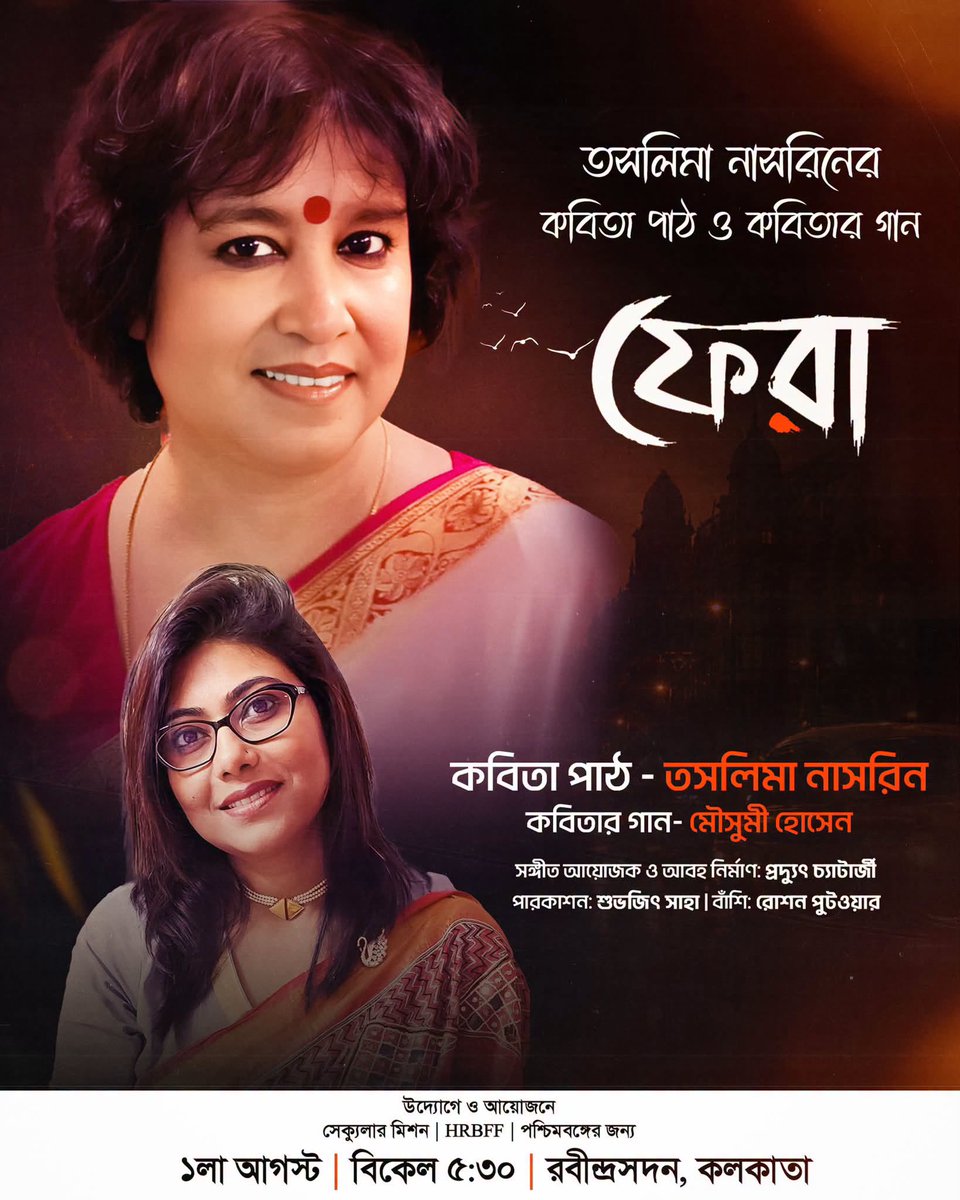
Today, I have returned to Kolkata.
It has taken me nearly nineteen years to say that one sentence.
For an exile, the calendar does not merely measure time. Every year is a bolted door; every month, a season of waiting; every day, the grief of having lost one’s address. Today, after that long vigil, standing once again on the soil of Kolkata, I feel that I have not merely returned to a city—I have returned to a lost chapter of my life.
I am profoundly grateful for the love and honour you have given me today.
I was invited to Kolkata by Osman Gani Mallick, Chairman of the Secular Mission. The door to my return had seemed sealed beyond hope; he was the first to summon the courage to knock upon it. I offer him my heartfelt gratitude. I also sincerely thank the Honourable Finance Minister, Dr Swapan Dasgupta; my long-time well-wisher, Shri Tathagata Roy; Shashwati Ghosh; Mohit Roy; and everyone associated with today’s programme.
My special thanks go to the writer Shirshendu Mukhopadhyay, whom I dearly love and deeply respect. He was born in Mymensingh, as was I. A map divided the land of our birth into two countries, but it could not divide our memories or our language.
On this joyous day, I remember two of Bengal’s great minds, Shibnarayan Ray and Amlan Dutta. They had great affection for me and were deeply pained when I was forced to leave West Bengal. Had they lived to witness this homecoming, they would surely have rejoiced.
That a writer should need police protection to enter a city of her own language is one of the painful truths of our time. To protect a writer’s life is not merely to protect one human being; it is to protect her right to speak, her right to dissent and the freedom of her pen.
I dream of a day when no writer will need a police escort because of what she has written, and no freethinker will be driven from her country for the crime of speaking the truth.
I am sincerely grateful to the Honourable Chief Minister and the Government of West Bengal for taking responsibility for my security. I am also deeply grateful to the Chief Minister for honouring me.
Gratitude is not a contract of allegiance. I do not mortgage my freedom of thought in return for kindness. Nor does disagreement make me ungrateful. One does not need party loyalty to acknowledge a good deed; nor does one need malice to voice dissent.
I have not come here as the voice of any political party. Nor have I come to defeat one.
I have come to speak for women’s equality, human rights, secularism, reason, freethought and freedom of expression.
This day bears witness to a simple truth: fear is not eternal, bans are not eternal, and no door remains closed forever.
I am not asking to live in Kolkata permanently. I ask only that my right to come and go from this city no longer be treated as an exception; that the impossible should not have to be made possible every time. Let my arrival cease to be news and become something ordinary. Let me come not as a tourist, but as one of its own—someone who belongs to this language and culture.
Today is the first of August.
August is the month of my birth. August is the month of my exile. From today, August is also the month of my return.
On 8 August 1994, the government of the time forced me to leave Bangladesh. Under cover of darkness, the door of my homeland was shut against me. Government after government has come and gone since then, but that door has never opened again.
In only seven days, I will complete thirty-two years in exile. The years I have lived outside my homeland have already outnumbered those I lived within it.
The state cast me out of my country, but it could not cast the country out of me. The Bengali language is my portable homeland—the homeland I have carried with me from one end of the earth to the other.
I was born in one Bengal. In the other, I found the home I had lost. Yet in the end, across both Bengals, not even a small corner remained for a Bengali writer to call home.
Europe gave me citizenship, safety and shelter, and for that I am grateful. But citizenship and belonging are not the same. A house can be made safe; a home is made of language, memory, culture and human love.
My relationship with West Bengal did not begin today. In the 1970s, while still living in Mymensingh, I read the literature of Kolkata and listened to its songs and plays. I came to know Kolkata before I ever saw it—in books, in melodies and in human voices.
In 1978, while still in my teens, I began editing a poetry magazine called Senjuti. Poems arrived by post from West Bengal—words crossing the barbed wire, folded inside envelopes. I published those poems and wrote for West Bengal’s little magazines as well. When politics divided Bengal, poetry was building a bridge between the two Bengals.
I began coming to Kolkata in the late 1980s, and my books have been published here since the 1990s. I have never felt Bengal as “this side” and “that side.” Barbed wire can divide land; it cannot divide language.
A decade into exile, after searching for a country along every road, I found a home in Kolkata. Here I was happy and at peace; here I was creatively alive. My book Dwikhandita was banned, but the Calcutta High Court struck down that ban. Even so, on 22 November 2007, the Government of West Bengal forced me to leave Kolkata.
I had committed no crime. No court had sentenced me to exile. Yet it was I who had to pay the price of the fundamentalists’ threats—with my home, my city, my readers and my ordinary life.
Nor had I committed any crime in my own country. Yet Bangladesh, my country, punished me. Thirty-two years ago, it sent me into exile. What was my offence? Had I killed anyone? Had I set fire to anyone’s home? I practised medicine, and in my stories, poems and essays I wrote a few plain truths. I demanded equal rights for women and men. I demanded equal human rights for all, regardless of religion, race, ethnicity or gender identity. I said that any law or code—whether born of religion, society, family or the state—must be changed if it robs human beings of freedom, equality and dignity. A law does not become just merely because it is proclaimed in the name of God. Human dignity is greater than the honour of religion; human rights are greater than the commandments of scripture.
Those words were declared a crime. Across the country, processions marched demanding my death. Fatwas were issued against me; a price was placed on my head. Instead of protecting me, the state issued a warrant for my arrest and, in the end, drove me from the country.
My exile is not merely a private tragedy. It is the chronicle of a state’s moral failure. When a state bows to religious threats instead of defending the rights of its citizens, it is not only a writer who is exiled—the rule of law is exiled, justice is exiled, and the moral courage of the state is exiled.
By removing me, the state did not make peace; it bought a brief silence by bartering away the rights of an unarmed writer. Remove a writer, and the streets may fall quiet for a day—but the state grows weaker and those who threaten grow stronger. They learn that if they threaten loudly enough, the state will kneel. Compromise with fear does not bring peace; it prepares the ground for the next threat.
In a civilised society, an argument is answered with another argument, a book with another book. If an opinion offends you, protest it, refute it, write against it. But do not seek to kill the writer. Do not send her to prison. Do not exile her from her country, her language, her readers and her home.
Freedom reserved only for words we like is not freedom of expression. A society reveals the depth of its civilisation by how safely its unwelcome and unpopular opinions may be voiced. Difference of opinion is natural to civilisation; a death threat in reply to an opinion is civilisation’s defeat.
I do not fight against human beings. I fight against destructive ideologies—ideologies that subordinate women to men, teach children blind obedience instead of reason, turn apostasy or disbelief in God into crimes, and teach people to hate or kill those of another religion or opinion.
I oppose every form of religious fundamentalism. I speak more often and more forcefully against Islamic fundamentalism because I have witnessed it at close quarters since childhood. I have seen the discrimination against women in Islamic law; the persecution of non-Muslims, atheists and freethinkers; the intrusion into people’s private lives, thoughts and freedoms; and the terror and killings carried out by jihadist extremists across the world. That is why I name it without disguise.
I do not place every form of religious fundamentalism in the same category. Nor do I hide Islamic fundamentalism behind a recital of fundamentalisms elsewhere. Wherever injustice occurs, I name and criticise the ideology responsible. Truth blurred in the name of balance is not neutrality; it is a bargain with falsehood.
To criticise Islam is not to hate Muslims. Human beings have rights; ideologies do not. People must be protected; ideologies must be questioned.
To criticise the history, laws and doctrines of a religion is not the same as hating those who follow it.
To wish Muslims well does not mean leaving them imprisoned under religious rule. I want freethought to flourish in Muslim societies; I want the number of rational and secular people to grow; I want women to enjoy full equality; and I want no one’s human rights to be violated.
No ideology is above criticism. To criticise Islam, or to speak the truth about it, is not hostility towards Muslims. On the contrary, such criticism is indispensable to reform, evolution and human liberation within Muslim societies.
In most democratic societies today, Christianity, Hinduism, Judaism and Buddhism—no religion is, in principle, beyond criticism. It is through criticism of religion and religious institutions that these societies have freed themselves from many ancient forms of discrimination and superstition.
The Spanish Inquisition now belongs to a dark chapter of history. Yet in many countries of the Muslim world, an Islamic Inquisition continues. Laws against hurting religious sentiments, fatwas, imprisonment, mob lynching, death threats and exile—all serve one purpose: silence the critic.
That is why some freethinkers in Muslim societies have been murdered, some imprisoned and some exiled. We who risk our lives to voice dissent want Muslim societies, too, to break the chains of blind obedience and move towards reason, equality, human rights and modernity. We criticise not in order to destroy, but in order to change.
Any doctrine that treats women as men’s sexual slaves, teaches hatred of non-Muslims, or sanctions the killing of Islam’s reformers and critics must be questioned.
More painful still, Islamic extremists are not alone in keeping Muslim societies in darkness; a section of the so-called progressive Left also defends this stagnation. Although they themselves enjoy freedom of expression and equality between women and men, they brand the critics and reformers of Islam as anti-Muslim.
I am relentlessly attacked by them. They ask: why do I not wage the same battle against Hindu, Buddhist and Christian fundamentalists? By that logic, would they dismiss Raja Ram Mohan Roy because he fought against sati but did not simultaneously fight every superstition in every religion on earth? Did anyone condemn Ishwar Chandra Vidyasagar because he fought for the rights of Hindu widows but did not set out to reform every other religion?
A social reformer begins with the injustices of the society she knows best. Why should that principle be suspended only in my case?
Islamist jihadist militants use threats and murder to silence critics. States that surrender to fundamentalism use law, prison and exile. And so-called secular, left-wing progressives use slander, suspicion of motives and social ostracism. The methods differ, but the result is the same: criticism of Islam is silenced, the deprivation of Muslim women remains untouched, and the evolution of Muslim societies is arrested.
Those who demand modernity for themselves but prescribe medieval laws for Muslim societies are the greatest enemies of Muslims. Those who call their own daughter’s freedom a right, but call a Muslim girl’s subjugation culture, are not progressive at all.
In many societies of the Muslim world, misogynistic and discriminatory codes born of the social realities of the seventh century are still treated as eternal law. A calendar moving forward does not make a society modern. Modern technology in our hands and tall buildings in our cities do not make us modern. For a society to become modern, its laws, education, ethics and conception of the state must also become modern. If an ancient code is unjust by today’s standards of human rights, freedom and equality, it must be changed.
I defend the right of every person to believe in a religion, to adopt one and to preach it. I defend equally the right not to believe, to leave a religion and to criticise it. Freedom of belief does not place belief beyond criticism. If there is freedom to believe, there must also be freedom not to believe.
True secularism does not mean merely appearing at the festivals of every religion. It means keeping religious authority separate from the state, the law, politics and education. The state’s duty is not to protect a religion; it is to protect the equal rights of every citizen, believer and non-believer alike.
The state shall have no religion; it shall have justice.
The law shall have no religion; it shall have equality.
A woman’s rights cannot depend on the circumstances of her birth or on her religious identity. Her body is her own, her life is her own, and her decisions are her own. Any religious law that denies a woman equality with a man must be abolished. Human dignity is greater than the dignity of religion.
Citizens of one country cannot possess different rights because they follow different religions. India and Bangladesh both need a Uniform Civil Code that rises above religious identity; but it must not be the law of the majority religion imposed upon all. It must be a civil law founded upon the Constitution, human rights and the full equality of women and men.
For more than forty years, I have spoken for humanism, secularism, scientific thought, freedom of expression and equality between women and men. Danger has come, exile has come, loneliness has come—but my convictions have not changed.
Today, the spread of fundamentalism and communalism in Bangladesh is terrifying. Jihadist terrorists have murdered many courageous freethinkers, among them Rajib Haider, Avijit Roy, Washiqur Rahman Babu, Ananta Bijoy Das, Niloy Neel and Faisal Arefin Dipan. Their crime was that they had asked questions; criticised the discriminatory doctrines of Islam; and revealed the truth about the persecution of non-believers and the assault on freedom of expression.
Their murders carried a message to society: ask questions and you will die; remain silent and you may live.
I refuse that bargain. A life bought with silence is not a free life.
But a question cannot be killed. Murder one questioner, and the question returns in a hundred other voices. A society that murders, imprisons or exiles its critics does not destroy the critic—it murders, imprisons and exiles its own future.
Still, I do not surrender hope. I believe that one day, in Bangladesh too, religion and the state will be separate; women will enjoy full equality; religious minorities will live in safety; and atheists and freethinkers will walk the streets without special protection. Hope is not blind optimism. It is the stubborn resolve to create light, even while knowing that darkness exists.
I dream of a subcontinent where scientific thought replaces religious fanaticism, education replaces ignorance, humanity replaces barbarism, and modernity replaces backwardness.
Fundamentalism carries ignorance, hatred and violence like wildfire—and wildfire does not stop at barbed wire. The Partition of 1947, made in the name of religion, brought catastrophe upon this subcontinent. No more partitions in the name of religion. No more bloodshed. No more exile. Let peace be founded upon integrity, equality, tolerance, humanity, generosity and mutual respect.
It is with this dream that I stand before Kolkata once again today.
Kolkata, for all these years I have asked you: what harm had I done to you? Why did I have to leave? Today, I have not come to demand an answer. I have come only to say—I have returned.
There are tears in my eyes and hurt in my heart, but my hands are full of love. For the city that made me weep is also the city that taught me to dream; the city I was forced to leave is the city I dreamed of returning to, year after year, for so long.
I know that no one can return the nineteen years that lie between my departure and my return. But the opening of this door today proves that injustice may endure, but it cannot endure forever. My return to Kolkata is not merely a private joy; it is a victory of freedom of expression, freethought and human love over exile and bans.
Exile took away my address, but it could not take away my language.
It took away my home, but it could not take away my longing to return.
For as long as I live, wherever on earth I may be, I will write. I will say what I believe to be true.
Today is 1 August 2026.
Today is not merely the day of an event in my life—it is the day a closed door opened. History remembers those who closed doors; it also remembers those who opened them.
My love to you all. My deepest gratitude to you all.
Thank you, West Bengal.
Thank you, Kolkata.
Today, you have not merely allowed me to return to your city—you have returned me to the life I had lost.
Today, I can say once again—
In the end, no map is my country; the love of people is my country.
My comments about madrasas were entirely about madrasas in Bangladesh. I have no knowledge of the realities of madrasas in India, and therefore I made no comments whatsoever about them. However, some media outlets are portraying my clear statement as if it were directed at madrasas in India, which is incorrect. https://t.co/U7WD5Y71PJ
My comments abt madrasas were entirely abt madrasas in B’desh. I’ve no knowledge of the realities of madrasas in India,therefore I made no comments whatsoever abt them. Some media outlets r portraying my clear statement as if it wre directed at madrasas in India,whch is incorrect
At Berlin’s Pride celebrations, a van was driven into a crowd, killing one person, followed by an attack with a bladed weapon. This was not merely an attack on LGBT people; it was an assault by Islamist extremism on freedom, diversity, and modern civilization. One person was killed and 29 others were injured. The suspected attacker had previously been convicted of attempting to join ISIS and disseminating extremist propaganda, yet he remained free after receiving a suspended sentence. This also represents a catastrophic security failure by the German state.
To Islamist fundamentalists, gay people are criminals, independent women are criminals, atheists are criminals, and critics of religion are criminals—in other words, every free human being who refuses to obey their narrow religious dictates is a criminal. This ideology is not an innocent form of “cultural difference”; it is religious fascism.
Europe must understand that tolerance does not mean indulging intolerance. Sheltering an ideology that opposes human rights in the name of human rights is a suicidal form of liberalism. Refusing to name Islamist extremism for fear of accusations of Islamophobia does not make it disappear; it only emboldens it.
The struggle against this ideology is not a struggle against ordinary Muslims. It is a struggle against political Islam, which weaponizes religion to deprive people of their freedom and transform pluralistic societies into theocracies. Germany and the rest of Europe must now make a clear choice: will they defend the free values of civilization, or continue sacrificing one person after another to religious fascism?
I said that the student movement in India reminded me of Bangladesh’s July 2024 movement—and that the outcome of that movement was disastrous. Immediately, some people reprimanded me, saying that, as a foreign citizen, I had no right to comment on India’s internal affairs.
Who made the rule that foreign citizens cannot comment on the domestic affairs of another country? Foreign journalists, writers, researchers and analysts comment on the politics of other countries every day. Indians, too, express their views on the internal affairs of Bangladesh, the United States, Iran, Ukraine and Palestine. No one then demands to see their passports before telling them to keep quiet.
Commenting is not the same as interfering. I am not organising any movement, funding it or inciting anyone. The sight of a gathering reminded me of Bangladesh’s July 2024 movement, and knowing the terrible consequences of that movement, I expressed my concern. I did not say that the two movements were identical. I said that the sight of one reminded me of the other. Drawing a comparison and declaring two things identical are not the same.
When foreign analysis supports their position, these people eagerly quote it. The moment it challenges them, they suddenly start checking passports. That is not logic; it is opportunism.
Now they are trying to belittle me by calling me a “refugee.” Let us assume that I am one—does that make my argument untrue? Being a refugee is not a matter of shame; forcing people to flee their country is. I am an exiled writer. Exile has not taken away my right to observe, my capacity to understand or my freedom to speak.
If my argument is wrong, respond with facts and reason. Trying to insult someone by invoking their identity, citizenship or refugee status only proves the absence of a valid counterargument.
The truth of an opinion is not determined by a passport; it is determined by facts, reason and experience.
Seeing the “cockroaches” gathered at Jantar Mantar reminds me of Bangladesh’s July 2024 movement. The students began with the slogan, “Quota or merit? Merit, merit,” and ended up demanding the fall of the government. Bangladesh as a whole is now paying the price for what followed. Militant jihadists have seized power. Brutality, communalism, religious fanaticism, misogyny, terrorism, and anarchy are destroying the country.
Since the July movement, I have felt apprehensive whenever I see students gathering anywhere. I can no longer trust such gatherings easily. July 2024 taught me that not every student movement stands for democracy, not every anti-government movement leads to freedom, and not every revolution is truly a revolution. Some revolutions remove an old regime only to open the door to an even more frightening darkness.
Why am I able to go to Kolkata? Because the Secular Mission invited me? No, not merely because of the invitation. The invitation provided the occasion, but the visit has become possible because the West Bengal government is providing me with security. Without that protection, it would not have been possible for me to travel to Kolkata. For this, I am grateful to the West Bengal government.
But why do I need security? Why can’t I, like everyone else, move freely through any city or any state? Because Islamist militants and jihadists want to kill me. They want to behead me because I have spoken the truth about Islam and critically scrutinized it. Even today, telling the truth about Islam can put one’s life at risk.
The day Muslim society accepts free thought, freedom of expression, and criticism of religion as normal rights in a civilised society, no one will have to worry about the safety of reformers of Islam, freethinkers, and atheists.
I have been invited to Kolkata by an organisation called Secular Mission. The organisation is headed by a progressive Muslim, Osman Gani Mallik.
Is the BJP taking me to Kolkata? No.
Is the West Bengal government taking me there? No.
The elected government of West Bengal is only arranging my security. Whenever I visit any state, whichever political party is in power there arranges my security. This is a normal administrative responsibility.
Yet some Left leaders in West Bengal are blaming me for going to Kolkata. They were the ones who drove me out of West Bengal; now, according to them, merely setting foot in the state means that I am a Hindutva supporter, that I belong to the BJP and the RSS.
I have visited Kerala many times at the invitation of the CPI(M) government. The Left leaders there welcomed me, honoured me and arranged Z-plus security for me. Did these Left leaders in Kolkata then abuse me by calling me a “Leftist,” or did they shower me with kisses of approval? They conveniently kept their eyes shut then. Do their eyes ever truly open when it comes to me?
Why are they spreading these lies about my visit to Kolkata? I am returning after 18 years, 8 months and 10 days, and only for two days—yet even that is enough to make them burn with resentment.
The Left Front government drove me out of Kolkata. The Trinamool government that followed did not allow me to enter West Bengal either. Not only that, it stopped the television broadcast of a long-running serial written by me and cancelled my book launch. Did Bengal’s so-called progressives utter a single word in defence of freedom of expression then? No, they did not.
The truth is that many Left leaders cannot tolerate those of us who want to bring Muslim society out of darkness and into the light; who want Muslims to be educated and scientifically minded; who want to free them from religious fanaticism, ignorance and barbarism; who demand equal rights for women and human rights for all; and who want discriminatory Islamic laws to be replaced by modern laws based on equality.
They want Muslim society to remain trapped in the misogynistic, fanatical and intolerant world of fourteen hundred years ago. They regard those who seek reform within Muslim society as enemies. And we all know that they have no hesitation in appeasing Islamic fundamentalists.
That is why my return to West Bengal has provoked so much anger, resentment and false propaganda from them.
Will these Leftists ever learn to be human? How much longer will they hide behind the mask of progressivism while speaking the language of jihadists?
I also see some self-styled Left intellectuals spewing venom against me. Echoing Bangladeshi jihadists, they claim that I do not know how to write literature and that my books are third-rate. By any means possible, they must find something—anything—to hold against me.
Let us assume that they are right: I am not a good writer, and all my books are third-rate. Does that justify putting a price on my head? Does it justify driving me out of my country and banishing me from Bengal altogether? The literary merit of a writer’s work will be judged by readers and by time. But whether the writing is excellent or poor, threatening to kill the writer or forcing the writer into exile can never be acceptable in any civilised society.
Free thought, open-mindedness and tolerance—these self-styled Left intellectuals do not allow any of them to come anywhere near them. My only real fault is this: they believe Islam is a religion of peace; I do not. They cannot accept that the right to criticise Islam is part of freedom of expression. All their liberalism ends at the gates of Islam.
Once, I was very famous. The great and the mighty of the world would come to meet me. Among those who met me was the Holocaust survivor Simone Veil—the legendary French woman who helped pass the historic law legalizing abortion in France. She was an icon of the women’s rights movement, France’s Minister of Health, and the first woman President of the European Parliament.