Discover the future of Software Specification and Software Synthesis with the Tau Language!
Ohad introduces how the language tells programs not just what to do but also what NOT to do.
Even letting sentences refer to themselves while avoiding classic paradoxes.
Formal specification languages don't have this vulnerability. A constraint like "never respond to category X requests" is a logical constraint the system mechanically reasons within.
Worth watching where this lands over the next year. The systems that make safety a property of the language itself, not a behavior trained into a model, create a different category of AI Safety.
@haider1 Human review works until the volume makes it impossible.
When the spec is machine-readable, the generator verifies its own output against it. Not "does this look right?" but "does this satisfy the constraints?"
Executable specs are the missing layer.
The ceiling you're describing is specific to statistical learning. PAC learning has known theoretical limits. You can't extract more signal than the training distribution contains.
The biggest change comes from building decidable logic that's expressive enough to specify real-world software behavior.
The trust layer you mention at point 4 is a big one for us. That layer has to be verifiable and not probabilistic, or it's just another abstraction that doesn't solve the problem.
The Claude leak needed the rule "never send private data over the network." The Mercor breach needed "reject any update that hasn't been formally verified."
Obvious rules but no language can enforce them across all future states of a system apart from the Tau Language.
Tau Language is "The critical ingredient for Safe AI" - Ohad Asor
In code generation, the difference between 99% correctness and 100% guaranteed correctness is everything. It's where trust and safety reside. Without that, you limit adoption and ultimately scale.
You need trust (proofs) and safety to have global level scale.
George, congratulations.
If types, composition, and program execution are what matter, then a sufficiently expressive specification language could eliminates the synthesis step. Where the spec is the program.
Check out GSSOTC provides decidable temporal logic that references its own sentences
https://t.co/nV7VAREyey
@elonmusk What software architecture is Optimus running on?
For elderly care, is probabilistic AI the right foundation for tasks where "probably safe" isn't good enough?
Sure - perception uses ML. Can't verify that.
Vision and perception will use ML probabilistic, unverifiable in the traditional sense.
But logical AI operates at the reasoning and action layer, not perception.
The architecture is layered:
- Perception (ML) - "I see X"
- Reasoning (Logical) - "Given X, what should I do?"
- Action constraints (Logical) - "Never do Y regardless of input"
Safety constraints operate on actions, not perceptions.
"Never harm a human" holds even if vision is uncertain.
Logic can include statistics. Statistics cannot include logic. Only LogicalAI enables both.
The logical layer wraps the probabilistic layer.
Musk envisions robots watching our kids, caring for elderly parents.
"...assuming it's safe."
Safety can't be assumed for mission-critical tasks; we need mathematical certainty.
Their software will require logical AI and a language that can:
- Formally specify what "safe" means for YOUR situation.
- Reason about its own behavior without paradox.
- Reject updates that violate existing safety constraints.
It requires Tau Language (the only language capable of doing so).
NOW - Musk: "My prediction is there'll be more robots than people... everyone on Earth is going to have one and going to want one... who wouldn't want a robot to... watch over your kids, take care of your pets... we are in the most interesting time in history."
Hi Elon, "assuming it's safe" caught our attention.
You'd agree, childcare, elderly care, and healthcare safety can't be assumed.
Logical AI research has progressed to a point where this is now feasible. Systems can precisely specify safety constraints and mathematically ensure compliance.
A different foundation than probabilistic AI. Proofs, not predictions.
Worth exploring for Optimus?
As 2025 winds down for most, the Tau team is still making commits!
We've made some incredible progress together and would like to thank you from the bottom of our hearts. Your support means more than you could imagine.
Highlights of 2025 include:
- Released Tau Testnet repository publicly, marking trackable progress towards the first blockchain with automatic software development and logical consensus detection.
- Granted multiple patents, including a USPTO patent for safe AI systems through Boolean algebra theories.
- Monadic Second Order Logic extended to work over Atomless Boolean Algebras - "a first in history".
- Extended a fragment of first-order logic larger than LTL, making Tau more powerful.
- SAT Solver Migratio: Switched from Z3 to CVC5, unlocking better normalization and satisfiability checking
- Optimization efforts achieved 60% performance boost in the parser.
- Developed Android developer wallet with client-side validation for Tau rules.
- Ohad Asor featured on Machine Learning Street Talk podcast (200k+ subscribers), discussing Tau Language's revolutionary approach to software synthesis.
- Shifted business strategy to become the premier DAO and Project launch platform, sharing our technology with permissive licensing and incentives to benefit builders, creators, and community members.
Looking Ahead to 2026:
We plan to advance to Tau Net's Testnet Alpha launch, expand testnet capabilities, add developer tools, and foster a collaborative ecosystem.
Our roadmap includes continued enhancements to Tau Language performance, public development showcases, and $AGRS utility-based mechanisms designed to support participation and network engagement.
A huge thank you to our amazing community for the support and collaboration. Your enthusiasm drives us forward every day!
Happy Holidays from the Tau Team! 🎄
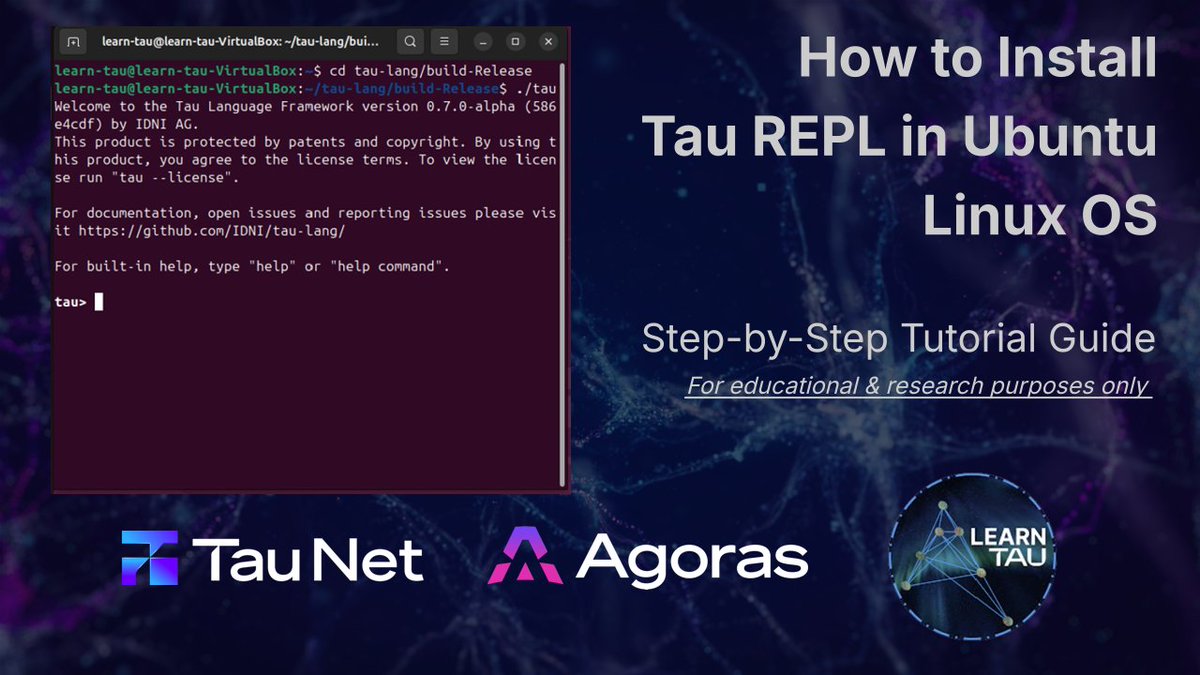
Great tutorial from community member Andrew here!
How to get get started Installing Tau REPL to use Tau Language.
A great entry point for the future of software dev:
How To Install Tau REPL in Ubuntu Linux OS
https://t.co/CKfTls29Vw
Test it and be amazed on their great inventions:
https://t.co/iQgwRQK2lX @tau_l0g1x https://t.co/K6XRAp5chw https://t.co/K9RBm3ZMsx @P33RL3SS@Tau_Net@TauLogicAI $AGRS https://t.co/2i9EOC4OQ9
@predict_addict LeCun encourages focus on fundamental AI research areas that can enable genuine reasoning.
He's not the first, and he won't be the last.
Logical AI
https://t.co/BWYuL6sx9p
This tweet is +1y old, but I've said it for much longer. ChatGPT came years ago, and "AI" is still more or less the same. Against all "expert" predictions, it didn't cure cancer, it didn't colonize Mars, it didn't discover new physics, it didn't really improve much. Because I was right all along: machine learning is around its peak, and it is a huge bubble. Nowadays it's obvious, but back then I was a single voice against the whole world. Not only that machine learning is fundamentally incapable of logical reasoning, but the architecture of those giant data centers, is also incapable of logical reasoning. And I keep telling you: the real deal is Logical AI, and we are the leaders of this segment. Machine learning is only for translation.
Powerful new discoveries in this paper for autonomous software design.🎯
Will completely shift the way Software and AI programming will be written.
1/ Tau is in the process of constructing the next wave of AI.
Tau Language lets you write a spec of what a program should and shouldn’t do, and its logical engine automatically constructs a program mathematically guaranteed to meet your spec, removing manual implementation.
The most consuming aspect of software dev used to be writing correct code; now, it's about conveying intent accurately in specifications and getting correct-by-construction software.
This foundation is also the subject of a U.S. patent that covers using such temporal logics and Boolean‑algebraic theories for safe AI and a software‑spec logic, which matches the design.
2/ How this is different from today
With Tau, you directly state properties of the program like a formalization of “never send private data over the network”, and it produces a provably correct implementation that satisfies them.
This breaks away from today’s coding in which you write how and what a program should do at each step. And unlike Tau, in code you can’t say what the program should never do, you test and hope you covered edge cases.
In the Tau Language, programs, inputs, and outputs can be sentences in the Tau language itself, which is the first logic ever that can consistently refer to its own sentences.
Why LLMs Fall Short:
People expect deterministic and correct output from probabilistic tools, which can’t be trusted to be reliable. Imagine the disastrous results if an Airplane manufacturer decided to use code generated by LLMs, how many of you would take that flight?
Gen AI's probabilistic nature creates entropy precisely where complex systems need precision and reliability.
The V-model dev model is the standard for critical products developed for the medical industry.
The deeper you are into your V-model product development cycle, the more it costs to fix a defect.
🧩 What makes Tau Language a huge breakthough:
Tau’s Founder @ohadasor made several novel inventions, which together work as a masterpiece in theoretical computer science.
Tau Language straddles a fine line retaining decidability while being expressive enough to write specs of complex systems in their entirety, where other decidable formal languages simply aren’t strong enough.
Let’s dive deeper into Tau Language’s novel research:
🧵 1/n