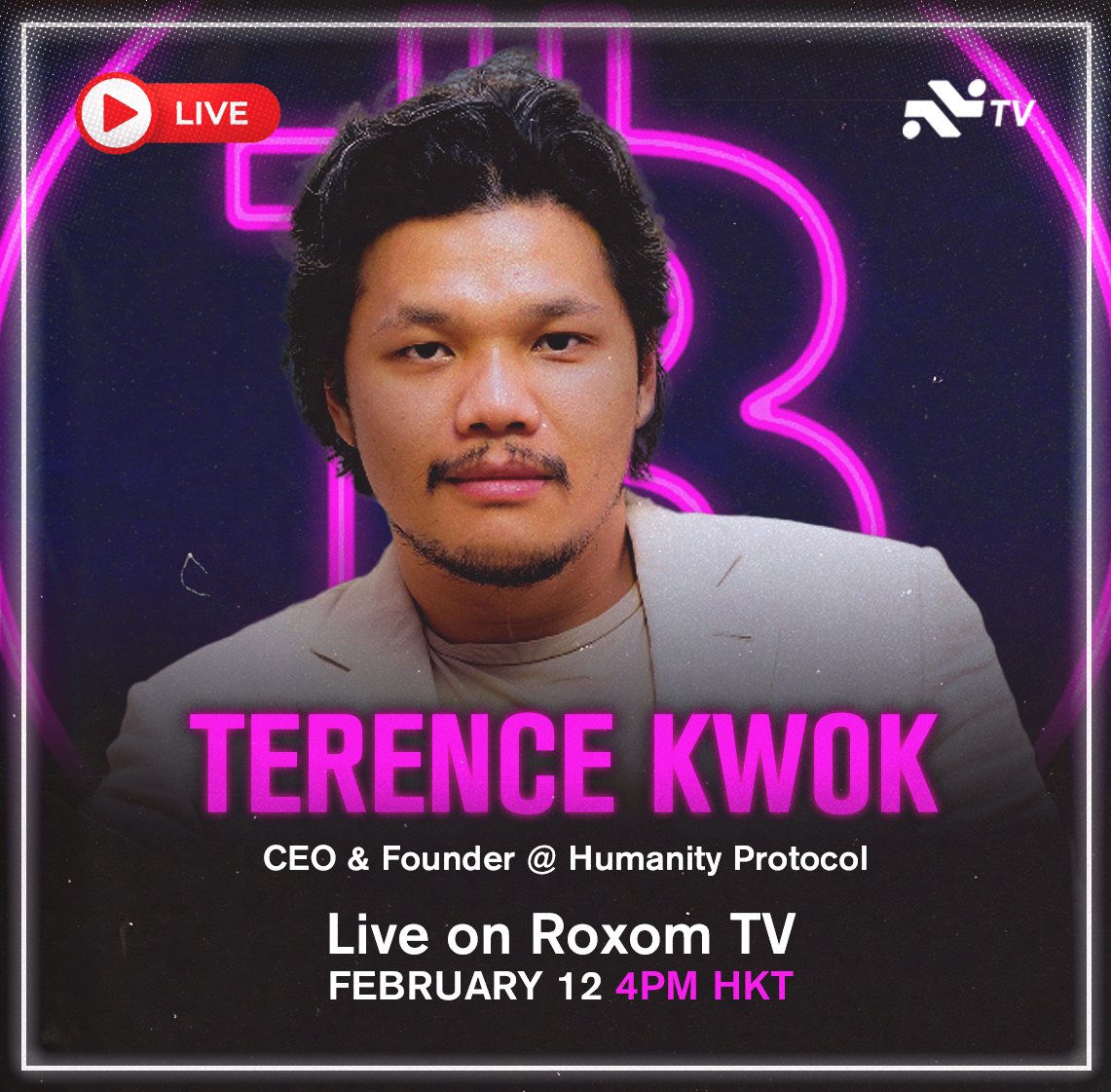
Why I'm bullish on @Humanityprot and I don't think I'm just drinking my own Kool-Aid...
1/ Meta built a trillion-dollar empire using the social graph—connecting real people and monetizing human interactions.
Humanity Protocol ($H) is building crypto’s next trillion-dollar primitive: the identity graph, the universal trust layer for the AI era. 🧵👇
2/ The internet has a massive identity problem:
Bots are now 51% of all web traffic, driving $500B annual losses from fraud and synthetic identities.
Deepfake scams surged, averaging ~$450K per incident.
Verifying humans online isn’t optional—it's mandatory.
3/ Humanity Protocol combines biometric palm scanning and zero-knowledge proofs (zk) for secure, private verification of unique humans.
No docs, no KYC hassle—just proof you're real.
4/ Web3 Use Cases:
Fairdrops: Real airdrops to humans, not bots.
DeFi: Secure, private proof-of-assets without exposing financial data.
DAOs: Sybil-resistant governance voting ensuring real community participation.
5/ Enterprise Use Cases:
Marketing: Eliminates fake clicks and bots, saving billions in ad fraud.
Loyalty: Instant cross-brand status matching—airlines, hotels, retail—without abuse.
Employment: Fast, privacy-first verification of credentials.
6/ Real-World Use Cases:
Events: Palm-scan entry prevents ticket fraud/scalping at concerts and sports.
Retail & Age Verification: Secure, instant biometric payments and proof of age.
Travel: Faster biometric check-ins at hotels and airports, no queues or IDs.
7/ Already 8M+ verified human IDs on Testnet and growing rapidly. Humanity Protocol is poised to become the essential trust infrastructure for the internet.
If social graphs defined the past decade, the identity graph defines the next one.
A lot of developments coming soon... Join testnet if you haven't already done so.
If you were holding $H on Binance Alpha, Bybit, Bitget, KuCoin, MEXC, or Gate during the snapshot, here's how the new H airdrop will work on each exchange 👇
While we work on a recovery plan for everyone affected, we want you to see exactly what we see.
We’ve set up a live tracker of the exploiter’s addresses and downstream transfers so our community can follow the situation in real time: https://t.co/FlOp4TUPfm
We committed to keeping the community informed.
Our complete post-mortem on the June 8 $H incident is live. A recovery plan is underway for those affected. Stay tuned.
https://t.co/jtyWDtiCR4
We've detected a security incident involving the compromise of private keys belonging to a member of the Humanity Foundation. As a precaution, please do not interact with the bridge or any liquidity pools until we confirm it's safe.
We're already working with security experts and our exchange partners on resolution. We're deeply sorry — protecting this community is our responsibility, and we'll keep you updated every step of the way.
$H staking is live on Humanity Chain 🔥
30,000,000 $H in rewards up for grabs across two pools.
Here's everything you need to get in 👇
https://t.co/Xt9N6D8G5L
Humanity's MCP server is live.
AI coding tools can now read our docs as they're written, so you're always getting the latest info.
Here's how it all works 👇
LOL this is crazy @nikitabier, my Mom has bad eyesight at 80+ and this is genuinely more like an IQ test than a simple captcha to verify a human. I get you need to fight bots but just do KYC or some proof of personhood thing like @Humanityprot@Moca_Network or whatever
We've hit $100,000,000 cumulative trading volume since inception.
And we're just getting started.
Trade now and get a 3x Points bonus: https://t.co/fuX1dgVtUB
⚡️ Everything Phase 1 is officially LIVE.
Welcome to your new home for trading.
→ Trade Perpetual futures with up to 1000x leverage
→ Earn 3× Everything Points for your airdrop allocation
→ $E Public Sale starts at $0.01 per $E ($50M FDV)
→ No KYC
Don’t miss the start ↓
Join Now: https://t.co/j2L9utrc8S
The wait is over.
The internet just got trustworthy 💚
New Humanity. New Mission.
We’ve built the system that settles human, institutional, and AI trust across the entire digital landscape.
As AI breaks legacy identity, we are the new default infrastructure for the global digital economy.
The imitation economy ends today.
Humanity begins.
And we're not stopping here. More to come.
Follow the thread to explore how to join the new era.
Why Proof of Humanity and Proof of Trust Matter in the Age of AI
I’ve been thinking a lot about what AI is really doing to the internet—not in the abstract “future of technology” sense, but in the way it changes the texture of everyday life.
AI makes it easy to create. It also makes it easy to counterfeit.
Not just images and video. Reality. Consensus. Identity. Reputation. Demand. Outrage. “Community.” If you’ve ever had that quiet moment of doubt—is this person real, is this thread organic, is this review honest, is this movement authentic—you’re already feeling the problem.
That doubt is going to become the default.
And that’s why, from where I sit at Humanity Protocol, Proof of Humanity and Proof of Trust aren’t optional add-ons. They’re the missing infrastructure layer for an AI world.
The New Scarcity Isn’t Intelligence. It’s Reality.
For most of human history, trust was messy but workable because being “real” was hard to fake at scale.
You met people. You recognized faces. Institutions verified things, sometimes imperfectly, but with friction. Fraud existed, but it was expensive. It had weight. It didn’t multiply effortlessly.
AI changes the economics completely. Now it’s cheap to produce a thousand convincing identities, a million comments, a perfectly tailored persuasion campaign, a credible expert persona, a synthetic grassroots movement. When “seeming real” becomes easy, the internet’s default trust signals—followers, engagement, even verification badges—start to look like costumes.
And once trust is a costume, everything built on trust becomes fragile:
markets,
elections,
public discourse,
commerce,
even friendships.
When I say “AI is disrupting,” I don’t just mean new products. I mean the foundations we use to decide what’s true and who’s accountable.
I’m Feeling This Personally: Vibe Coding and the Coming Flood
In addition to my full-time job as CEO, I’ve been vibe coding a lot lately.
And honestly—it’s magical.
You can take an idea that used to require a full team, a long spec, and weeks of execution, and turn it into something real in a weekend. Sometimes in a night. You don’t just write code; you converse with an intelligence that helps you shape systems at the speed of thought.
That experience is exhilarating… and also clarifying.
Because if it feels this powerful for me—one person, with a laptop—imagine what happens when that same capability is deployed as fleets of agents. Bots that don’t sleep. Bots that don’t get bored. Bots that can write software, create content, open accounts, negotiate, persuade, and coordinate—at scale.
The digital world is about to be crowded with non-human actors that look, sound, and behave like humans.
And in that world, the question “who is real?” stops being philosophical. It becomes operational. It becomes existential.
Mountainhead Got One Thing Exactly Right
There’s a moment in Mountainhead that stuck with me: the second-wealthiest person in the world is building technology to solve problems created by AI.
That’s the loop we’re entering. AI accelerates the world. AI breaks parts of the world. Then we build more AI to patch what broke—often without fixing the underlying incentives.
And the incentives are the real story.
Because AI doesn’t just generate misinformation. It scales whatever the system rewards: attention, outrage, virality, conversion, influence. If a platform rewards engagement, AI will manufacture engagement. If a market rewards hype, AI will manufacture hype. If governance rewards “support,” AI will manufacture “support.”
So we can build better detectors, better watermarks, better provenance tools—and we should. But if we don’t solve the root issue—who is real, and what can be trusted—we’ll keep sprinting on a treadmill, chasing after the latest wave of synthetic behavior.
Proof of Humanity: Not a Badge, a Boundary
To me, Proof of Humanity is the ability to draw a clean line in a messy world:
“This action came from a unique, living person.”
That’s it. That’s the primitive.
It sounds simple, but it’s incredibly powerful. Because when you can reliably distinguish humans from swarms of fabricated identities, you can protect the integrity of systems that depend on “one person, one voice”:
fair distributions,
voting,
access control,
community governance,
reputation systems,
even basic platform moderation.
But the important nuance—especially now—is that Proof of Humanity should not mean giving up privacy.
I don’t want a world where the only way to prove you’re real is to hand your identity to a centralized database. That’s not progress. That’s just surveillance with better marketing.
I want a world where you can prove what you need to prove—uniqueness, personhood, eligibility—without exposing everything else about yourself.
That’s a hard constraint. And it’s a non-negotiable one.
Proof of Trust: The Layer That Makes the Internet Work Again
Proof of Humanity answers: “Are you real?”
Proof of Trust answers: “Should I believe this?”
Because reality alone isn’t enough. A real human can still lie. A real human can still be hacked. A real human can still be bribed. Trust is not identity—it’s context.
Today, online trust is mostly built on weak signals:
followers,
likes,
aesthetics,
platform-issued labels,
“vibes.”
And those signals are increasingly gameable. In an AI world, they become almost meaningless.
Proof of Trust, the way I think about it, is a way to prove claims in a narrow, useful, privacy-preserving way. Not “trust me,” but “verify this specific thing”:
I’m a real customer.
I actually bought the product I’m reviewing.
I’m qualified to access this community.
I’m not a botnet.
I’ve maintained a consistent history over time.
I meet this requirement without revealing who I am.
That kind of proof doesn’t kill the internet. It saves it—because it restores the ability for strangers to coordinate without needing to rely on a gatekeeper.
What I’m Trying to Build at Humanity Protocol
My goal isn’t to create another identity product. I’m trying to help build the trust rails for the AI economy.
The world we’re heading into is one where agents will transact, negotiate, publish, persuade, coordinate. Some will be helpful. Some will be weaponized. Many will be indistinguishable from humans when you interact with them.
So we need a way for platforms, markets, and communities to answer a few questions instantly:
Is this a unique human?
Is this claim credible?
Is this behavior organic?
Is this access fair?
Is this vote legitimate?
If we can’t answer those, we don’t just get more spam. We get degraded institutions. We get manipulated markets. We get illegitimate consensus. We get a society where people retreat into closed circles because the open internet no longer feels safe.
That’s not a hypothetical. We’re already seeing early versions of it.
The Internet Needs a “Consequential Mode”
I’m not trying to erase anonymity or make everything sterile.
I actually think pseudonymity is part of what made the internet powerful. Creativity thrives when people can experiment with identity. Communities can form around ideas, not passports.
But we need a stronger boundary between play and consequence.
Let people be anonymous when it’s harmless.
But when something is consequential—money, governance, access, reputation, safety—then the proof should be stronger than aesthetics.
In the age of AI, trust can’t be a vibe. It has to be verifiable.
The Future I Want
I want a future where AI makes us more productive and more free—not more paranoid.
Where the internet still feels open, but not easily captured by synthetic actors.
Where you can prove you’re real without giving up your privacy.
Where you can verify what matters without handing power to a single platform.
That’s what Proof of Humanity and Proof of Trust mean to me.
Not theory. Not buzzwords.
Just the basic ability to live, build, and coordinate in a world where intelligence is abundant—but reality needs protecting.