Spent a few hours cancelling subscriptions this morning, ended up saving $5,877 a year so far.
I uploaded my credit card statements into Claude and had it organize every subscription into a spreadsheet.
Then used Claude Co-work to go through and actually help cancel them (or draft the email if they don’t have a cancel button).
The apps fell into 3 buckets:
/1 Don't use it anymore
Sometimes I'd sign up for a free trial and forget to cancel. Other times I'd replace a tool and never cancel the old one.
Notion - was great a few years ago but don’t really use it anymore.
Gamma. Used it for slides, but I prefer Claude Design now.
/2 Free alternatives.
Asked Claude to find free or cheaper alternatives to the big names. Found quite a few:
• Loom → @cap
• Calendly → Cal com
• Wispr Flow → FluidVoice
• YNAB (personal budgeting) → Actual Budget
The value prop isn't just free. Some of the alternatives focus on privacy.
I didn't love the idea of everything I dictate running through Wispr Flow's servers when I can self host instead.
I bought a mac mini during the OpenClaw craze a while back, so it’s for me to self host a lot of stuff.
3. Vibecode your own.
For a lot of apps, you can just vibecode your own solution with Claude, Hermes, etc.
• Front com (email management) → vibecoded my own
• To do list → vibecoded my own
Replacing an entire app sounds like a pain in the ass, but you're not replacing the entire app.
Hear me out.
Most of this software kept adding features I didn't want or need. I'd sign up for one simple tool, and they'd keep piling on bloat like "AI."
Why? Add features → raise the price.
So when I vibecode, everything gets stripped down to the bare essentials. The shit I actually signed up for and want to use.
Caveat, don’t try to replace everything. Security risks or the maintenance involved can cost more than just paying for the software.
It's your hard earned money. Don't let it go to waste.
Think ETH is about to shoot itself in the foot.
Why? The latest EIP, called Tapered Issuance Burn, wants to change ETH staking rewards.
Right now, Ethereum pays stakers no matter how much of the supply gets staked. There's a floor of around ~1.5%.
This EIP kills that floor. As the staking ratio climbs toward 50% of supply, the protocol burns a growing share of validator rewards.
At 50% staked, net issuance hits ZERO.
Rewards go from ~2.6% to an estimated ~1.1%, phased in over about 18 months.
Personally, I'm against this. But before I get into why, the other side deserves a fair hearing.
Steelmanning the pro-EIP case
1. Inflation. A floor that never hits zero is a ~0.85%/year tax on every unstaked ETH, forever. High inflation = bad money.
2. LSTs replace ETH. Keep rewards this high and eventually every ETH gets staked and wrapped. stETH becomes money instead of raw ETH.
3. The incentive to keep staking never turns off, and that's a bug. Past a certain point, more staked ETH doesn't buy more security. It just concentrates stake, because the only players who can keep piling in at low yields are the ones with the deepest pockets: exchanges, custodians, BlackRock-scale operators.
So I get why researchers who care about ETH's monetary integrity are drawn to this. The current reward curve never had much research or data behind it anyway.
But they're out of touch with reality.
1. This is disastrous for DeFi because Staking yield is the base rate everything in DeFi prices off. Lending rates, the wstETH/ETH loop, the cost of borrowing against ETH collateral, all of it references that staking rate as the floor.
Taper it to zero and the loops that generate most of ETH's borrow demand invert overnight. Borrow demand collapses, LSTs lose their edge over plain ETH, utilization drops, and lenders earn less.
You're not adjusting an isolated rate. You're pulling the floor out from under every product built on top of it. The proposal never even considers DeFi.
2. Institutions bet billions on the current rate. BlackRock, Fidelity, and ETH treasuries like SharpLink and BitMine all allocated based on today's staking rate.
Change the rules mid-game through a contentious proposal and you inject uncertainty into the whole asset. Cryptopolitan
Institutions want yield on their assets. They don't care if it comes from inflation. Kill the yield and that capital looks elsewhere.
The concentration argument doesn't make sense imo. A 0% floor doesn't spread out the validator set.
A CEX staking desk or an institutional custodian can run near break-even and wait it out. A home staker paying retail power and hardware costs can't. This prices out the exact solo operators the EIP claims to protect.
You end up with a handful of institutions running Ethereum which is a security nightmare.
Even if the issuance curve needs to change someday, the timing is wrong. They submitted this days before the EIP deadline for the next upgrade, Hegotá.
Rushing a monetary policy change of this size, right as crypto and TradFi are finally converging, is shooting yourself in the foot.
Someone told me eth was gonna be $10k, I dunno anymore.
Pendle's new PT looping was paying 13.42% twelve days ago.
It pays 9.39% today.
The crowd showed up and the yield came down.
I ran the numbers at every leverage level to see how much edge is left, and where the leverage stops being worth it.
How the loop works:
PT is Pendle's fixed rate token: you buy it below face value, it redeems at full value at maturity (Oct 22, 77 days out), and that discount is where the 4.09% fixed yield comes from.
The loop buys PT sUSDe on Pendle, posts it to Aave on Plasma as collateral, borrows stables, and swaps them for more PT, repeating until you hit your target leverage.
Your fixed rate locks when you enter, but the borrow rate floats for the life of the position.
What the crowd repriced:
• PT fixed APY: 4.09% then, 4.09% now
• USDe borrow rate: 2.69% → 3.22%
• Available borrow liquidity: $155M → $105M
Every looper borrows from the same USDe pool, so more loops push the borrow rate higher, and that floating leg is exactly what the crowd repriced while the fixed leg never moved.
Each turn of the loop earns the spread between the fixed 4.09% and the floating borrow rate, and that spread has shrunk from 1.4 points on July 24 to 0.87 today.
What's left:
Leverage → Net APY → % PT drop to liquidation
2x → 4.96% → 46.0%
3x → 5.83% → 28.0%
4x → 6.70% → 19.0%
5x → 7.57% → 13.6%
6x → 8.44% → 9.96%
7x → 9.31% → 7.39%
Everyone sizes off the middle column, but the right column decides whether you keep your bags, because it shows how far the PT price can fall before Aave liquidates you.
Where I'd stop:
I'd cap it at 4x-4.5x, which lands around 7% net with a 19% liquidation buffer.
Going to 7x only buys 2.6 more points while cutting the buffer to 7.39%, and that's too thin for a trade this crowded in a market that just moved the borrow rate half a point in twelve days.
The first wave got the 13%. People coming later gets 7% and the same liquidation line.
Hope you enjoy, trying to share some more DeFi strategies
If you like reads like these, you'll love the free weekly newsletter.
Every Thursday: new strategies, narratives, and the latest in DeFi. No fluff or b.s.
https://t.co/stddYOY4lr
Hyperliquid may have found its KYC path to the US.
Onchain gacha, a $230M-a-month sector, got an innovative entrant. China generates three times America's electricity, and that might decide the AI race.
All from 8 reads worth your time:
End of US dominance?
This piece argues that Nvidia, Intel, and Amazon are heading for the same disruption that hollowed out Ford, GE, and U.S. Steel. How? China might be overtaking the US.
Its case rests on power. China generates 4TW and grows it 16% a year. The US sits at 1.3TW growing 4%.
BitMEX and BitMart announced they're shutting down three days apart. One of them invented the perpetual swap.
It might look like traders are leaving crypto. Not exactly…they're trading somewhere else.
Check out this data.
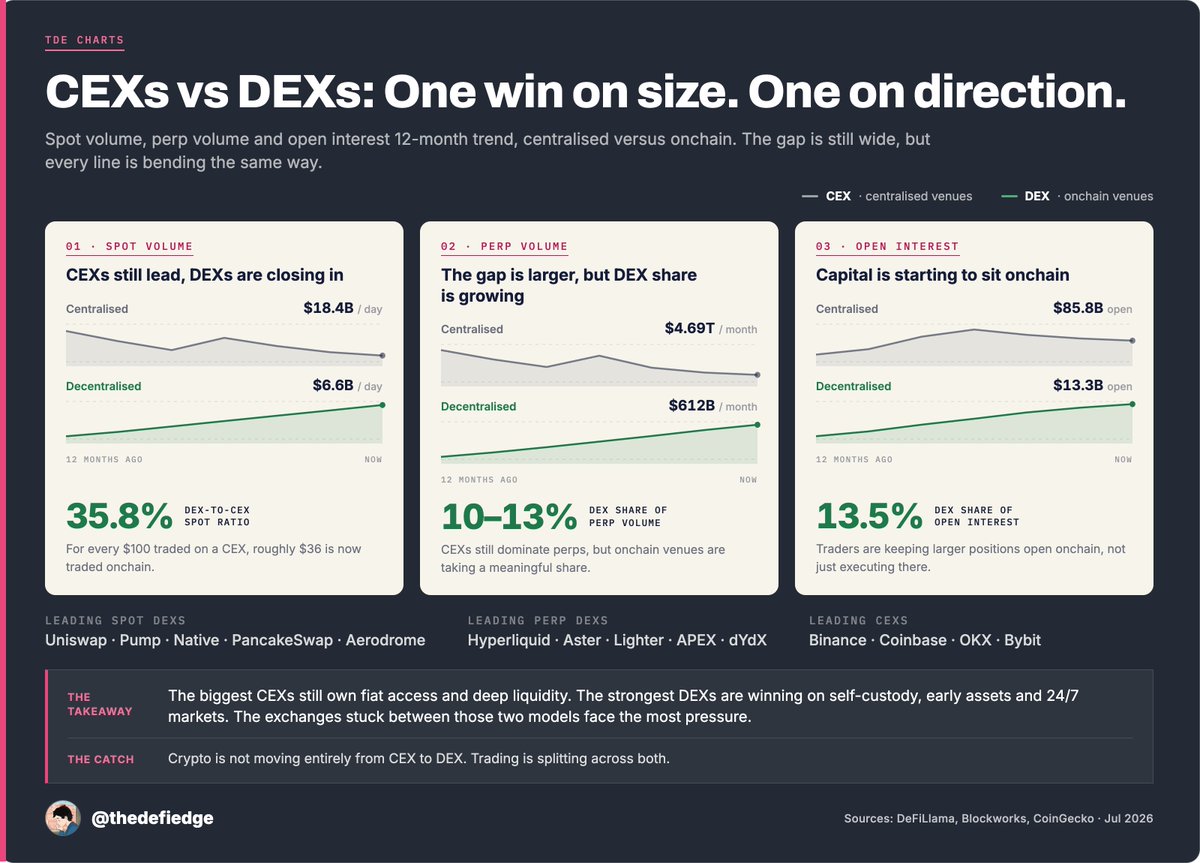
For three years, DEXs never held above $20 in spot volume for every
$100 traded on centralized exchanges. Every breakout snapped back.
For over a year now, they haven't dropped below it. Even spiked to $35 in June 2025, though most of that was one Binance integration routing through PancakeSwap.
DEXs haven't replaced centralized exchanges, and they probably won't.
It's because the biggest CEXs still have advantages that are hard to recreate onchain: fiat access, deep liquidity, regulatory reach and simple onboarding.
Binance, Coinbase, OKX and Bybit will stay the way most people enter crypto, exit it, and trade the deepest markets.
The people getting squeezed are the smaller centralized exchanges.
They're now competing against the largest CEXs on liquidity and trust, while competing against DEXs on self-custody, 24/7 markets and access to assets before they reach a centralized listing.
Their old edge was that they were easier and safer than using a DEX while still offering more opportunities than the largest exchanges. Both sides of that have weakened.
So crypto isn't moving from CEX to DEX in one clean jump. Instead, it's splitting.
How does this affect you? If your funds sit on an exchange that isn't top four or onchain, ask what its advantage is. Bc most of the time the risk isn't worth the reward.
Same goes for mid-tier exchange tokens. BMX dropped 66% in a day when the announcement hit.
The giant CEXs survive.
The strongest DEXs keep taking market share.
And there's going to be a lot of dead bodies between them.
By the time the subsidies end, Chinese models will probably be cheap and capable enough for most people.
I love seeing each new model improve, but it feels like we’re nearing diminishing returns for the average user.
im starting to really understand over reliance on subsidized $200/mo coding agent plans
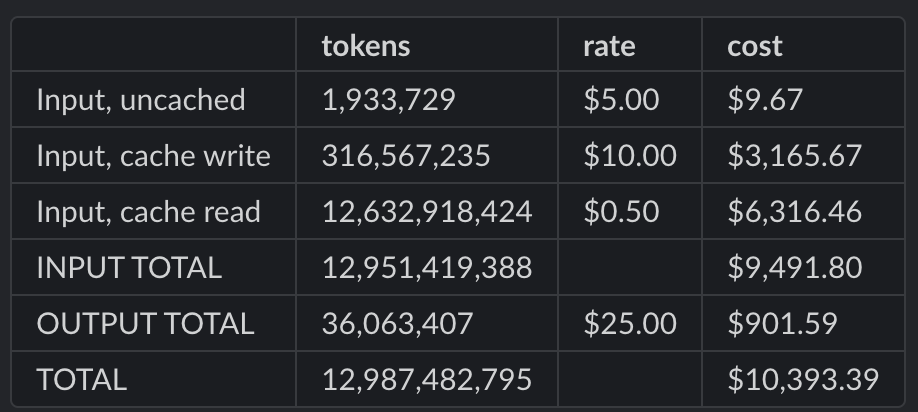
in enterprise token pricing equivalents, in july id have spent ~$10k (and i did not max out the sub at any time)
when the ai lab overlords pull the plug on subsidies it will be truly over for many engineers currently living in the most productive period of their lives
Most crypto yield products launch a token and then go hunting for a business to justify it.
The Origin Vault from Axis is worth understanding because the product itself is a bit different from the usual stablecoin farm.
The easiest way to think about this vault is this:
The same dollar can trade at slightly different prices across different markets.
Axis tries to buy where it’s cheaper, sell where it’s higher, and repeat that across exchanges, assets, and settlement rails without taking a big directional bet on the market.
They’ve been doing that for eight years, with a reported 36% annualised return, 4.9 Sharpe, and $400M peak AUM.
The part that interested me is that they’re now putting the same engine onchain.
The Origin Vault takes USDT or USDC and, once the deposit window closes, puts the position into USDx and staked sUSDx for 30 days.
The target is 10 - 15% APY, with returns coming from the trading activity rather than a token emissions programme. Early deposits also earn 20 Coordinates per dollar per day.
There are obvious trade-offs. Funds are locked for 30 days, the return moves with strategy performance, and there’s more risk here than simply lending stables onchain.
Still, I think the model itself is worth watching.
A lot of crypto yield starts with a token and then looks for a reason to exist.
Axis is doing the opposite by taking an old trading business and turning access to it into an onchain product.
Pleased to partner with @AxisFDN on this one.
$50M filled in 22 hours.
The cap has increased to $100m. Multiplier reduced to 1.75x, from 2x at launch.
Origin Vault closes August 5, 2PM UTC, or when the cap fills. Whichever comes first.
Referrals are live. Share your code, earn bonus Coordinates.
https://t.co/AzOLc0EJwX
Imagine being able to loop Bitcoin the way people loop ETH or stablecoins.
You stake BTC for a base yield, borrow against it, deploy that capital somewhere else, and keep earning underneath the whole time.
Which is kinda strange when you think about it.
$BTC is the biggest pool of capital in crypto and most of it does nothing, mainly because the yield options have meant handing your coins to a custodian or wrapping them.
Stacks has been building towards that kind of setup for a while.
Self-custodial Bitcoin Staking first, then liquid products on top like stBTC so the position can actually move through lending and trading instead of sitting stuck.
Its Q2 report shows the surrounding ecosystem is starting to look ready for it:
• 110K+ new wallets, up roughly 50% from Q1
daily users up around 55%, past 1.6M cumulative wallets
• Zest at $70M TVL, 1,500+ liquidations with no bad debt
• BitFlow past $5B cumulative transaction value
• Hermetica's latest 75 BTC hBTC allocation filled in a day
Stacking DAO also announced stBTC, which is meant to let BTC keep earning staking yield while remaining liquid enough to use elsewhere.
The part I find interesting is what this could eventually lead to.
Not just earning a few percent on idle BTC, but building proper Bitcoin strategies around it: lending, looping, trading, and whatever comes next.
Q3 is where we start finding out how much demand there really is for that.
Glad to partner with @Stacks on this one.