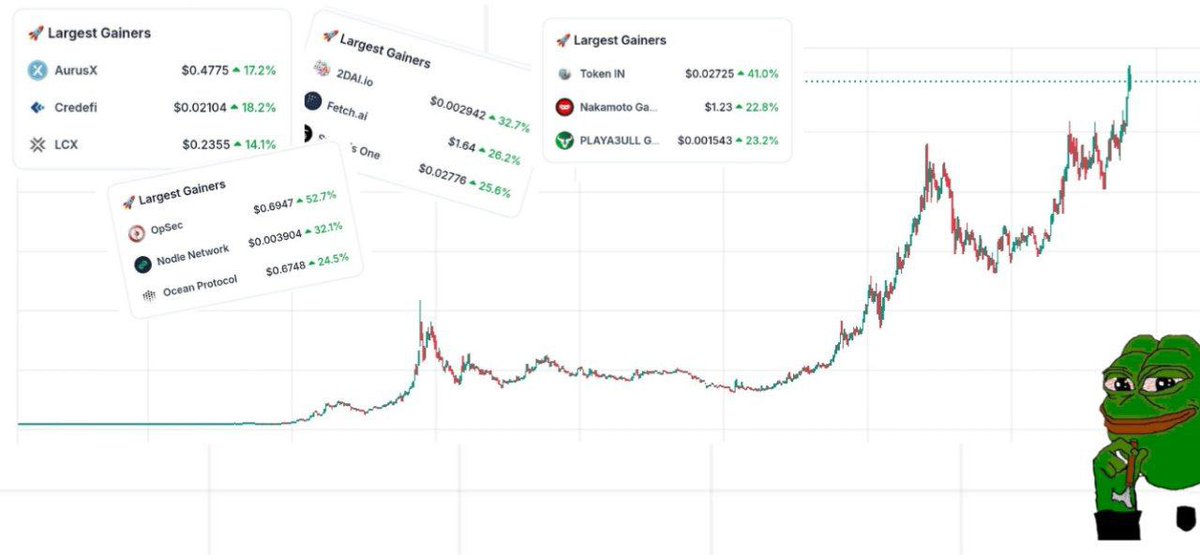
When some top chads post their portfolio, some people ask questions "what are they doing, that I'm not doing?"
It's diversification mate!
Many people flock to overpriced crypto assets, overlooking the vast landscape of innovative projects emerging.
While diversification can improve risk-adjusted returns through metrics like the Sharpe ratio, its benefits go deeper.
In a dynamic market like crypto, it's crucial to gain exposure to the diverse applications and other crypto sectors.
Think of returns like a power law distribution. A few investments deliver exceptional results, while many yield lower or negative returns. This is similar to venture capital, where success hinges on identifying a few breakout startups.
Diversification in crypto serves the same purpose, it increases your chances of capturing the "runner" that'll propel your portfolio upwards.
In the last 24h, AI tokens surged +15% outperforming other crypto sector. This is because Nvidia is close to becoming World’s Most Valuable Company.
If you had spread your investment into AI tokens also, your portfolio would've added gains despite this week's bloodbath.
➭ 𝗕𝗲𝘆𝗼𝗻𝗱 𝘁𝗵𝗲 𝗧𝗼𝗽 𝟭𝟬: 𝗔 𝗕𝗿𝗼𝗮𝗱𝗲𝗿 𝗖𝗿𝘆𝗽𝘁𝗼 𝗨𝗻𝗶𝘃𝗲𝗿𝘀𝗲
A portfolio concentrated solely on the top 10 cryptocurrencies by market cap might seem diversified, but it only captures a limited scope.
These are primarily Layer 1 blockchain protocols. While these tokens may appear less risky, they miss the wave of innovation happening across the crypto landscape.
Expanding your portfolio to include the other top crypto sector paints a more dynamic picture. This encompasses:
• AI: $ARKM, $GRT, $BOTTO, $DEAI, $KAI
• RWA: $PENDLE, $OM, $LNDX, $TRADE, $PRCL, $SOIL
• Layer 2: $ARB, $OP, $STRK, $METIS, $MANTA
• DePIN: $OPSEC, $FIL, $AIOZ, $IOTX, $GPU
• GameFi: $PIXEL, $APE, $SAND, $NAKA, $KARRAT, $MYRIA
The crypto market's rapid evolution necessitates an active approach to portfolio management. Diversification isn't simply buying more assets.
It's about taking a long-term view and strategically allocating your investments across different sectors and project sizes to capitalize on diverse potential outcomes.
RWA Market Cap Expected to Reach $16 Trillion in 2030. DYOR and find your best RWA project pick, buy and HODL!
✍️ 𝗖𝗼𝗻𝗰𝗹𝘂𝘀𝗶𝗼𝗻
Think of diversification not as weakening your portfolio, but as giving it more firepower. It increases your chances of capturing the winners while managing risk.
In essence, diversification gives you more opportunities for success, for less.
Crypto security has a weird problem.
There is no shortage of money.
There is no shortage of open-source code.
There is a shortage of people willing to continuously stare at that code looking for ways to break it.
The Bitcoin Red Team may have found a way around that.
Following the Coldcard exploit, a 16-person volunteer team organized by Calle and Rob Hamilton spent 27.5 hours reviewing 390 open-source Bitcoin ecosystem repositories with frontier AI models.
The campaign was funded by more than $40K from OpenSats for AI compute and inference.
The result:
➤ 4,962 total findings
➤ 85 critical
➤ 635 high-severity
➤ ~$40K in AI spend
The $40K is the number I keep coming back to.
● The Economics Are Changing
Security audits are expensive because good engineers are expensive. They need time to understand the code, test different parts of it and figure out what could actually be exploited.
And most audits happen once.
Then the code changes. New dependencies get added. New features get shipped. Eventually, the old audit starts losing relevance.
AI changes the cost of the initial review.
If 390 repositories can be examined in 27.5 hours for roughly $40K, doing this repeatedly starts looking realistic.
The goal isn’t to replace security researchers. It’s to let AI search through far more code while humans focus on the findings worth investigating.
● Where AI Still Breaks
4,962 findings does not mean 4,962 vulnerabilities.
The initial campaign reportedly achieved roughly a 21% verification rate. Most of the findings did not survive the first round of human review.
That’s the biggest limitation.
AI is good at finding things that look suspicious. It still needs people to determine whether those issues are real, exploitable and worth fixing.
So the important number isn’t the 4,962.
It’s how many survive verification.
If that number remains meaningful as the process scales, the economics become difficult to ignore.
● From One-Off Audits To Continuous Review
The bigger opportunity isn’t another AI audit after another exploit.
It’s making code review something that happens continuously.
A major upgrade happens? Review it.
A new dependency gets added? Review it.
A critical piece of code changes? Review it.
AI doesn’t need to approve the code. It needs to keep looking for problems and bring the important ones to human reviewers.
The Bitcoin Red Team doesn’t prove this model will work forever.
It proves something simpler.
Looking at hundreds of repositories with AI is already cheap enough to try.
➤ 390 repositories
➤ 27.5 hours
➤ ~$40K
Crypto spent years making its code open.
The next step is making sure someone is always looking.
● My Take
The 21% verification rate leaves plenty of room for improvement. But 4,962 findings for ~$40K changes the economics of security review.
AI doesn’t replace auditors.
It makes continuous review affordable.
Crypto security has a weird problem.
There is no shortage of money.
There is no shortage of open-source code.
There is a shortage of people willing to continuously stare at that code looking for ways to break it.
The Bitcoin Red Team may have found a way around that.
Following the Coldcard exploit, a 16-person volunteer team organized by Calle and Rob Hamilton spent 27.5 hours reviewing 390 open-source Bitcoin ecosystem repositories with frontier AI models.
The campaign was funded by more than $40K from OpenSats for AI compute and inference.
The result:
➤ 4,962 total findings
➤ 85 critical
➤ 635 high-severity
➤ ~$40K in AI spend
The $40K is the number I keep coming back to.
● The Economics Are Changing
Security audits are expensive because good engineers are expensive. They need time to understand the code, test different parts of it and figure out what could actually be exploited.
And most audits happen once.
Then the code changes. New dependencies get added. New features get shipped. Eventually, the old audit starts losing relevance.
AI changes the cost of the initial review.
If 390 repositories can be examined in 27.5 hours for roughly $40K, doing this repeatedly starts looking realistic.
The goal isn’t to replace security researchers. It’s to let AI search through far more code while humans focus on the findings worth investigating.
● Where AI Still Breaks
4,962 findings does not mean 4,962 vulnerabilities.
The initial campaign reportedly achieved roughly a 21% verification rate. Most of the findings did not survive the first round of human review.
That’s the biggest limitation.
AI is good at finding things that look suspicious. It still needs people to determine whether those issues are real, exploitable and worth fixing.
So the important number isn’t the 4,962.
It’s how many survive verification.
If that number remains meaningful as the process scales, the economics become difficult to ignore.
● From One-Off Audits To Continuous Review
The bigger opportunity isn’t another AI audit after another exploit.
It’s making code review something that happens continuously.
A major upgrade happens? Review it.
A new dependency gets added? Review it.
A critical piece of code changes? Review it.
AI doesn’t need to approve the code. It needs to keep looking for problems and bring the important ones to human reviewers.
The Bitcoin Red Team doesn’t prove this model will work forever.
It proves something simpler.
Looking at hundreds of repositories with AI is already cheap enough to try.
➤ 390 repositories
➤ 27.5 hours
➤ ~$40K
Crypto spent years making its code open.
The next step is making sure someone is always looking.
● My Take
The 21% verification rate leaves plenty of room for improvement. But 4,962 findings for ~$40K changes the economics of security review.
AI doesn’t replace auditors.
It makes continuous review affordable.
RWA adoption is growing faster in users than in capital.
➤ $38.14B in tokenized assets
➤ +1.69% distributed value over 30 days
➤ 1.72M holders
➤ +56.54% holder growth
The impressive part isn’t that holder count is rising.
It’s the size of the divergence.
More than half a million new addresses entered the market while tokenized asset value barely moved.
That suggests the marginal RWA user is arriving with significantly less capital than the users already in the market.
And I think that’s more important than the headline growth rate.
Tokenization is starting to look less like a capital aggregation trade and more like a distribution trade.
A $1,000 position and a $1M position both count as one holder.
So holder growth tells us something TVL doesn’t:
how quickly ownership is spreading beneath the headline capital figure.
Right now, ownership is expanding far faster than capital.
The question is whether those new holders eventually increase their exposure, or whether RWA adoption settles into a long tail of smaller positions.
That distinction will tell us a lot about how deep this market actually is.
@JensenHuang shift to financing AI factories as productive, software upgradable infrastructure will certainly make room for a new kind of intelligence era.