NEW: Putin and members of the Russian delegation outlined Russia’s steadfast commitment to its original territorial demands of Ukraine and ultimatums to dismantle NATO and the post-Cold War European security architecture following the latest trilateral talks in Abu Dhabi on November 12. Putin remains unwilling to compromise on any of these demands. ⬇️
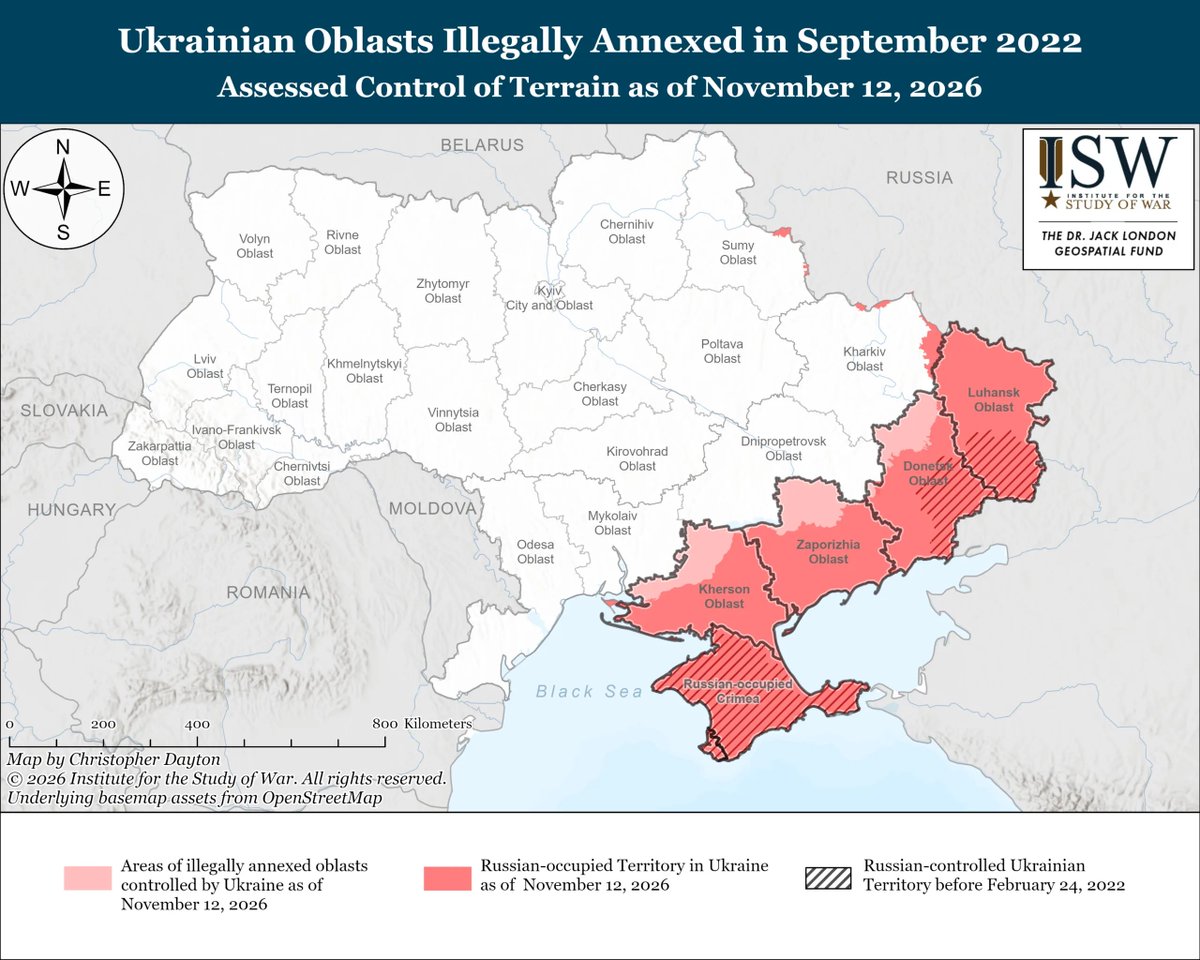
- Putin is refusing to accept any proposed future demilitarized zone in post-war Ukraine or to abandon his demand that Ukraine hand over the parts of Luhansk, Donetsk, Zaporizhia, and Kherson oblasts that Russian forces have not seized.
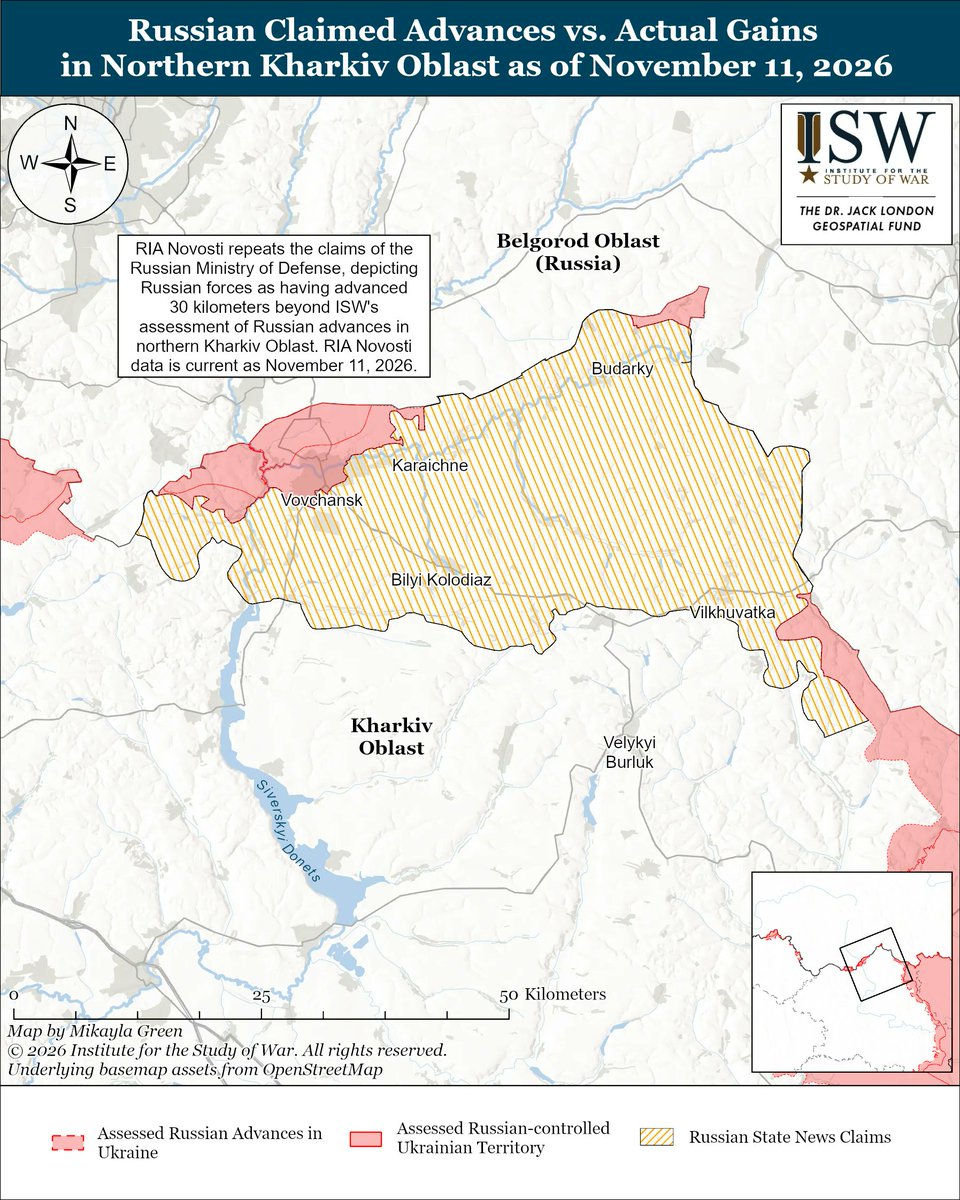
- Putin is also unwilling to cede the territory in northern Ukraine that the Kremlin claims Russian forces have seized but that lies outside of the four illegally annexed oblasts.
- Putin continues to reject all meaningful Western security guarantees for post-war Ukraine.
- Russian negotiators used the Abu Dhabi talks to reassert their 2021 demands of NATO.
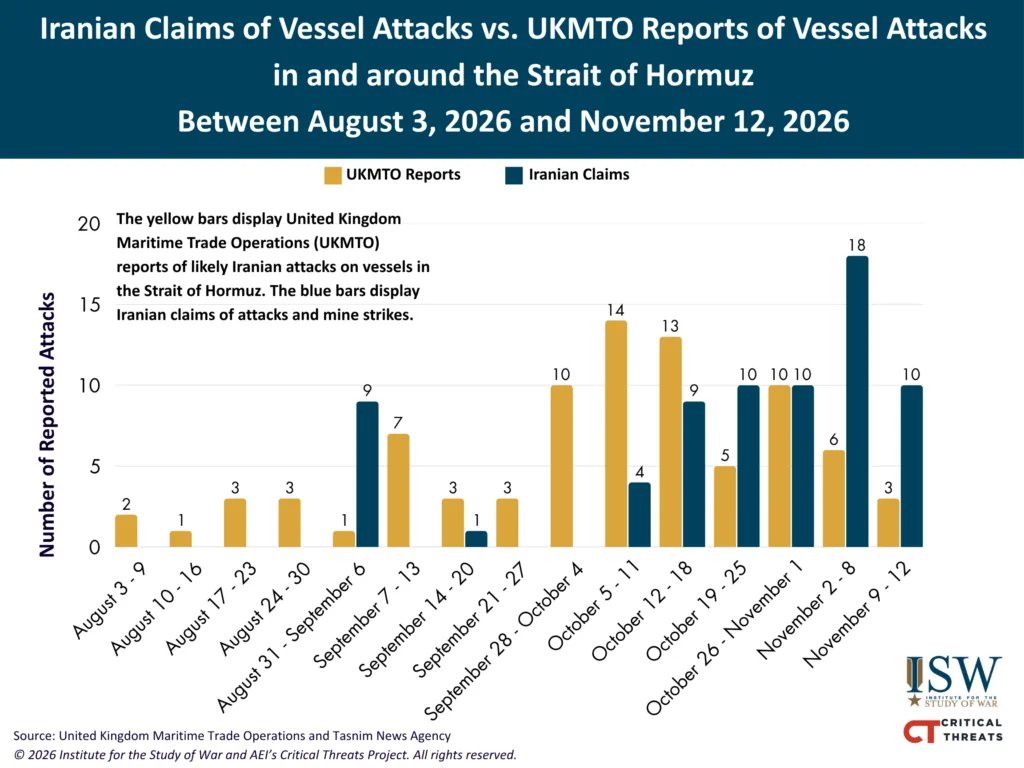
MORE: Iran continues to claim that commercial vessels are striking naval mines along the US-backed route in the southern part of the Strait of Hormuz, likely to undermine ship operators’ confidence in US escort operations and compel vessels to transit through Iranian territorial waters. The Islamic Revolutionary Guards Corps (IRGC) and Artesh have consistently claimed that vessels have struck mines following US Central Command’s August 27 confirmation that US forces had completely demined the strait. The start of these claims also coincided with US strikes on August 31 targeting rockets that Iran was reportedly attempting to use to re-mine the strait. ISW-CTP assessed at the time that Iran may have been using the rockets because previous US strikes had degraded other, more effective Iranian strike-laying capabilities. ISW-CTP has not observed any indicators that Iran has successfully re-mined the strait. The IRGC and Artesh have recently started to note in their claims of vessels hitting mines that the vessels were allegedly under US escort, likely to try to reinforce Iran’s information operation to discredit US escort operations.
Iran continues to attack vessels with likely drones and missiles in and around the Strait of Hormuz. United Kingdom Maritime Trade Operations (UKMTO) reported two projectile attacks against tankers in and near the Strait of Hormuz, including a strike on an engine room. This attack is consistent with a recent increase in Iranian attacks on vessel engine rooms. ISW-CTP assessed on October 21 that Iran may be using more advanced weapons systems to conduct more precise attacks after at least five of 23 attacks in early October struck engine rooms.
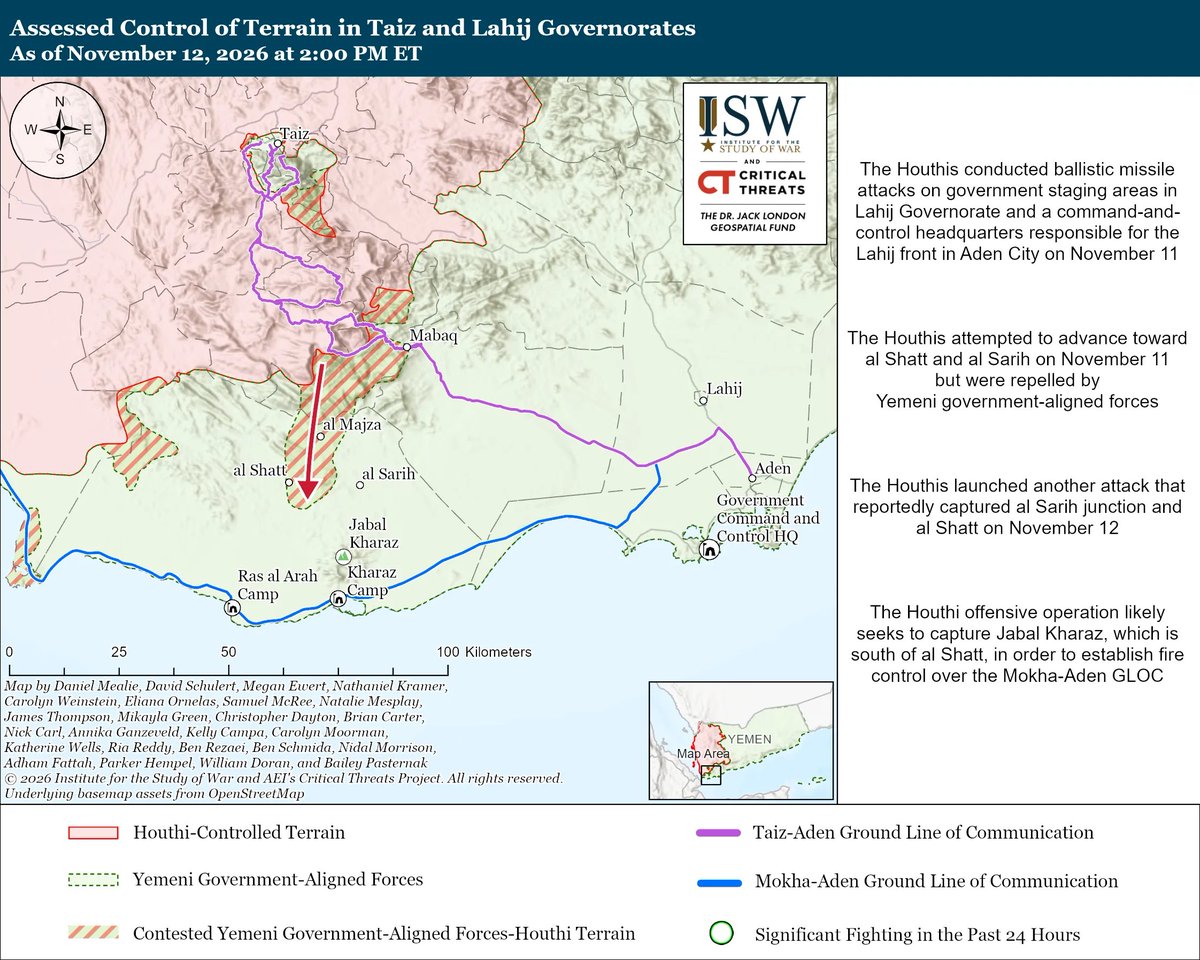
NEW: The Houthis launched a combined-arms offensive operation in southeastern Lahij Governorate on November 11 that likely aims to isolate Yemeni government-aligned forces on the Red Sea coast by severing the Mokha-Aden ground line of communication (GLOC).
The Houthi offensive on the Lahij front likely seeks to capture Yemeni government-controlled high ground at Jabal Kharaz, which lies south of al Shatt, in order to establish fire control over the Mokha-Aden GLOC.
Houthi fire control over the Mokha-Aden GLOC would effectively isolate some Yemeni government-aligned forces on the Red Sea coastal plain, which would simultaneously set conditions for the Houthis to capture the remainder of the Red Sea coastal plain while depriving the Yemeni government of the units best able to defend Aden City.
3/ A ceasefire, like the one in Oleshky, is impossible to execute in Kostyantynivka, however, because the actual frontline military situations are not comparable.
Russian forces fully control Oleshky — a settlement located roughly 3.7 kilometers from the frontline, which meant that it was mainly necessary for Russian and Ukrainian forces to agree to stop strikes across the Dnipro River that separates Russian soldiers from Ukrainian soldiers. That ceasefire on strikes allowed the delivery of humanitarian assistance and evacuation of civilians in the Kherson direction. Russian forces, in contrast, do not control Kostyantynivka, but are instead intermingled with Ukrainian forces engaged in active combat.
Negotiating, observing, and enforcing a ceasefire in such conditions would be extraordinarily complex if it is even possible.
MORE: Putin is simultaneously doubling down in his efforts to convince US officials to accept Russia’s fictitious frontline. ⬇️(1/3)
Putin reiterated his false July 3 claim that Russian forces have full control over Kostyantynivka, Donetsk Oblast, in his meeting with Witkoff and Kushner and proposed that Russia and Ukraine could conduct a humanitarian mission in Kostyantynivka as a continuation of recent humanitarian work in occupied Oleshky, Kherson Oblast. Putin proposed inviting international media representatives and Ukrainian and Russian human rights representatives to oversee the evacuation of civilians from Kostyantynivka and to show who actually controls the town. Putin has previously made similar performative offers to call attention to his exaggerated claims about Russian battlefield progress.
ISW has observed evidence of at least 41 Ukrainian positions in and around Kostyantynivka since September 1, 2026, however, undermining Russia’s multi-month-long narrative of full control over the town. ISW assesses that Putin is accepting the Russian military’s fictional presentation of the battlefield and likely believes that Russian forces are operating far forward of the real line of contact. Russian state media regularly publishes maps showing the extent of these exaggerated Russian-claimed advances.
NEW: Putin and members of the Russian delegation outlined Russia’s steadfast commitment to its original territorial demands of Ukraine and ultimatums to dismantle NATO and the post-Cold War European security architecture following the latest trilateral talks in Abu Dhabi on November 12. Putin remains unwilling to compromise on any of these demands. ⬇️
- Putin is refusing to accept any proposed future demilitarized zone in post-war Ukraine or to abandon his demand that Ukraine hand over the parts of Luhansk, Donetsk, Zaporizhia, and Kherson oblasts that Russian forces have not seized.
- Putin is also unwilling to cede the territory in northern Ukraine that the Kremlin claims Russian forces have seized but that lies outside of the four illegally annexed oblasts.
- Putin continues to reject all meaningful Western security guarantees for post-war Ukraine.
- Russian negotiators used the Abu Dhabi talks to reassert their 2021 demands of NATO.
2/ Putin likely would seek to use a temporary localized ceasefire in Kostyantynivka to accumulate Russian forces and resources needed to drive northward to Druzhkivka — one of Ukraine’s most heavily fortified cities in the Fortress Belt defense line.
NEW: The Houthis launched a combined-arms offensive operation in southeastern Lahij Governorate on November 11 that likely aims to isolate Yemeni government-aligned forces on the Red Sea coast by severing the Mokha-Aden ground line of communication (GLOC).
The Houthi offensive on the Lahij front likely seeks to capture Yemeni government-controlled high ground at Jabal Kharaz, which lies south of al Shatt, in order to establish fire control over the Mokha-Aden GLOC.
Houthi fire control over the Mokha-Aden GLOC would effectively isolate some Yemeni government-aligned forces on the Red Sea coastal plain, which would simultaneously set conditions for the Houthis to capture the remainder of the Red Sea coastal plain while depriving the Yemeni government of the units best able to defend Aden City.
NEW: Putin and members of the Russian delegation outlined Russia’s steadfast commitment to its original territorial demands of Ukraine and ultimatums to dismantle NATO and the post-Cold War European security architecture following the latest trilateral talks in Abu Dhabi on November 12. Putin remains unwilling to compromise on any of these demands. ⬇️
- Putin is refusing to accept any proposed future demilitarized zone in post-war Ukraine or to abandon his demand that Ukraine hand over the parts of Luhansk, Donetsk, Zaporizhia, and Kherson oblasts that Russian forces have not seized.
- Putin is also unwilling to cede the territory in northern Ukraine that the Kremlin claims Russian forces have seized but that lies outside of the four illegally annexed oblasts.
- Putin continues to reject all meaningful Western security guarantees for post-war Ukraine.
- Russian negotiators used the Abu Dhabi talks to reassert their 2021 demands of NATO.
The third Russia-Africa summit did not mark a major inflection point in Russia’s engagement with African partners.
CTP Africa Team Lead @liam_karr explains the implications of this:👇
Other Key Takeaways ⬇️
- The Russian and Ukrainian delegations at the Abu Dhabi talks reportedly agreed to a large-scale prisoner of war (POW) exchange. The US delegation will meet with Putin in Moscow City on November 12 to discuss the progress of the talks and the potential involvement of European officials in future negotiations, while the Kremlin continues to explicitly reject the idea of a multilateral format.
- The Russian Ministry of Foreign Affairs reported that Alexander Darchiev, the Russian ambassador to the United States, passed away on November 11 at the age of 66.
- Russian forces recently advanced southeast of Dobropillya.
- Ukrainian forces continued their long-range strike campaign against Russian critical infrastructure on the night of November 10 to 11.
- Russian forces launched 163 drones (including 91 jet-powered drones) and S8000 Banderol/Dan-T loitering munitions and one Kh-59/69 cruise missile against Ukraine overnight on November 10 to 11.
MORE: Russian officials used the Abu Dhabi talks to try to persuade US and Ukrainian officials to accept Russia’s carefully crafted fictional version of the frontline. Ukrainian President Volodymyr Zelensky stated on November 10 that Russian military and intelligence officials falsely claimed to the US and Ukrainian delegations in Abu Dhabi that Russian forces control half of the part of Donbas that Ukrainian forces, in reality, still control. The Kremlin has long made exaggerated and grossly inaccurate claims of Russian battlefield successes. The Russian MoD, in fact, regularly claims a frontline trace that does not correspond with reality at all.
MORE: The front group’s pattern of activity suggests that its operations are part of an Iranian effort to compel Israel and the United States to halt attacks on Iran.⬇️
NEW: The US Department of Justice indicted three members of an Iranian-supported Kataib Hezbollah front group on November 10 for their involvement in nearly 20 attacks or plots in Europe and the United States, including an attempted attack on the Royal Air Force (RAF) base in Fairford in September 2026. (1/2)
NEW: Senior Kremlin officials explicitly and emphatically articulated Moscow’s persistent demands for complete Ukrainian capitulation and territorial concessions that extend far beyond Donbas. Kremlin officials have frequently claimed that the Ukrainian withdrawal from all of Donetsk Oblast is a necessary but insufficient condition for a peace settlement, and Putin and other high-ranking Kremlin officials have often reiterated Russia’s commitment to Putin’s June 2024 demands.
Ukrainian forces maintain control over 0.38 percent of Luhansk Oblast, 20.12 percent of Donetsk Oblast, 24.42 percent of Zaporizhia Oblast, and 30.11 percent of Kherson Oblast, but Putin continues to demand territory that his forces have been unable to seize.
Other Key Takeaways ⬇️
- The Russian and Ukrainian delegations at the Abu Dhabi talks reportedly agreed to a large-scale prisoner of war (POW) exchange. The US delegation will meet with Putin in Moscow City on November 12 to discuss the progress of the talks and the potential involvement of European officials in future negotiations, while the Kremlin continues to explicitly reject the idea of a multilateral format.
- The Russian Ministry of Foreign Affairs reported that Alexander Darchiev, the Russian ambassador to the United States, passed away on November 11 at the age of 66.
- Russian forces recently advanced southeast of Dobropillya.
- Ukrainian forces continued their long-range strike campaign against Russian critical infrastructure on the night of November 10 to 11.
- Russian forces launched 163 drones (including 91 jet-powered drones) and S8000 Banderol/Dan-T loitering munitions and one Kh-59/69 cruise missile against Ukraine overnight on November 10 to 11.
MORE: Russian officials used the Abu Dhabi talks to try to persuade US and Ukrainian officials to accept Russia’s carefully crafted fictional version of the frontline. Ukrainian President Volodymyr Zelensky stated on November 10 that Russian military and intelligence officials falsely claimed to the US and Ukrainian delegations in Abu Dhabi that Russian forces control half of the part of Donbas that Ukrainian forces, in reality, still control. The Kremlin has long made exaggerated and grossly inaccurate claims of Russian battlefield successes. The Russian MoD, in fact, regularly claims a frontline trace that does not correspond with reality at all.
MORE: The front group’s pattern of activity suggests that its operations are part of an Iranian effort to compel Israel and the United States to halt attacks on Iran.⬇️
NEW: The US Department of Justice indicted three members of an Iranian-supported Kataib Hezbollah front group on November 10 for their involvement in nearly 20 attacks or plots in Europe and the United States, including an attempted attack on the Royal Air Force (RAF) base in Fairford in September 2026. (1/2)
3/ Ukrainian and US officials in Abu Dhabi reportedly rejected Russian officials’ false claims about the battlefield, and ample evidence of Ukrainian successes in 2026 directly undermines Russia’s false narrative. Zelensky stated on November 11 that US negotiators confirmed Ukraine’s assessment of the battlefield situation — rejecting the false Russian claim that Russian forces control half of the Ukrainian-controlled territory in Donbas. Russian forces have, in fact, lost the initiative and much of their offensive capabilities in several sectors of the theater throughout 2026. Russian forces have suffered a net loss of territory in four of the last eight months since the previous round of US-Ukrainian-Russian talks in February 2026, while simultaneously suffering increasingly high casualties.
Ukrainian forces have conducted several successful counteroffensive operations throughout 2026 in the Lyman, Oleksandrivka, and Kupyansk directions, liberating over 1,000 square kilometers of territory. Successful Ukrainian counteroffensive operations have entirely disrupted the Russian plan to seize Donetsk Oblast and created cascading effects across other sectors of the frontline, as the Russian military command had to make difficult decisions about the allocation of manpower and resources between sectors.
There is no basis to assess that Russian forces will be able to take the rest of Donetsk Oblast in any short period of time, as Putin continues to claim that they will, or even to forecast that Russian forces will ever be able to seize the region by force.
MORE: Russian officials used the Abu Dhabi talks to try to persuade US and Ukrainian officials to accept Russia’s carefully crafted fictional version of the frontline. Ukrainian President Volodymyr Zelensky stated on November 10 that Russian military and intelligence officials falsely claimed to the US and Ukrainian delegations in Abu Dhabi that Russian forces control half of the part of Donbas that Ukrainian forces, in reality, still control. The Kremlin has long made exaggerated and grossly inaccurate claims of Russian battlefield successes. The Russian MoD, in fact, regularly claims a frontline trace that does not correspond with reality at all.
NEW: Senior Kremlin officials explicitly and emphatically articulated Moscow’s persistent demands for complete Ukrainian capitulation and territorial concessions that extend far beyond Donbas. Kremlin officials have frequently claimed that the Ukrainian withdrawal from all of Donetsk Oblast is a necessary but insufficient condition for a peace settlement, and Putin and other high-ranking Kremlin officials have often reiterated Russia’s commitment to Putin’s June 2024 demands.
Ukrainian forces maintain control over 0.38 percent of Luhansk Oblast, 20.12 percent of Donetsk Oblast, 24.42 percent of Zaporizhia Oblast, and 30.11 percent of Kherson Oblast, but Putin continues to demand territory that his forces have been unable to seize.
2/ The Kremlin will likely continue to make false claims of advances along the frontline in an effort to establish its fictional frontline as the basis of future negotiations on territorial issues. Russian officials often claim that peace talks need to take into consideration the “realities on the ground,” and the Kremlin is trying to push its own reality onto US, Ukrainian, and other negotiators. The Kremlin will very likely increase its claimed advances throughout Winter 2026-2027 and into Spring 2027 far beyond territories its troops can take or hold. Putin likely hopes that a devastating wintertime Russian long-range strike campaign against Ukraine will break Ukraine’s will to continue to fight and degrade Western support for Ukraine, allowing him to insist on his claimed line of advance as the starting point of any talks about a final settlement of the war.
NEW: The US Department of Justice indicted three members of an Iranian-supported Kataib Hezbollah front group on November 10 for their involvement in nearly 20 attacks or plots in Europe and the United States, including an attempted attack on the Royal Air Force (RAF) base in Fairford in September 2026. (1/2)