Cleaning the Glass splits plays into half-court, transition and putback contexts. Those same easy-to-understand numbers haven't been publicly available in the same way for the WNBA.
So, let's fix that.
Introducing Cleaning the Glass-style contextual stats for the WNBA!
WNBA minutes distribution through August 1. The Dream were playing their starters more than any other team in the league; the Valkyries the least, with 10 players playing 10+ MPG.
Fever also notably low, as discussed more here: https://t.co/XaGxKDjV2A
Per Synergy, Sonia Citron has guarded more possessions as a primary defender than anyone else in the WNBA. She is holding opponents to 32.7 percent shooting from the field, No. 1 among the top 40 players in possessions guarded.
@mikemoreau85 think your instinct is right!
for reference, I define scramble as "a play that occurs soon after an offensive rebound, before the offense and the defense reset"
@roemelloreyes@jfeltonnn haha genius is definitely overstated 😂
most of the work was watching ~15 games and manually labeling each play as halfcourt, transition, scramble or other in order to build the model.
a lot of what I have done is built on the shoulders of what others have done in NBA spaces!
@roemelloreyes@jfeltonnn It's based on my own research! See the tweet below for what I did. I have an algorithm that runs on WNBA play-by-play data and generates the labels.
I'm hoping that we'll create a dedicated page on SI where these we'll update daily. working on that!
https://t.co/7xDOMFAWcR
Cleaning the Glass splits plays into half-court, transition and putback contexts. Those same easy-to-understand numbers haven't been publicly available in the same way for the WNBA.
So, let's fix that.
Introducing Cleaning the Glass-style contextual stats for the WNBA!
Here is how each team ranks in net half-court efficiency (numbers are rounded to two decimal places):
The Fever and Mystics are elite in one direction (offense for the Fever, defense for the Mystics) but may need to raise their baseline in the other to reach their true ceiling.
@jasonhorowitz Thank you so much! I appreciate that. Hoping to have some sort of WNBA RAPM update in a month or so.
(Focusing on 1-year RAPM for now for philosophical/downstream SPM reasons, but it should have some time-related things in there.)
Ahead of refreshing WNBA RAPM for 2026, I wanted to look at one question more fully: Does adding more seasons help with predictive accuracy?
Answer is somewhat nuanced: Largest gains come at 3-4 seasons, some small improvements come later
One plot and one update on my approach:
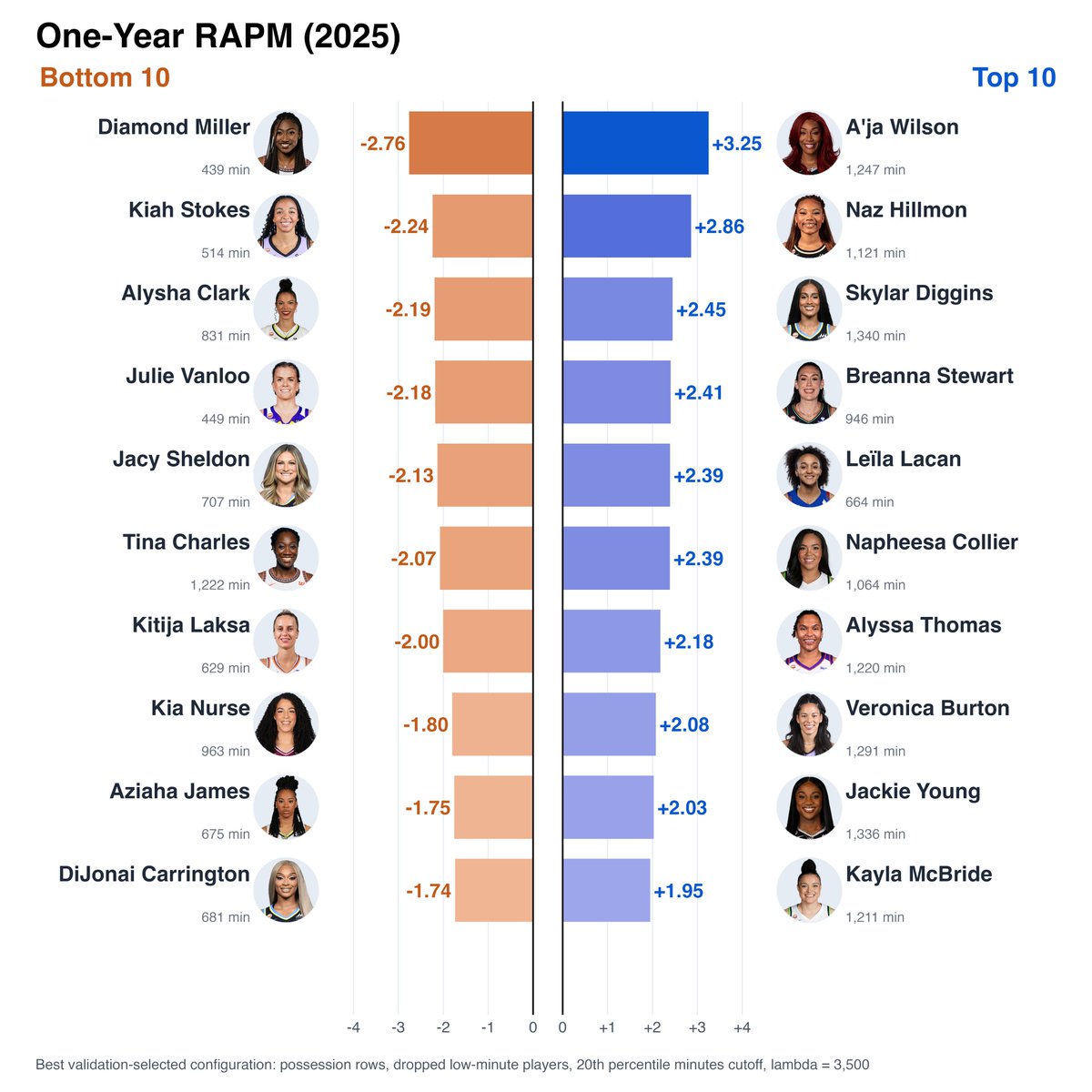
Can a WNBA-tailored RAPM model provide similar predictive power compared with its NBA counterpart?
If so, how should it be built?
The answer to the first is yes. Following @joe_sill's methodology, I built and tested a WNBA version of RAPM.
Here's what I found.
unresolved questions:
- at longer time horizons, does model selection via straight-up five-fold CV become less representative of the test task as folds span a larger historical window and include older (and more) games? seems like it.
- where does time decay fit in?
So, I dove back in and the mean-selected winners seem to be a bit more stable
tl;dr:
- 3-4 seasons gets most of the predictive gain
- adding seasons produces small gains when holding a few configs fixed
- now selecting configurations by mean rather than median validation RMSE