Inside TheHUB, fair access starts with the physical network.
Step inside the facility to see how participants connect, how fiber paths are calibrated to equalize latency, and how orders are timestamped at entry.
An accurate record of order arrival times is critical to fair and transparent markets.
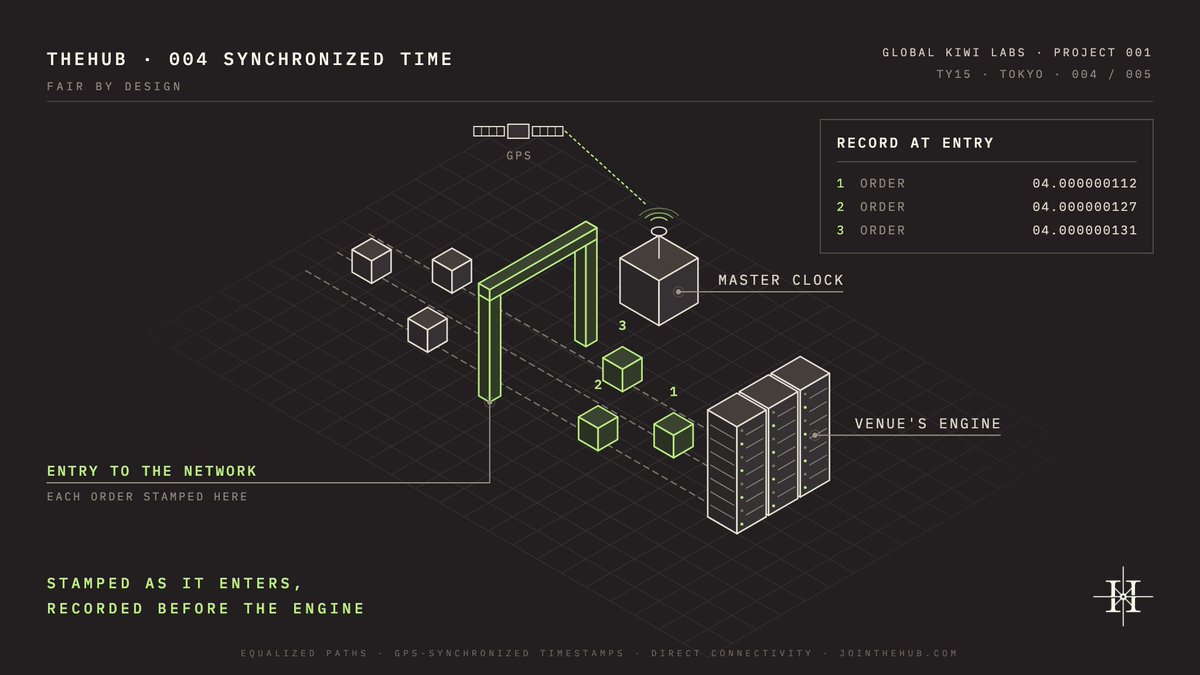
Inside TheHUB, order traffic is hardware-timestamped at network ingress using a shared, GPS-synchronized master clock.
This creates an auditable record of when each order arrived, before it reaches the venue’s matching engine.
TheHUB @TheHUB is setting up inside Equinix's Tokyo data center.
Trading venues, firms and node operators on the same network, with equalized latency by design.
Basically, the goal is to compete on trading, not connection speed.
TheHUB is being built inside @Equinix in Tokyo to give digital markets a level playing field: venues, trading firms, node operators and infrastructure providers in one physical environment, where traders reach venues over the same network, at the same latency, by design.
Venues compete on market design, while traders compete on strategy and execution.
Thanks to the Equinix team for highlighting what we're building in Tokyo!
Information moves instantly. Money often doesn't.
Many financial transactions still rely on processes that take days to complete. The next wave of innovation is about modernizing the infrastructure behind global markets.
See how Global Kiwi Labs built @TheHUB at Equinix: https://t.co/DuFOMwtFMg
Tighter spreads attract more trading activity, which makes a venue more attractive to market makers.
The more venues operate inside the same facility, the more valuable that facility becomes to every trading firm connected to it.
That’s the magnetic effect behind TheHUB.
Exchanges and prediction markets have a strong incentive to provide equal access to their matching engines: tighter spreads.
Running the matching engine inside @TheHUB means no colocated trading firm gets a shorter network path to it than another. With less risk of being picked off by someone with a faster path, market makers can quote tighter spreads, making the market more attractive to traders and ultimately driving more volume to the exchange.
TheHUB provides purpose-built colocation infrastructure for latency-sensitive markets, with its first facility inside Equinix TY15 in Tokyo.
Exchanges, trading firms, bare metal providers, and node operators can operate in the same building, connected through one network, under equalized latency. Participants can bring their own servers or use bare-metal or on-prem cloud providers.
Inside TheHUB, every trading firm’s network path to a venue’s matching engine is designed to be the same length, so no participant can buy a shorter connection.
Inside TheHUB, fair access starts with the physical network.
Step inside the facility to see how participants connect, how fiber paths are calibrated to equalize latency, and how orders are timestamped at entry.
Inside TheHUB, fair access starts with the physical network.
Step inside the facility to see how participants connect, how fiber paths are calibrated to equalize latency, and how orders are timestamped at entry.
In case you missed yesterday’s film: whether participants’ servers are inside TheHUB's cage or connected from outside, the fiber paths to each venue's matching engine are measured and adjusted to the same length.
The result is equal latency to the matching engines for every participant, regardless of where their servers are located.
That’s what we call latency equalization.
5/ Connect without the cost of moving.
Firms with infrastructure already running nearby can join the equalized network through a single cross-connect, without moving their racks.
Their fiber connections are precisely measured and matched in length so every participant has the same network distance to the matching engine.
4/ Synchronized time.
Inside TheHUB, every packet receives a hardware timestamp as it enters the network, using a GPS-synchronized clock.
This creates a common record of when orders arrived, before they reach a venue's matching engine.