First up in our Disability Pride ACM Recommended Reads: "Against Technoableism" by Ashley Shew. Shew invites us to rethink disability technologies and challenge the harmful belief that disability is a liability.
Follow along all month as we share more recommended reads celebrating #DisabilityPride! https://t.co/4Fknx7rlWZ
"The IDD is not just a document; it is a vital process that codifies agreement, prevents process churn, and preserves precious engineering focus."
Read more on the Important Decisions Document (IDD) from our popular #Substack newsletter: https://t.co/N50gPDVofp
Happy Birthday to Nikola Tesla, who was born on this day in 1856.
In 1888, Tesla revolutionized the generation and transmission of electricity by developing a practical alternating current (AC) power system, including the induction motor and polyphase system. Unlike direct current, AC could be transmitted efficiently over long distances, making widespread electrification practical.
Beyond AC power, Tesla pioneered innovations in wireless communication, high-frequency electrical engineering, and radio-controlled machines. His inventions transformed electrical engineering and laid the foundation for technologies that followed.
Today, Tesla's innovations remain at the heart of electrical power systems around the world. The electric vehicle company Tesla, Inc. was named in his honor, reflecting the lasting impact of his work with electricity and engineering.
#PioneerPOV #ACM #Pioneer #ComputerScience #ComputingHistory #Tesla
How should increasingly capable AI systems be governed? What responsibilities come with developing technologies that influence decisions, institutions, and everyday life?
These questions cannot be answered by technical experts alone.
Join us for the inaugural ACM AI Leadership Summit, where we are bringing together voices from research, industry, government, education, and civil society for meaningful dialogue on the challenges and opportunities shaping the future of AI.
Check out our stellar lineup and full program here: https://t.co/Pf26Hh1HP6
#ACM #AI #TechLeadership #AIGovernance #Innovation
In this week’s People of ACM, we interview Paolo Ferragina, ACM Fellow, and Professor, @ScuolaSantAnna. He discusses innovations that paved the way for today’s search engines. Read here: https://t.co/1R2luJI7g7
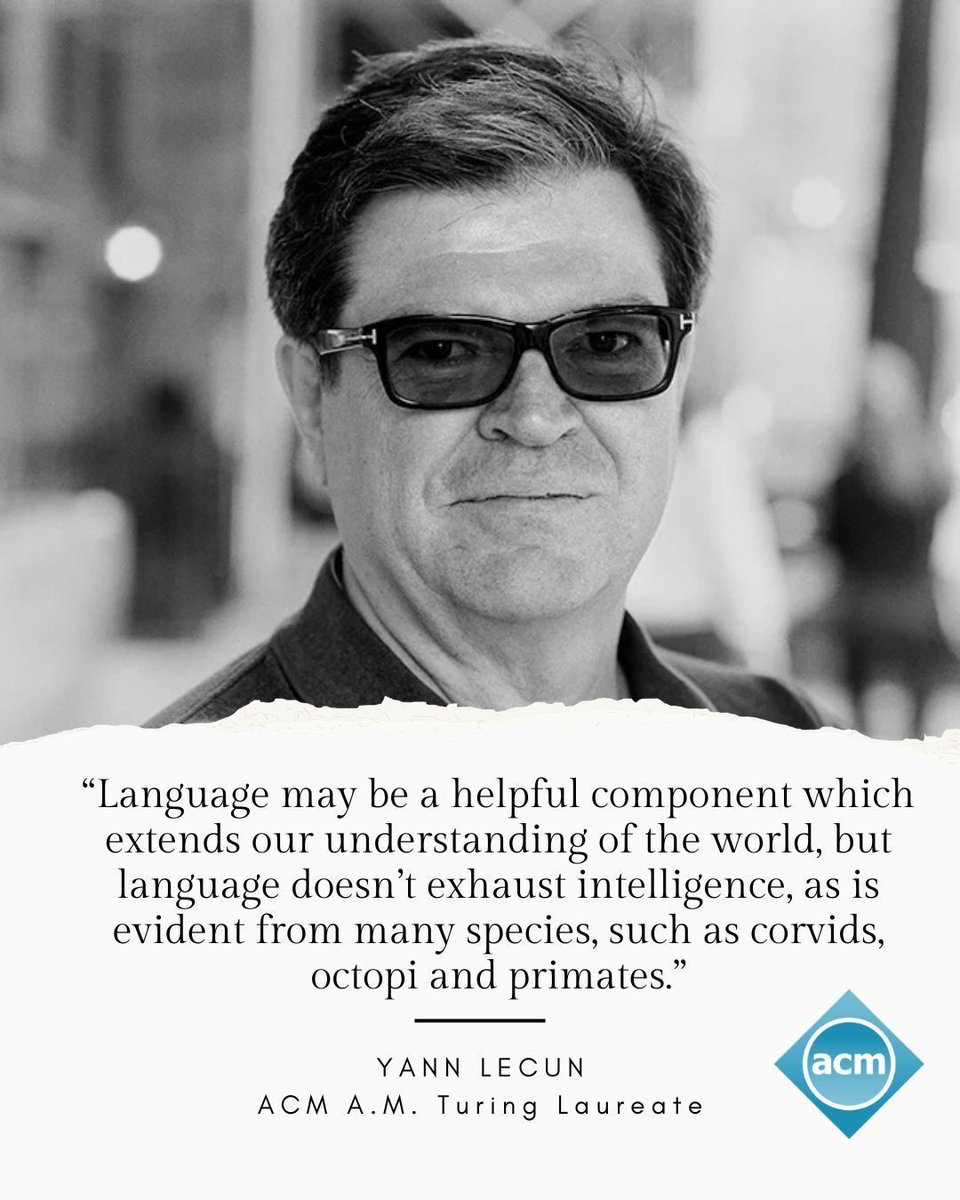
Happy Birthday to Yann LeCun! LeCun received the 2018 #ACMTuringAward for conceptual and engineering breakthroughs that have made deep neural networks a critical component of computing.
LeCun is often called a “godfather of AI” because of his early work in the field.
He developed the convolutional neural network, a type of deep learning model designed to automatically and adaptively learn spatial hierarchies of features from input images, making them highly effective for tasks like image classification and object detection. https://t.co/R6bnecnWmZ
Happy Birthday to Joseph-Marie Jacquard, who was born on this day in 1752.
In 1804, Jacquard transformed textile manufacturing with a loom that used a series of punched cards to automatically control intricate weaving patterns. By encoding instructions on interchangeable cards, his invention demonstrated that a machine could be directed by stored instructions, a concept that would later become fundamental to programmable computing.
The Jacquard loom's punched-card system inspired Charles Babbage's designs for the Analytical Engine and later became the basis for Herman Hollerith's tabulating machines, which helped launch the modern data processing industry.
Today, Jacquard's legacy is a reminder that transformative ideas often emerge from practical needs.
#PioneerPOV #ACM #Pioneer #ComputerScience #ComputingHistory
Happy Birthday, Adi Shamir! Shamir received the 2002 #ACMTuringAward with Leonard M. Adleman and Ronald Rivest, for their ingenious contribution to making public-key cryptography useful in practice.
In 1977, Adi Shamir, Rivest and Adleman created a system that made it possible to encrypt messages using a public key, freely shared with anyone, and decrypt them using a separate, private key known only to the recipient. Their method, called the RSA Method, allowed confidential information to be exchanged without requiring the sender and receiver to share a secret key in advance.
The RSA Method still underpins internet transactions today. https://t.co/G040q98FrT
Today in 1928, #ACMTuringAward recipient Juris Hartmanis was born. Hartmanis and Richard E. Stearns received the award together in 1993 in recognition of their seminal paper which established the foundations for the field of computational complexity theory.
While working for General Electric in the 1960s, Hartmanis and Richard Stearns became interested in how much time and memory are needed to perform different computations – a field that they named computational complexity. They defined different classes of calculations according to how much calculation and/or memory space each would require, which is a measure of their difficulty. Their famous 1965 joint paper began to interest other computer scientists in looking at complexity the same way.
Watch Hartmanis talk about the beginning of his collaboration with Stearns: https://t.co/CHRs0JWfeK
#OTD #ComputerScience #computationalcomplexity #TuringAward
Happy Birthday, Richard E. Stearns! Stearns received the 1993 #ACMTuringAward with Juris Hartmanis in recognition of their seminal paper which established the foundations for the field of computational complexity theory.
In this video, Stearns describes how he and Harmanis discovered the breakthroughs that contributed to their paper. The full video is here: https://t.co/UyPIY8lYsG
#ComputerScience #computationalcomplexity #TuringAward
"Even when you write a paper about a pretty obviously significant theoretical idea, people don’t take you seriously until you build it and do an experiment."
What's in our latest edition of #AdvancesInComputing:
- the much-anticipated conversation with the 2025 #ACMTuringAward recipients;
- A.I. for software engineering;
- exploring the relationship between technology, joy, and justice
& more.
Grab a copy via #Substack📜 : https://t.co/nTus0za8fZ
July is Disability Pride Month! Ever wonder how technology can be better designed for accessibility? Join ACM in celebrating the contributions of disabled computing professionals and explore our curated reading list on accessibility designs. 📚
Today in 1926 #ACMTuringAward recipient Fernando J. Corbato was born. He received the award in 1990 for his pioneering work organizing the concepts and leading the development of the general-purpose, large-scale, time-sharing and resource-sharing computer systems, CTSS and Multics. Many of Corbato’s ideas are now ingrained in computer science ideology, including: dynamic linking; hierarchical file systems; and paging and segmentation
In this 2018 interview, Corbato explains how he developed Multics in 1963: https://t.co/hQoWnyfjfp
#OTD #ComputerScience #Multics #CTSS #TuringAward
Ever wonder what happened at this year's ACM Awards Banquet afterparty? From brilliant researchers exchanging ideas over drinks to fun group photos, the energy didn't slow down.
Check out the unforgettable highlights 👇️
For more: https://t.co/c9hXJomgeX
#ACMAwards #computing #researchers #innovations
The ACM India Council has constituted its new Executive Committee for the upcoming term.
We are delighted to announce that @ponguru will serve as President of ACM India.
Dr. Kumaraguru is a Professor of Computer Science at IIIT Hyderabad, Fellow of the Indian National Academy of Engineering (FNAE), and received his PhD from Carnegie Mellon University. His research spans Responsible AI, Interpretability and AI Alignment. His PhD research led to the creation of Wombat Security Technologies, and he currently manages the Precog research group at IIIT Hyderabad.
Joining Prof. Kumaraguru on the Executive Committee are Dr. Sachin Lodha, Head of Research at Tata Consulting Services, who will serve as Vice President, and Prof. Yogesh Simmhan, Professor Indian Institute of Science (IISc) who will serve as Secretary/Treasurer.
Please join us in congratulating the new Executive Committee as they work with the ACM India Council and the broader computing community to advance ACM India’s mission of strengthening computing education, research, and professional engagement across the country.
The Council also expresses its sincere gratitude to the outgoing Executive Committee for its leadership, dedication, and service to ACM India over the past term.
We look forward to an exciting new chapter for ACM India!
ACM India Council
#ACMIndia #Computing #TechLeadership #Research #Education
“We started investing in AI training not because it’s a trend, but because we saw real fear in the team,” said Alexey Karnaukh. “People thought AI would replace them, and because of this, they either ignored the tools or used them very superficially.”
Learn more about the benefits of AI training for employees: https://t.co/TN8A38I127 #CACM #CareerNews
On this day in 2007, Apple released the original iPhone. By combining an iPod, a phone, and a breakthrough internet communicator into a single touch screen device, Apple swept away the physical keyboards and stylus-driven interfaces of the past. The iPhone effectively consolidated the entire internet into a pocket sized device, forever changing how humanity interacts with technology.
#OTD #ComputingHistory #Apple #iPhone
"The easiest way to avoid the second-system effect is the most obvious: Don’t do it. But like any good rule of thumb, there have to be exceptions. How do you know when it’s the right thing to do?"
Learn more from our #Substack newsletter:
https://t.co/XF12dce9Ua
#OTD in 1913, Maurice V. Wilkes was born. Wilkes received the 1967 #ACMTuringAward for his many contributions to the field of #computerscience. He built and designed the EDSAC, the first computer with an internally stored program. https://t.co/eZ7cr1mFmY
What is information? How to use quantum mechanics for cryptography?
Find out the answers in our latest interview with #ACMTuringAward recipients Charles H. Bennett and Gilles Brassard.
Watch the laureates discuss details of their work and explain how quantum information science provides a new way to communicate information.
For full video, visit: https://t.co/ebihzPZXhI