Join us on Wednesday 10 June, 4.00-4.45pm, for a practical webinar exploring what the new Inclusive Mainstream Fund (IMF) and Inclusive Early Years Fund (IEYF) mean for schools and settings.
Schools are beginning to receive IMF allocations from June 2026, with primary schools expected to receive an average of around £14,000 per year and secondary schools around £48,000. Eligible early years settings are also preparing for the IEYF, with funding expected from September 2026.
Join our expert panel to explore the funding, the priorities within the guidance and how settings can maximise this opportunity to strengthen inclusive practice.
📅 10 June 2026 | 🕓 4.00-4.45pm BST
Reserve your free place https://t.co/xpgMXAEqta
#SEND #Inclusion #InclusiveMainstreamFund #InclusiveEarlyYearsFund
The new Inclusive Early Years Fund (IEYF) is designed to help eligible early years settings strengthen inclusive practice, early intervention and support for children with emerging SEND and SEMH needs.
Local authorities are expected to distribute funding to eligible settings in England from September 2026.
The fund reflects a growing focus on:
• workforce capability
• inclusive environments
• relational practice
• earlier support for children and families
We’ve explored what the IEYF means for settings and how Thrive aligns with the key priorities in our latest blog 👉 https://t.co/ojZz2jmbwa
#EarlyYears #EYFS #SEND #Inclusion #EarlyIntervention #InclusivePractice
Early years teams are supporting increasing levels of sensory, communication and emotional need - often while balancing stretched resources and rising expectations.
So how can settings create environments where every child feels safe, regulated and ready to learn?
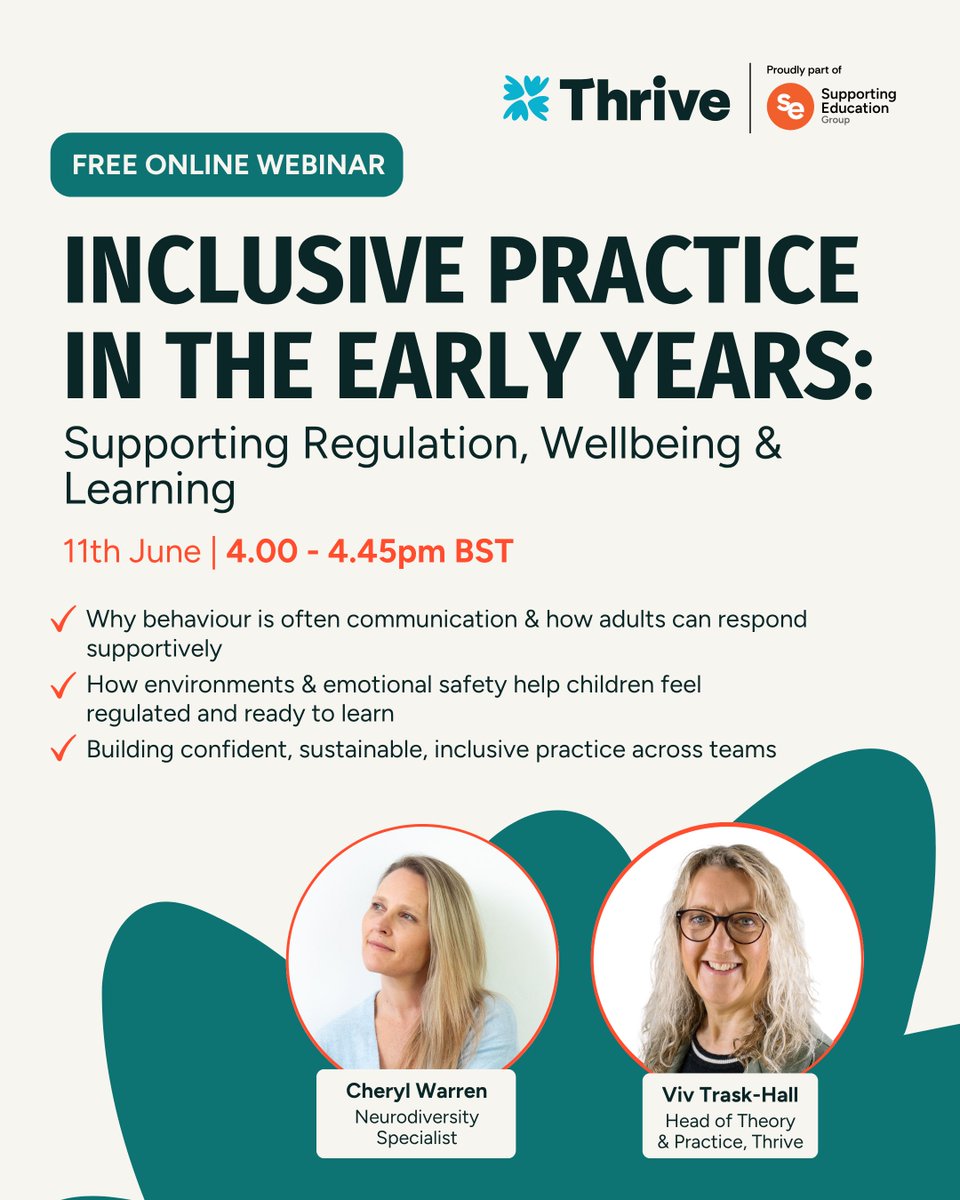
Join Thrive's Viv Trask-Hall alongside neurodiversity specialist Cheryl Warren for a free webinar exploring practical, inclusive approaches that support wellbeing, regulation and engagement in the early years.
We’ll explore:
• Why behaviour is often a sign of stress, not defiance - and what children may be communicating through dysregulation, withdrawal or overwhelm
• How environments, routines and adult responses can help children feel safe, regulated and able to engage
• Why inclusive practice should begin before diagnosis, and how this benefits all children
• The connection between emotional safety, regulation and engagement in the early years
• How settings can build more confident, consistent and sustainable inclusive practice across teams, without overwhelming staff
📅 11 June 2026
🕓 4.00-4.45pm (BST)
Reserve your free place: https://t.co/V5mg9XABQ4
#EarlyYears #InclusivePractice #SEND #Neurodiversity #EarlyYearsEducation #ChildDevelopment #EYFS
With schools set to receive Inclusive Mainstream Fund allocations from June 2026, many leaders are now starting to consider where this funding can have the biggest long-term impact.
The 7 Principles of Inclusion within the IMF guidance give a clear indication of the direction of travel for mainstream inclusion - placing greater emphasis on earlier intervention, staff capability, adaptive teaching, accessible environments and whole-school approaches that strengthen belonging and participation.
Rather than focusing on isolated interventions, the principles encourage schools and trusts to think about how inclusive practice is embedded across the whole school day and wider school culture.
We’ve explored the 7 Principles of Inclusion, what they mean in practice, and how Thrive aligns with these priorities in our latest blog:
👉 https://t.co/6lH0OtDiTa
#SEND #Inclusion #EducationLeadership #SEMH #SchoolImprovement #InclusiveMainstreamFund
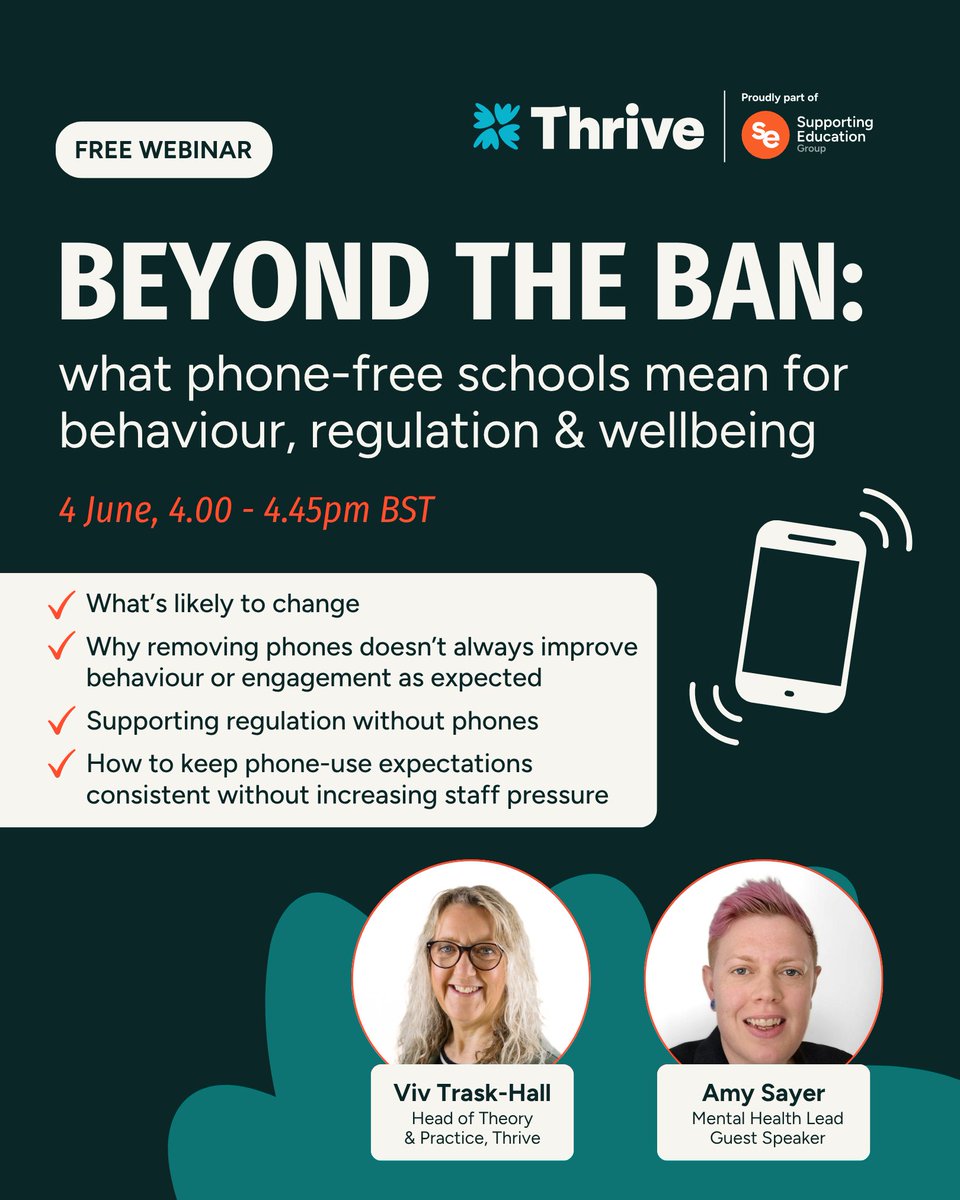
Phones out of sight. But what happens next?
As more schools introduce phone-free approaches, many are seeing shifts in behaviour, regulation and relationships - but not always in the ways they expected.
Join Viv Trask-Hall alongside guest speaker and mental health expert, Amy Sayer, on 4th June 4.00 - 4.45pm (BST), for a practical conversation exploring:
• What phone-free schools are likely to change - and what they won’t
• Why behaviour and engagement don’t always improve overnight
• How to support pupil regulation when phones are no longer available as a coping tool
• Ways to maintain consistent expectations without increasing staff pressure
A practical webinar for school leaders and educators focused on behaviour, wellbeing and supporting pupils effectively in phone-free environments.
Register here 👉 https://t.co/1bjsZJ42U5
The new Inclusive Mainstream Fund will provide additional funding to help mainstream schools strengthen inclusive practice and support pupils with SEND and SEMH needs.
For school and trust leaders, understanding how the funding can be used - and what effective inclusive provision looks like in practice - will be an important part of planning over the coming months.
We’ve pulled together a practical guide covering:
• what the Inclusive Mainstream Fund is
• the 7 key themes of inclusion
• how schools may choose to use funding
• where Thrive aligns with the guidance
Read the guide:
👉 https://t.co/qBSjUBmQxi
#SEND #Inclusion #EducationLeadership #SEMH #SchoolImprovement #InclusiveMainstreamFund
Want to feel more confident using Thrive-Online to demonstrate impact and track wellbeing across your setting?
Join us next Tuesday, 5th May, for our customer-only Thrive-Online network session: Using Thrive-Online to report on wellbeing & impact of interventions
In this focused 1-hour live session, you’ll:
- Better understand assessment data, reports and dashboards
- Strengthen whole-school or trust-level reporting
- Take away practical insights you can use straight away
Whether you're a senior leader or a regular user, it’s a valuable opportunity to get more from Thrive-Online.
⏱️ 3.45-4.45pm BST
🔴 Live only (not recorded)
Please note this is for Thrive customers only.
Sign up here and explore other upcoming customer network sessions:
https://t.co/E51Ahed3c1
When children and young people don’t feel safe, understood or able to take part, it shows up.
Sometimes as:
- Distress behaviour
- Withdrawal
- Low attendance
- Disengagement
These aren’t separate problems. They’re signals that something important is missing. Inclusion is most visible in how we respond in these moments.
Read more about how Thrive supports inclusion in practice: https://t.co/tDusa3A8w6
#Inclusion #Education
If Thrive has been on your radar, but you haven’t taken the next step yet, join our webinar on 29 April, 4–5pm BST. We’ll share what Thrive looks like in practice, how it works across phases, what schools are seeing, and what’s involved in getting started.
Register here: https://t.co/UWycI3xa0n
New research from @ThriveApproach@ImpactEd_Group raises concerns about schools’ readiness for #inclusion-led SEND reforms. Large-scale survey finds limited capacity, stretched staffing & growing pressure on wellbeing despite strong commitment from staff https://t.co/xUVM07zLw2
Inclusion isn’t about what’s “wrong” with a child.
It’s about what might be getting in the way.
That might be:
- The environment
- Expectations
- Relationships
- How support is structured
When we shift the focus, new possibilities open up.
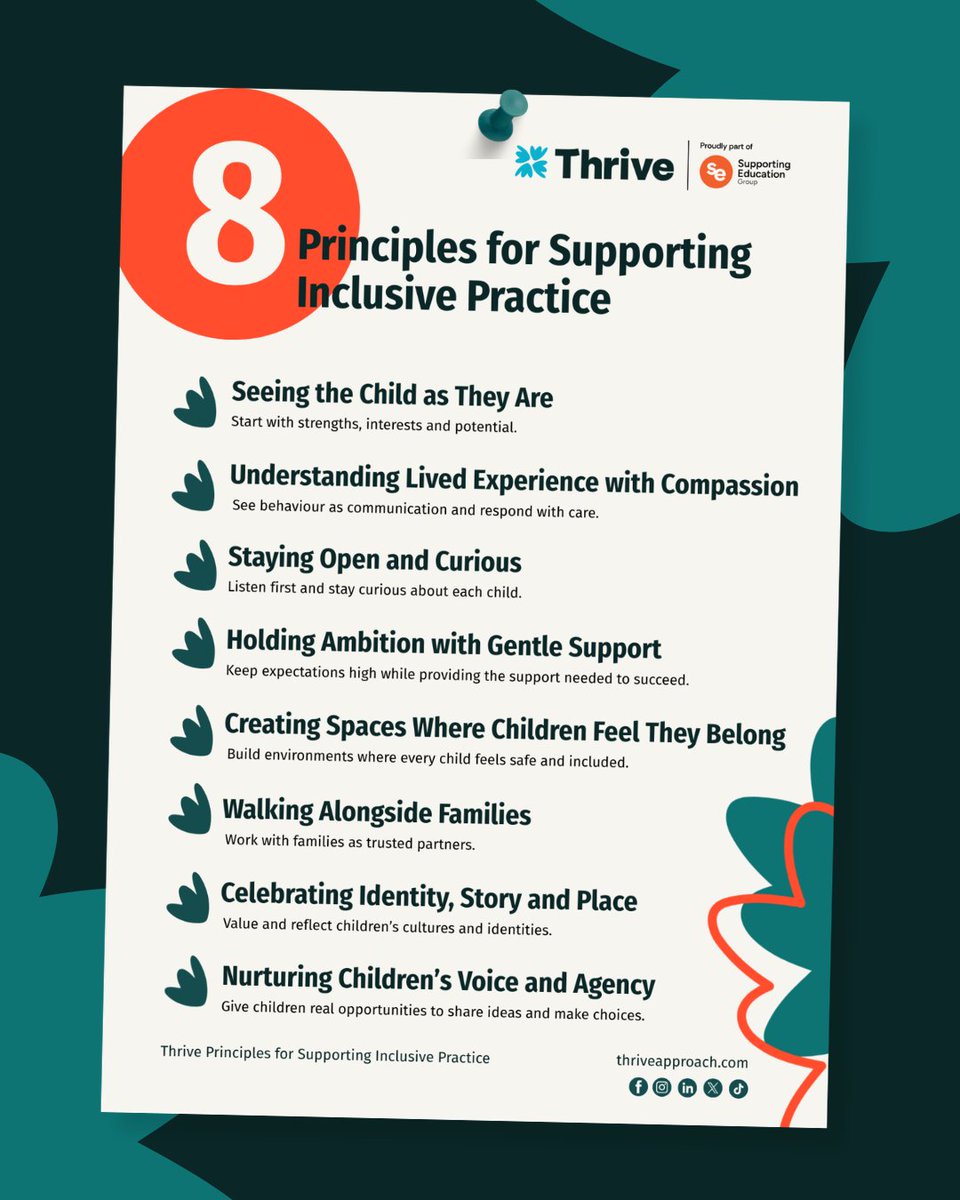
Explore our 8 Principles for Supporting Inclusive Practice: https://t.co/gvba4icFrk
Exclusive for Thrive customers: introducing Network Sessions
Are you a Thrive School or Licensed Practitioner looking to embed Thrive with confidence?
Our customer-only Network Sessions are designed to help you strengthen whole-setting practice and get more from Thrive-Online and My Thrive Scan.
Each session is stand-alone, so you can join what fits your role, priorities, and stage in your Thrive journey.
Explore what's coming up in the summer term https://t.co/px1yqFr9qz
New research from @ThriveApproach@ImpactEd_Group raises concerns about schools’ readiness for #inclusion-led SEND reforms. Large-scale survey finds limited capacity, stretched staffing & growing pressure on wellbeing despite strong commitment from staff: https://t.co/xUVM07zLw2
New research from @ThriveApproach@ImpactEd_Group raises concerns about schools’ readiness for #inclusion-led SEND reforms. Large-scale survey finds limited capacity, stretched staffing & growing pressure on wellbeing despite strong commitment from staff: https://t.co/wgAul8rAeh
When a child is struggling, behaviour is often the first thing we notice.
But it’s rarely the whole story.
Behaviour can be a signal that something is getting in the way of:
- Feeling safe
- Feeling understood
- Being able to take part
Inclusion starts when we pause and ask:
What might this child be communicating?
What might need to change around them?
Explore more in our blog on how Thrive supports inclusion: https://t.co/0H5ELyWjCE
🚨 Final call: £9,000 levy-funded leadership development ending
Only 4 days left to secure a place before the Level 5 Operations Manager apprenticeship is withdrawn.
This is your last opportunity to access funding for:
• Thrive Wellbeing Leadership Level 5
• Thrive Advanced Practitioner Leadership Apprenticeship
If you’re leading on behaviour, wellbeing or SEMH, this gives you a clear, structured way to embed a whole-school approach.
🎥 We’ve broken it all down in a recent webinar. See what’s involved and what you’ll gain in practice.
⏳ Deadline: midnight, Sunday 19 April
Places are limited - and this is the last ever cohort.
👉 Apply now or watch the webinar to decide: https://t.co/ocmzkM3S4g
#Level5Apprenticeships #SchoolLeadership #SEMH
Join us for a practical conversation on what the Schools White Paper really means for inclusion across your trust.
We’re bringing together Thrive's Tom Preston and Viv Trask-Hall, alongside guest speaker Liz Murray (SEND Director, Supporting Education Group), to explore what it takes to deliver inclusion consistently, at scale.
Most trusts understand the expectations. The challenge is making it work across every school.
Capacity is stretched. Needs are rising. And what works in one setting doesn’t always translate.
Drawing on new research from Thrive and ImpactEd, based on 1,000+ education professionals, we’ll unpack where delivery breaks down - and what to do about it.
You’ll learn:
- What the White Paper means in practice for trust-wide inclusion
- Where delivery tends to break down across schools
- Why some approaches don’t scale - and what to do instead
- How to use new investment to build capacity across your trust
- How to assess and strengthen inclusion readiness
If you’re responsible for inclusion across multiple schools, this will give you a clearer path forward.
Save your place:
https://t.co/F7cawY0VYS
Can’t join live? Sign up and we’ll send the recording.
Inclusion isn’t what’s written in a policy.
It’s what children experience every day.
Whether they feel they belong.
Whether they know they matter.
Whether they can take part in learning and school life.
If those conditions aren’t there, inclusion isn’t fully in place.
Schools understand this.
The challenge is having the time, capacity and shared approach to make it consistent.
See what schools are saying in our latest Inclusion Readiness report: https://t.co/5iskpBNhHJ
What difference does a whole school approach to wellbeing, behaviour and inclusion make in schools?
Our new independent evaluation with ImpactEd highlights some clear patterns.
Schools using Thrive are seeing:
27% lower exclusion rates than the national average
Primary exclusions down 52%, secondary down 35%
Improved wellbeing for pupils with SEND, despite national trends
Up to 38% lower rates of severe absence in highly engaged schools
Stronger staff wellbeing, morale and confidence
But the numbers only tell part of the story. Schools also report calmer learning environments, more consistent responses to behaviour and children who feel safe and ready to learn.
These results show what is possible with early support, strong relationships, and a deep understanding of social, emotional and mental health.
If you want to create a more inclusive school where all children feel safe, supported and ready to learn, read the full ImpactEd evaluation.
Explore the full report https://t.co/mxnVftM1f0
Belonging influences how we show up, how confident we feel and whether we choose to participate.
Children and young people experience this every day in school environments. When they feel safe, recognised and included, they are more able to engage, build relationships and take part in learning.
In this video, Sarah Browne shares practical ways schools can create stronger conditions for belonging:
• Calm, predictable spaces that reduce anxiety
• Consistent routines that support regulation
• Listening to pupil voice, especially those less often heard
• Representation that helps children feel seen in their environment
When children feel they belong, confidence grows, engagement strengthens and learning becomes more accessible.
Explore our 8 Principles for Supporting Inclusive Practice in Schools: https://t.co/brIlaWdsaC
#Inclusion #SEMH #EducationLeadership #PupilWellbeing #SchoolCulture