Thank you to @timhammerich for having me on the Future of Agriculture to talk about Farm Profit Manager https://t.co/0LX34LAJGn. A great interviewer and awesome post-record editing! We look forward to having you on the Farm Profit Manager team at https://t.co/PVuXHhO4fd
Upstream Ag Professional - The Big Three Stories of the Week
◼︎◼︎◼︎
A look at what agribusiness leaders will find in this weekend's edition of Upstream Ag Professional:
1. Cognitive Biases and Improved Decision Making for Agribusiness Professionals
Often we focus on making smarter decisions, but as good of an opportunity to improve our decison making and effectiveness is to remove predictably bad ones.
Over a decade of collecting cognitive biases led me to build a practical guide with 40 biases I reference often, organized into six clusters, each with agribusiness-specific examples and science-based strategies for overcoming them.
The aim is to have a reference piece for agribusiness professionals to imrpove their decision making, or enhance their influence.
2. Biostimulant Sales: Like selling seed? Or something else?
Check out a small clip from this week's @UpstreamAg Professional audio coverage highlighting the similarities to crop protection, but it goes further than that and I dive in in this weekend's edition.
3. Mental Models for Agribusiness Leaders with Shane Thomas on The Future of Agriculture
This week I joined @timhammerich on The Future of Agriculture podcast to discuss 7 useful mental models that are directly applicable to agribusiness professionals. Models include some popular, and some lesser known ones: Jevons Paradox, Influence Erosion, Strategy Tax, Friction Reduction, Contrarian Decisions, Jobs to be Done and One-Way Doors vs Two-Way Doors
Plus much more in this weekend's edition.
Mental Models for Agribusiness Leaders
◼︎◼︎◼︎
Recently, I talked with @timhammerich on The Future of Agriculture, one of my most listened to podcasts.
It was a ton of fun to join Tim and talk about some of the concepts that have been valuable to me over the course of my career.
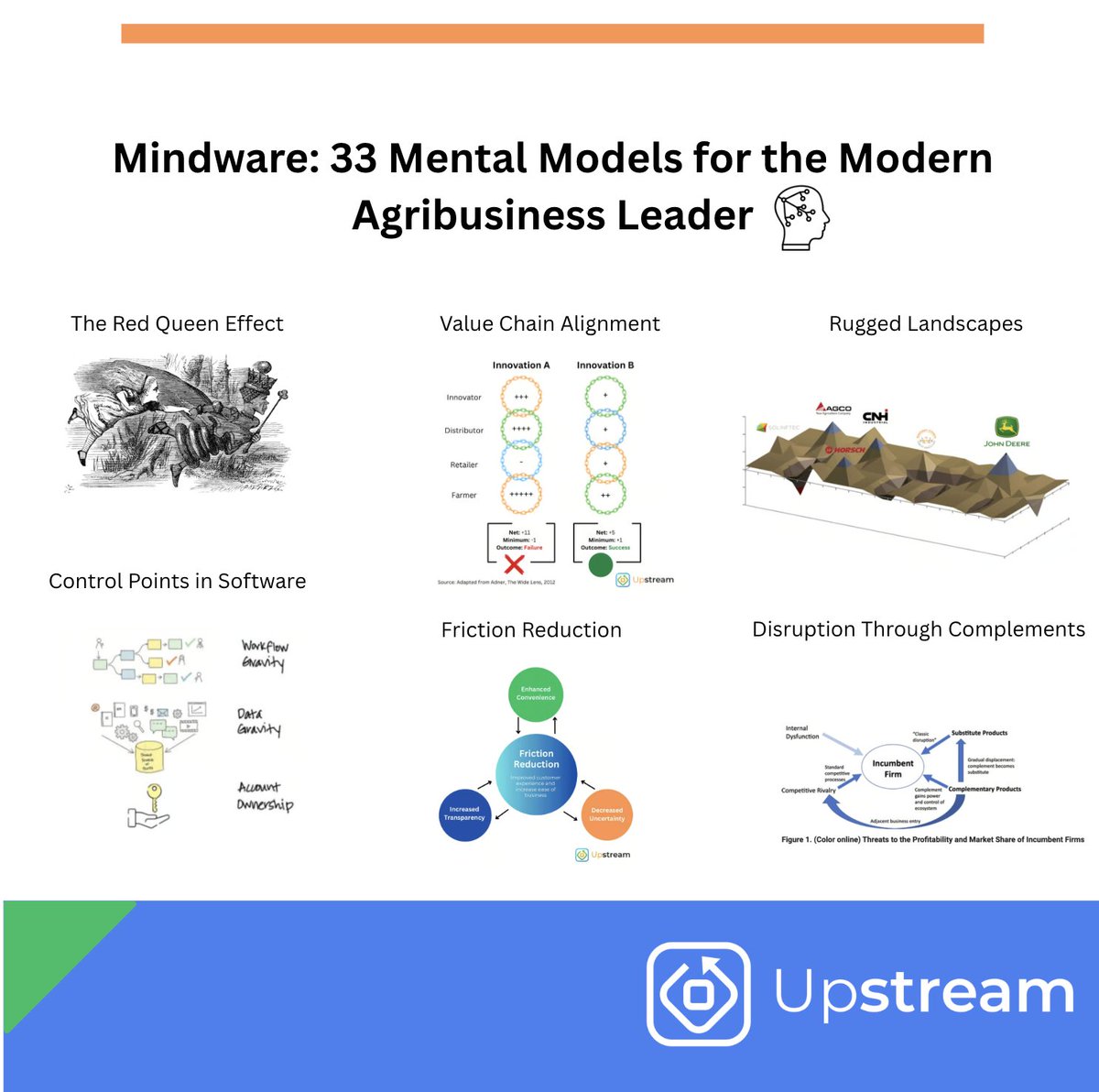
In the conversation, we dive into half a dozen of the mental models I covered in the @UpstreamAg Insights e-book, Mindware: 33 Mental Models for The Modern Agribusiness Leader.
The basis of the concepts are that agribusiness professionals operate in a world full of volatility, complexity, and constant change. Commodity price swings, regulatory shifts, changing customer demands, and technological evolution create a landscape where uncertainty is the norm.
And ultimately, agribusiness professionals are knowledge workers and what separates the best in agribusiness from the rest is often how they think.
Thinking better, whether more strategically or quickly, requires mental tools.
Carpenters have a tool belt, golfers carry 14 clubs, a chef has more than just a spatula.
Every "tool" serves a specific purpose, depending on what is required.
Agribusiness professionals should operate the same way with mental tools.
These mental tools are what I refer to as Mindware - models and frameworks that help to gauge a scenario, find gaps in logic, or think long term, ultimately delivering improved judgement and better outcomes for careers and businesses.
Check out the full conversation where Tim and I discuss the concepts and apply them directly to agribusiness: https://t.co/CfvkuAYbmw
I want to design a project-based curriculum for my kids' summer break to help them learn more about AI tools and how to use them (grades 2nd and 6th).
I've found a few resources in researching the idea. I'm curious if anyone has firsthand experience with this & what worked well?
“It’s a trying time. In 24 years (in fertilizer) I’ve never seen it like this. I hope I never see it again.” - @JLinvilleFert
Full interview on today’s episode of the Future of Agriculture podcast
https://t.co/7YMwThKuPa
Zack Smith (@zebulousprime) is doing something really interesting with his latest StockCropper product.
Instead of targeting Midwest row crop farmers, he designed and positioned it for homesteaders and backyard producers. He continues to innovate!
https://t.co/UXDQOEzOcs
@NickHorob Very cool Nick. Thanks for sharing. I like the idea of adapting EOS for personal projects accounting for personal strengths/weaknesses. I’d love to read the full doc if you’re willing to share. It would be a good exercise to try myself.
One minute of wisdom from Cal Newport in this clip.
The best way to kill your phone addiction is to fill your life with the good stuff.
Cal’s ideas have really improved my life.