We prefer the language of diplomacy, but we speak other languages far more fluently. Break your commitments, and we'll switch to what we speak best.
You ride the horse you saddled!
Foreign forces in proximity to our territory are at constant risk on account of their own human errors, plain accidents, or potentially being caught in crossfire.
To reduce risk, best solution is for them to leave.
We prefer language of diplomacy but speak other languages too.
Absolutely. The whole point is to destroy the Middle East as an oil-producing region and make the market come to America.
The US already succeeded in becoming Europe's #1 supplier of LNG, oil, & coal by taking out Russia/Nord Stream
They're simply scaling the plan up globally.
They knew an attack on Iran would threaten Gulf economies, disrupt diversification plans, and increase regional instability. They did it anyway and expected the Gulf states to absorb the costs. So much for caring about their allies and partners’ stability and security.
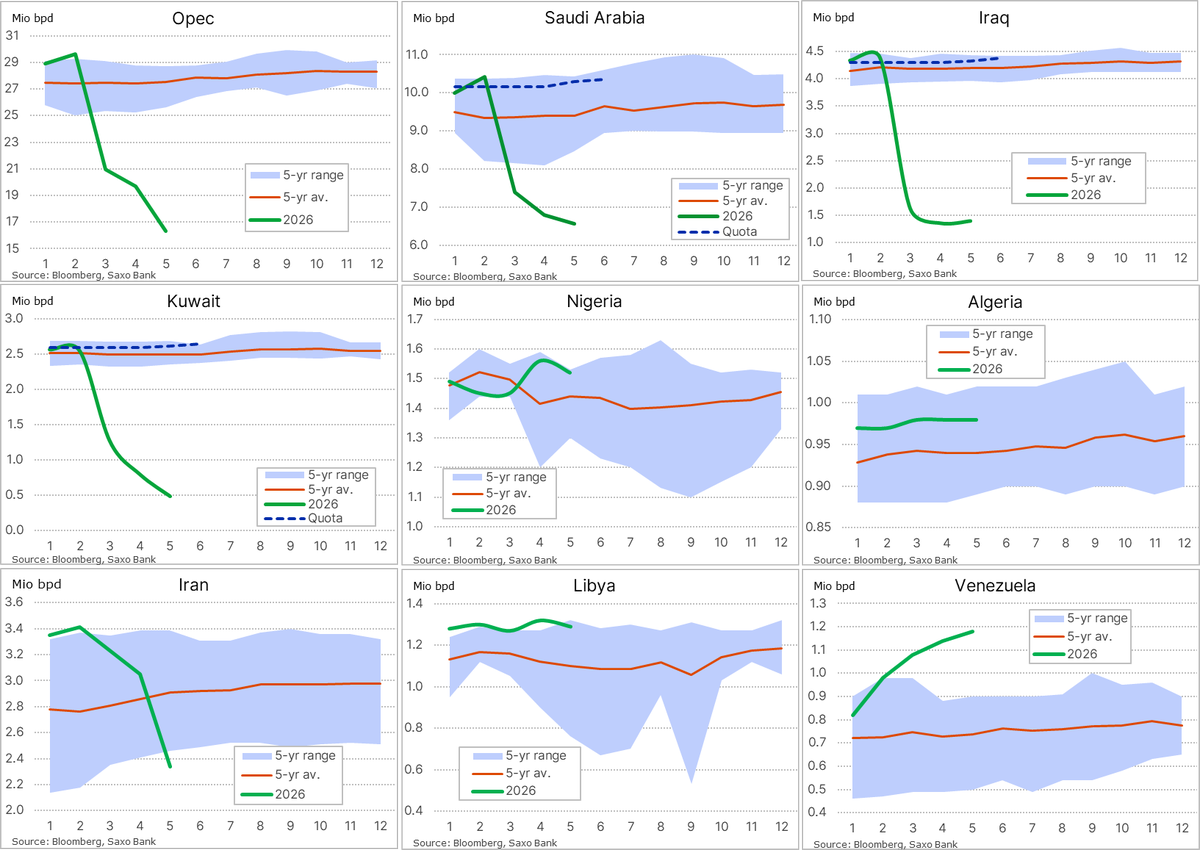
OPEC crude production fell to a fresh 40-year low last month as the continued blockade of the Strait of Hormuz forced another round of production shut-ins across the Gulf region. The group, now reduced to 11 members following the UAE's departure, saw output decline by 1.2 million barrels per day to 16.33 million barrels per day.
Iran and Kuwait accounted for more than 1 million barrels per day of the total decline, while Iraq recorded a modest recovery in output. Saudi Arabia's production fell by a further 240,000 barrels per day to 6.57 million barrels per day, leaving output down 37% from February levels. While extensive pipeline infrastructure has prevented a more dramatic decline - compared with production losses of around 80% in Kuwait and 70% in Iraq - it nevertheless highlights the kingdom's limited ability to offset regional supply disruptions while key export routes remain constrained.
Outside the Gulf, Venezuela continued to benefit from US involvement and its relative insulation from the crisis, with production rising to a fresh seven-year high of 1.18 million barrels per day.
Data from Bloomberg's monthly production survey.
As expected, Israel struck Iran's oil production just as Ukraine have been doing to Russia's these last months.
This cuts off China + reduces their market share at the source — while US naval blockades pirate the oil in transit.
In the end US sales go up & Petrogas-Dollar wins.
Iran has included three important tests within the terms the MOU it is negotiating with the United States. These tests are intended to give Iran's leaders confidence that Trump, a counterparty they see as highly unreliable, is ready to make credible commitments, opening a pathway for further diplomacy.
First, the Iranians are testing the credibility of American security commitments by insisting that the MOU encompasses a Lebanon ceasefire. They are not doing this for the sake of Hezbollah or Lebanese Shias. Rather, they want to see if Trump can restrain Israel in its own backyard. If Trump is able to do that, then he might be able to defend his own deal with Iran from further Israeli sabotage.
Second, Iran is insisting on a nominal fee for vessels passing the Strait of Hormuz. This is not because they want more revenue, which would be negligible. They are insisting on this arrangement because they want to test whether Trump will endorse a deal that includes a clear instantiation of Iranian sovereignty and authority, especially one that did not exist before the war. Iran believes in the logic of a win-win agreement. Trump does not. Forcing him to accept a fee forces him to give Iran a "win" and to defend it as such from the Iran hawks in his circle. This is politically meaningful.
Finally, Iran is insisting on a the release of frozen assets. The sums in question are a tiny fraction of the economic cost of the war and the release of assets is not as valuable as sanctions relief that Iran will also be targeting. But by insisting on the release of funds at an early stage of the negotiations, Iran can test whether broader economic commitments, such as sanctions relief, will be credible. Iran will only consider the promise of sanctions relief to be credible if Trump's sanctions bureaucracy allows Iran to move and spend its own money. The Iranian side will insist on transactions that push the Trump administration to set new precedents for how sanctions relief can be operationalized, especially through guidance to banks.
For many in Washington, these demands seem unreasonable. But that is entirely the point. Iran's leadership won't tolerate a kind of narrow deal that allows U.S. policymakers to avoid putting political capital at stake. Iran wants a deal that reflects the unprecedented nature of the war and ensuing crisis. To meet the moment, the diplomacy has to be transformative.
Iran's leaders don't trust Trump, so they are testing him. So far, he is failing these tests.
Firstly, Ethiopia is under US sanctions while Vietnam is not. And speaking of former French colonies, Haiti was the first to get independence (1804) and is still one of the poorest countries in the world because of the debt they had to take on to gain independence (it took them until 1947 to fully repay it!). Whereas, New Caledonia is still a French colony and is neither rich nor poor.
"If colonialism were the answer to why Africa is poor..."
This line completely ignores the European powers' (and US) post-colonial control over Africa. Patrice Lumumba, the first democratically elected leader of the DRC, was tortured and killed by Belgium and the US for being a nationalist. His body was dissolved in acid so he wouldn't become a martyr. His legacy is largely unknown even within the continent. Several other such "lessons" were meted out. Google Thomas Sankara (Burkina Faso) and Sylvanus Olympio (Togo).
Once you set the example, you gain obedience. The VietCong, on the other hand, didn't surrender even though 3 million Vietnamese died during the war, and several thousand more continue to die to this day (!) from Agent Orange exposure.
As for former French colonies in Africa, France still controls their currency and holds their central bank reserves in France. As Rothschild purportedly said, "permit me to issue and control the money of a nation, and I care not who makes its laws."
Third, the borders in Africa were drawn in such a way that conflict was inevitable. At the Berlin Conference in 1884-85, the European powers simply carved up the continent by drawing straight line borders. African leaders were conspicuous only by their absence at this historic event which shaped the next century. This is why Cameroon, a French-speaking country, has a minority English-speaking territory, ensuring it remains destabilized. Likewise for West Asia/the Middle East, where the Sykes-Picot legacy lives on.
@magattew conflates formal colonial rule with colonial control. Vietnam managed to fully kick out both France and the US, reunified the North and the South, and kept its sovereignty. All African leaders who attempted the same have been systematically eliminated (see Muammar Gaddafi, Libya's divisive leader, for a recent example), ensuring Africa forever bears the open wounds of its colonial legacy.
But Ms. Wade is right on one thing: Vietnam owes its prosperity to overcoming colonial rule. Maybe Africa can become prosperous if Africans do the same.
The Iranian navy, which has been destroyed eight times, has apparently closed the Strait of Hormuz again, because the United States, for the seventh time, won the war that wasn’t a war, so now the United States has to open the Strait of Hormuz that was already open before the not-war began.
The not-war began because Iran had uranium that was totally, completely, beautifully obliterated, so they can’t build the nuclear bomb they weren’t building, which is why the United States had to start the not-war it definitely didn’t start.
Now the United States, which has nuclear weapons, is threatening to use nuclear weapons to stop Iran from getting nuclear weapons, because nuclear weapons are far too dangerous for countries with nuclear weapons to allow other countries to have.
If the United States saw the United States doing what the United States does in other countries, the United States would invade the United States to liberate the United States from the tyranny of the United States.
🔥 CENTCOM boldly claimed that they intercepted all the ballistic missiles and drones Iran fired earlier this week against US bases in Kuwait.
New high-res satellite imagery attests exceptionally precise strikes against multiple hangars and other facilities.
Extradition requires the cooperation of the state where the pill provider operates. Those states have shield laws specifically stating that they will not help you, and in fact, will protect the pill provider from you.
Targeting out-of-state and/or international pill providers is not an effective solution (though those people should be prosecuted whenever possible).
The only solution that has any teeth is criminalizing abortion as homicide for anyone and everyone who willfully participates in it, including mothers who abort their own children.
Please take a minute to watch this brief video where you can see @J_R_Haas, VP of @AATXNow address a similar scenario to what you describe. He gave this testimony in 2025 to address legislation that seeks to go after providers sending pills into Texas.
We must stop chasing faux solutions that only look good in headlines. The axe must go to the root of the problem by making abortion prenatal homicide for everyone involved.
https://t.co/iRT1V35Ffg
In 90 days, foreign investors brought ₦16 trillion into Nigeria. Nearly 73% of it went into one sector. The world's smartest money just told you where to look.
“The closure of Hormuz has taken 34% of globally-traded crude oil, 12% of refined petroleum, 20% of LNG offline. It has taken 30% of urea and 25% of ammonia offline, putting the northern planting season at risk in the largest shock to food production in generations. Some 20% of aluminum production if offline too. In the chips supply chain, in addition to the LNG, 35% of helium, 60% of bromine, and 44% of sulphur are now offline.
Unless the war ends soon and Hormuz is reopened, this will be the single greatest stagflationary shock in the history of the modern world economy. And the costs are cumulative. The longer the war lasts, the greater the stagflationary shock and the more central banks must respond by monetary tightening.”