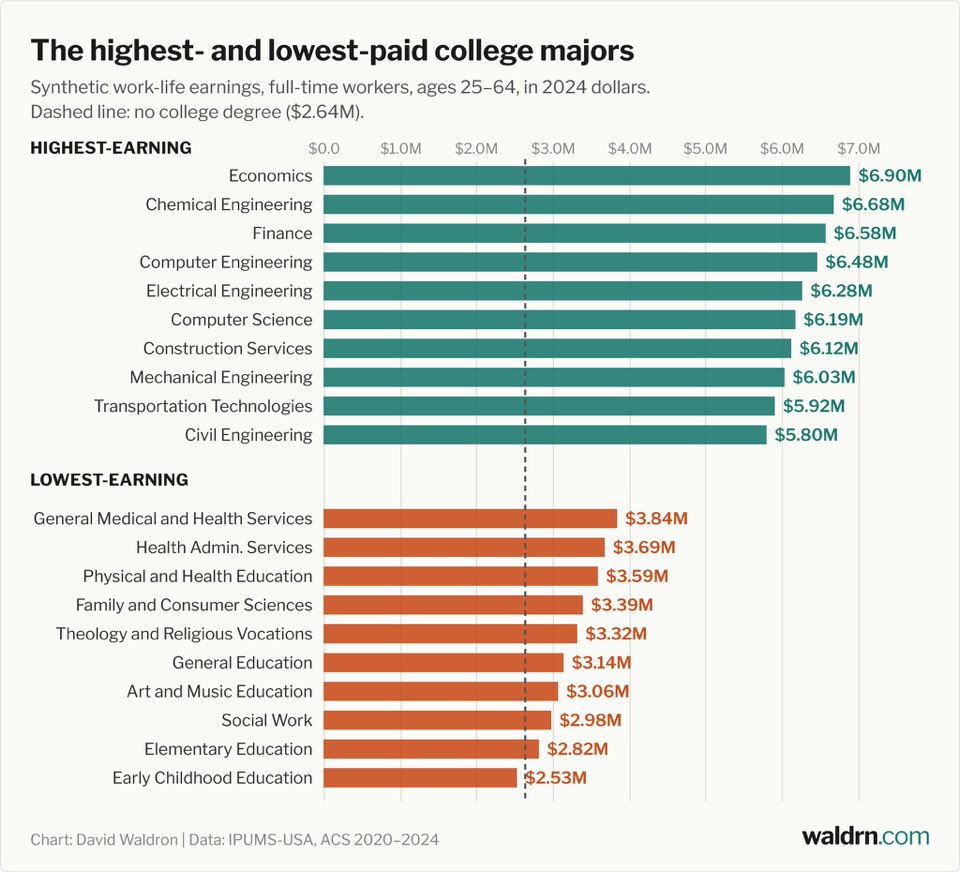
Universities spent years sneering at the tax paying public, calling half of them evil fascists, refusing to reform, waving their PhDs as if they were magical amulets that protected them from the consequences of their own actions. Surely they don’t expect sympathy now do they?
Uniformly high oil and gas well bonding rules do little to protect taxpayers or the environment. Ironically, as well operators struggle to cope with more financial assurance regulations and capital market trends, the well abandonment problem can worsen. https://t.co/OOv7wJulgs
Robert, I have a lot of respect for what you do, but can't wrap my head around this: "J. Gresham Machen spent his career warning that you cannot separate education from worldview, that every curriculum teaches a theology whether it names one or not. Classical Conversations was built on the opposite premise: teach the trivium the way it was taught for two thousand years, ground it explicitly in a biblical worldview, and surround your children with a community that is actually rowing in the same direction you are."
Why is this "opposite"? Why isn't it consistent to say that *because* all education has an implicit theological basis, it is best to explicitly ground that in a biblical world view, delivered in the classical method? It seems to me that Machen's view and your view would be mutually reinforcing.
I’ve spent many weeks doing fieldwork in Tibet, sitting above these enormous, deeply incised Himalayan river systems and seeing firsthand just how geologically active this landscape is.
So spare me the climate-change grift every time a natural disaster strikes.
Catastrophic glacial outburst floods are not new. The 1981 Zhangzangbo GLOF released ~20 million m³ of water and debris into Nepal, with estimated peak discharge approaching 16,000 m³/s. The Himalayas experienced enormous GLOFs long before today's atmospheric CO₂ concentrations.
If it happened naturally in the past, we should expect it to happen naturally again in the future—regardless of atmospheric CO₂.
Turning a horrific loss of life into an immediate climate-change narrative without demonstrating that CO₂ caused this particular event isn't attribution. It's opportunism.
And the people exploiting tragedy to do it are grifters.
@WolfpackS2k@ChrisMartzWX Right. And we have huge cockroaches, hurricanes, and rednecks.🪳The rednecks attack Democrats at random. So if you’re politically leftist, better move elsewhere. Chris can come though.
This is Mises from Omnipotent Government (1944) summarizing his 1920 argument. Socialism cannot do what capitalism can do, which it appears is to solve a knowledge problem. Those planners under a system of collective ownership simply ‘cannot know’ because they cannot calculate.
It's not a problem to use #AI as a tool in writing or let it entirely write for you. Or even, if you prefer, "think" for you (I don't recommend it). The problem is the fraud of using AI but claiming that what you present is *by you*. Many seem to fail to grasp this distinction.
Our Classical Liberals in the Carolinas event would not have been successful without generous sponsorship from the John William Pope Foundation, the American Institute for Economic Research, the Institute for Humane Studies, the John Locke Foundation, and the College of Charleston Center for Public Choice and Market Process.
A great weekend at the Classical Liberals in the Carolinas event in Charleston SC, with engaging talks from Sen. Phil Gramm and AIER's Samuel Gregg. We heard from many others on topics related to the 250th anniversaries of American independence & Adam Smith's Wealth of Nations.
Sell someone an e-bike?
No crime has been committed, and no person has been hurt. There is no victim from that action.
Making it illegal *creates* the victims: the retailer who has a right to sell a good and earn money, and the consumer who has a right to buy the device and use it. Neither of them has committed any crime, yet are now victimized under the coercion of state.
If you hit/hurt someone whether on an e-bike, or a car, or any other device, that is already illegal. If the state was ethical and effective, it would prosecute such crimes. Since it is neither ethical nor effective, it invents new crimes where no victim exists and punishes people for those.
Zohran Mamdani is launching five government-run grocery stores in NYC with 30% discounts on essentials funded by $70 million of taxpayer money.
Sounds wonderful. Cheap food for areas that need it.
Who could object?Anyone who understands the economics, history and game theory.
Here’s why kind-sounding ideas can be dangerous ideas:
1. It’s a marketing campaign, not a food policy. Five stores won’t feed a city of 8.5 million. They exist to produce a spectacle - a photo of Mamdani holding a loaf of cheap bread and a grin that says “see socialism works.” The stores are the ad but the the product he’s selling is collectivism and more state control… which doesn’t work.
2. The maths is predatory. Grocers run on 1–3% margins. Mamdani is discounting 30% … over ten times the entire profit margin of potential competitors. Tax payers fund rent, property tax and supply and offer no penalty for a business that’s losing money. That kills any hope of competition that would naturally transform demand and supply dynamics for real.
3. It corrupts price signals and creates an arbitrage economy. Prices are data. They tell farmers what to grow, distributors what to ship, entrepreneurs where to invest. Subsidise the price and you corrupt the data ... and create a guaranteed profit for anyone with a shopping trolley. People will stockpile non-perishables, clear the shelves, and resell at market price, pocketing the taxpayer subsidy as personal margin. Venezuela ran this exact experiment: price-controlled stores bred a professional class of resellers, and the subsidised goods ended up on the black market anyway. The discount doesn’t reach the needy. It reaches the fastest to grab and resell the stock.
4. It’s proven to fail at scale. Kansas City tried a municipal grocery store and it burned through millions and ended in empty shelves. The Soviet Union tried it with an entire nation. In 1989, Boris Yeltsin visited an ordinary supermarket in Texas and was so staggered by the abundance available to regular working people that he later admitted it shattered his faith in the Soviet system. A random capitalist grocery store did more to end communism than any weapon ever built. The well sticked grocery-store is a miracle of capitalism not state control.
5. There’s no feedback loop. When a private store fails, it closes. When a government store fails, it gets a bigger budget. A failure becomes the argument for more funding. Losses don’t kill a failed experiment in a state run program… They feed bigger budgets. Watch and be prepared to see the $70m budget become $100m in no time.
And the punchline: New York just published a tender asking private operators to actually run these stores. Even the socialist experiment needs capitalists to work the tills. The actual profits will go to government contractors- watch as Accenture suddenly becomes a leading grocery story Labour hire company.
Markets aren’t the enemy of ordinary people. They’re the greatest anti-poverty machine ever discovered. Break the machine and everyone eats worse - especially the people you promised to help.
The only problem is that by the time it proves to be anothet failed socialist initiative there will have been millions of Tik Tok views of Mamdani pretending it works and spreading socialist propaganda to young people who are weaponised against their own interests.
On Aug. 7-8 in Charleston, the Classical Liberals in the Carolinas annual conference will celebrate America at 250 years. Senator Phil Gramm will discuss the triumph of economic freedom, and @DrSamuelGregg will discuss Adam Smith and 1776. Register below!
https://t.co/eSb1DMq9by