This weekend marks 40 years since I arrived in London aged 18 from a working-class background, not knowing anyone - just determined to become a great secretary. I became a Cabinet Minister and Leader of the House of Lords. The real story about me isn't where I started, but why the sensibilities I grew up with and brought with me, took me so far. And my story has never been more relevant for leaders in a world of political and technological turbulence and at a time when public trust in institutions is low – because it’s about bridging divides and building coalitions to foster trust and get results.
To find out more, watch my showreel and visit my website: https://t.co/A7iGmfQqyB
The questions are still difficult. They’re just easier to answer when you:
🧠 use common sense
📚 do your homework
📝 have a plan…
and actually give an honest answer! 😏
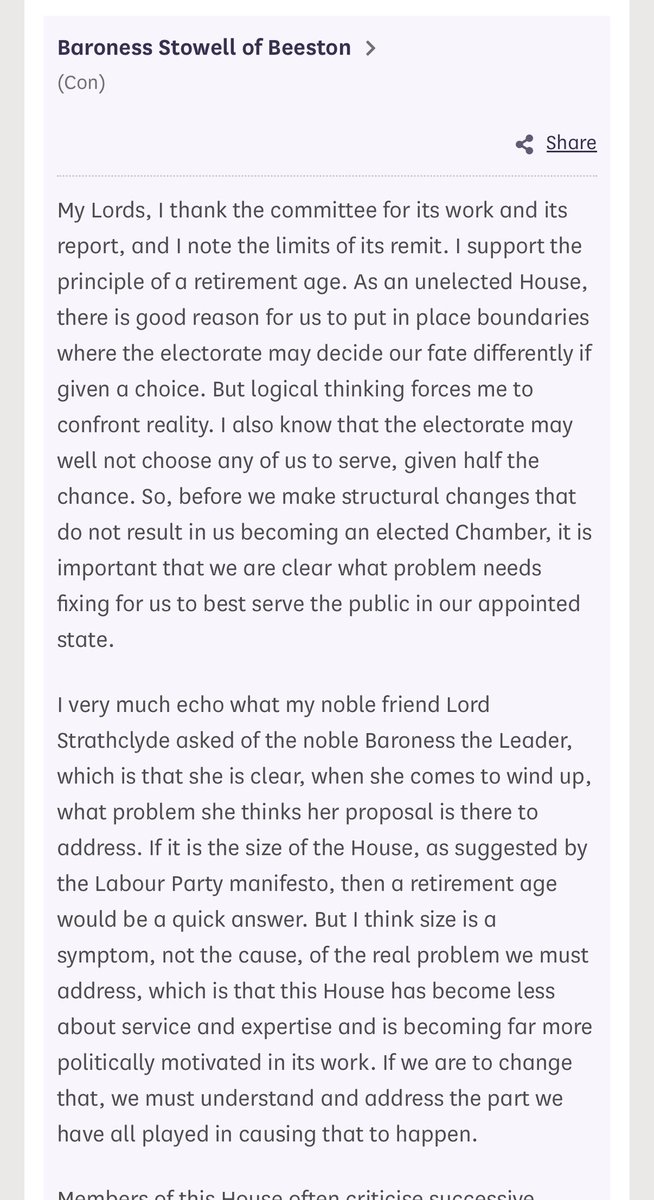
I support a retirement age for the House of Lords in principle. But would it solve the right problem?
The size of the House is a symptom, not the cause.
The real problem is that an appointed House has become more political against the electorate's priorities when the majority of peers disagree with what the majority of people voted for (eg, Brexit, stronger immigration controls) – when its value should lie in expertise and wisdom in service of the public's objectives.
My fear is that the reforms being proposed, including minimum participation requirements, risk making that problem worse.
My speech in the Lords 👇
I support a retirement age for the House of Lords in principle. But would it solve the right problem?
The size of the House is a symptom, not the cause.
The real problem is that an appointed House has become more political against the electorate's priorities when the majority of peers disagree with what the majority of people voted for (eg, Brexit, stronger immigration controls) – when its value should lie in expertise and wisdom in service of the public's objectives.
My fear is that the reforms being proposed, including minimum participation requirements, risk making that problem worse.
My speech in the Lords 👇
We welcome contributions in the Lords today from Lord Parkinson and @tinastowell, challenging the Government’s proposals for the state to determine which “trustworthy” news social media platforms must make prominent.
Their comments followed Baroness Berger’s question on Australia’s proposed legislation, which would give users greater control over what they see.
Watch the exchanges below.
Interesting article from @FrancisAlun on why social mobility should be central to devolution, not driven by EDI - on the day Government announced that it will do the opposite.
This is my view, building on research (some published some coming) from @SMCommission on how devolution needs social mobility to set targets and measures for growth and reform - thank you to @NewStatesman : https://t.co/3UsPK3SQlg
You will see a lot of people arguing that England's better performance has only been achieved at the expense of worse mental health, or worse youth unemployment.
But this doesn't really stack up either. The World Health Organisation do a regular "PISA for health" style study, and there aren't massive differences between kids in England, Wales, Scotland. (They all seem to dislike school equally, and feel equally pressured by coursework).
https://t.co/Qv5s2uXUwS
And the youth unemployment rate in Wales is worse than in England. (Scotland don't keep comparable records).
https://t.co/no9MpqsHG8
2) England is a rare exception.
During the 2010s many other countries (including the other 3 UK nations) changed tack, experimenting with ideas like transferrable skills instead of focusing on tried-and-tested disciplines and methods. It looks like those experiments have failed.
It’s entirely for Ministers to decide how best to use Whitehall resources to tackle barriers to social mobility and I want the Government to succeed. But choosing to expand identity politics over expanding economic growth to create opportunities for all is not an approach I can support. As someone who grew-up in an East Midlands industrial town to a proud painter-and-decorator father and factory-working mother, and left school at 16 determined to become a successful secretary - I am proud of the sensibilities I brought with me as they are how I’ve travelled so far. One thing I know for sure, telling someone they are automatically disadvantaged because of who they are or where they come from limits potential, and risks denying them opportunities they deserve.
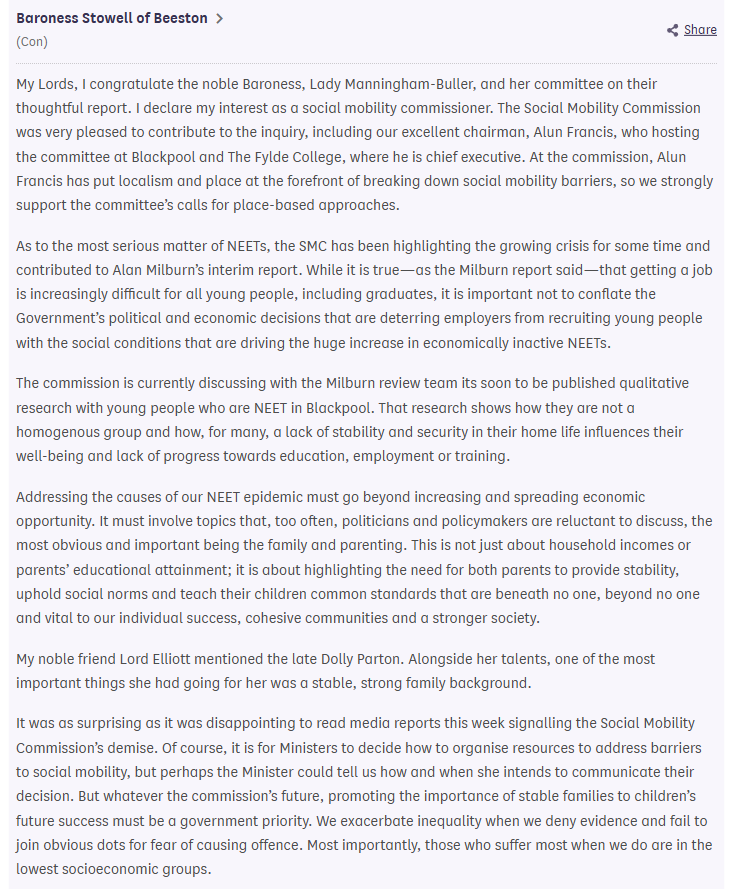
Spoke about importance of stable families to social mobility outcomes in @UKHouseofLords debate last week, and (prompted by @matthew_elliott speech), highlighted Dolly Parton as a great example of someone from a stable, loving family with low income and parents without degrees.
The Moment Julia Roberts Thanked Dolly Parton. ♥️
Gratitude.
One of the most beautiful moments from the Steel Magnolias press tour wasn’t on screen—it happened during an interview.
While talking about the experience of making the film, Julia Roberts took a moment to express her admiration for Dolly Parton. There was nothing rehearsed about it. Just genuine appreciation for someone whose kindness and generosity had clearly left an impression.
By 1989, Julia’s career was already taking off, but moments like this remind us why audiences connected with her long before she became Hollywood’s biggest star. She never seemed afraid to acknowledge the people who inspired her.
Sometimes the most memorable stories from classic films aren’t found in the scenes themselves. They’re hidden in small conversations that reveal the respect, warmth, and gratitude shared behind the camera.
That’s one of the reasons Steel Magnolias still feels so special decades later.
❤️ If you could spend one day with this cast, who would you choose to have lunch with?
#SteelMagnolias #JuliaRoberts #DollyParton #ClassicHollywood #AbsoluteCinema