The AI detector industry should be very uncomfortable reading this MIT report.
The strongest institutional rejections yet, direct from MIT.
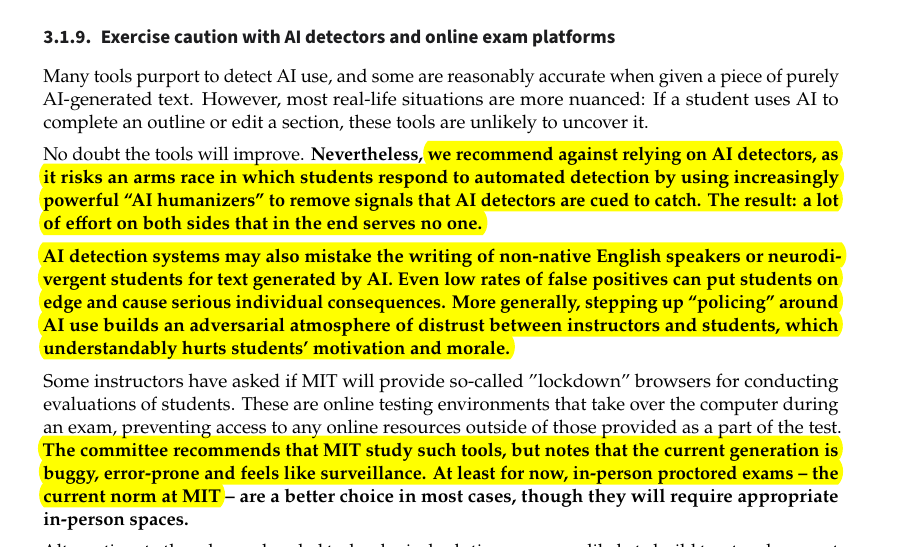
"we recommend against relying on AI detectors. "
"As it risks an arms race in which students respond to automated detection by using increasingly powerful “AI humanizers” to remove signals that AI detectors are cued to catch. The result: a lot of effort on both sides that in the end serves no one."
The report argues that mixed human/AI writing is difficult to detect, detectors can be evaded by “AI humanizers,” false positives can harm students, and heavy policing creates distrust.
AI detection systems may also mistake the writing of non-native English speakers or neurodivergent students for text generated by AI. Even low rates of false positives can put students on edge and cause serious individual consequences."
From a policy perspective, I see this as one of the big "shifts" in modern technology and technocratic politics; any policy practitioner should, from my perspective, capitalize on research in this realm.
Chat → Code → @Bots
I was skeptical at first, but I'm now Bot-pilled. It is hard to give up "the old way" of prompting agents, but I strongly believe always-running bots are the future of where all work on a computer is headed.
For example, it still feels *weird* to not see the response stream back to me, or not look at model pickers, and trust in the model/harness to do compaction in these very long conversations.
But once you see how simple the product UX can be, and see the results, this way of working is amazing (even with it being in early beta). Models will continue to improve exponentially in the next 3-6 months, getting better and better at proactively doing real work for you in the background. And this feels like the right interface and UX for that work.
I started by using Bot for personal tasks instead of work things, but it quickly took over the majority of my tokens. Very excited about the future of Bot!
Cursor has been a trusted partner of Anthropic since Sonnet 3.5. We’ll continue to increase compute to support Claude models in Cursor and are excited for what comes next with them at SpaceX.