Alan McClain and I have a new paper further exploring what can happen when photosynthesis is pushed too hard and too fast. Access is free
https://t.co/a9TegFsaPs
Recognizing Plant Direct author Sarathi M. Weraduwage https://t.co/o3J5KwrNIs first author of "Characterization of promoter elements of isoprene-responsive genes and the ability of isoprene to bind START domain transcription factors" @SharkeyLabMSU@ASPB @Wileyplantsci @SEBiology
My lab mates, and Bahtijor Rasulov and Ülo Niinemets have published on the various methods we use to study isoprene and the MEP pathway
https://t.co/bI1C7YT9Fc
Introducing our next Plant Genomics @MSU#REU student Raeshell Leek from @SAU_News Raeshell is performing her REU research on isoprene responses in plants with @bianca_serda @SharkeyLabMSU@MSUNatSci
@dibble_ted@Yafang_Cheng I have postponed retirement and still need meaningful employment. But we are making progress and the next post-doc will solve it all. Please apply if you are in the market.
Post-doc position in the laboratory of Thomas D. Sharkey at Michigan State University to study isoprene and plant physiology. Funded by the National Science Foundation. A one-year position with the possibility of renewal.
https://t.co/uRJtMTvqTM posting number 790207
Collaborative work of Yuan Xu, @WielochThomas, @JoshuaKaste, and Yair Shachar-Hill. I think we found answers to several puzzling observations in labeling of photosynthesis intermediates.
#MSUPRL researcher Tom Sharkey explores the processes that balance a plant's energy during changing conditions in a paper published in PNAS. The research looks at a metabolic "pilot light" that plants use in photosynthesis. https://t.co/wxZXCnNFdw
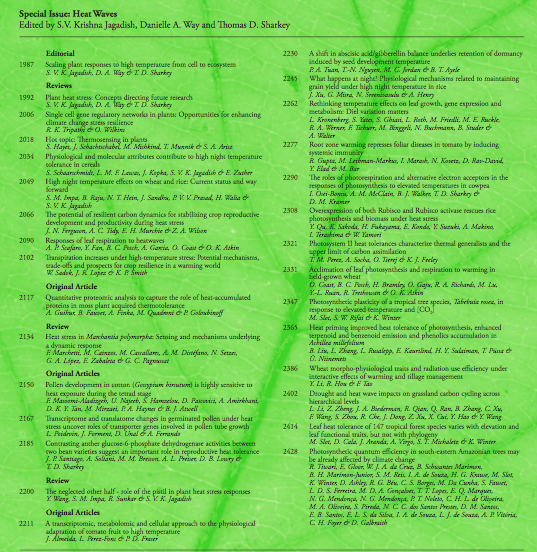
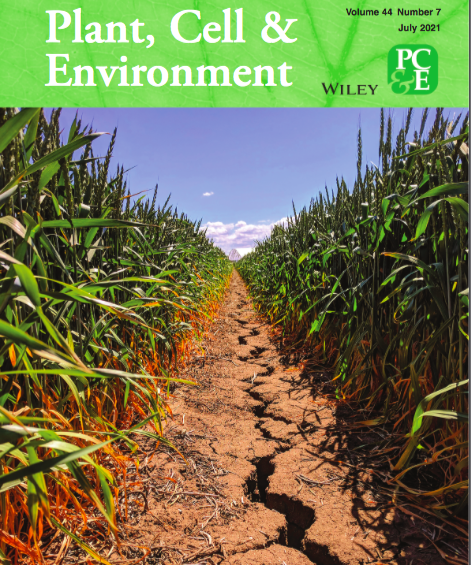
Plants feel the heat! The PCE Special Issue on Heat Waves is now out with a great collection of reviews and original papers on this important topic. Congratulations to all authors and a big thank you to the Issue editors Dani Way, @KJagadish_KSU , @TomSharkeyMSU
@SharkeyLabMSU looking for a post-doc to study benefits and costs of #isoprene emission from plants. Help find out why and how this most important hydrocarbon emission from plants to the atmosphere occurs. apply at https://t.co/4JCnnx3hOf 714579
Is 700 nm a good cutoff for PAR? See this interesting opinion piece with references to good papers showing usefulness of 700+nm light.
https://t.co/ph5YVhRLnz
@wileyplantsci @FlorianABusch @PlantCellEnvir@SvonCaemmerer I enjoyed working with Xinyou, Paul, and Florian to take a look back on the development of this important model
We need to better understand plant heat stress responses as global temps rise. 🔥
Should we integrate heat stress recovery into breeding programs?
This review in @PlantCellEnvir provides a comprehensive overview ➡️ https://t.co/QmuBQ5oD73
@KJagadish_KSU @TomSharkeyMSU
The metabolic origins of non-photorespiratory CO2 release during photosynthesis: A metabolic flux analysis (Yuan Xu, Xinyu Fu, Thomas D Sharkey, Yair Shachar-Hill, Berkley J Walker) #PlantSci#Photosynthesis @xyplore @TomSharkeyMSU https://t.co/V0QWwodAKd
The Cardon lab @MBLEcosystems@MBLScience seeks a #postdoc to focus on root-microbe-mineral interactions in the #rhizosphere. Interdisciplinary, inter-institutional DOE-funded project. Visit https://t.co/bhaIMnnOUA "MBL Jobs" Req# POSTD01260. Flexible start date. Plz retweet!