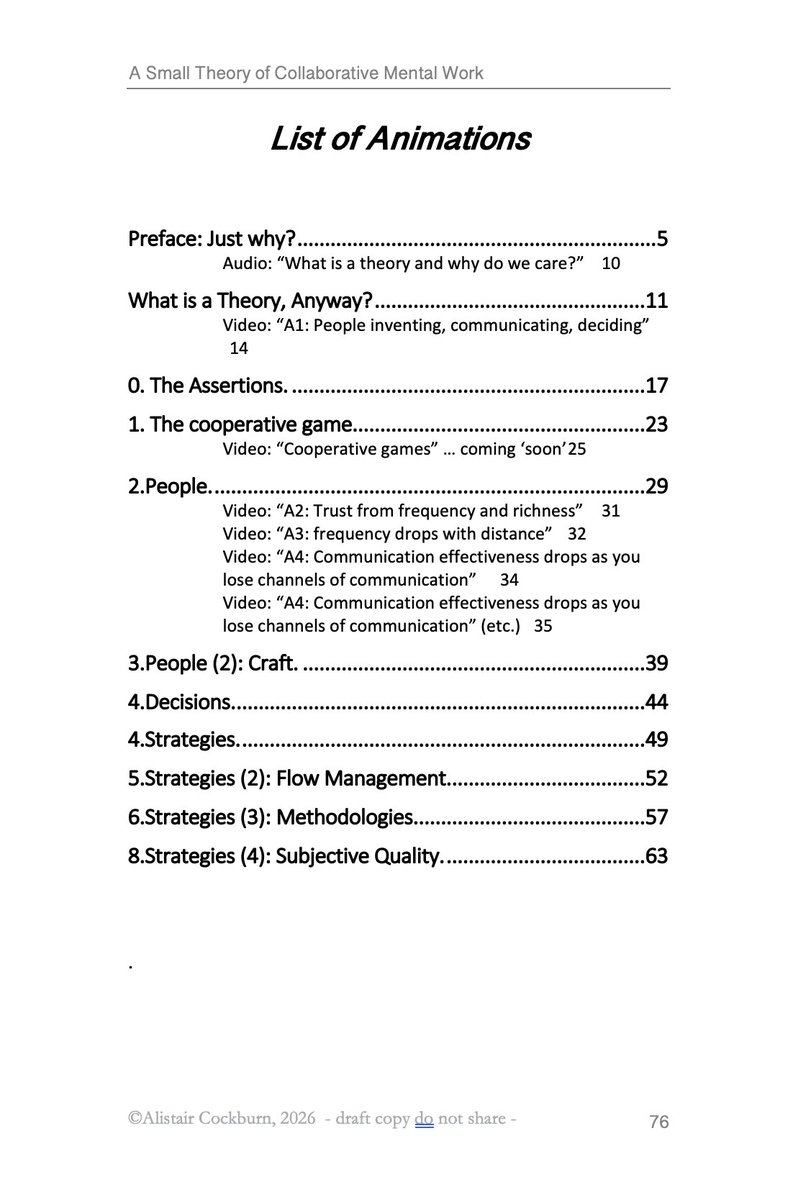
But first - I enjoyed writing these 2 pages, trying to lock down why there can't be a master methodology, process or strategy . Also shows the cross linking needed. This has to work in epubs as hot links
https://t.co/gQkpVkLsYF
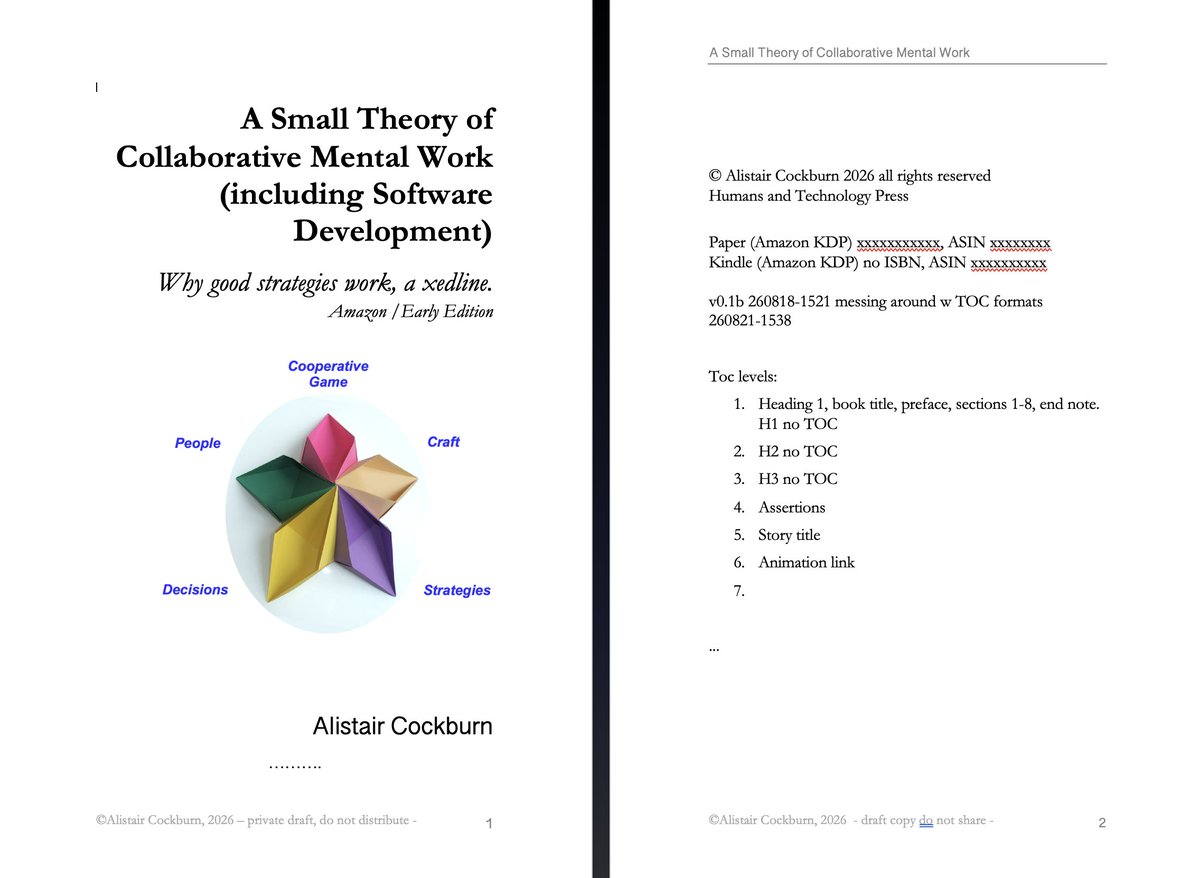
Back on the theory book - The difficulty is there are 33 assertions, most with a graph or graphic that needs explaining with an external audio or video, and some cross references... Spent the last few days working on that. Some pics below
people will compare other things to developing software (AI changes that, now)
hence I looked for a vocabulary without reference to other activities. My next book will be "a small theory of cooperative mental work (including software), see my patreon posts https://t.co/1OPA2uVhNc
Just a note: My work came out of my "anthropological" approach to understanding software teams through the 1990s and my desire to get away from "software is like bridge-building" or "software is like..." anything - my conclusion was that software is its own thing, and in 50 years
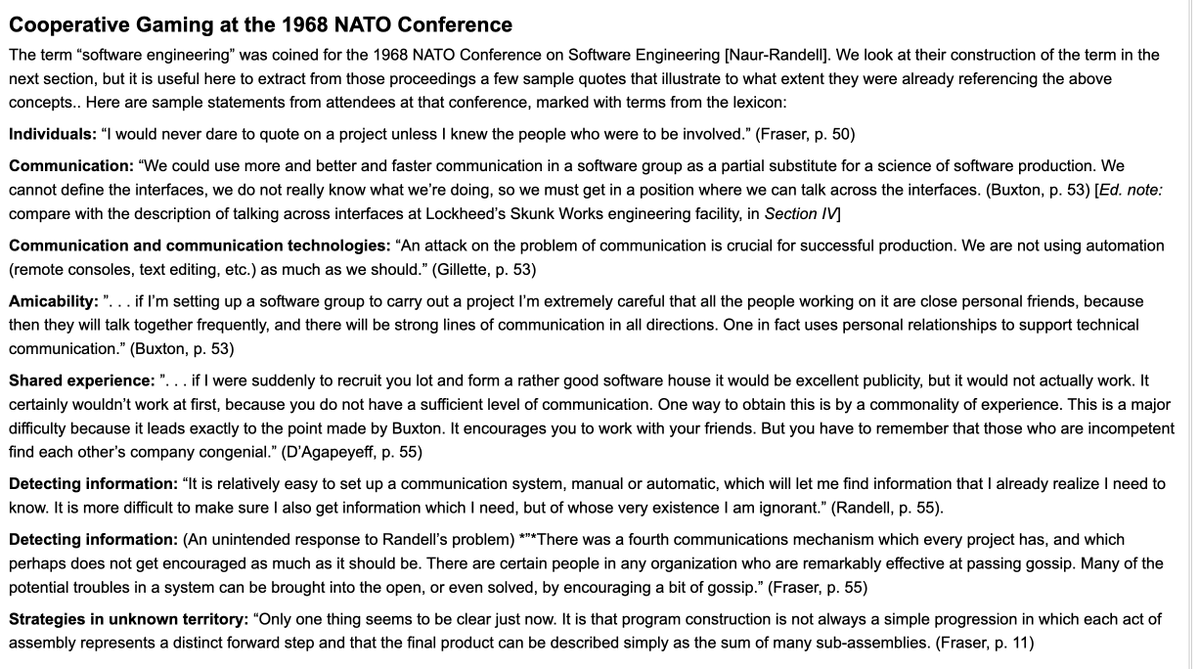
3 - when they described what they themselves personally did, it much more resembled what we wrote about in the manifesto : individuals and interactions, running software.
I wrote a deconstruction of it in
https://t.co/HdYufNa5Xz
https://t.co/HdYufNa5Xz
Few people know the origin of the term "software engineering" even though the entire proceedings of that conference were recorded and written up for us all to read.
1 - they coined the term to be "provocative", not predictive.....
/
https://t.co/HdYufNa5Xz
2 - they knew precious little about actual engineering, and even less about how the Wright brothers worked (they said the brothers just threw planes off hills, when in fact they built the world's first wind tunnels --- those two did actual engineering!)
/
"A small theory of collaborative mental work"
:))
https://t.co/XnvMe0yyse
https://t.co/SW8Q5NgvVB
https://t.co/YChKyJQoJB
https://t.co/EV48ifws5S
https://t.co/FAFHSNwmAk
https://t.co/sapzS6a9du
https://t.co/4Zzm27gJ60
https://t.co/XQZLz0xUwD
https://t.co/ieCZUJxQOr
https://t.co/viv2VDFwnD
occasionally, there is a song so simple, it makes no sense how it hits. Little Clubthing's "Sadness" is one. So few notes, but chills running up and down my spine - makes me want to cry and listen on repeat at the same time
https://t.co/viv2VDFwnD
https://t.co/GALPZoCT5m
4th in A small theory of collaborative mental work
Comm effectiveness drops as you lose body language, voice, drawing, cross-modality timing, question and answer.
(p.s. watch for fragments of the xedline to show up here and at https://t.co/1OPA2uVhNc)
https://t.co/2H2a9OpmE3
A small theory of collaborative mental work (including software development).
3rd:Trust is sensitive to the frequency and richness of the communication between people. Frequency drops rapidly with distance.
watch for here and at https://t.co/1OPA2uVhNc
https://t.co/0qzXUxmG7B
i think i’m making progress - it’s easy to write these books - it’s hard to write them in a way that others can read and take action out of
that’s why the vids will be so important.
Here are the assertions and structuring of them, for your consideration.
test 1, xedline voice over a graph
https://t.co/bDaZ09OZBR
this video is obviously not ready for prime time viewing, but you can see where I'm heading. will probably delete it once I get to the final technique.
Next will be paper, i suspect will work better, will post later
Just uploaded the 1st video of the xedline "A small theory of collaborative mental work (including software development)"
https://t.co/2ViasTeFY9
It's the same thing I put into the book part, but I think works better with the voiceover.
Comments welcome at all levels, thanks,