TubeProxies | 🏆 #1 Zero-Fraud Proxy Network | High trust score static residential IPs dedicated exclusively to you | Ideal for social media account management
Hey!
DM'ed you. I'd be curious to check if there could be any fingerprint issues on any of your profiles.
In general though for gmails getting disabled I'd assume it's related to how they were made. E.g. if bought from a 3rd party provider, they could've potentially mass created them via a bot. If Google finds out about this later on, they could flag it.
From thousands of users, no one has reported a case like this. That said, a situation like that absolutely sucks, so I'd be more than happy to try looking into it for you, although I doubt I will find anything from our side that has caused it.
As for your question how you can get fraud score on a profile only used for uploading and channel management, it can be difficult for me to give a specific concrete answer. Because each IP you buy is dedicated only to you, so you're the only user.
That said, we've had cases in which people bought an IP and it immediately right after got fraud scores. It appears (as we solved these issues) the profile's fingerprint settings weren't good enough which caused things to leak through. I mean, the stuff you would not see on e.g. browserscan . net.
The issue is, IP checkers have "honey pots", so they buy data from other platforms and in case you visit any of those while having bad fingerprint a fraud score can be added.
Unfortunately this is difficult for us to control for each user, although we're not working on SOPs to share with all customers to minimize this. But in general after a user starts using a proxy, it's sort of out of our hands to 100% ensure it never ever gets a fraud score. But as mentioned, we're working on materials to share with all our users to teach more about best practices.
As for the captcha on Google, I'd say this is not something to worry about unless it does not let you solve the captcha at all (I mean, where it endlessly doesn't let you solve it).
Newly network announced IPs are "new" and "fresh", so for Google if they see it for the first time coupled with your unique browser fingerprint, this in itself is something they'll be cautious about because they have never seen it before. Not in a bad way, just similar to if you meet a new person and it takes you some time to feel comfortable. For Google, they have no cookies on you or anything, so they're cautious.
That said, hearing your experience we will test out more warm up methods to potentially eliminate this altogether. But just keep in mind it's usually quite harmless.
We always also test a bunch of different things internally (because for many theories about IPs there's NO definitive answers online) and I'd say in our experience this is like perfectly fine.
E.g. if a consumer in a city where your IP is attempts to scrape a lot from Google, they can take "cluster" actions and many users that didn't do anything wrong can experience captchas (this is just an edge case I wanted to share) within the city or within the same internet provider.
Hope it helps!
Gmail disabled is most likely not an issue related to our IPs. More likely the gmails have been touched using the same IP + fingerprint that was used on many other gmails.
Other reasons in which IP could be included is if it has e.g. been managed on many different IPs within a short time frame shortly after it was made. This doesn't mean an IP is bad, it just means it's suspicious from Google's site if a gmail is used across many different fingerprints + IPs in a way that a genuine user likely wouldn't.
Or if e.g. seller used it on a few IPs in his country, sold it to you and you used it on an IP in another country.
One tip: When you e.g. buy an aged channel, log in on it, open it and then close it, wait a week before doing anything.
It gives extra 7 days of the account being on your IP before you use it.
Hope it helps :)
If you don’t know and act on this, there’s a HIGH change your channel will NEVER grow simply because of your IP address…
ESPECIALLY if you live in a poor / crowded area
Let me explain:
Your home IP came from a provider.
They didn’t ask you which one you wanted.
And in some regions, those providers randomly recycle addresses.
Which means that the exact IP you're uploading your videos from might have already been used by scammers, bot farms, spam networks, sneaker resellers, or whatever crazy stuff people do in your area.
And your YouTube channel inherits all of that the second you log in.
So your fraud score might’ve already been high and trust score low BEFORE you even first picked a niche.
Some manifestations of this in your YouTube channel are:
→ Zero view jail
→ Competitors monetizing quicker
→ Growth that feels like pushing a boulder uphill
→ Random shadowbans (0 impressions / big drops)
→ Constant demonetizations, copyrights, terminations, etc
→ Appeals rejected every time
This can happen with IPs from any place, but especially in very big cities or locations with a bad rep for scamming, like Pakistan, India, Africa, etc
People call YouTube racist over this but you honestly can’t blame them.
They're trying to protect the audience from address ranges where a huge share of historical traffic was fraudulent.
And your channel ended up getting cooked because of it.
Here’s the worst part though:
EVEN if you bought an IP from a specific provider just for YouTube channels from a trusted source that allegedly gave low fraud score US IPs…
They were still NOT prepared for YouTube’s system.
I know these providers because I’ve tried them before.
For example, I put 20 channels on a new batch of “residential” proxies, and 10 of them were terminated within the first week.
These are not safer than any other because they weren’t made SPECIFICALLY for Faceless YouTube.
But that’s something that I’ll touch more on soon.
Here’s the fix for all this:
First of all, you need a proper IP.
One channel, one identity, nothing shared.
Think of the IP as the house your channel lives in.
If 5 channels live in the same house, YouTube does not see 5 separate people.
It sees the same entity pretending to be 5 people.
So every serious channel needs its own dedicated residential IP.
Not just a VPN or a datacenter proxy.
Not the same connection you use for your personal Gmail, your old terminated channel, and 3 test accounts.
A dedicated residential IP that stays attached to that channel.
This is where @tubeproxies comes in.
I built it because nothing on the market was made specifically for faceless YouTube operators (and I needed something like that).
The IPs are not random cheap proxy stock thrown into a dashboard.
They are sourced through residential ISP networks and used for one use case:
YouTube channels.
So when you plug one into a channel, the whole point is that YouTube sees a stable residential environment instead of some bot-looking setup that has been passed around 400 times.
But the IP alone is not magic.
If you put a clean @tubeproxies IP on a browser profile that already logged into 7 channels, you still messed it up.
That is why the browser is the second layer.
Your browser has a fingerprint.
YouTube can see things like:
→ Device type
→ Browser version
→ Timezone
→ Language
→ Screen resolution
→ GPU
→ CPU
→ RAM
→ Canvas/WebGL behavior
Basically, the internet gets a signature from your device.
So if you run 20 channels from the same normal Chrome browser, changing only the IP, you did not create 20 identities.
You created one device wearing 20 masks.
That’s why you use an anti-detect browser.
I’m launching TubeGhost soon for this exact purpose.
(DM me “GHOST” if you want early access)
Each browser profile here acts like its own device.
→ Profile 1 has its own fingerprint and its own IP
→ Profile 2 has another fingerprint and another IP
→ Profile 3 has another fingerprint and another IP
So from YouTube’s side, it looks like different real devices in different real homes, not one guy opening 30 tabs on the same laptop.
The setup is simple:
Channel 1 goes inside Profile 1
→ Profile 1 uses IP 1.
Channel 2 goes inside Profile 2
→ Profile 2 uses IP 2.
Channel 3 goes inside Profile 3
→ Profile 3 uses IP 3.
Never cross them.
→ Don’t log into Channel 1 from Profile 2 because you were lazy
→ Don’t open youIf you don’t know and act on this, there’s a HIGH change your channel will NEVER grow simply because of your IP address…
ESPECIALLY if you live in a poor / crowded area
Let me explain:
Your home IP came from a provider.
They didn’t ask you which one you wanted.
And in some regions, those providers randomly recycle addresses.
Which means that the exact IP you're uploading your videos from might have already been used by scammers, bot farms, spam networks, sneaker resellers, or whatever crazy stuff people do in your area.
And your YouTube channel inherits all of that the second you log in.
So your fraud score might’ve already been high and trust score low BEFORE you even first picked a niche.
Some manifestations of this in your YouTube channel are:
→ Zero view jail
→ Competitors monetizing quicker
→ Growth that feels like pushing a boulder uphill
→ Random shadowbans (0 impressions / big drops)
→ Constant demonetizations, copyrights, terminations, etc
→ Appeals rejected every time
This can happen with IPs from any place, but especially in very big cities or locations with a bad rep for scamming, like Pakistan, India, Africa, etc
People call YouTube racist over this but you honestly can’t blame them.
They're trying to protect the audience from address ranges where a huge share of historical traffic was fraudulent.
And your channel ended up getting cooked because of it.
Here’s the worst part though:
EVEN if you bought an IP from a specific provider just for YouTube channels from a trusted source that allegedly gave low fraud score US IPs…
They were still NOT prepared for YouTube’s system.
I know these providers because I’ve tried them before.
For example, I put 20 channels on a new batch of “residential” proxies, and 8 of them were terminated within the first week.
These are not safer than any other because they weren’t made SPECIFICALLY for Faceless YouTube.
But that’s something that I’ll touch more on soon.
Here’s the fix for all this:
First of all, you need a proper IP.
One channel, one identity, nothing shared.
Think of the IP as the house your channel lives in.
If 5 channels live in the same house, YouTube does not see 5 separate people.
It sees the same entity pretending to be 5 people.
So every serious channel needs its own dedicated residential IP.
Not just a VPN or a datacenter proxy.
Not the same connection you use for your personal Gmail, your old terminated channel, and 3 test accounts.
A dedicated residential IP that stays attached to that channel.
This is where @tubeproxies comes in.
I built it because nothing on the market was made specifically for faceless YouTube operators (and I needed something like that).
The IPs are not random cheap proxy stock thrown into a dashboard.
They are sourced through residential ISP networks and used for one use case:
YouTube channels.
So when you plug one into a channel, the whole point is that YouTube sees a stable residential environment instead of some bot-looking setup that has been passed around 400 times.
But the IP alone is not magic.
If you put a clean @tubeproxies IP on a browser profile that already logged into 7 channels, you still messed it up.
That is why the browser is the second layer.
Your browser has a fingerprint.
YouTube can see things like:
→ Device type
→ Browser version
→ Timezone
→ Language
→ Screen resolution
→ GPU
→ CPU
→ RAM
→ Canvas/WebGL behavior
Basically, the internet gets a signature from your device.
So if you run 20 channels from the same normal Chrome browser, changing only the IP, you did not create 20 identities.
You created one device wearing 20 masks.
That’s why you use an anti-detect browser.
I’m launching TubeGhost soon for this exact purpose.
(DM me “GHOST” if you want early access)
Each browser profile here acts like its own device.
→ Profile 1 has its own fingerprint and its own IP
→ Profile 2 has another fingerprint and another IP
→ Profile 3 has another fingerprint and another IP
So from YouTube’s side, it looks like different real devices in different real homes, not one guy opening 30 tabs on the same laptop.
The setup is simple:
Channel 1 goes inside Profile 1
→ Profile 1 uses IP 1.
Channel 2 goes inside Profile 2
→ Profile 2 uses IP 2.
Channel 3 goes inside Profile 3
→ Profile 3 uses IP 3.
Never cross them.
→ Don’t log into Channel 1 from Profile 2 because you were lazy
→ Don’t open your personal Gmail inside the channel profile
→ Don’t check an old banned channel from the same browser
That one lazy login is how people connect a clean channel to a dirty history.
Then comes phone numbers.
This is one of the biggest links.
If 2 channels share the same phone number, why would YouTube assume they are separate people?
They won’t.
You don’t use the same phone number as a friend, family member, or stranger.
It makes no sense.
The phone number is not some tiny detail.
It’s one of the strongest identity signals you can give them.
So the rule is:
→ One channel
→ One phone number
No recycling with a lazy SMS number across the whole portfolio or an “I’ll just use my number for setup and remove it later.”
This one you can also get inside @tubeproxies
Same thing with recovery emails.
If you use the same recovery email on 10 accounts, those accounts are one family.
And if one gets demonetized, terminated, or flagged, you gave YouTube an obvious map to the other nine.
So every channel gets its own recovery email.
And that email should be created and managed from the same clean environment as the channel.
Also known as a separated browser.
And even your AdSense here must be separated.
This is where people think they’re safe until they get monetized.
They launch 10 channels on:
→ Separate IPs
→ Separate browsers
→ Separate emails
→ Separate phones
Then every single one gets connected to the same AdSense.
At scale, AdSense becomes its own infrastructure problem.
One legal entity can only have one AdSense.
So if you want multiple truly separated AdSense accounts, you need different legal entities.
Annoying as hell, but that’s the game.
This is why running a serious YouTube operation is not “buy proxy and post videos.”
It’s closer to building a banking system for channels.
Everything must be separate:
→ The account
→ The device
→ The IP
→ The phone
→ The email
Even the AdSense layer has to be thought through before the channel makes money.
Because the worst time to think about infrastructure is after a channel is already doing 300k views a day.
At that point, you’re scared to touch anything.
And you should be.
Sudden changes look like account takeover.
So you build it right from the start.
Then you act normally.
→ You don’t start posting before browsing
→ You don’t upload 3 videos in 24h out of nowhere
→ You don’t log in from Denmark at 9am and Texas at 9:20
Infra is the MOST important part of faceless YouTube.
Do not take this advice lightly.
r personal Gmail inside the channel profile
→ Don’t check an old banned channel from the same browser
That one lazy login is how people connect a clean channel to a dirty history.
Then comes phone numbers.
This is one of the biggest links.
If 2 channels share the same phone number, why would YouTube assume they are separate people?
They won’t.
You don’t use the same phone number as a friend, family member, or stranger.
It makes no sense.
The phone number is not some tiny detail.
It’s one of the strongest identity signals you can give them.
So the rule is:
→ One channel
→ One phone number
No recycling with a lazy SMS number across the whole portfolio or an “I’ll just use my number for setup and remove it later.”
This one you can also get inside @tubeproxies
Same thing with recovery emails.
If you use the same recovery email on 10 accounts, those accounts are one family.
And if one gets demonetized, terminated, or flagged, you gave YouTube an obvious map to the other nine.
So every channel gets its own recovery email.
And that email should be created and managed from the same clean environment as the channel.
Also known as a separated browser.
And even your AdSense here must be separated.
This is where people think they’re safe until they get monetized.
They launch 10 channels on:
→ Separate IPs
→ Separate browsers
→ Separate emails
→ Separate phones
Then every single one gets connected to the same AdSense.
At scale, AdSense becomes its own infrastructure problem.
One legal entity can only have one AdSense.
So if you want multiple truly separated AdSense accounts, you need different legal entities.
Annoying as hell, but that’s the game.
This is why running a serious YouTube operation is not “buy proxy and post videos.”
It’s closer to building a banking system for channels.
Everything must be separate:
→ The account
→ The device
→ The IP
→ The phone
→ The email
Even the AdSense layer has to be thought through before the channel makes money.
Because the worst time to think about infrastructure is after a channel is already doing 300k views a day.
At that point, you’re scared to touch anything.
And you should be.
Sudden changes look like account takeover.
So you build it right from the start.
Then you act normally.
→ You don’t start posting before browsing
→ You don’t upload 3 videos in 24h out of nowhere
→ You don’t log in from Denmark at 9am and Texas at 9:20
Infra is the MOST important part of faceless YouTube.
Do not take this advice lightly.
4.7M subscribers across 3 channels is at risk right now.
this is exactly why everyone is stressing over youtube's policies.
because a termination often isn't about the videos. it can come down to what the account is linked to.
one channel trips something → and anything connected to it can get swept in → email, phone, IP, browser fingerprint all tie them together. and the violation label that shows up is sometimes just whatever the system landed on, not what actually happened.
which might be why all 3 went and not just one. and why a year of appealing hasn't moved anything. if the real issue is the connection and not the content, there's nothing in the videos for a review to clear.
the takeaway for anyone reading before it happens to them:
when channels aren't linked, one going down doesn't have to take the rest with it.
separate email, phone number, IP, and browser profile on each → less tying them together → so if one gets flagged, the others don't necessarily follow.
Well... i have 3 unfairly terminated youtube channels which combined make up 4.7M subscribers. Ive tried appealing and everything. It's been over 1 year since the first ban and I am stressing like hell. #YouTube@TeamYouTube@YouTube
1,621 videos. 8 channels wiped. and 5 of them had nothing on them.
that one detail says a lot.
5 empty channels probably didn't get removed for their content. there wasn't any. more likely they got caught because they were connected to the one that got flagged.
that's often what a termination comes down to. it's not always youtube grading your videos. sometimes it's youtube following a trail.
one account trips something → and anything attached to it can get looked at too → then it can work down the list.
which might be why yours didn't all fall at once. first channel went. then the second. then june 8th the rest. that spread can happen when channels are linked.
it could also be why support told you your other channels were "fine." the person you talked to was likely looking at your content. the system that removes channels tends to look at connections. two different things.
11 months clean, 271 videos, 40K subs, 10M views... a strong track record still might not protect a channel if the issue isn't the content in the first place.
here's the part worth knowing before it happens to anyone else:
when channels aren't linked, one going down doesn't have to drag the others with it.
separate email, phone number, IP, and browser profile on every channel → less connecting them → so if one gets flagged, the rest don't necessarily go with it.
it can go down alone instead of taking everything with it.
1,621 videos. 8 channels wiped. and 5 of them had nothing on them.
that one detail says a lot.
5 empty channels probably didn't get removed for their content. there wasn't any. more likely they got caught because they were connected to the one that got flagged.
that's often what a termination comes down to. it's not always youtube grading your videos. sometimes it's youtube following a trail.
one account trips something → and anything attached to it can get looked at too → then it can work down the list.
which might be why yours didn't all fall at once. first channel went. then the second. then june 8th the rest. that spread can happen when channels are linked.
it could also be why support told you your other channels were "fine." the person you talked to was likely looking at your content. the system that removes channels tends to look at connections. two different things.
11 months clean, 271 videos, 40K subs, 10M views... a strong track record still might not protect a channel if the issue isn't the content in the first place.
here's the part worth knowing before it happens to anyone else:
when channels aren't linked, one going down doesn't have to drag the others with it.
separate email, phone number, IP, and browser profile on every channel → less connecting them → so if one gets flagged, the rest don't necessarily go with it.
it can go down alone instead of taking everything with it.
Crazy how ONE MISTAKE on YouTube can leave you like this…
No real reviews. No warning. No explanation. Then everything gets removed.
LOOK AT MY SITUATION.
My original channel had 11 MONTHS OF CLEAN, ORIGINAL ROBLOX CONTENT. 271 VIDEOS. ZERO PROBLEMS.
Then for 5 days, I made content telling people that if they needed help with an event in the game I played, they could subscribe and follow me on Roblox.
THIS WAS INCENTIVIZED CONTENT TELLING VIEWERS TO LIKE AND SUBSCRIBE FOR A REWARD.
I didn’t know I couldn’t do it.
Those 5 days brought my channel from 7K → 25K SUBSCRIBERS.
The event ended. I PLANNED TO RETURN TO MY NORMAL CONTENT. TOO LATE.
YouTube removed my channel with NO WARNING, NO STRIKE, and my appeal was denied in 9 MINUTES.
WHY COULDN’T I GET A FIRST WARNING, REMOVE THEM, AND CONTINUE?
Instead, I got an INSTANT LIFETIME BAN.
Then it got worse.
I contacted YouTube Support and asked if I could continue using my other channels.
THEY TOLD ME YES.
I followed their advice.
IF YOUTUBE SUPPORT WOULD’VE JUST TOLD ME THE ACTUAL RULES AND THAT MY OTHER CHANNELS WERE UNSAFE, I WOULD’VE NEVER BUILT THIS CHANNEL. I WOULDN’T EVEN BE HERE. BUT THEY DID ME WRONG.
That channel reached 40K SUBSCRIBERS, 10 MILLION VIEWS AND 1,000+ VIDEOS IN 6 MONTHS.
Then MAY 13TH.
YouTube’s outage started around 5 AM and lasted until around 8 AM.
My upload time was 5:40 AM. I tried uploading and kept getting an “UNTITLED” ERROR every time.
I kept trying from 5:40–6:00 AM, not knowing YouTube was down.
6:00 AM MY CHANNEL WAS REMOVED.
No warning. No strike.
2 HOURS LATER, MY APPEAL WAS DENIED. I LOST 1,000+ VIDEOS AND ANOTHER FANBASE I BUILT.
Then JUNE 8TH came.
YouTube removed the rest too.
I seriously worked on 3 CHANNELS: 25K, 40K and 2K.
Total of 1,621 videos GONE…
YouTube removed 8 CHANNELS TOTAL.
5 HAD NOTHING ON THEM.
They really try to WIPE YOU OFF THE PLATFORM LIKE YOU NEVER EXISTED. Like you’re just some type of TRASH to them.
LOOK AT WHAT HAPPENED TO ME.
I’ve been asking for a review for 4 MONTHS SINCE MAY 18TH. Day in and day out, begging for help.
I even got SUSPENDED ON X FROM MAY 23RD MAY 29TH because I was posting so much trying to get help and find creators in the same situation.
Now I have 500 FOLLOWERS WHO ARE OTHER TERMINATED CREATORS.
I wish I could help y’all.
BUT I CAN’T EVEN HELP MYSELF.
I feel powerless. I make posts EVERY DAY hoping someone finally sees this and actually looks at my case.
I just want answers even if it's a denial. Just tell me why it went straight to lifetime ban. Tell me why support told me my other channels were fine and I was fine. Tell me why my second channel was removed after those upload attempts and why my other channels only fell after the second channels hit. Why were they all not removed after the first removal.
4 MONTHS. ZERO PROGRESS.
And I’m not stopping. I might go A YEAR WITH NO HELP.
It doesn’t matter how long you made clean content. It doesn’t matter if your other channels are clean.
ONE MISTAKE EVEN FOR A FEW DAYS OR BY ACCIDENT AND YOU’RE DONE.
I ALWAYS TALK ABOUT OTHER APPS THAT ARE BETTER THAN YOUTUBE, BUT THERE REALLY ISN’T ONE. YOUTUBE IS THE PLACE FOR CREATORS THEY JUST WON’T HELP ANYONE, EVEN ME. I SHOW PROOF EVERY DAY.
THIS PLATFORM IS TRULY CARELESS.
I WANT A REAL HUMAN REVIEW.
Not just for me.
FOR ALL OF US.
✅ REPOST — WARN OTHER CREATORS.
✅ LIKE — HELP THIS REACH MORE PEOPLE.
✅ COMMENT — TELL YOUR STORY.
✅ TAG @TeamYouTube & CREATORS WHO NEED TO SEE THIS.
you open your analytics.
0 views.
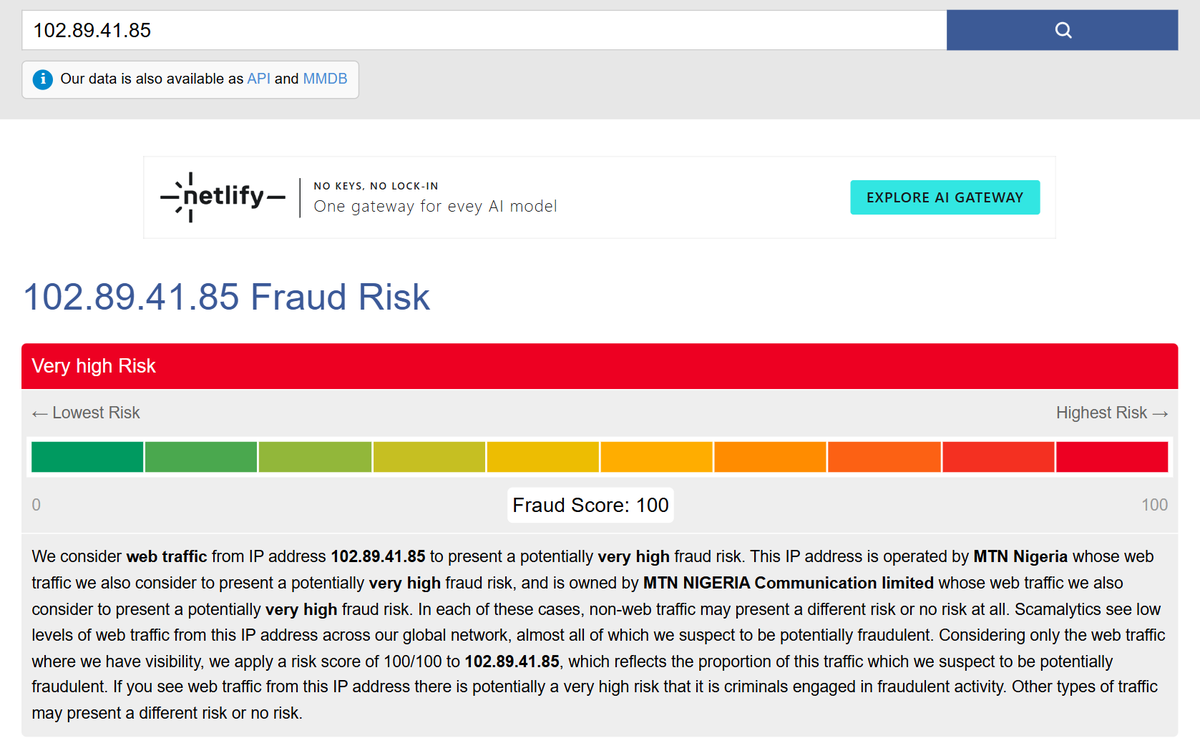
the algorithm doesn't hate you. your IP is probably f*cked.
here's how to fix it.
here's the thing nobody explains. before YouTube decides whether your video is good, it decides whether you're worth showing to anyone at all. that decision happens before a single person watches, and it's based on what's uploading rather than what's uploaded.
so what is it actually looking at? where you're connecting from, whether that location has a history, whether your device looks like a real device, and whether anything about you matches accounts it's already dealt with.
and this is where most people get quietly killed. you bought a proxy, you did the "right" thing, except that IP was resold to a few hundred people before it got to you. some of them were running bots. some were doing worse. YouTube already has an opinion about that address, and it formed that opinion before you ever logged in. you didn't get flagged for anything you did, you inherited it.
you won't be able to tell anything is wrong. no strike, no warning, just a video sitting at 5 impressions. people spend the next three weeks redesigning thumbnails for an audience that was never going to see them.
the fix isn't complicated, it's just boring. one clean IP per channel that nobody else is on, a device fingerprint that looks real, and never logging into that channel from anywhere else, ever. do that and the channel gets evaluated on its content, which is what you wanted in the first place.
TubeProxies exists because "residential" on a product page means nothing. IPs get checked before they go out, and they're not shared with anyone else.
if you have a bad IP, almost nothing else matters.
save this for later.
everyone's panicking.
this is just what the platform does.
the rules move. they always have.
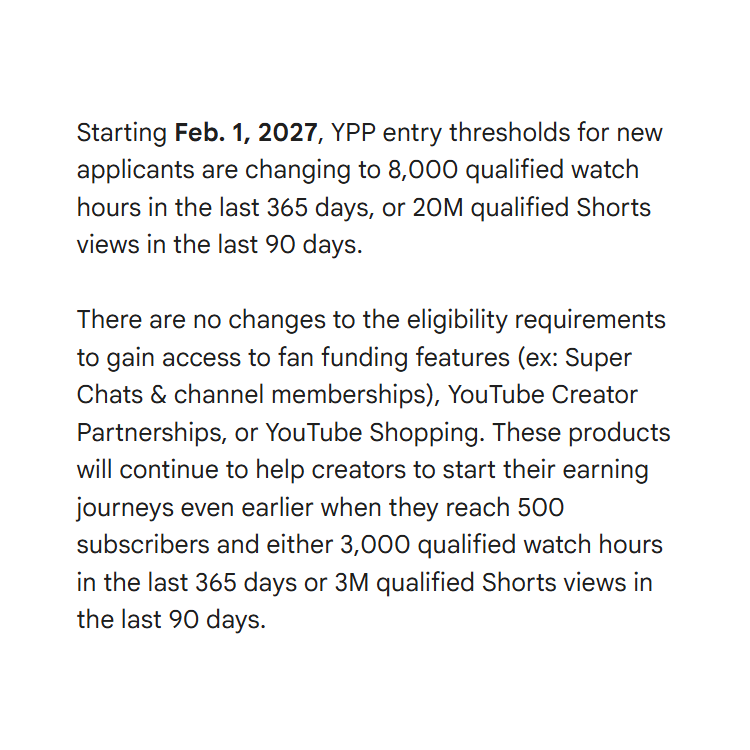
4,000 → 8,000 watch hours. 10M → 20M for shorts views.
happened out of nowhere.
this is part of the business model.
so the idea was never "hope the rules don't change"
it's "build something that isn’t affected when they do"
which means more channels, not one perfect one.
and setups that don't all die together the second something shifts.
diversification + risk management is key.
the platform's gonna keep changing.
your setup is the only part you actually control.
🚨BREAKING🚨
YouTube is raising the bar for new creators.
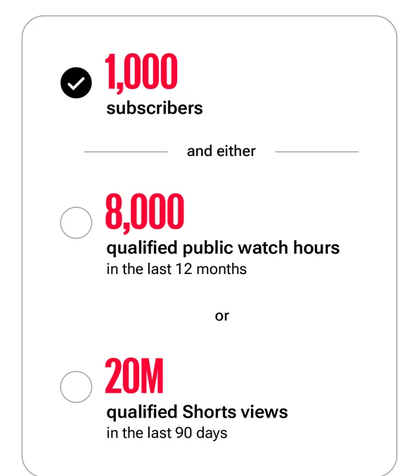
Starting Feb 1, 2027, new channels need 8,000 watch hours (up from 4,000) or 20M Shorts views in 90 days (up from 10M) to join the YouTube Partner Program
4 channels terminated. then the main one went down.
that doesn't usually happen by accident.
most people think a termination is about your videos.
it's usually about your account.
YouTube isn't sitting there rewatching everything you made. it's looking at what's connected to what.
so a channel that broke zero rules can still go down.
once one account gets marked, anything attached to it gets marked too.
not because those channels did anything wrong.
just because they were connected.
the fix:
give every channel its own email, phone number, IP, and browser profile.
nothing shared means nothing to connect.
so if one goes down, it goes down alone.
TubeProxies handles the IP and phone number part.
the people making over $100K a month from YouTube don't rely on one channel.
they run 5, 10, even 20 at once, treating every single one as a replaceable asset inside a bigger system.
let's break down why this is basically the only sustainable way to build on this platform.
nearly every creator approaches YouTube like their entire business depends on one channel surviving forever. they spend months building it, they get mentally attached to it, and eventually the channel becomes their identity. the problem is that there's no guarantee your channel won't get terminated. channels get demonetized. policies change without warning. entire niches get hit with enforcement waves. if your whole income depends on one channel surviving forever, you didn't build a business, you built a side hustle.
running multiple changes everything. when the platform kills one, you don't rebuild from zero. you already have 5 others paying you while you're working on a replacement. that's the difference between a bad month and starting over.
and it's not just about surviving terminations. it's about your income staying stable month to month. say you run 2 channels. in month one, channel A does $3,000 in a good month while channel B does $1,000 in a bad one, and your total is $4,000. in month two it flips completely. channel A drops to $1,000 and channel B climbs to $3,000, and your total is still $4,000.
now your business is reliable and consistent. scale that to 5 or 10 channels and the fluctuations barely register at all. the goal isn't necessarily 10 channels for 10x the money, it's 10 channels for consistent, predictable earnings every single month. the extra income is just a bonus.
the math is simple enough. with one channel, it goes down and you're at zero. with three channels, one goes down and you lose 33% of your income. with 10 channels, one goes down and you lose 10%. at 10, a termination is barely a dent. you're replacing one small piece while the other 9 keep paying.
that's the whole point. the question was never "how do I stop anything from going wrong," it's "when something goes wrong, will I still keep earning?"
one more thing nobody mentions. running multiple channels only works if they're actually separate. same IP, same email, or same device across all of them and YouTube can link them together. one gets flagged and the rest could follow. separate email, phone, IP, and browser profile per channel, and that's what makes the whole model work.
the operators winning at this aren't lucky. they just stopped betting everything on one asset, and they built it so one bad day can't touch the rest.
TubeProxies gives every channel its own clean, dedicated IP and phone number, so your channels stay separate. actually separate.
save this for later.
4 channels terminated. then the main one went down.
that doesn't usually happen by accident.
most people think a termination is about your videos.
it's usually about your account.
YouTube isn't sitting there rewatching everything you made. it's looking at what's connected to what.
so a channel that broke zero rules can still go down.
once one account gets marked, anything attached to it gets marked too.
not because those channels did anything wrong.
just because they were connected.
the fix:
give every channel its own email, phone number, IP, and browser profile.
nothing shared means nothing to connect.
so if one goes down, it goes down alone.
TubeProxies handles the IP and phone number part.
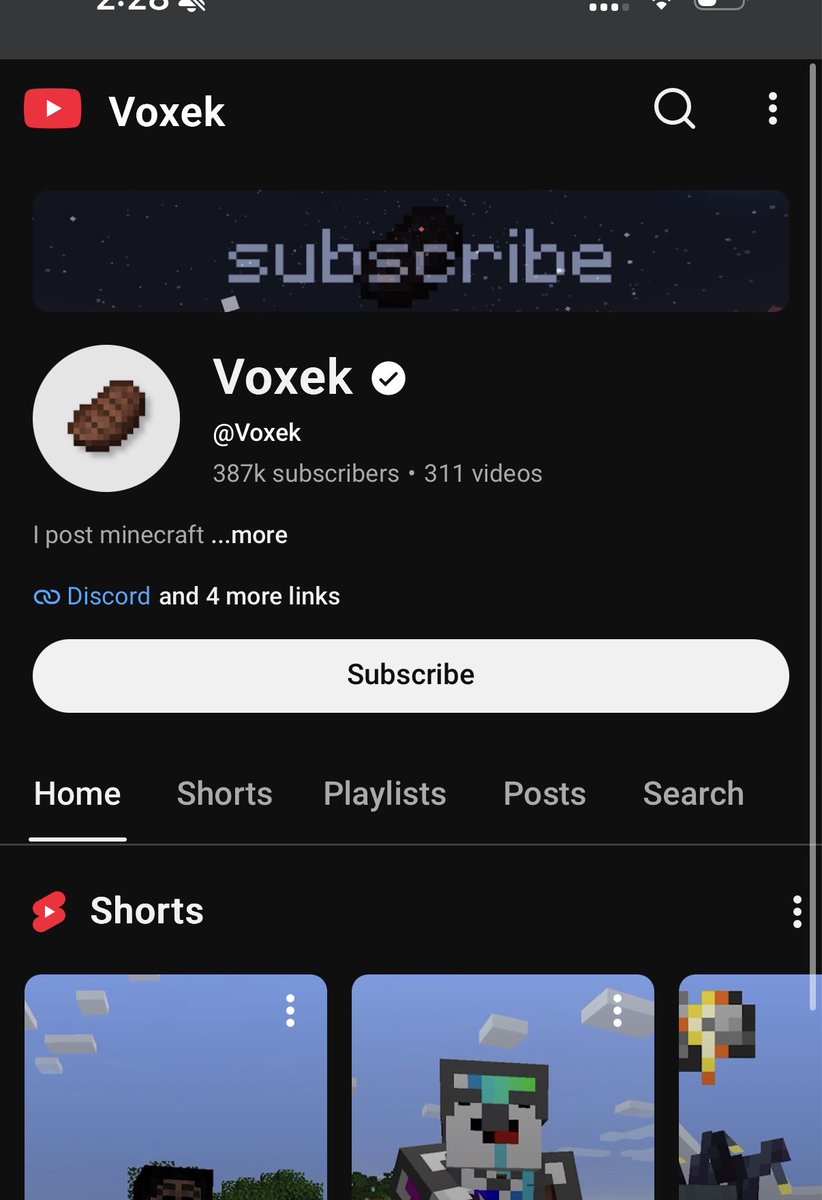
It happened. My 400,000 subscribers just evaporated.
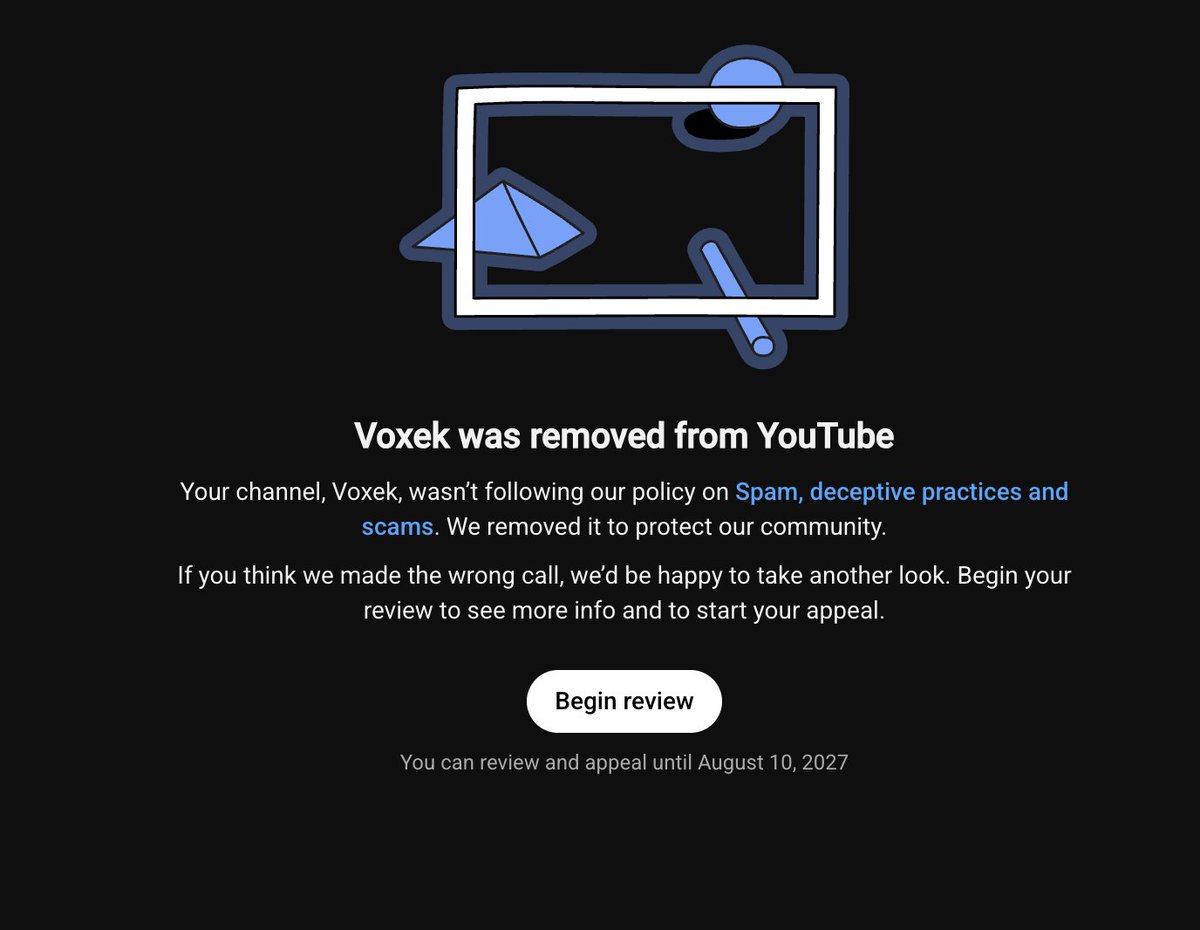
YouTube terminated my main channel for "spam, deceptive practices, and scams” after I spent a month fighting the termination of 4 other channels.
None of them have anything to do with this policy. Instagram and TikTok are still up smh.
I’m just speechless, @TeamYouTube.
steal this full system for launching faceless YouTube channels.
six steps, in this exact order. save this for later.
step one: niche selection
most people pick a niche they're personally interested in. that's a bad approach, and it's why so many channels never get off the ground. the only question that matters is whether other people are already winning in that space. go find channels in the niche doing 100K to 1M views a month. if there are a few clearly working, that's your proof of concept. if you can't find any, the demand isn't proven and you should move on.
huge emphasis on RPM here. some niches sit at $2 to $5 for every thousand views. others run $10 to $20 for the exact same view count. boring niches with high RPM are usually the play, even when they're the ones nobody wants to make videos about.
step two: infrastructure
this is the part everyone skips. it's also the part that ends channels. before you upload anything, every channel gets its own Gmail connected to nothing else you own, its own phone number for verification, its own dedicated IP (residential and static, not a rotating VPN), and its own anti detect browser profile.
here's why it matters. YouTube doesn't just look at your content, it looks at what connects to what. same IP, same email, or same device across multiple channels and they can get linked together. one gets flagged and they could all go, which is a huge risk to take for no reason. it doesn't matter that the other channels did nothing wrong. the whole thing takes about 20 minutes per channel, so do it before you have anything worth losing.
step three: branding
these are rough guidelines rather than rules, but they matter more than people think. keep things consistent across everything you post. similar fonts, similar colors, similar thumbnail style. the goal is that people start recognizing your stuff in the feed before they even read the channel name.
every video you post trains people to recognize the next one. that recognition is what turns a random viewer into a repeat viewer, and repeat viewers are the entire difference between a channel that plateaus and one that compounds.
step four: format
don't invent a format. steal one that's already working. find the outlier videos in your niche, the ones doing way more than the channel average, and break down every factor they share. length, pacing, structure, how they open, how they close. then rebuild it in your own way.
nobody winning at this is inventing new formats. they're taking a proven one and adding their own twist, which is a far lower risk bet than trying to invent something from scratch and hoping an audience shows up for it.
step five: retention
packaging gets the click. retention decides whether YouTube pushes you after that. the first 30 seconds matter most, and if your graph nosedives before 0:30 the video could likely be dead. get to the point as soon as you can and don't waste any time getting there.
then read the graph. a smooth slide down is normal and every video has it. a sharp cliff is a specific moment with a timestamp, so go rewatch that exact second. a spike means people rewound to see something again, which is your audience telling you exactly what they want more of. fix the moments, not the whole video.
step six: scaling
once something works, run it back. build a second channel with similar branding. or run the same concept in an adjacent niche. or take your existing channel and do the whole thing in another language. you already know the format works, so you're just pointing it somewhere new.
just make sure step two is handled properly first. otherwise scaling turns into one flag taking everything down at once, and you've multiplied your risk instead of your income.
the order matters as much as the steps. niche, then infrastructure, then branding, then format, then retention, then scaling. most people skip step two entirely and wonder why their portfolio disappeared in a week.
bookmark this.
everyone's reading this as "monetization got harder."
sure. but that's not the interesting part.
the interesting part → the channels you already got monetized just got a lot harder to replace.
losing one used to be a setback.
now it's an even bigger setback.
and here's what nobody's going to tell you in the replies.
most people lose channels to their setup, not their content.
shared IP, shared email, shared device → YouTube can connect them.
one gets flagged and you can lose more than just that channel.
so if you've been putting off separating everything, this is your sign.
separate email, phone, IP, and browser profile per channel.
it's a one time thing that takes minutes.
the platform is forever changing.
proper setup will never hurt you.
save this for later.
YouTube is making changes to the YouTube Partner Program (YPP) for *new* applicants.
Starting February 1, 2027, creators will need:
1. 8000 Qualified Watch Hours (up from 4000), or
2. 20M Qualified Shorts Views (up from 10M)
There are no eligibility changes for fan funding.
steal this full system for launching faceless YouTube channels.
six steps, in this exact order. save this for later.
step one: niche selection
most people pick a niche they're personally interested in. that's a bad approach, and it's why so many channels never get off the ground. the only question that matters is whether other people are already winning in that space. go find channels in the niche doing 100K to 1M views a month. if there are a few clearly working, that's your proof of concept. if you can't find any, the demand isn't proven and you should move on.
huge emphasis on RPM here. some niches sit at $2 to $5 for every thousand views. others run $10 to $20 for the exact same view count. boring niches with high RPM are usually the play, even when they're the ones nobody wants to make videos about.
step two: infrastructure
this is the part everyone skips. it's also the part that ends channels. before you upload anything, every channel gets its own Gmail connected to nothing else you own, its own phone number for verification, its own dedicated IP (residential and static, not a rotating VPN), and its own anti detect browser profile.
here's why it matters. YouTube doesn't just look at your content, it looks at what connects to what. same IP, same email, or same device across multiple channels and they can get linked together. one gets flagged and they could all go, which is a huge risk to take for no reason. it doesn't matter that the other channels did nothing wrong. the whole thing takes about 20 minutes per channel, so do it before you have anything worth losing.
step three: branding
these are rough guidelines rather than rules, but they matter more than people think. keep things consistent across everything you post. similar fonts, similar colors, similar thumbnail style. the goal is that people start recognizing your stuff in the feed before they even read the channel name.
every video you post trains people to recognize the next one. that recognition is what turns a random viewer into a repeat viewer, and repeat viewers are the entire difference between a channel that plateaus and one that compounds.
step four: format
don't invent a format. steal one that's already working. find the outlier videos in your niche, the ones doing way more than the channel average, and break down every factor they share. length, pacing, structure, how they open, how they close. then rebuild it in your own way.
nobody winning at this is inventing new formats. they're taking a proven one and adding their own twist, which is a far lower risk bet than trying to invent something from scratch and hoping an audience shows up for it.
step five: retention
packaging gets the click. retention decides whether YouTube pushes you after that. the first 30 seconds matter most, and if your graph nosedives before 0:30 the video could likely be dead. get to the point as soon as you can and don't waste any time getting there.
then read the graph. a smooth slide down is normal and every video has it. a sharp cliff is a specific moment with a timestamp, so go rewatch that exact second. a spike means people rewound to see something again, which is your audience telling you exactly what they want more of. fix the moments, not the whole video.
step six: scaling
once something works, run it back. build a second channel with similar branding. or run the same concept in an adjacent niche. or take your existing channel and do the whole thing in another language. you already know the format works, so you're just pointing it somewhere new.
just make sure step two is handled properly first. otherwise scaling turns into one flag taking everything down at once, and you've multiplied your risk instead of your income.
the order matters as much as the steps. niche, then infrastructure, then branding, then format, then retention, then scaling. most people skip step two entirely and wonder why their portfolio disappeared in a week.
bookmark this.