Many among us are living and behaving as if they are the only ones who matter, and no one else exists.
They also somehow believe that the past, present and future belong only to them.
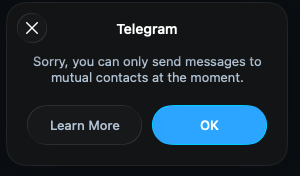
We have an infrastructure for censorship in place.
It must be dismantled.
The secrecy around blocking orders must go.
We need to know: why something is blocked, who ordered it, who reviewed, how it can be removed, how it's proportionate and lawful usage won't be harmed.
Craziest thing I wanted to highlight this week is about a pediatrician fighting tooth and nail against fake ORS product marketed by a huge money loaded private pharma company who legally threatened her for calling out THEIR bluff...
...and then she finding herself at a national pediatric conference which was majorly sponsored by THE same company and all pediatricians there, including the president of the pediatric organization chilling with the sponsor money...
...when children across the country are fed rebranded fake ORS.
Someone should make a short film documentary out of this. Fact is stranger than fiction.
Why are you spreading misinformation?
Telegram’s transparency figures for 2024 also show that the messaging app gave over phone numbers and IP addresses to Indian authorities on 14,641 occasions, affecting 23,535 users.
Telegram’s privacy policy explicitly states that after legal review it may disclose a user’s IP address and phone number to relevant authorities when presented with valid legal requests. In 2022 Telegram disclosed IP addresses and phone numbers following a Delhi High Court order.
same dude gave a solution for traceability on whatsapp without breaking end to end encryption... which isn't possible because end to end encryption as per the signal protocol has plausible deniability baked in.
but then he's IIT madras director and all.
completely unrelated: check out this useful logical fallacy called "appeal to authority".
Imagine explaining to international investors and protocol engineers that your startup progress is stalled because your government decided restricting Telegram groups was the answer to exam leaks.
My startup @GammaHedgeX being incubated by a Vietnam-based VC and was in active integration talks with protocol teams. Now critical discussions are frozen overnight.
Overnight, critical communication channels are disrupted. 📵
The people leaking papers will find another platform by tomorrow.
Founders, builders, and legitimate communities are the ones paying the price. 💸
Peak incompetence. 👏🤦♂️
This is the craziest thing you'll read today.
Customer buys a Toyota Innova Hycross ZX(O) Hybrid in 2023, but dealer delivers a ZX (one trim lower).
Customer clueless until he finds out about this, nearly two full years later. Confronts dealer but dealer says 'can't help it now'.
Pissed customer then takes the dealer to court. Court orders Toyota dealer to replace the Innova HyCross with a brand new ZX(O) trim, and pay road tax, insurance etc.
Court also orders dealer to pay customer another 3 lakh for mental harrassment.
When it rains, it pours.
PS: PDI (pre delivery inspection) is important guys. At least, do a basic PDI. Don't leave it to the dealer.
@CarToq
https://t.co/G8abJGCJAb
A few additional thoughts on the Telegram ban in India:
1. Is this a permanent ban?
It's unusual for the Indian government to issue a press release about the telegram ban: the precedence that I remember is when Chinese apps were banned in India in June 2020 including tiktok. A Section 69A order to ban something doesn't necessitate a press release, in fact it is protected by a secrecy clause, which should be held unconstitutional.
So what prompted this press release? Is this a signal? Were they expecting a backlash and a PR puts a govt justification (as hollow as the Chinese app ban, which I supported) before the reaction. A BJP guy I spoke to the night of the Chinese app ban told me if they had their way, this would be permanent.
So, is this ban permanent? As in, after things die down, will the date be extended?
2. This looks terrible for India and will impact us:
It makes us look like a banana republic. Who in their right mind blocks an app used by hundreds of millions of users because of AN EXAM? How is this even legal, and is such a short-sighted-knee-jerk-uneducated-action-even-justifiable in a democracy?
We talk about ease of doing business but for us it's a slogan. Which global business will want to operate in an environment of such regulatory uncertainty? We've seen some exit: toyota, citibank.
This will play out across the world. It will definitely make it to late-night-comedy on US TV shows. We'll be a joke. Blocks telegram because of EXAMS?
These are important signals that investors look at, and investors like going where things are predictable from a regulatory standpoint (unless they're playing a high stakes game), and not operating on whims. Look at the Crypto ban that pushed Indian crypto companies overseas. Look at the advisory on AI regulation that made founders question about building AI in India, before it was hurriedly rolled back.
And this does look whimsical, unconstitutional and the idea of some guy with power who decided this is how things go. I mean, look at the US these days. Same thing.
Varun Grover's "kabootar ki barfi" commentary comes to mind.
At this point in time, as a nation, we need to project regulatory certainty and rule of law in a global economy where money doesn't know where to go. If the CEO of a company has to justify investing in India to her board, with the limited understanding that people have about India, the board is likely to push back because its their job to protect investor money.
We're failing at this spectacularly, and I'm not saying this just wrt the Telegram ban. We're doing the opposite of what we ought to do.
3. This is precedence-setting.
Once this goes through unchallenged, this will happen again and again and again. it happened with Internet shutdowns, and the Indian government got a lot of criticisms for years, for over 100 Internet shutdowns a year in the country. In some cases, especially Kashmir and Darjeeling, there were over 100 days of bans. Kashmir had bans regularly, for years. At that time we argued that this won't happen in a major city.
App bans are easier: you block one, and people switch to an alternative, because as Indians, we adjust to government diktats. It hurts less than an entire Internet ban.
IT Cell kicks in and says:
- "you can't sacrifice using a messaging app for your country?"
-"They didn't follow government orders, so this is right." - "there's lots of harmful content on telegram (pick anything from terror financing to port to copyright violation to app features)"
- "It has harmful features like message editing that can lead to people being mislead that an exam paper has leaked."
I'm surprised tech company founders haven't been given rewritten tweets on this issue btw. It's a thing and I'm surprised to see some friends of mine tweet a copypasted tweet recently, but I understand their compulsions: they're in a high risk business in a high risk country with little or no leverage.
4. Is this a smoke-test for Whatsapp?
I'm wondering about how the decision went, and who took the final call. We know that it probably wasn't MEITY: for things like such bans, MEITY bows to Home Affairs. It's a BIG decision to take, given the hundreds of millions of users impacted. Did it go up to the PM? Ofc heads won't roll, like in case of the education minister, and that was demonstrably a shit-show that deserved a public sacking. this is smaller.
This is kinda like the Indian Internet's demonetization moment, except there's no Paytm publishing ads in newspapers, and no payments industry celebrating a windfall, leeching growth off millions of people hanging off a cliff trying to get access to their own money. Media is already controlled and probably won't cover this well, and social media and YouTube is all there is, and it's tiny, and this is Telegram not Whatsapp. This makes me wonder if this is a smoke test as leverage against Whatsapp.
Remember that the streaming services did not challenge the IT Rules in 2021 after what happened in case of Tandav.
5. Legality of the ban:
legality of a ban is not a consideration anymore in India since the IT Rules challenges (they're largely unconstitutional) are stuck in courts, and in my opinion Indian courts are doing little about constitutional rights like freedom of expression, so that has given confidence to the government to create an infrastructure for censorship, and increasing censorship over the last five months. They're not responding to RTI's btw. We tried.
Make no bones about this:
- This act is disproportionate. There is legitimate speech that is being pre-censored with a ban on an app like this.
- there is no clear cause-and-effect impact in terms of public order here.
- The short term of the ban (so far) doesn't justify the scale of the impact, though that might be leverage in courts because by the time the hearing happens, the ban may be lifted so no one may actually consider challenging it.
I'm of the opinion that except in some cases, our courts, including our Supreme Court, haven't upheld constitutionality and individual rights of citizens that is core to the functioning of a democracy. But that's a global trend, and this too shall pass. I think that when courts act to protect our rights, its an exception rather than the rule. Most of the time, like the SC did in case of the Right to Privacy (700+ days before a nine judge bench was founded), they just delay justice.
6. There are reports, and I don't understand this too well since I've not tracked network infrastructure for a while, that Internet landing station infra is being used to block Telegram. Ignore Durov's conspiracy theory claims of Whatsapp initiating this, because afaik this is a different Reliance (ADAG). Plus I don't think Whatsapp is that stupid or short sighted. But for those in networking, is the usage of landing stations to block an app unprecedented?
Anyway, these are just some things I was thinking about so dumping it here.
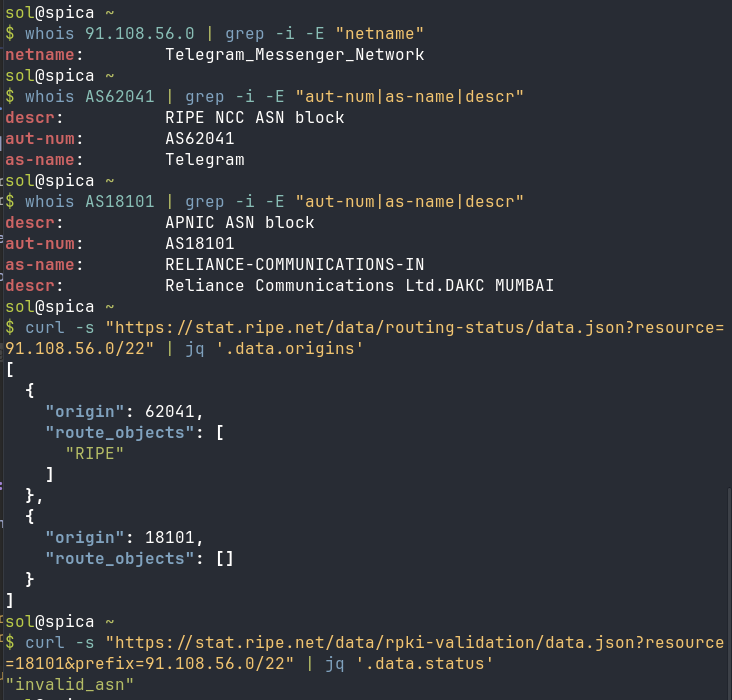
Wow. Reliance Communications has engaged in BGP hijacking of Telegram's IP prefixes and is leaking it globally via FLAG Telecom (AS15412) and affecting traffic far beyond India. (Is this an accident?)
It is still live:
cc: @anurag_bhatia@Squeal@kingslyj@AroonDeep@Aditi_muses
Indian telecom Reliance is sabotaging access to Telegram for millions of users OUTSIDE India (including the UAE) via a rogue method called BGP hijacking.
The sabotage seems intentional, as Reliance has ignored multiple reports.
This may be part of a competitive war, as Reliance is partially owned by Meta — the company behind WhatsApp.
Network operators are advised to reject unauthorized BGP announcements from Reliance (AS18101) to prevent route hijacks and ensure stable Internet access for their users.
Such abuse of global Internet routing is alarming. I wouldn’t be surprised if Reliance/WhatsApp were also behind the recent lobbying effort to ban Telegram in India.
Sad to see how disconnected from reality @jasveer10 is.
It’s always easy to support bans when they affect someone else’s platform.
Today it’s Telegram. Tomorrow it could be a @KnotDating, a social network, or any service that falls out of favor.
Every platform seems expendable until it’s your own.
First they came for @telegram, The people who didn’t use Telegram cheered. History tells us that’s not where these stories end.
Hey everyone, come here, I want you to see a fckn moron who calls himself a "cancer doctor". He is Arjun Sankaran, a cancer surgeon (MBBS, MS) at Srikara Hospital, Miyapur who is advising people to drink one to two alcoholic drinks "safely".
Doctors (of all people) need to embrace evidence and scientific rationale for the public. There is no safe level of alcohol. Even the lowest level of consumption can increase risk of 7 types of cancer.
https://t.co/FRTnTOlyuM
Is this Srikara Hospital's way of increasing business? It's pathetic when doctors do this to public health. Shameless.
https://t.co/ri5IGZVnPE
Srikara Hospital should ask this useless man to take the post down. It is not made in good faith for the public.
https://t.co/fDdLE6yc09