Last week taught us that being a Cardano SPO is no walk in the park — managing infra is complex.
What happens when we add 10+ partner-chains + Midgard + Hydra + bridges + oracles? How do we unify operations without compromising decentralization?
Enter: SuperNode 🧵👇
We've been talking to wallets, explorers, dapps. There's a common theme: we need a way to provide richer context to txs.
Knowing when a tx is a DEX swap, a prediction market bet or a loan from a lending protocol changes everything for UX, security, analytics and DevEx. 🧵
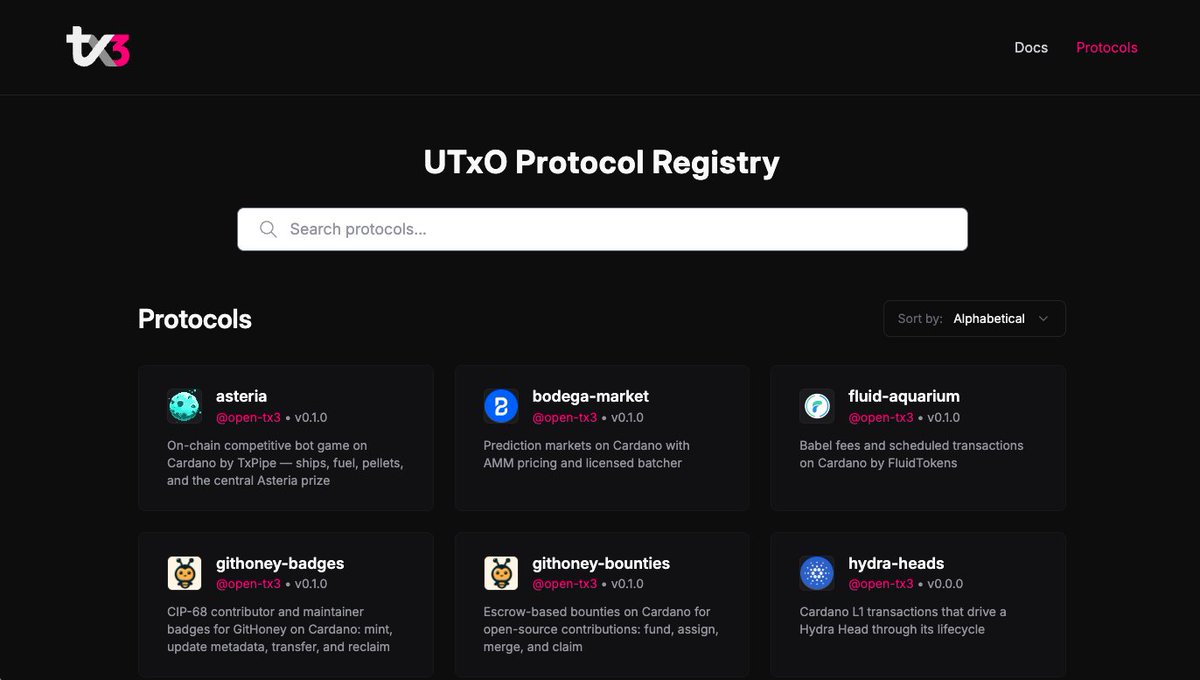
This is just the start for Tx3. We have an ongoing gov proposal to continue the mapping and build a comprehensive map of the Cardano ecosystem.
Please read it, discuss it, and if you're a DRep: we'd appreciate your vote 🙏
https://t.co/OrG2ySbPPS
What you get from a Tx3 mapped protocol:
→ Codegen SDKs in TypeScript, Rust, Go and Python
→ Open, auto-generated docs for every transaction
→ Protocol-specific skills for agentic coding
→ Overlaying rich context on top of on-chain txs
https://t.co/LGQQpCstr8
HTTP/JSON wins at simplicity, but if you care about low-latency or high throughput, gRPC makes a huge difference.
- binary serialization (compact & fast)
- HTTP/2 request multiplexing
- schema-driven, less payload
Dolos is a lightweight Cardano data node. It speaks UTxO RPC natively — no extra adapters needed.
If you're building indexers, wallet backends, or anything that needs to react to on-chain events in real time, this is an efficient pattern.
https://t.co/T5tkVZY8r7
UTxO RPC is a gRPC API for Cardano nodes.
Because it's gRPC, you get something REST APIs can't easily do: server-side streaming.
You open ONE long-lived stream and the node pushes txs to you as they land on chain — a live firehose of every tx. No polling. 🧵
We put together a fully working TypeScript example using the official utxorpc/sdk.
Five scripts that cover every WatchTx filtering pattern.
https://t.co/4v2vzpKPAO
I’m happy that the UTxO model is getting the attention it deserves. Cardano has been leading the way in building actual dApps with it.
One thing we were missing was a way to describe the interfaces for these protocols. Tx3 solves this.