Africa attracted $70bn in foreign direct investment in 2025.
More telling is where investors are increasingly positioning themselves: in strategic sectors such as energy, infrastructure & critical minerals.
Read more in the World Investment Report 2026: https://t.co/pvhfAcZu6e
World export volumes increased by 1.4% in the first quarter of 2026 (seasonally adjusted index), broadly unchanged from the 1.4% growth recorded in the previous quarter.
📊Read the insight: https://t.co/Db7L55rvMJ
🔢Get the data: https://t.co/0ecLdEYZol
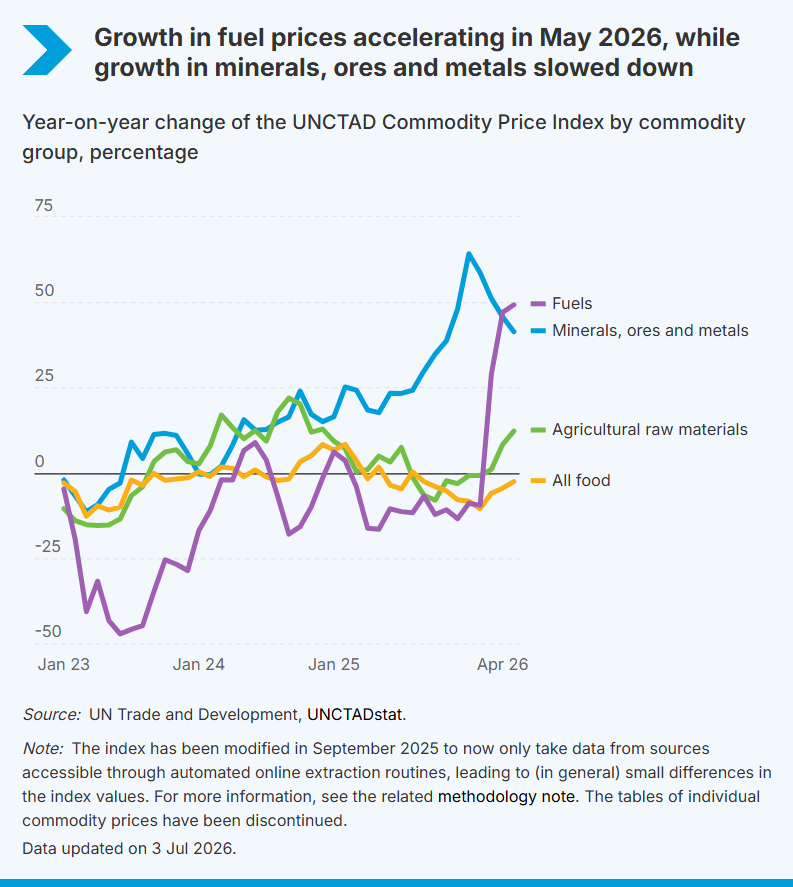
In May 2026, the UNCTAD Commodity Price Index increased by 39.3%, year on year.
📊Read the insight: https://t.co/sjZIVTU5mR
🔢Get the data: https://t.co/wXV4KBj0Lv
𝗕𝗲𝘁𝘁𝗲𝗿 𝗗𝗮𝘁𝗮 𝗳𝗼𝗿 𝗔𝗜: 𝗔 𝗣𝗼𝘀𝘀𝗶𝗯𝗹𝗲 𝗧𝗮𝘀𝗸 @WSISprocess Forum 2026
UNCTAD and partners will discuss how official statistics and data ecosystems can strengthen trustworthy, inclusive AI.
📅 9 July 2026 | 16:00–16:45 CEST in Geneva
➡️ https://t.co/HOPWXsOzki
Asian ports continue to dominate global rankings, with Shanghai (2 372), Ningbo-Zhoushan (2 041), and Singapore (1 834) leading in the second quarter of 2026.
📊Read the insight: https://t.co/z4Neloe5X4
🔢Get the data: https://t.co/wFRKZehcy9
Bilateral connections in Asia, especially those involving China, have strengthened over the last twenty years and now surpass many other connections.
📊Read the insight: https://t.co/1L1odKIZ5s
🔢Get the data: https://t.co/FbUU3ILlSB
Ocean-related goods trade surpassed $1 trillion in 2025, up 8% – with most value coming from manufacturing, processing and services rather than primary commodities.
What can coastal developing countries do to capture more value from this trend?
https://t.co/q9ZzJ8FlQe
In 2025, trade in ocean goods and services reached $2.5 trillion. Alongside well-known ocean sectors such as international marine and coastal tourism (32%) and maritime freight transport (20%).
📊Read the insight: https://t.co/c7e6v9sP7q
🔢Get the data: https://t.co/wrVC3KcjZr
On 24 June, @UNCTAD presented MyACTA, a new application for collecting data on informal cross-border trade.
🔗 Meeting: https://t.co/pM139maooZ
📱 MyACTA: https://t.co/TodeCljfZZ
The Syrian Arab Republic (+84.7%) recorded the largest increases in liner shipping connectivity in the second quarter of 2026, while the sharpest declines were observed in Qatar (−66.6%).
📊Read the insight: https://t.co/1L1odKIZ5s
🔢Get the data: https://t.co/oQaC7uNRa8
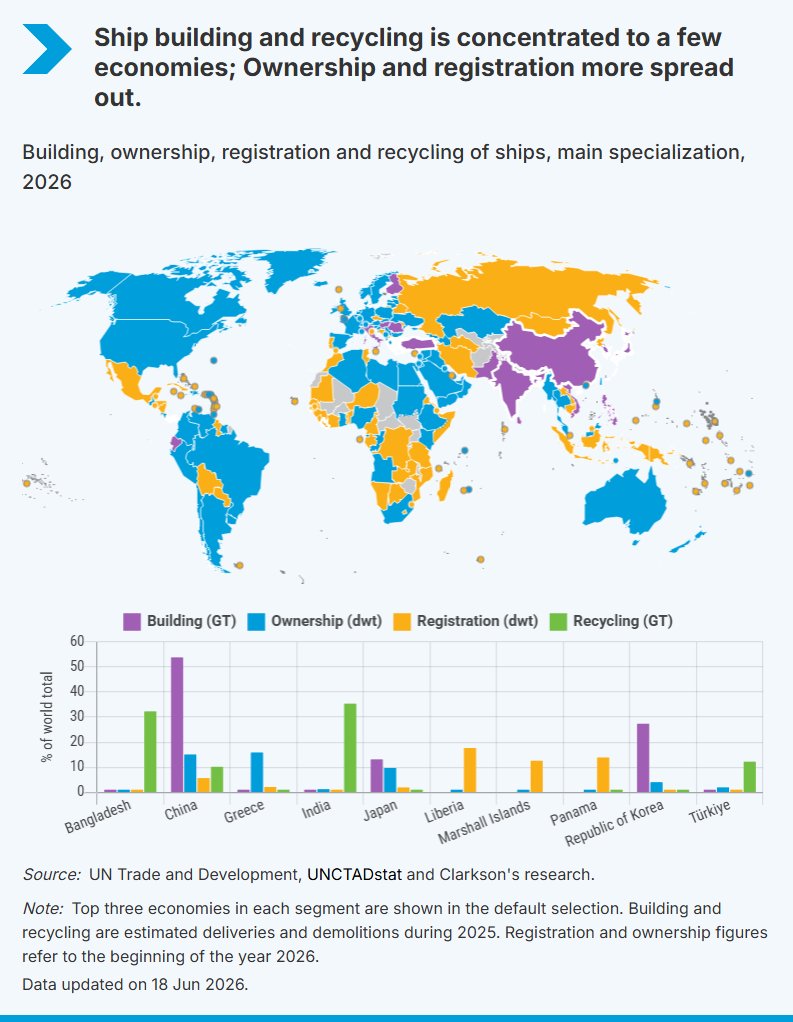
At the start of 2026, the global merchant fleet comprised around 116,000 vessels of at least 100 gross tons (GT).
Several economies play specialized roles in the global maritime industry.
📊Read the insight: https://t.co/awzyCxL8HW
🔢Get the data: https://t.co/3vO5OqLrDv
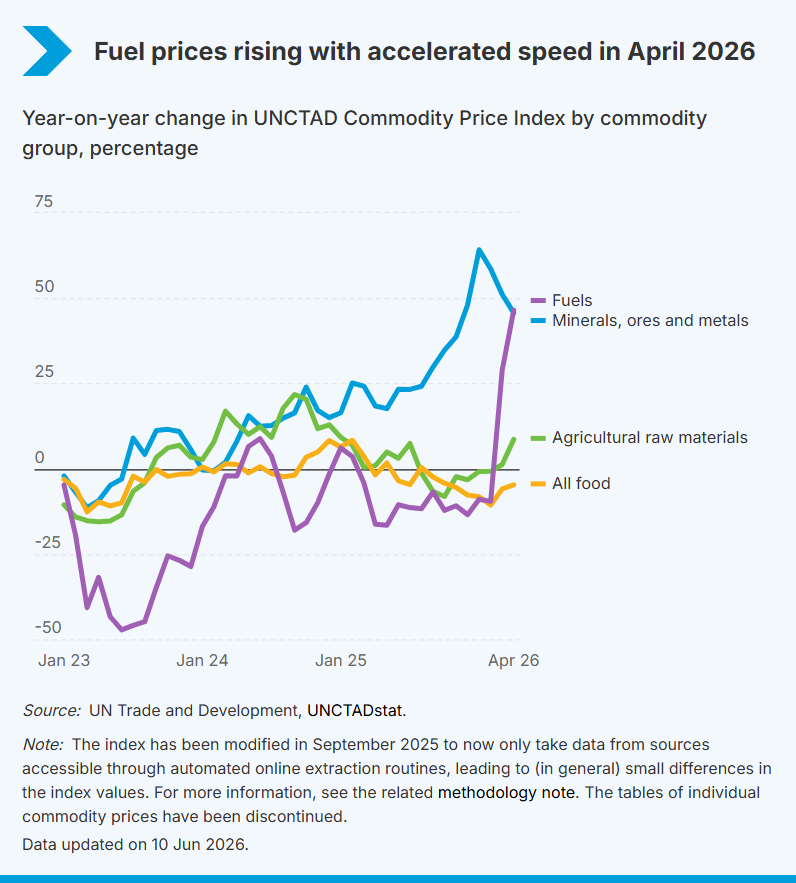
The UNCTAD Commodity Price Index was 39.0% higher in April 2026 than a year earlier. This high growth was driven by prices of minerals, ores and metals that continued rising rapidly (+45.7%).
📊Read the insight: https://t.co/sjZIVTU5mR
🔢Get the data: https://t.co/wXV4KBj0Lv
Data on SDG 16.4.1 (illicit financial flows) are now available, covering trade misinvoicing (@UNCTAD) and crime-related IFFs (@UNODC).
This first release includes a small set of countries, marking the start of a gradual expansion.
👉Get the data: https://t.co/GiMENBP6Km
🗓️Happening now in Bangkok
The Kick-off Workshop on Better Statistics for Digital Services Trade and Gender-Responsive Trade Policies is bringing together policymakers, statisticians, researchers, and trade experts.
➡️ More about the event: https://t.co/OD3fAsvbFO
At the Youth Network Town Hall, co-organized by @UNCTAD , participants explored the path from recommendations to action.
Opening the event, Anu Peltola highlighted the Youth Network's important contribution to advancing the #BeyondGDP agenda.
➡️https://t.co/hH21RMsxfY
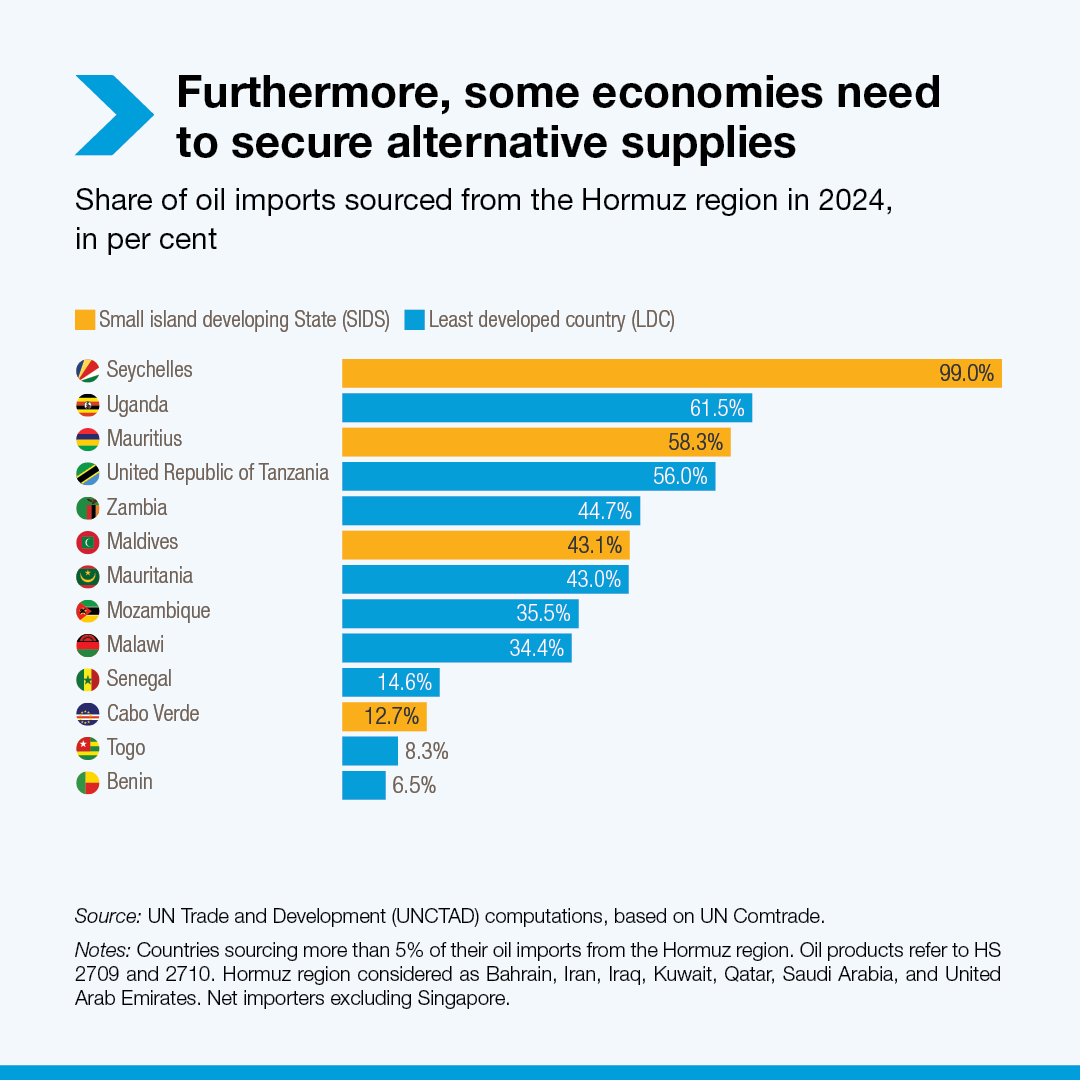
Disruptions in the Strait of Hormuz have pushed up oil prices and hit vulnerable economies hard.
Some depend on the Gulf for a significant share of their energy imports and now face the added challenge of securing alternative supplies.
Read more: https://t.co/aPnFv4QVlX
On World Oceans Day, new @UNCTAD data show that services surpassed goods to account for over half of ocean trade ($2.5 trillion) in 2025.
How can developing economies turn this shift into greater value creation and stronger ocean conservation?
Explore: https://t.co/mmnqjZ22xg
From 2024 to 2025, the euro, the yen and the pound sterling appreciated against the United States dollar respectively at rates of 4%, 1% and 3%. The yuan was stable.
📊Read the insight: https://t.co/4c7P9EjVfZ
🔢Get the data: https://t.co/9lDqjAmBnD
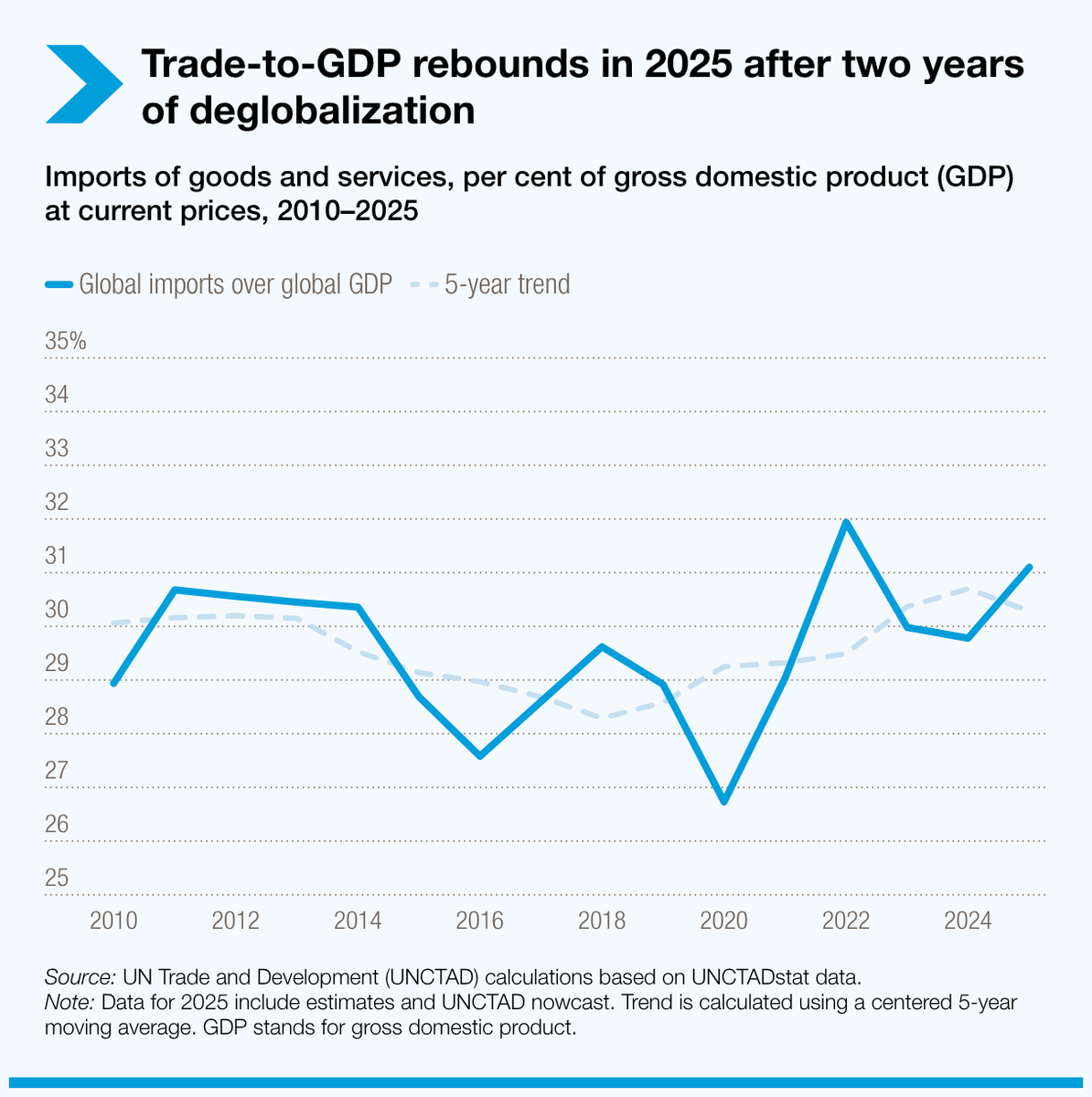
Globalization rebounded in 2025 as trade-to-GDP rose again.
But fragmentation is growing: Trade is concentrating in large economies, geographically closer trade links are growing faster, and geopolitics continue to reshape flows.
Explore: https://t.co/Ih6YUduUrq
The age structure in developing economies is pyramid-shaped. By contrast, in developed economies, the largest age groups are 35 to 69 years old.
🔢 Get the data: https://t.co/V5REqNokrn
📊 Read the insights: https://t.co/KMvRKrxWyH