In our recent paper in @SciReports, we report a negative trend in the global mean ecosystem carbon use efficiency of (–1.2 ± 0.3) × 10⁻³ yr⁻¹, indicating a declining capacity of terrestrial ecosystems to sequester atmospheric CO₂.
Details here: https://t.co/apJ5A2SPuZ
I am glad to share our last publication in ISPRS Journal of Photogrammetry and Remote Sensing, entitled 'The nonlinear embeddings method for long-term vegetation dynamics '.
https://t.co/W1B871peBG
📕The @UVERS2 book, 𝐂𝐚𝐫𝐛𝐨𝐧 𝐅𝐥𝐮𝐱𝐞𝐬 𝐚𝐧𝐝 𝐁𝐢𝐨𝐩𝐡𝐲𝐬𝐢𝐜𝐚𝐥 𝐕𝐚𝐫𝐢𝐚𝐛𝐥𝐞𝐬 𝐟𝐫𝐨𝐦 𝐄𝐚𝐫𝐭𝐡 𝐎𝐛𝐬𝐞𝐫𝐯𝐚𝐭𝐢𝐨𝐧, is now available for pre-order at @ElsevierConnect. Lots of colleagues and collabs!
https://t.co/fwCTmyT3Rg
➡️20% savings off code: BAFF20
OPINIÓN | Calentamiento global, DANAs e inundaciones. Un mar demasiado cálido, por María José López García, catedrática de Geografía Física de la Universitat de València https://t.co/PhEFPfsqhY vía @eldiariocv
Our work on global carbon fluxes retrieval is out.
We exploit multi output Gaussian processes to jointly estimate GPP, TER, and NEE preserving their physical relationship.
https://t.co/h9R1ALlOur
@UVERS2@GuanterLuis
Beca de introducción a la investigación para estudiantes del Grado en Física y Máster en Teledetección.
Programa: Estimación de variables biofísicas de vegetación mediante teledetección e inteligencia artificial
🔗 https://t.co/MFxUPcWCFH
contacto 📩: [email protected]
Divide and conquer 🏛️
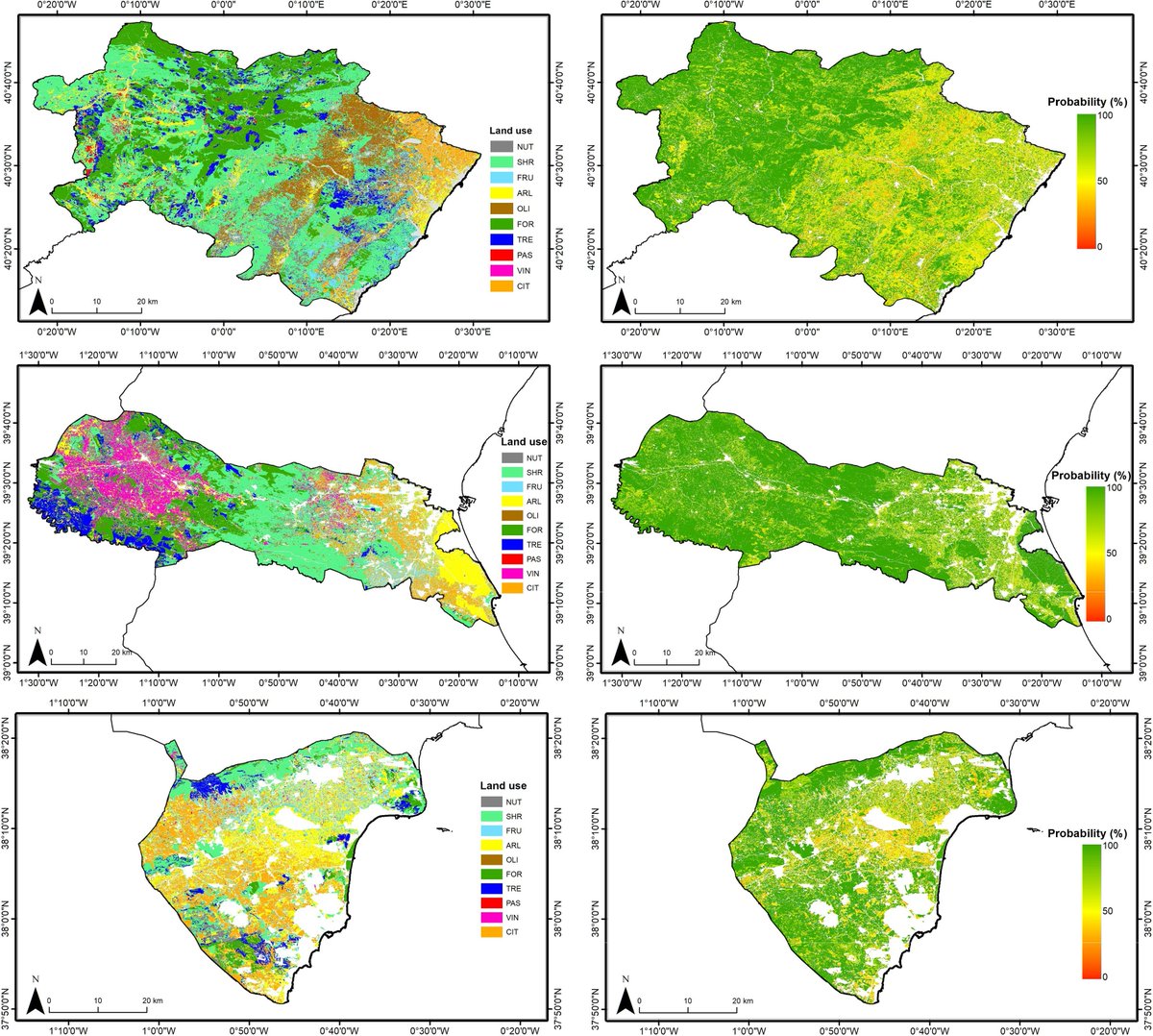
A new spatial approach for #LCLU classification from #Sentinel2 and #DeepLearning to cope with smallholdings, very fragmented areas, and classes with spectral hetereogenity. #NewCAP 👨🌾.
A cool collab with @UVERS2 and @isp_uv_es ⬇
https://t.co/VzX9XD8KrK
Check out the work by Qiang Wang @isp_uv_es@almoma153@MaCamTab on vegetation traits w/ kernel NDVI:
1) LAI, GPP, leaf/canopy Chl, fAPAR, & latent heat. 🌍🌻🛰️
2) #kNDVI propagates less uncertainty
3) alleviates saturation
📜https://t.co/EfalscoNFO
🕸️https://t.co/fLg8NlzRYu
We are looking for a pre- or postdoc researcher to join our group at the @UPV, in Valencia, Spain. The researcher will work on methods to detect and monitor methane emissions from space. DM me or [email protected] if you are interested!
Weather satellites can observe so much more than just the weather, and we can learn so much with hypertemporal remote sensing of the land surface. Please consider submitting to the new special issue in RSE w/ @DechantBenjamin on vegetation monitoring with geostationary satellites