As the governor of Anambra State, Peter Obi introduced the famous "Anambra ANIDS card".
With these cards, with which students, disabled and elderly accessed free health care in govt hospitals.
Peter Obi said if elected he will ensure that 100million Nigerians accessed free medical treatment in all public hospitals.
If he did in Anambra, he can do it in Nigeria!
Please vote for Peter Obi to transform Nigeria
Building a Healthier Nigeria Through Stronger Healthcare Systems
As part of our desire and commitment to building a healthier Nigeria, I met with some healthcare professionals and experts in the United States on Friday, June 5, 2026. The meeting was essentially to deepen my understanding of how successful health insurance systems deliver improved healthcare, especially in the areas of primary and emergency care.
One of our key health objectives remains unchanged: to expand health insurance coverage, strengthen primary healthcare across our electoral wards, train more healthcare workers, and make quality healthcare accessible and affordable for all Nigerians.
A New Nigeria must be a healthier Nigeria.
A New Nigeria is possible. -PO
Media Framing of Crime Along Ethnic Lines: Divisive.
As an Igbo man, I have endured stereotypes, judgment, and labelling solely based on my ethnic origins. This is not an isolated Igbo experience. Most Nigerians have, at some point, been reduced to their ethnicity rather than recognised for their true character.
I understand the pain of the ordinary Fulani man today, often unfairly judged by the actions of criminals he does not support, has never met, and who are not representative of his people.
Even in America, such unjust labelling fueled the civil rights movement and prompted Martin Luther King Jr. to declare that people should be judged by the content of their character, not the colour of their skin.
Every Nigerian ethnic group is known for its unique traditions, occupations, skills, and strengths. Crime, however, has no ethnicity. A thief is a thief. A terrorist is a terrorist. A kidnapper is a kidnapper. They are bad actors, not representatives of any people. They must be identified, arrested, and punished according to the law.
We must decisively abandon the dangerous practice of blaming entire ethnic groups for the actions of a few criminals. It is unjust, it breeds hatred, and it damages our national unity.
Let us proudly celebrate our diverse cultures, talents, and contributions, rather than falling prey to stereotypes and prejudices that politicians and divisive interests exploit for their gain.
A new Nigeria must emerge—one where no citizen is condemned because of tribe, religion, or birthplace. We can cherish our cultural roots while standing united by justice, mutual respect, and hope for a better future. We are capable of this.
A new Nigeria is within our reach. -PO
Tiping your office security N1k for buying your lunch, is not you doing him a favour. He earned it. If e easy, stand up from your seat and go get the food yourself. Calculate the financial cost of the stress of going the distance to get the food and back.
If you want to do him a favour, give him money for no reason. Someone would do you a favour, but you would see yourslf as the one doing them a favour because you earn higher than them and don't respect them.
If you send money to your colleague that does the same work with you and asked them to please get you lunch on their way back from wherever they were going, you see it as them doing you a favour because you respect them. You don't see it as a favour done to you when it is done by the office security or cleaner because you don't respect them. If you treat these people well and respect them, they will be happy to do things for you. You've become entitled to their help that you now expect them to use their money to fund your lunch.
My security does errands for me, and every errand comes with a tip. That is thank you for doing this because it is not his job. Favour is when I give him money for no reason which happens often or when he has special needs and makes a request and I give him money. You need to start respecting people as human beings, not by how much they earn. This thing is a common problem in our society.
There was a time in Nigeria when the man carrying a sewing machine on his shoulder was called Obioma.
Because almost all the artisanal tailors were Easterners of Igbo descent.
After the Civil War, many Easterners emerged from one of the most devastating chapters in Nigerian history with almost nothing but skill, mobility, discipline, and a survival instinct.
Some carried sewing machines from street to street, patching clothes, repairing trousers, adjusting school uniforms, and moving from compound to compound looking for work.
That image became so common that the name stuck.
Obioma.
A man with a sewing machine on his shoulder, moving under the sun and doing work many people looked down on.
But the same people who were once reduced in the public imagination to street tailoring slowly began to move.
From roadside tailoring to shops.
From shops to markets.
From markets to importation.
From importation to manufacturing.
From apprenticeship to industrial clusters.
From survival to ownership.
Go to Nnewi.
Go to Aba.
Go to Onitsha.
Go to Alaba.
Go to Ladipo.
Go to Ariaria.
You will still see poverty, struggle, disorder, bad roads, poor power supply, and all the normal Nigerian problems. Nobody is pretending the Southeast has become Singapore.
But you will also see something powerful.
You will see a people who took humiliation, displacement, and economic ruin and built a survival machine around trade, apprenticeship, mobility, and family capital.
And this is what makes my heart sink as a Northerner.
Today, the mai guard, mai ruwa, mai shayi, mai kaya, shoe repairer, the man pushing a wheelbarrow, carrying loads, shining shoes, patching clothes, riding okada, clearing construction sites, packing refuse, digging soakaway pits, hawking small goods, or sleeping beside a kiosk in Lagos, Abuja, Port Harcourt, Ibadan, Onitsha, and other cities is often called "Aboki."
That is the story we don't want to face.
One people moved from grass to grace.
Another moved from grace to grass.
This is not to take anything away from the Igbo people. I have nothing but admiration for them.
And it is not an insult to the Hausa people or to menial jobs. I am a proud son of Arewa, and in Arewa we do not look down on any vocation earned through halal means.
This is a history lesson.
Now look at us in the North.
We did not begin from the bottom.
Long before colonial Nigeria existed, Kano was already one of the great commercial cities of West Africa. Merchants from Tripoli, Fez, Agadez, Timbuktu, and Bornu passed through its markets. Caravans crossed the Sahara carrying leather goods, textiles, kola nuts, salt, and livestock. The city walls of Kano were not built around a village. They were built around a thriving urban economy that connected West Africa to North Africa.
We had cities that were centres of commerce when many parts of modern Nigeria were still organized around smaller local economies.
We had emirates that provided administration, taxation, courts, and political order across vast territories.
We had centres of Islamic scholarship that attracted students from across the region. In places like Kano, Katsina, Sokoto, and Borno, generations of scholars produced manuscripts and taught jurisprudence, theology, grammar, astronomy, and history. The reputation of northern scholarship travelled far beyond Nigeria's borders.
We had trade routes that linked us to the wider world. For centuries, merchants moved goods across the Sahara and across the savannah belt. Northern markets were not isolated local markets. They were part of international commercial networks.
We had cattle wealth on a scale few regions could match. Fulani pastoralists moved millions of cattle across grazing routes stretching from Senegal to Cameroon. Livestock was not merely food. It was wealth, trade, transport, status, and economic security.
We had one of the most respected leather industries in Africa. Kano leather was famous across the continent. Tanned hides from northern Nigeria found their way into trans-Saharan commerce and international markets. The famous red goatskin known as Morocco leather often originated from skins processed through West African leather networks in which Kano played a major role.
We had textile industries that employed thousands long before modern factories arrived. Hand-spun cotton was woven into cloth across northern towns. Entire communities depended on spinning, weaving, dyeing, trading, and transporting textiles.
We had the famous dye pits of Kano.
Not one or two pits.
Dozens of them.
For centuries, the Kofar Mata dye pits transformed locally woven cloth into richly coloured fabrics using indigo. Traders came from different parts of West Africa to buy these textiles. The dye pits became one of the oldest continuously operating industrial sites on the continent. They supported craftsmen, traders, transporters, farmers growing indigo, and entire commercial networks built around textile production.
We had the groundnut economy.
There was a time when the groundnut pyramids of Kano were not merely tourist attractions on postcards.
They were symbols of enormous agricultural wealth.
Thousands of farmers cultivated groundnuts across the North. Rail lines carried produce southward for export. Groundnut exports generated foreign exchange, supported industries, created jobs, and helped finance government revenues. The pyramids themselves represented mountains of produce waiting to enter global markets.
And if we move into the colonial and post-colonial era, the advantages become even harder to ignore.
We had numbers.
The North occupies roughly three-quarters of Nigeria's landmass. Depending on how one defines the region, the nineteen northern states account for well over half of Nigeria's population. Kano State alone has a population larger than many African countries.
We had manpower.
For decades, millions of young people entered the labour force every year. We were not a small minority struggling to find relevance. We were one of the largest demographic blocs in Africa.
We had land.
Hundreds of thousands of square kilometres of territory stretching across the Sudan and Sahel savannahs.
Land suitable for millet, sorghum, maize, rice, cotton, groundnuts, and livestock.
Land crossed by major river systems such as the Niger and Benue, and supported by irrigation projects in several states.
We had agricultural potential that many countries would envy.
We had political influence.
From independence onward, northern politicians, military officers, civil servants, traditional rulers, and power brokers occupied some of the most influential positions in the Nigerian state for long periods.
Prime ministers.
Heads of state.
Presidents.
Military rulers.
Senior ministers.
Powerful bureaucrats.
Influential legislators.
Whether one likes that fact or not, the North was never politically invisible.
We had religious authority.
The Sultanate of Sokoto remains one of the most influential Islamic institutions in Africa.
The emirates commanded legitimacy that extended beyond politics.
Mosques, Islamic schools, scholars, judges, and religious networks shaped social life across millions of households.
We had institutions.
Not perfect institutions.
But institutions nonetheless.
Emirate councils.
Traditional courts.
Islamic learning centres.
Agricultural boards.
Marketing boards.
Regional administrations.
Cooperative systems.
Educational establishments.
Commercial associations.
Structures that survived for generations.
We had a head start.
That is what makes the present situation so painful.
Because today, when millions of young Hausa and northern boys enter any big city, what work are many of them known for?
These boys are not lazy.
A lazy man does not leave Kano, Katsina, Zamfara, Sokoto, Jigawa, Bauchi, Kebbi, or Borno and sleep under a bridge in Lagos just to survive.
A lazy man does not push water from street to street.
A lazy man does not carry cement until his back bends.
A lazy man does not guard another man's house all night and still open a kiosk by morning.
The problem is not laziness.
The problem is that too many of our people enter the modern economy from the lowest possible point.
No certificate.
No skill that scales.
No capital.
No protection.
No formal training.
No strong educational foundation.
No industrial ladder waiting for them.
So they sell their bodies first.
Their backs.
Their hands.
Their legs.
Their sleep.
Their youth.
That is the real tragedy.
The Igbo Obioma story became a ladder because it was connected to apprenticeship, trade discipline, family networks, and commercial ambition.
The Hausa Aboki story too often becomes a trap because it is connected to poverty, broken schooling, rural collapse, insecurity, and survival migration.
One system turns a boy into a trader.
The other turns a boy into cheap labour or, worse, a recruitment ground for terrorism.
This is the painful contrast.
The Southeast came out of war and produced commercial networks.
The North came out of power and produced surplus labour.
That sentence is harsh, but look around before you reject it.
Who is carrying the load?
Who is guarding the gate?
Who is pushing the cart?
Who is fetching the water?
Who is sleeping in the market?
Who is leaving the village because bandits have made farming impossible?
Who is entering the city with nothing but strength?
If the answer to all the questions above is Arewa youth, then you must not be offended by the diagnosis. Instead, start asking your leaders the harder questions.
Because what is happening to Arewa is a failure of social organization. We shield our leaders too much and outsource criticism of them.
Our fathers inherited a civilization.
Too many of our boys inherited migration.
Our fathers inherited functioning economic systems.
Too many of our boys inherited survival.
Our fathers participated in trade networks stretching across continents.
Too many of our boys participate only in daily labour markets.
Our fathers built industries around leather, textiles, livestock, agriculture, and commerce.
Too many of our boys now rent out their muscles by the day.
And the painful thing is that the word Aboki, which originally means "friend," now, in the mouth of the Nigerian city, often becomes a class marker.
It becomes a way of saying: the northern poor man who does the work nobody respects but everybody needs.
That should break our hearts.
Not because the work is shameful.
No honest work is shameful.
What is shameful is that a whole region with history, population, religious authority, political influence, institutions, agricultural potential, and vast territory keeps producing young people whose first contact with the economy is desperation.
This is why history matters.
The question is not whether the Igbo are better than the Hausa.
That is a childish argument.
The real question is: what system turns hardship into enterprise, and what system turns heritage into dependency?
Because poverty alone does not explain everything.
War did not stop the Igbo from building trade networks.
Lack of oil did not stop Nnewi from producing industrialists.
Bad Nigerian roads did not stop Aba from becoming a manufacturing symbol.
Weak government did not stop apprenticeship from creating business owners.
So what stopped us?
What happened to the North that inherited thriving cities, trans-Saharan commerce, respected scholarship, textile industries, leather industries, livestock wealth, agricultural exports, demographic strength, political influence, and enormous land resources?
How did a people with so much historical structure produce so many young men with so little modern preparation?
That is the conversation we need.
Not insults.
Not denial.
Not ethnic pride.
Not hiding behind "our culture."
Not pretending every criticism is hatred.
The Obioma story should humble us.
Because it shows that a people can begin with a sewing machine on the shoulder and still build a commercial ladder.
The Aboki story should disturb us.
Because it shows that a people can begin with history on their side and still end up supplying cheap labour to other people's cities.
That is the mirror.
Igbo moved from Obioma to enterprise.
Hausa must not remain trapped inside Aboki survival.
The North needs a ladder.
Last year in December, I made a phone call to the NHS because I believed I had something meaningful to contribute.
A few months later, I was invited to a meeting.
After completing the necessary checks with @valerian247 and the onboarding process, I had the opportunity to present an idea focused on the early detection of patient deterioration… an early-warning system designed to identify risks before they become emergencies.
After I finished speaking, there was a brief silence.
In those few seconds, I could tell they were seeing the same big picture I was seeing.
“We would love to work with you on this.”
Since then, it has been a journey of putting together the right team, building the structure, and turning an idea into something that can make a real difference.
Almost 3AM, I am still awake at this hour brainstorming, knowing fully well that I have meetings lined up today from 11am to 4pm.
Some opportunities come with applause…Others come with responsibility.
This one came with both… But the game is the game, we gonna deliver.
This lady sent me a message that she is hungry.
I ask her "are you hungry or is there no food in the house?"
I asked because I understand their situation.
She said there is actually no food in the house, so I asked her to think of what to cook and come take the money.
She said she doesn't want to eat homemade meals. She wants to go to lace and eat rice.
I said okay.
I had my bath and then went over to their house and gave her father some money.
If they cook, make she no chop.
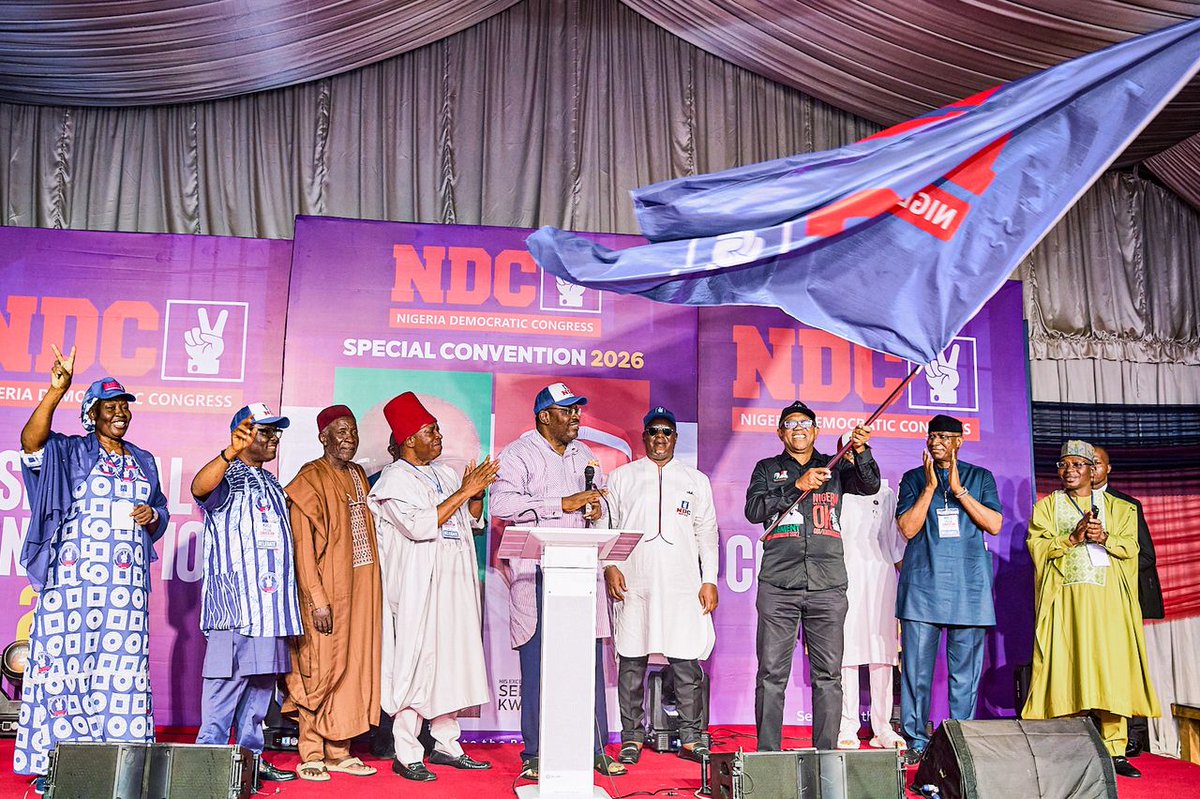
ACCEPTANCE SPEECH BY MR. PETER OBI FOLLOWING HIS NOMINATION AS THE PRESIDENTIAL CANDIDATE OF THE NIGERIAN DEMOCRATIC CONGRESS(NDC) – MAY 30, 2026
Protocols,
Esteemed citizens of Nigeria,
It is with deep humility that I accept the role of presidential candidate for our party.
I express my profound gratitude to the leaders of our party. His Excellency Seriake Dickson, the National Chairman, National Secretary and the National Working Committee, NWC members and members of our relentless supporters, and the Nigerian populace who have steadfastly kept the spirit of hope alive. I commend those who have made the journey from every region of our nation to convene here in Abuja.
I wish to assert unequivocally: a New Nigeria is Possible. This conviction has united us; it must serve as our compass on the challenging road ahead and sustain us through all trials we may face. This pivotal moment transcends the individual ambitions of Peter Obi; it concerns the essence of our nation and the future of our children. It is about rekindling hope for millions who have faced adversity yet remain committed to Nigeria.
Today, our nation finds itself at a crucial juncture, enveloped in uncertainty. Families are anxious about their safety; parents are concerned for their children's futures; and talented youth increasingly question their prospects in their homeland.
Businesses are struggling, communities are suffering, and an alarming number of citizens have lost faith in the very concept of governance. Yet, I stand before you filled with optimism and strong faith in the resilience of our people, for I firmly believe that a New Nigeria is possible.
UNITY
To realise this New Nigeria, we must first mend the foundational elements essential for the success of any nation.
Nigeria cannot advance while fragmented by ethnic, religious, regional, or narrow political divides. We may communicate in different languages and practise diverse faiths, but we share a singular destiny under one flag. Our diversity should not be a source of division; rather, it is among our greatest strengths.
We should build bridges where others erect barriers, replace mistrust with confidence, division with understanding, and resentment with a collective purpose. A united Nigeria is indispensable. As Will Durant wisely pointed out, "A great civilisation is not conquered from without until it has destroyed itself from within." We must never self-destruct. We must heal, unify, and progress together.
INSECURITY
In terms of security, the situation in Nigeria has considerably worsened. The global terrorism impact assessments ranked Nigeria as the 8th most affected nation in 2022, 6th in 2024, and 4th in 2026.
Yet, for many years, Nigeria garnered global recognition as a reliable contributor to peacekeeping, regional stabilisation, and conflict resolution. Our troops have not only displayed bravery but have also shown professionalism, discipline, resilience, and empathy in the most challenging operational contexts. Our officers and personnel have successfully commanded multiple international forthe ces, safeguarded vulnerable civilian populations, monitored ceasefires, reinstated constitutional order, and contributed to rebuilding efforts.
Nigeria became one of the leading contributors of troops from Africa to UN peacekeeping missions and earned widespread admiration for operational effectiveness and leadership in various countries, including Rwanda, Sudan, Liberia, Sierra Leone, Mali, Western Sahara, Congo, Lebanon, Cambodia, Haiti, and Kuwait. At one pointin a Nigeria, Lt. General Isaac Obiakor (rtd) even led global peacekeeping initiatives.
We must address insecurity with resolve and urgency, for no nation can thrive while its citizens live in trepidation. The primary responsibility of the government is to ensure the safeguarding of lives and property.