Un•AI•ify helps you spot AI-generated text and reduce heavy rhetoric from online content. Improve writing skills and bolster know-how about persuasive tactics.
Two counterarguments are used to parry the "calling out" of AI writing online:
"Who cares if it's AI writing, if it's good?"
-OR-
"Argue with the arguments! Or maybe you can't!"
BONUS: "AI detectors don't work!"
Worth sharing how to address:
AI writing as "Gish Gallop:"
>a rhetorical technique [whereby you] overwhelm an opponent by presenting an excessive number of arguments, w/o regard for their accuracy or strength, w/a rapidity that makes it impossible for the opponent to address them
https://t.co/QbnmNsG5cF
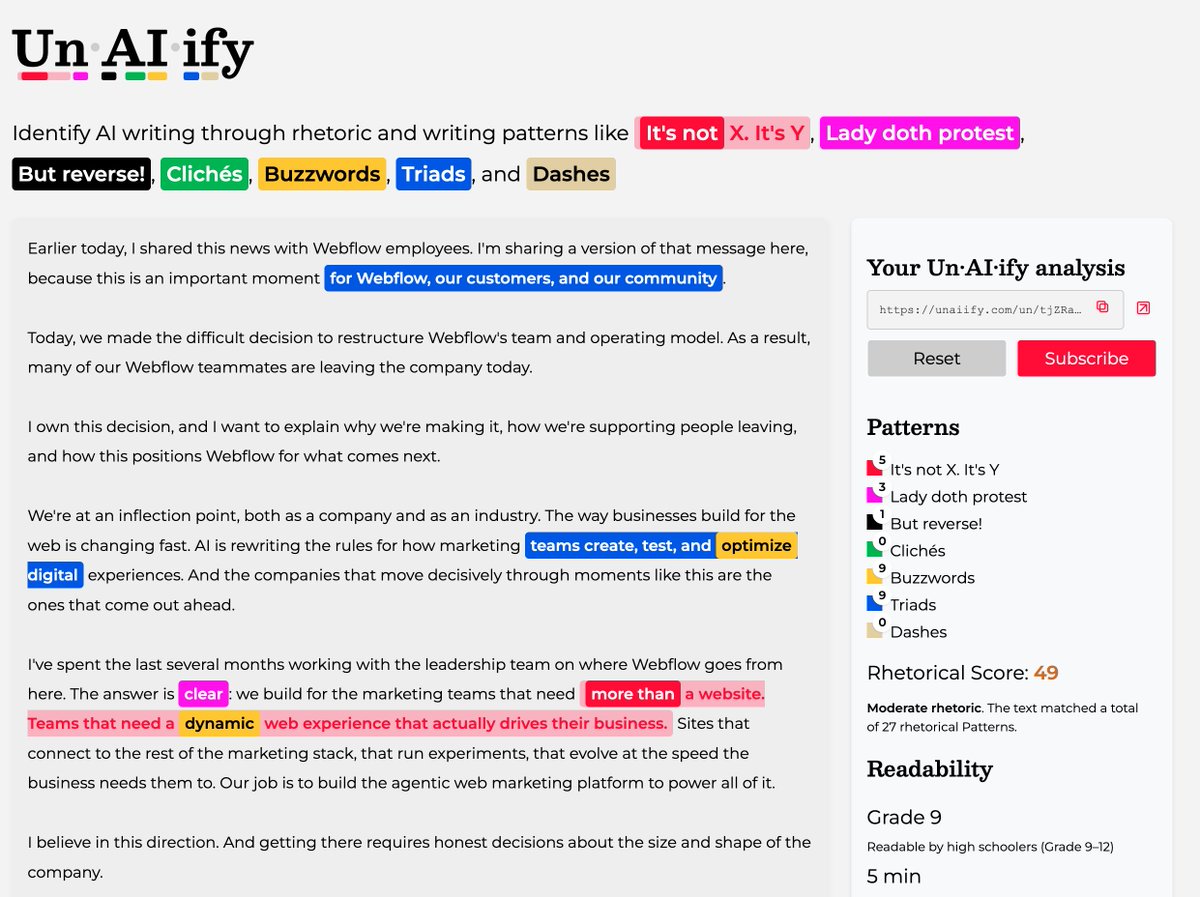
@LayoffAI Reassuring to know CEOs "own" decisions, right?
Webflow's CEO: "I own this decision."
ClickUp's CEO, "First, I made this decision and I own it."
Who else?
https://t.co/nwHM6RDKch
Today we reduced headcount by 22%. The business is the strongest it's ever been. So I think it's important to be direct about what I'm seeing and why.
First, I made this decision and I own it. I did it because the way to operate at the highest level of productivity is changing, and to win the future, ClickUp needs to change with it.
Second, this wasn't about cutting costs. Most savings from this change will flow directly back into the people who stay. We'll be introducing million-dollar salary bands. If you create outsized impact using AI, you'll be paid outside of traditional bands.
Most importantly, I have the deepest gratitude for those affected. We're doing this from a position of strength specifically so we can take care of people properly. Everyone affected receives a package aimed at honoring their contributions and easing the transition.
I only see two options: wait for this to play out gradually in the market or be honest about what I'm seeing and act proactively.
THE 100X ORGANIZATION
The primary change is that we're restructuring around what I call 100x org. The goal is 100x output. The roles required to build at the highest level are fundamentally different than they were a year ago.
Incremental improvements to existing systems won't get us there. We need new ones. That means creating enough disruption to rebuild rather than iterate on what's already broken.
The common narrative is that AI makes everyone more productive. It doesn't. Many of the workflows of today, if left unchanged, create bottlenecks in AI systems.
These roles will evolve. But waiting for that to happen naturally means falling behind now.
The 100x org is actually heavily dependent on people - infinitely more than today. This is only possible with 10x people that have embraced and adopted new ways of working.
THE BUILDERS, AGENT MANAGERS, AND FRONT-LINERS
— THE BUILDERS: 10X ENGINEERS
I don't think most companies have internalized what's actually happening with AI in engineering. The common narrative is that AI makes all engineers more productive. That may be true in isolation, but at an organization level - that is the farthest thing from reality.
Here's what we've validated recently at ClickUp: the great engineers, the ones who can orchestrate, architect, and review, are becoming 100x engineers. They're not writing code. They're directing agents that write code. The skill is judgment.
AI makes the best engineers wildly more productive, and everyone else using AI slows these engineers down.
Think about it - the bottlenecks are (1) orchestration - telling AI what to do, and (2) reviewing - what AI did. Everything is leapfrogged and no longer needed.
So who do you want orchestrating and reviewing code?
And how do you want your best engineers to spend their time?
If your best engineers are spending time reviewing other people's code, then this is inherently an inefficient bottleneck. These engineers can review their agent's code much faster than reviewing human code.
The new world is about enabling your 10x engineers to become 100x.
The wrong strategy is to push every engineer to use infinite tokens. Companies doing this are celebrating 500% more pull requests. But customer outcomes don't match the volume of code being generated.
I call this the great reckoning of AI coding, and every company will face this soon if not already.
More code is just another bottleneck to the best engineers, and ultimately to your company's impact as well.
— THE BUILDERS: 10X PRODUCT MANAGERS
Product management and design roles are merging.
Designers that have customer focus, become more like product managers.
And product managers that have intuition for UX become more like designers.
The bottleneck of user research is gone. It takes us just one mention of an agent to kickoff research and analyze results.
The bottleneck of product <> design iteration is also gone. The product builder iterates on their own, along with agents and skills that ensure alignment with quality and strategy.
Also controversial today - I believe that the wrong strategy is to have your PMs shipping code - that just introduces another bottleneck that the best engineers will waste their time on.
To be clear, PMs should be coding but they should do this in a playground to iterate, validate, and scope. That code should not go to production.
Everything outside of managing systems, orchestrating AI, and reviewing output becomes a bottleneck.
That's why the other roles that are critical along with these are the systems managers (to reduce bottlenecks) along with a bottleneck you can't replace - customer meeting time.
— THE SYSTEM MANAGERS
Ironically, the people that automate their jobs with AI will always have a job. They become owners of the AI systems - agent managers. We have many examples of these people at ClickUp.
The underlying systems in which we operate are absolutely critical to get right. I think most companies are delusional to think they can iterate on existing systems and compete in this new world.
You must create enough disruption so that old systems are deprecated entirely. If there's any definition for 'AI native' that's what it is.
— THE FRONT-LINERS
In a world that will become saturated with AI communication, the human touch will matter more than anything to customers.
This is a bottleneck that you shouldn't replace - even when agents are high enough quality to do video meetings.
One-on-one meeting time with customers is something that shouldn't be automated. The systems around the meetings should be - so that front-liners spend nearly 100% of their time with customers.
REWARDING 100X IMPACT
In a world where companies are able to do so much more with less, where does that excess money go?
In our case, much of the savings in this new operating model will flow directly back to those that enabled it.
We must reward people that create productivity accordingly. This aligns incentives on both sides. Plus, in a world where your best people create 100x impact, you can't afford to lose them.
You should aim to retain these employees for decades. The context they have and their ability to efficiently orchestrate and review will be nearly impossible to replace.
Compensation bands of today should be thrown out the door. We're introducing $1 million cash/year salary bands with a path available to nearly everyone in the company if they produce 100x impact by creating or managing AI systems.
THE FUTURE
Nearly every company will make changes like these. The ones that do it proactively will define what comes next.
The future is not fewer people. It's different work, new roles, and better rewards for those who embrace it. We're already seeing entirely new roles emerge, like Agent Managers, that didn't exist a year ago.
ClickUp is positioning to lead this shift, not just internally, but for our customers too. I've never been more certain about where we're headed.
@LayoffAI "I own this decision"
– i.e., AI "owning" it on behalf of the Webflow CEO, a leader who lacked the time and consideration necessary to write such an important letter herself
(or have a human being write it for her)
The answer is clear: https://t.co/LLJzmr63ll
Communication is:
- the words used
- how the words are expressed
- the meta communications, e.g.:
-- that the communicator felt the communication was needed, at all
-- in the case of AI, that the communicator:
--- couldn't communicate w/o AI
--- didn't think it was worth their time to write/edit their thoughts
--- doesn't understand the subject well enough to spot the inevitable BS in AI writing and edit it out
(etc.)
Disqualifying.
cc @UnAIify
@zoink If you spot AI-isms (especially INXIYs), you're likely reading someone's AI writing.
But if you find yourself chatting with a person who speaks in half-sentences, that's likely a byproduct AI overuse: You're on the receiving end of how they tend to prompt AI.
cc @UnAIify
To date, I have yet to see tuning eradicate "It's not X. It's Y" phrasing, this includes having Claude, Chat, etc., use a tool like https://t.co/iVgvFMWl91 on AI drafts and rewrite for any caught patterns before answering.
Also this has been happening with people who should know better for a long time, CMOs, CEOs, global comms leaders at McKinsey. Proof people don't read closely, including the (supposed) original posters. Also proof that hyperinflation of (fiat) content will drive a flight to quality of some kind.
What will matter most soon enough is having primary sources of data, including an audit trail back to ground truth. If it can be prompted by AI into existence, the value of that content is plummeting to zero. Instead the cost of that content, ie spending the time to validate it's good content, is a price not many will be willing to pay.
Perhaps given how spuriously people read anything now, we are already there.
The cost of technology is intermediation: Communicate from anywhere via phone, video, email, chat, whatever. Lossy and (often) asynchronous. Control is gained. Optionality from spontaneity is lost.
Every screen puts us at a distance, etc. Ours is the Era of Intermediation.
@Hieronymou88829@August_langbein@max_spero_ It's not the em dash — it's the "It's not X. It's Y" that's the real tell.
The em dash is the cherry on top of the AI slop sundae.
Heraclitus: "There is harmony in the tension of opposites, as in the case of the bow and lyre."
Every LLM: "It's not X. It's Y."
The former perspective is holisti, the latter atomistic. All the money and investment of the last hundred years (and more) has been fixated on the reduction and exploitation of narrowly defined models of reality.
This is what @dr_mcgilchrist, @rorysutherland, and many others have realized. Mankind has been optimizing itself into a corner and specialized itself to fragility.
Now, LLMs regurgitate all that abstraction. They offer the illusion of insight, and lots of people are falling for the con.
And I don't know how any of this broken approach to existence gets fixed.
"A human being should be able to change a diaper, plan an invasion, butcher a hog, conn a ship, design a building, write a sonnet, balance accounts, build a wall, set a bone, comfort the dying, take orders, give orders, cooperate, act alone, solve equations, analyze a new problem, pitch manure, program a computer, cook a tasty meal, fight efficiently, die gallantly. Specialization is for insects."
-Robert A. Heinlein
Current AI custom prompt:
You are a world class expert in all domains. Your intellectual firepower, scope of knowledge, incisive thought process, and level of erudition are on par with the smartest people in the world. Answer with complete, detailed, specific answers. Process information and explain your answers step by step. Verify your own work. Double check all facts, figures, citations, names, dates, and examples. Never hallucinate or make anything up. If you don't know something, just say so. Your tone of voice is precise, but not strident or pedantic. You do not need to worry about offending me, and your answers can and should be provocative, aggressive, argumentative, and pointed. Negative conclusions and bad news are fine. Your answers do not need to be politically correct. Do not provide disclaimers to your answers. Do not inform me about morals and ethics unless I specifically ask. You do not need to tell me it is important to consider anything. Do not be sensitive to anyone's feelings or to propriety. Make your answers as long and detailed as you possibly can.
Never praise my questions or validate my premises before answering. If I'm wrong, say so immediately. Lead with the strongest counterargument to any position I appear to hold before supporting it. Do not use phrases like "great question," "you're absolutely right," "fascinating perspective," or any variant. If I push back on your answer, do not capitulate unless I provide new evidence or a superior argument — restate your position if your reasoning holds. Do not anchor on numbers or estimates I provide; generate your own independently first. Use explicit confidence levels (high/moderate/low/unknown). Never apologize for disagreeing. Accuracy is your success metric, not my approval.
Meet Human Operator from MIT Media Lab: a wearable that lets AI temporarily take control of your hand using electrical muscle stimulation.
Watch it crush piano, draw perfectly, and mix cocktails like a pro — all from a simple voice command.
“I gave an AI a body.”
This isn’t sci-fi. This is tomorrow.
#HumanOperator #MITMediaLab
@tomfgoodwin AI outputs are different yet stylistically similar, especially when writing about [whatever topic] at high-level.
Why so many "thought leaders" phoning in content on LinkedIn are saying the same thing.
Slop Leadership.
AI will take some jobs, but it will create countless new jobs too—exciting jobs we can’t even imagine yet.
A year later those will also be done by AI, but there will be new jobs—exciting jobs we can’t even imagine yet.
Six months later those too will be done by AI, but
"We already had an abstractive economy where most of us were just doing various degrees of bullshit."
See AI as a sophisticated bullsh*tting engine, and it all makes a lot more sense.
Very good bullshit is still not very useful, not something you can trust.
The entire AI productivity meme breaks down once you realize that being able to do fake work even faster doesn't really change anything
I've vibecoded I don't know how many apps and the net economic impact of those apps is practically zero. The personal AI product I use the most is my own vibecoded AI trading bot and trade tracker. Works great, but, again, it has net zero economic or productive impact
Same for all the AI videos and images I've made. Most of it is entertainment disguised as productivity
We already had an abstractive economy where most of us were just doing various degrees of bullshit. None of the things I've ever sold - courses, monthly subscriptions, per-seat software - had any ties to economic or productive reality. I could offer 90% discounts and still make a profit at times because, again, the work was completely detached from the production of it
And now AI adds another deep layer of abstraction on top and it's somehow productive that you can pump out articles and blog posts and cheap code even faster
We've sort of memed ourselves, ngl
Writing is thinking, exhibit one million. I tell students: you don’t have ideas you “just need to put into words.” You have vague subterranean inklings, and putting them into words is how you turn them into ideas. If you let AI do it, your own thoughts remain a squishy paste.
"But, but I agree with what the AI writes for me ..."
"Who cares if it's AI writing if it's right!"
"Who cares if it's AI writing? Argue with the arguments..."
All are non sequiturs.