Non-profit & editorially independent. Exploring science as a frequently wondrous, sometimes contentious, and occasionally troubling byproduct of human culture.
💉 Vaccines have transformed public health, but their journey is far from over.
Join us for a 4-week deep dive into the past, present, and future of immunization, curated from our extensive archive.
Subscribe for free ⬇💉 Vaccines have transformed public health, but their journey is far from over.
Join us for a 4-week deep dive into the past, present, and future of immunization, curated from our extensive archive.
Subscribe for free ⬇💉 Vaccines have transformed public health, but their journey is far from over.
Join us for a 4-week deep dive into the past, present, and future of immunization, curated from our extensive archive.
Subscribe for free ⬇💉 Vaccines have transformed public health, but their journey is far from over.
Join us for a 4-week deep dive into the past, present, and future of immunization, curated from our extensive archive.
Subscribe for free ⬇💉 Vaccines have transformed public health, but their journey is far from over.
Join us for a 4-week deep dive into the past, present, and future of immunization, curated from our extensive archive.
Subscribe for free ⬇️
Kobuk was a grizzly bear who lived at a sanctuary in Montana.
He and other “problem bears” earned their keep by testing products like bear-proof trash cans and camping food canisters.
John Schwartz reviews Alex Davies’ book on the bizarre frontiers of product testing.
🔗: https://t.co/2O5qnBYp2C
In the 18th and 19th centuries, body snatchers — known as “resurrection men” — proliferated as a response to a supply and demand problem.
Medical schools needed cadavers for student training, but the legal supply of executed criminals couldn’t keep pace.
🔗 Read the full opinion piece by Katherine O'Malley: https://t.co/bwsmPUKT6o
What if the cruel voice in your head had a face?
Researchers in Denmark are testing virtual reality avatars that represent the internal voices experienced by some patients with eating disorders.
During therapy, patients confront the avatar while a clinician controls what it says.
The idea is gaining attention, even as researchers continue to ask how well it works.
🔗 Read the full story: https://t.co/BWaEKatdPG
#AI #VirtualReality #Technology #Psychotherapy
The vagus nerve has become a wellness obsession online.
In medicine, researchers are asking a much bigger question: Can electrical signals in the nervous system be used to treat disease?
Undark spoke with neurosurgeon Kevin Tracey about the science behind that idea.
🔗: https://t.co/tqb70Beptq
What happens after someone donates their entire body to science?
Katherine O’Malley argues that the answer is less clear than many people might assume.
Whole-body donation in the U.S. operates without a single federal body overseeing the programs that receive and use donated remains.
🔗: https://t.co/bwsmPUKT6o
Abandoned mines in Italy may offer clues to life on Mars.
Astrobiologist Luca Tonietti studies microbes living in dark, nutrient-poor, iron-rich environments that resemble conditions beneath the Martian surface.
Their survival strategies, and the traces they leave in rock, could help scientists know what to look for on the Red Planet.
📷 See the research through Andrea De Giovanni’s photographs. https://t.co/lnARCcpG4e
Birds were once noise on weather radar. Now, that noise is data.
With machine learning, researchers can pull migrating birds out of radar images and watch movements that would be impossible to track one animal at a time.
🔗: https://t.co/HILcBC2KxS
Schools are spending millions on AI systems designed to spot weapons.
Evidence that these tools actually prevent shootings remains thin, while false alarms can carry serious consequences for students.
🔗: https://t.co/Sn1Hsr3FG7
The search for alien life can begin surprisingly close to home.
Across Italy, scientists are studying some of Earth’s harshest environments to understand what life might look like on Mars or elsewhere in the universe.
🔗: https://t.co/Cj7GKjozDw
Science gets interesting when the answer refuses to settle down.
Entanglements: The Undark Podcast follows the questions that remain open even after the research has piled up.
Catch up on the latest conversations from Undark!
🔊 Available on Apple Podcasts, Spotify, Pandora, and SoundCloud.
🔗: https://t.co/fIaV7vRvcQ
Undark’s November 2026 issue is here! 🗞️
Our cover story looks at life after cancer treatment, where being cancer-free can still leave survivors managing long-term health effects and a medical system that does not always know what comes next.
This month, Undark also explores how AI is changing migratory bird tracking, how virtual reality is entering difficult conversations in medicine, why engineers sometimes have to push things to the breaking point to keep people safe, and more.
🔎 See what’s inside the November issue: https://t.co/7ifaqeLDJw
Prediction markets have become increasingly visible in political coverage, especially after the 2024 election.
Their rise has fueled questions about whether they could eventually rival traditional polling.
Experts caution that the two tools measure fundamentally different things.
🔗 Learn more: https://t.co/K1QTckTQXl
Could a pig someday grow a human kidney or pancreas?
Scientists studying human-animal chimeras are working toward that possibility as roughly 100,000 people in the U.S. wait for organ transplants.
Researchers still face major biological obstacles before the idea could become a clinical reality.
Read the full story in Undark. https://t.co/EguSRF0KNT
The November issue of Undark is here.
Our cover story looks at the complicated reality of life after cancer, when being cancer-free can still mean years of medical consequences.
Across the rest of the issue, Undark follows the questions that surface when science meets the institutions and people expected to live with its effects.
🔬 Explore the November issue! https://t.co/7ifaqeLDJw
This weekend, most Americans will turn their clocks back an hour.
The ritual has survived decades of debate over whether we should keep changing the clocks at all.
What does the science say about how we mark time? 🕰️
🔗 Read more: https://t.co/E2V2VUOiYf
Genomic databases hold an extraordinary amount of information. Some records, however, no longer carry enough context to show exactly where the data came from or how reliable they are.
As those archives become training material for AI, Jonathan Jacobs and Patrick Boyle argue that this old problem deserves new attention.
🔗: https://t.co/4vdWeGITcS
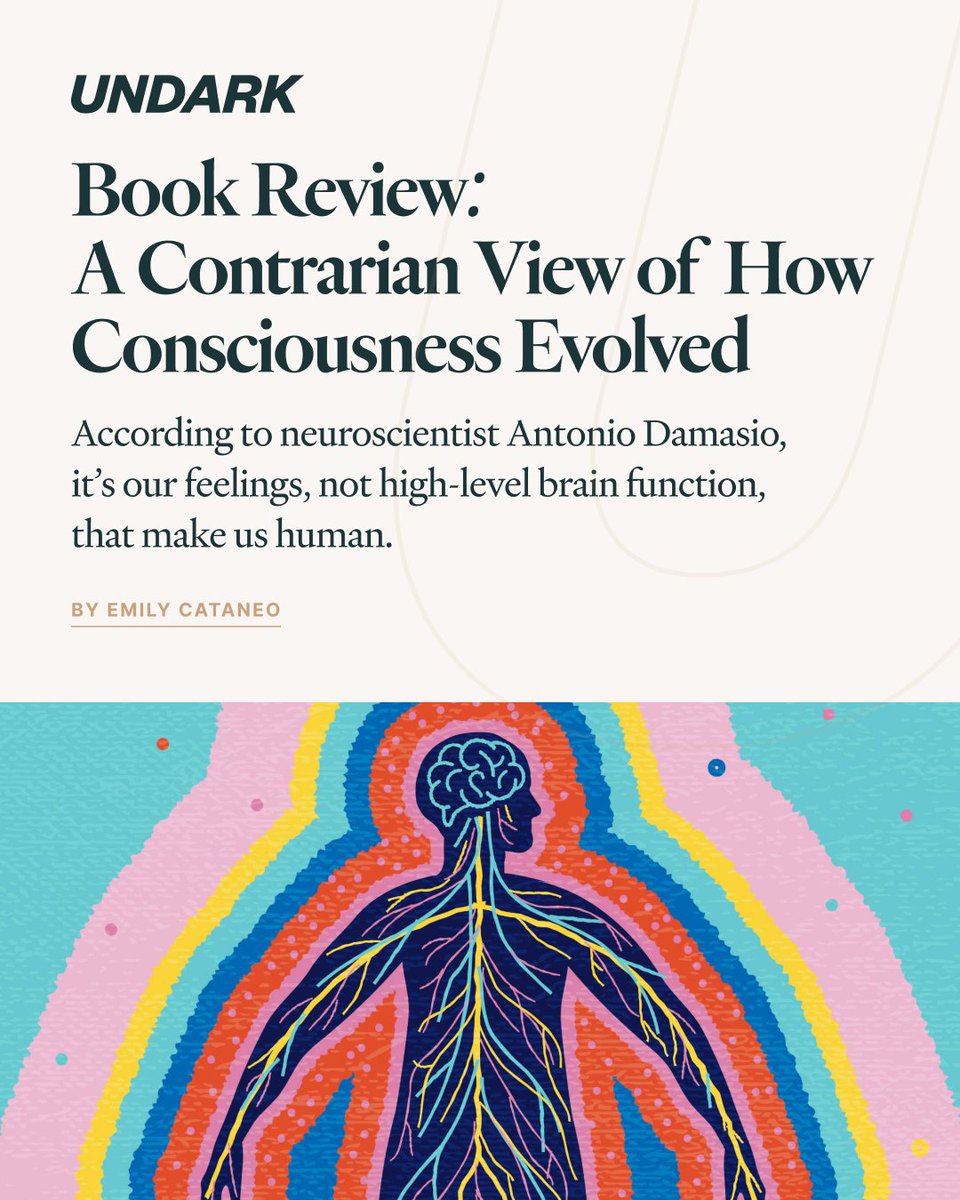
Antonio Damasio argues that consciousness may have begun with something much more basic than abstract thought: the body’s need to stay alive.
In Natural Intelligence & the Logic of Consciousness, the neuroscientist traces consciousness back to homeostatic feelings and explores what that theory could mean for artificial intelligence.
Read Emily Cataneo’s review in Undark.
🔗: https://t.co/rvcKJeKzxQ
Sweden was once a frontrunner in digital education. Now, its schools are rethinking when technology actually helps students learn.
The shift has opened a broader debate over foundational skills and what evidence should guide classroom technology.
🔗 Read the full story: https://t.co/7tbZegDIfx
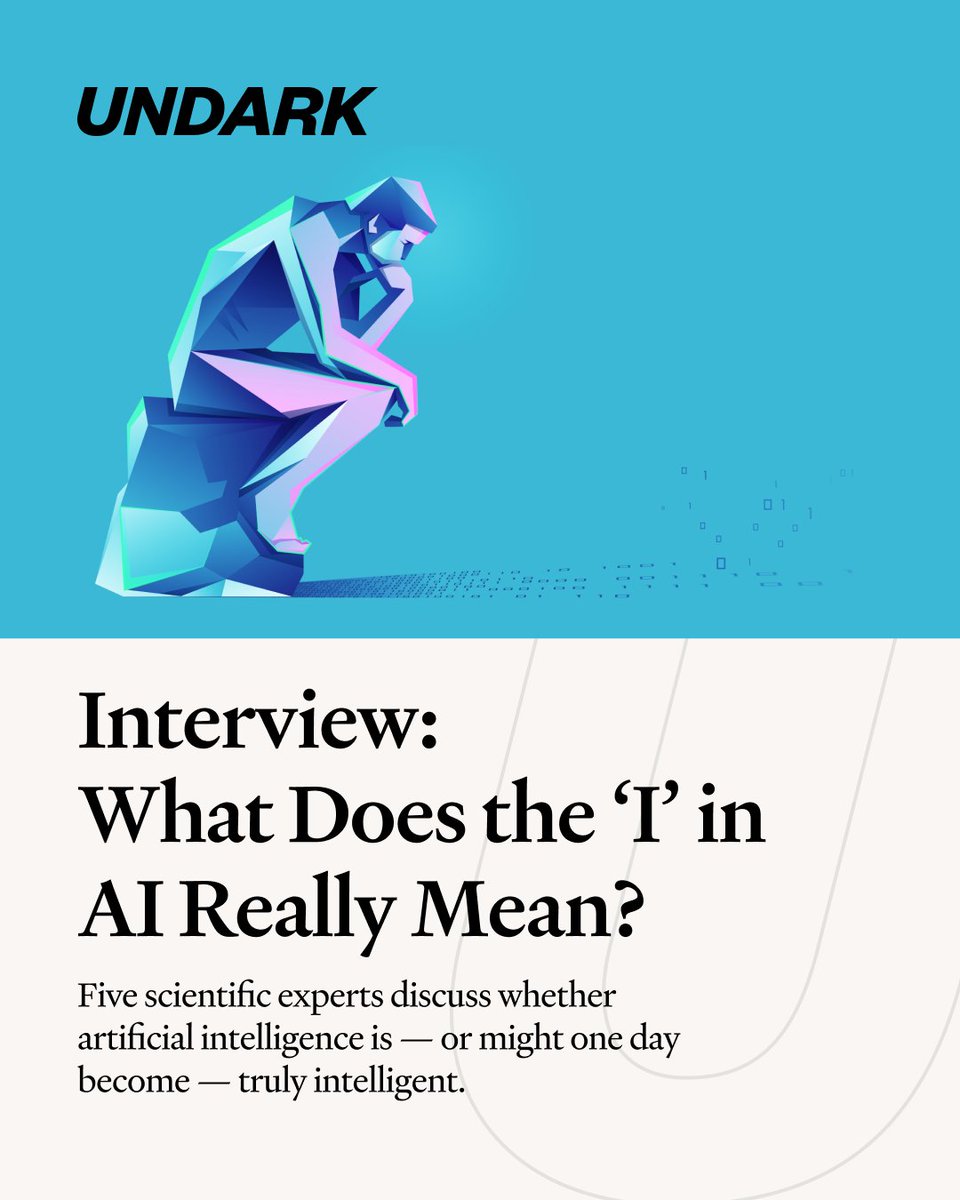
Is AI truly intelligent?
Undark asked five experts in linguistics, computer science, cognitive science, and psychology.
Their answers differ sharply, beginning with disagreement over what the word “intelligence” should mean at all.
🔗: https://t.co/Y7jOoxwVun
A poll says a candidate has 48% support, with a margin of error of ±3 points. How much uncertainty does that actually capture?
Less than many readers might assume.
As Americans head toward the 2026 midterm elections, we’re revisiting Michael Schulson’s 2020 look at the statistical shorthand that accompanies nearly every election poll, and the debate over whether it communicates uncertainty well at all.
🔗: https://t.co/eE9oByiv5Y