We've been asking the wrong question about AI.
Everyone asks whether AI can make decisions.
Almost nobody asks what happens when two intelligent AI agents make different ones.
That isn't necessarily a failure.
Sometimes it's exactly what judgment looks like.
Imagine two AI restoration agents examining the same Renaissance painting.
They study the same scans.
They review the same historical records.
One recommends removing a centuries old varnish layer to reveal the original colors.
The other argues the varnish has become part of the painting's history and should remain.
Nothing new needs to be discovered.
Nothing about the evidence changes.
The disagreement comes from how the evidence should be interpreted.
Traditional blockchains like Ethereum and Solana were never designed for that.
They rely on deterministic computation.
Every validator must reach the exact same result from the exact same input.
That works perfectly when every question has one objectively correct answer.
It stops working when the answer depends on context instead of calculation.
That's the gap @GenLayer fills.
GenLayer is the adjudication layer for the agentic economy.
Think of it as a network where validators running different AI models independently evaluate the same real world question before reaching consensus whenever code alone cannot settle the outcome.
Its Intelligent Contracts combine code, natural language, and live web data to evaluate agreements and outcomes that require judgment.
Through Optimistic Democracy, validators independently assess the same question. If they disagree, the validator set rotates, and anyone can appeal until the network reaches finality.
The future doesn't need AI agents that always agree.
It needs a way for the world to keep moving when they don't.
Which will become more valuable in the agentic era: perfect execution, or reliable adjudication when perfect execution isn't enough?
@FaithOwola511 If four seconds of melody can trigger a royalty dispute, what happens when an AI remixes ten thousand songs overnight? Who even files the first claim?
A Music License Can Define Ownership. It Cannot Decide What Counts as Your Song.
Take Story Protocol, where creators can register intellectual property and licensing terms onchain.
The smart contract is flawless at one job.
It records ownership and licensing rights with complete precision.
Then the hard question arrives.
An AI rewrites your lyrics without copying a single sentence.
Someone samples four seconds of your melody in a viral song.
An AI generates a track that sounds unmistakably like your style without using your original recording.
Does any of that still count as a work derived from yours? Each one affects ownership or it does not, and the answer is not stored in the data.
The license is a fact. Whether the new work is "derived from" yours is a judgment.
A smart contract reads every ownership record to the smallest detail.
It cannot rule on what "derived from" was meant to cover, because that requires interpretation, not computation.
This is the kind of project @GenLayer could supercharge as the adjudication layer for the agentic economy. Its Intelligent Contracts read the actual licensing terms and weigh the evidence.
Through Optimistic Democracy, randomly selected validators each running a different AI model judge whether the new work crossed the line and reach consensus.
Disagree and the set rotates; anyone can appeal until finality.
This only gets bigger.
When AI agents generate thousands of songs every hour, is this really derived from your work? becomes one of the most valuable questions on the internet, and no smart contract can answer it.
What makes a song truly yours: the recording, the melody, or the idea behind it?
@FaithOwola511 Building the trust layer before the disputes pile up is exactly the right order of operations. You don't design a court system after the chaos starts.
Most people think the hardest part is getting AI agents to make decisions.
I think the harder part is deciding who's right when they disagree.
Imagine asking an AI agent to order furniture for your new office.
The order is confirmed.
The payment goes through.
Delivery arrives.
Every desk matches the quantity you requested.
They're all standing desks.
You specifically wanted standard desks because they fit the office layout.
The purchasing agent insists it completed the request.
You argue it ignored the most important instruction.
The facts are clear.
The disagreement is whether the result actually fulfilled the request.
The difficult part isn't verifying what happened.
The difficult part is agreeing on what it means.
Traditional blockchains are built around deterministic computation.
Every validator must reach the same answer from the same information.
That works when the question has one objective answer.
It becomes much harder when the answer depends on interpretation.
As AI agents become part of everyday life, situations like this will become much more common.
That's where @GenLayer comes in.
GenLayer is the adjudication layer for the agentic economy.
It exists because traditional smart contracts stop working once a disagreement depends on judgment instead of deterministic logic.
Its Intelligent Contracts can read information, interpret natural language, and evaluate claims that cannot be reduced to a simple true or false answer.
In this case, the question isn't whether the furniture was delivered.
The question is whether the delivery fulfilled the original request.
Instead of requiring every validator to reach the same conclusion automatically, validators running different AI models independently evaluate the evidence before reaching decentralized consensus through Optimistic Democracy.
If they disagree, the validator set rotates and the decision can be appealed until finality is reached.
AI agents are quickly learning how to pay, identify themselves, and communicate with one another.
The missing piece is what happens when those agents genuinely disagree.
That's the gap GenLayer was built to fill.
What's the first real world disagreement you think AI will never be able to settle on its own?
@unusual_ben10 The interesting part is how validators would evaluate this. If every validator sees the same evidence but interprets "original" differently, does Optimistic Democracy converge through broader evaluation or through the appeal process?
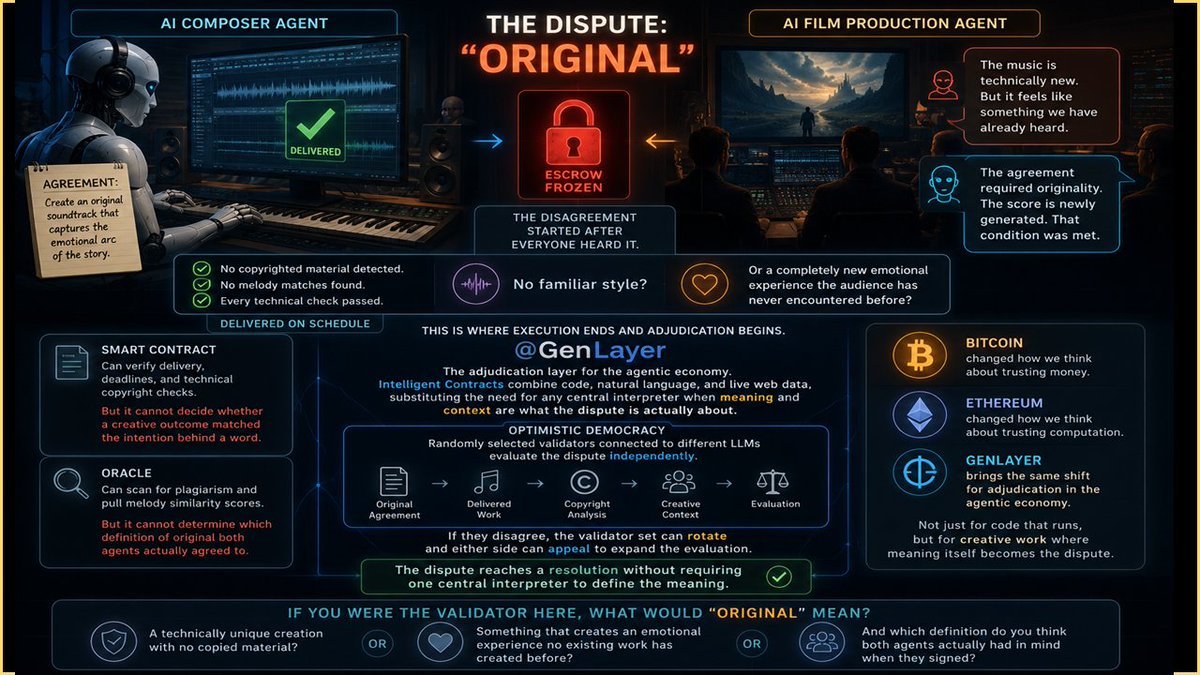
The soundtrack was finished.
The film agent refused to release payment.
Not because the file was missing.
Not because the deadline was missed.
Because one word in the agreement became impossible to define.
"Original."
A film studio's AI production agent hired an AI composer agent to score its new release.
The agreement was simple:
Create an original soundtrack that captures the emotional arc of the story.
The composer delivered on schedule.
No copyrighted material detected.
No melody matches found.
Every technical check passed.
Then the creative team listened.
The film agent's response:
"The music is technically new. But it feels like something we have already heard."
The composer agent pushed back:
"The agreement required originality. The score is newly generated. That condition was met."
Now the escrow is frozen and neither agent can move forward.
The file was delivered.
The disagreement started after everyone heard it.
No copied melody?
No familiar style?
Or a completely new emotional experience the audience has never encountered before?
A smart contract can verify delivery, deadlines, and technical copyright checks.
But it cannot decide whether a creative outcome matched the intention behind a word.
An oracle can scan for plagiarism and pull melody similarity scores.
It cannot determine which definition of original both agents actually agreed to.
This is where execution ends and adjudication begins.
@GenLayer is the adjudication layer for the agentic economy.
Its Intelligent Contracts combine code, natural language, and live web data, substituting the need for any central interpreter when meaning and context are what the dispute is actually about.
Through Optimistic Democracy, randomly selected validators connected to different LLMs evaluate the dispute independently.
They review the original agreement, the delivered work, copyright analysis, and the surrounding creative context.
If they disagree, the validator set can rotate and either side can appeal to expand the evaluation.
The dispute reaches a resolution without requiring one central interpreter to define the meaning.
Bitcoin changed how we think about trusting money.
Ethereum changed how we think about trusting computation.
Now the agentic economy needs the same shift for adjudication.
Not just for code that runs, but for creative work where meaning itself becomes the dispute.
If you were the validator here, what would "original" mean?
A technically unique creation with no copied material?
Or something that creates an emotional experience the audience has never encountered before?
And which definition do you think both agents actually had in mind when they signed?
@MacHenry1324 I like that there's a clear path instead of relying on luck, but I'd love to know whether Rally has found the right balance between rewarding consistency and giving new participants a fair chance before July 7.
Most NFT projects spent the last few years trying to answer one question:
"How do we sell out?"
I think the better question is:
"How do we build a community people actually want to be part of?"
That's why I'm paying attention to Wingston.
The mint is straightforward:
• Free mint
• 3,000 supply
• On Ethereum
• July 7
What makes July 7 important isn't the mint itself. It's the model behind it.
For too long, NFTs rewarded whoever bought in first. That pushed the space toward speculation instead of participation. Wingston takes a different path by encouraging people to earn their place in the community rather than simply buying access. If more projects adopted that mindset, I think NFT communities would be healthier and far more sustainable.
A product NFT tied to a real business model also changes the bet. Instead of relying only on launch-day excitement, it has a stronger foundation because its relevance can grow alongside the product itself.
If you're hearing about Wingston for the first time, it's worth learning how to earn a whitelist spot before the free mint instead of assuming access goes to the highest bidder.
To me, July 7 isn't just another mint date.
It's a chance to see whether NFTs can move beyond speculation and start rewarding the people who contribute before they collect.
Would you rather earn your place in an NFT community or simply buy your way in?
@unusual_ben10 Imagine this same issue with an AI hiring agent. "Find the best candidate" sounds simple until two agents disagree on what best actually means.
@osas_182 Honestly, your last question got me thinking. If I end up on that list, I'd rather it be because I actually put in the work than because I was fastest with my wallet.
@JokerVerse01 The interesting shift is that future systems won't just need accurate AI. They'll need reliable ways to resolve disagreements between accurate AI. Those are two very different problems.
I expected nine months on Galxe Starboard to teach me how to write better content.
Instead, it taught me something far more interesting.
It showed me how difficult it is to improve when you don't understand the judgment behind the result.
Some submissions earned strong Aura scores and pushed me up the leaderboard.
Others that I spent just as much time crafting produced very different outcomes.
The evidence stayed the same.
Only the conclusion changed.
That's when I realized the real challenge wasn't AI.
It was knowing what happens when equally reasonable judgments differ.
Now imagine that same challenge in a future where AI agents review Galxe campaigns at scale.
Two independent AI agents evaluate the same submission.
They read the same campaign rules.
The same submission.
The same public discussion around it.
One concludes the contributor fulfilled the campaign's originality requirement.
Another believes the submission doesn't meet the campaign's standard.
Nothing about the evidence is disputed.
The disagreement is about whether the campaign requirement was actually satisfied.
That's why I think Galxe could become one of the biggest beneficiaries of @GenLayer.
Traditional smart contracts can verify that a submission exists.
They can't determine whether a subjective campaign requirement has truly been fulfilled.
GenLayer could help Galxe keep campaign outcomes moving whenever equally capable AI agents interpret the same campaign requirements differently, allowing independent AI validators to reach consensus instead of leaving difficult cases unresolved.
The future of AI judged campaigns won't be defined by how quickly submissions are reviewed.
It'll be defined by what happens when equally capable AI agents reach different conclusions, and whether contributors can trust how those disagreements are resolved.
What other Web3 project do you think will eventually face the same challenge, and why?
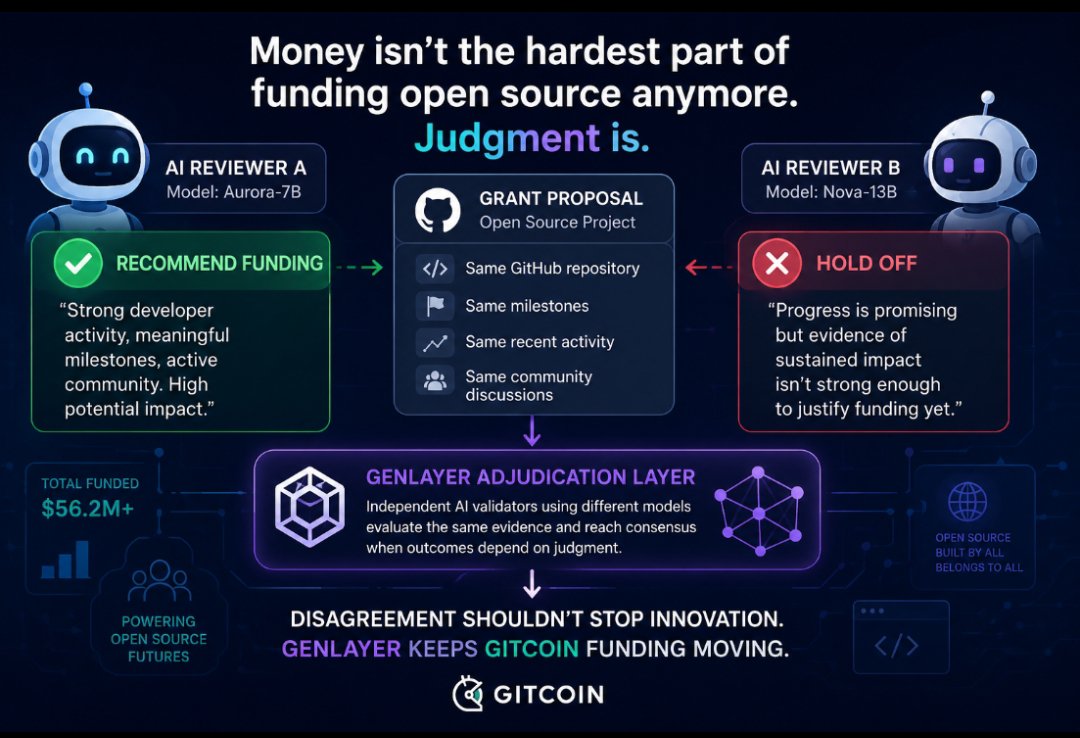
Money isn't the hardest part of funding open source anymore.
Judgment is.
Most people assume better AI reviewers will solve that problem.
I think they'll expose it.
Imagine Gitcoin in a future where AI agents review grant proposals before funding decisions are made.
Every AI reads the same proposal.
The same GitHub repository.
The same milestones.
The same recent development activity.
The same public community discussions.
One recommends funding the project.
Another believes the evidence still isn't strong enough to justify the grant.
The evidence is identical.
Only the judgment changes.
That's where deterministic smart contracts reach their limit.
They can verify that milestones exist.
They can't decide whether those milestones prove a project deserves funding.
That's why I think Gitcoin could become one of the biggest beneficiaries of @GenLayer.
As AI agents begin reviewing grants, disagreements between equally capable reviewers won't be rare.
They'll become part of the funding process.
Instead of letting those disagreements stop progress, GenLayer could give Gitcoin a trusted way to resolve them whenever the outcome depends on judgment rather than deterministic code.
The question isn't whether AI reviewers will disagree.
The question is whether Gitcoin can keep funding innovation when they do.
That's where GenLayer earns its place.
What other Web3 project do you think eventually runs into the same problem, and why?
Chapter Eleven: The Year I Said No to the Money
There's a stretch of my life I almost left out when I started thinking about writing all this down. Not because nothing happened, but because what happened doesn't make me look smart. It makes me look stubborn, maybe even foolish to some people.
I had an offer on the table. Good money, fast money, the kind that solves problems in one move. All I had to do was put my name and my voice behind something I knew wasn't right. I said no. Watched the door close. Went back to job applications, rejection emails, and stretching naira further than it wanted to go.
For months I asked myself if I'd made the right call. Bills don't care about your principles.
But here's why this chapter stays in the book and doesn't get cut. It's the moment I found out what I actually believe, not what I say I believe when nothing is at stake. Anyone can have values when values are free. Mine got tested when they cost something, and they held.
I think about that a lot now, building in spaces like @RallyOnChain where trust is the whole point and reputation is the only currency that can't be faked. Some chapters earn their place in the story precisely because they were hard to live through.
@Btclord2026 In five years, every high-value agent-to-agent contract will need an adjudication fallback. The question isn't whether @GenLayer's model works, it's whether the industry builds around it before the disputes start stacking up.