Students without access to LLMs are 2 to 8 times more creative than students with access.
That is the finding of a new paper comparing 2,200 college admissions essays written by humans before ChatGPT with essays generated by GPT-4.
The key point is not individual creativity. GPT-4 can write well, sometimes better than individual students. The problem is collective creativity.
Each new human essay added new semantic territory. New ideas. New angles. New experiences. New combinations.
Each new GPT-4 essay added much less.
The authors call this the diversity growth rate: how much novelty each additional text contributes to the collective pool of ideas.
Humans kept expanding the pool. GPT-4 made the pool converge.
Even when the authors pushed GPT-4 to be more creative, changed parameters, or used chain-of-thought prompting, the homogenizing effect remained.
This is the real danger of AI in education.
Not that students will write worse.
That everyone will write the same.
*
Full paper in the first reply
SEC Rule S7-2026-15 would let public companies stop filing quarterly reports and hide financials for six months. Your savings are in those stocks. Comment is open right now.
When big changes happen in one country, there will be many theories. When big changes happen globally, there are fewer candidates. Two new studies on the global drop in birthrates point to the iPhone as a contributor. By @stavernise
https://t.co/ffaNDLr3mg
In an exclusive interview with CNN, Lebanese President Joseph Aoun tells CNN's Christiane Amanpour his message to the IRGC and Iran. https://t.co/V3msdvKCG1
Is AI breaking the career ladder?Back ButtonFilter Button. As AI reshapes the workplace, cutting entry-level jobs today could create a skills shortage tomorrow. https://t.co/MaYtwmlsrp
The next frontier for prevention of heart and vascular disease isn't targeting lipids. It's about blocking inflammation. These are some of the ongoing clinical trials @NatureMedicine
https://t.co/DSLMoPFqs7
An easy way to get unstuck is to get up and take a walk.
We generate more creative ideas during and after walking outdoors—and even on a treadmill facing a blank wall.
Divergent thinking rarely happens when we're tethered to a desk. Moving our bodies frees our minds.
WATCH: “We made an enormous mistake allowing the ed tech industry to come in and give every kid a computer, a tablet, an iPad, a Chromebook… and the results are devastating and we need to stop.” @JonHaidt via @andersoncooper@AC360
There is now a solid body of evidence showing that internet availability is causing a variety of outcomes that adversely affect democracy
The answer may have something to do with platform algorithms, such as curated newsfeeds (e.g., on Facebook) or ranking of posts (e.g., the “for you” feed on X).
Algorithms have long been in the sights of researchers and regulators as potential culprits of polarization because of their opacity and their known focus on maximizing user engagement and platform dwell time with little regard for the quality of curated content. https://t.co/IInHHOwBwI
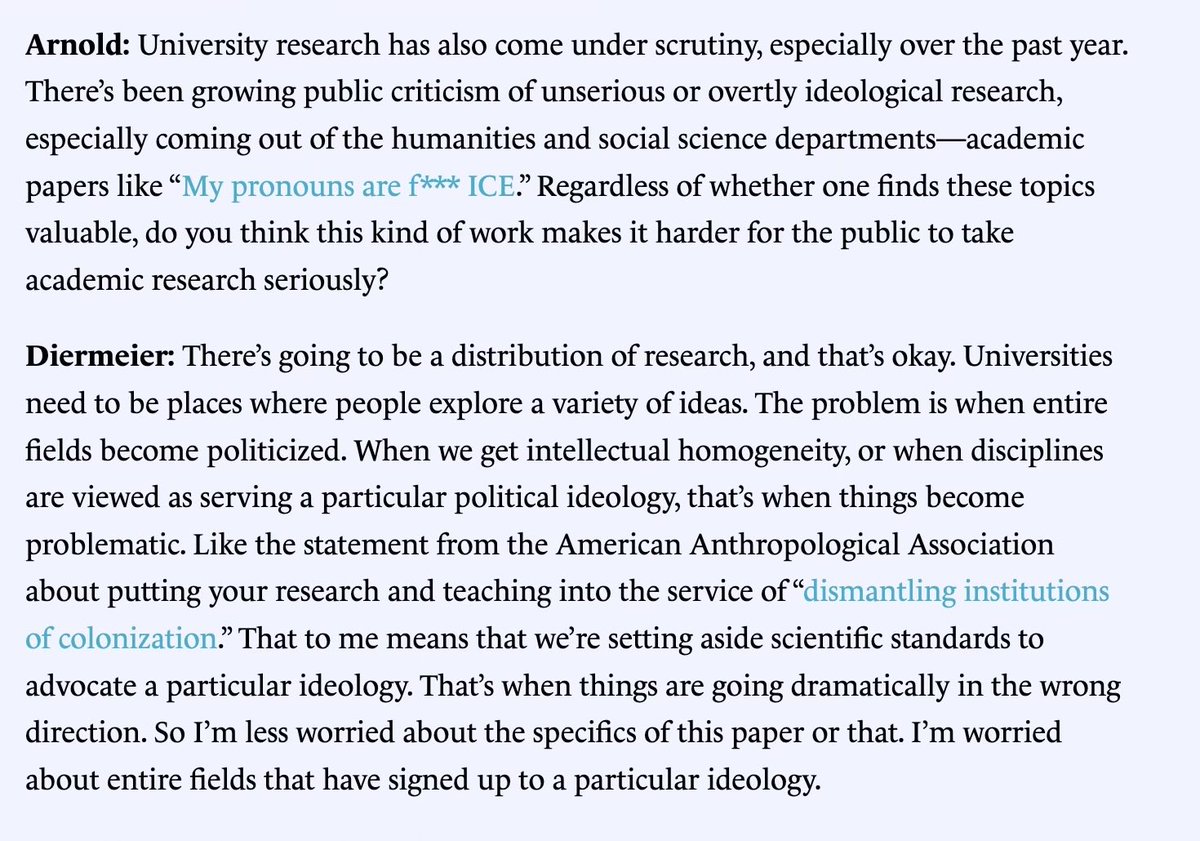
One of the report’s commissioners is Vanderbilt chancellor Daniel Diermeier, whom we were lucky to interview @CityJournal several months ago
Even at that time, he was willing to confront the problem of politicized research & academic departments—a problem admins rarely acknowledge
Glad to see this report elaborating on these issues
https://t.co/DKbe5u8agw
People don’t realize that the entire history of Israel was subjected to a hostile, coordinated, well-funded rewrite on Wikipedia. History is being rewritten to support the disinformation war that supported the Iranian Axis’ kinetic objectives.
Readers often ask: "Is Rung-3 of the Ladder really needed for practical decision making?". Here is a very practical application -- the crashing of self-driving cars -- that hinges entirely on Rung-3 analysis:
https://t.co/hjdkKdJIUK @vardi@eliasbareinboim@smueller@analisereal@DrBobGoldberg