AI coding assistants ship features fast. They also ship your next exploit 💀
Veritas RedTeam runs autonomous penetration testing on your AI-built infrastructure before attackers do.
AI coding assistants ship features fast. They also ship your next exploit 💀
Veritas RedTeam runs autonomous penetration testing on your AI-built infrastructure before attackers do.
The U.S. ranks 91st out of 112 countries for fraud vulnerability in 2025. Bottom 20% globally.
Look at the map below. The pattern is clear.
Nordic and Western European countries dominate the top spots. Luxembourg sits at #1 with a score of 0.8. Denmark, Finland, Norway, and the Netherlands follow right behind.
Then look at the U.S. at 3.8. That puts it closer to countries like China (4.1) and Argentina (4.1) than to peers like Canada (1.6) or the UK (2.3).
The index weighs four factors: fraud activity (50%), resource accessibility (20%), government intervention (20%), and economic health (10%).
So half the score comes from how much fraud actually happens. The rest is about how well a country prevents and responds to it.
A few surprises in the data:
- South Korea (1.9) and Japan (2.0) outperform most Western economies
- Saudi Arabia (1.9) ranks 26th, ahead of France, Italy, and Spain
- Pakistan (7.5) and Nigeria (6.4) sit at the bottom of the list
Being a wealthy country doesn't protect you. Systems, enforcement, and digital infrastructure matter more.
🚨 SCAM ALERT: The "Fake AI Interview" Malware Attack 🚨
yeah, again and again!
We just intercepted a highly sophisticated recruitment scam targeting senior DeFi operators. It uses real company names, real recruiter domains and a fake AI interview platform to deliver malware.
Here is exactly how they do it 🧵👇
How to protect yourself:
1. No legitimate interview platform will EVER ask you to run terminal commands. Camera/mic checks happen in the browser.
2. Verify open roles directly on the company's official careers page.
3. If it feels too good to be true, it is.
Stay safe out there!
To add pressure, the site actively monitors if you open Developer Tools to inspect the code, throwing a warning to close them immediately. They want you blind and compliant.
Post-quantum cryptography is a strong step forward for sure. But these algorithms resist known quantum attacks. That's not the same as proven secure. RSA was considered unbreakable too until the math changed. PQC buys us time and shifts the problem, it doesnt eliminate it. We're replacing one set of hard math problems with another set we believe quantum computers can't solve efficently. That belief is well founded but it's still a belief.
The real upgrade isn't any single algorithm ,rather crypto agility, the ability to swap out your cryptographic foundations when the landscape shifts again
You probably never think about the encryption behind your online banking. But you rely on it every time you log in. RSA encryption and elliptic curve cryptography protect most digital communications. Their security rests on math problems that classical computers struggle to solve. Shor's algorithm, executed on a large enough fault-tolerant quantum computer, could break those problems efficiently.
1. The quantum resources needed to crack modern encryption have fallen fast. In 2019, Craig Gidney and Martin Ekerå estimated that breaking RSA-2048 would take roughly 20 million physical qubits.
2. A 2025 update from Gidney brought that number below one million qubits, using the same hardware assumptions.
3. In early 2026, Iceberg Quantum's Pinnacle architecture introduced QLDPC codes in place of traditional surface codes. Their proposal suggests RSA-2048 could fall with fewer than 100,000 physical qubits, though the underlying assumptions remain unvalidated at scale.
4. A separate March 2026 paper on elliptic curve cryptography showed that breaking secp256k1, the curve that secures Bitcoin and most digital signatures, could take fewer than 500,000 physical qubits.
As TQI reported, these three papers together mark the largest downward shift in quantum threat resource estimates since Shor's algorithm first appeared in 1994.
These are theoretical proposals, not proven capabilities. Today's quantum systems run hundreds to thousands of noisy qubits. The gap between current hardware and cryptographically useful machines is still large. The harvest-now-decrypt-later threat, though, is already active regardless of when that hardware arrives. Adversaries can collect encrypted data today and store it until quantum decryption becomes possible. That means any organization holding data that must stay confidential into the 2030s faces a real risk right now.
The defensive answer is post-quantum cryptography: mathematical algorithms built to withstand quantum attacks. Standardization and deployment are already underway.
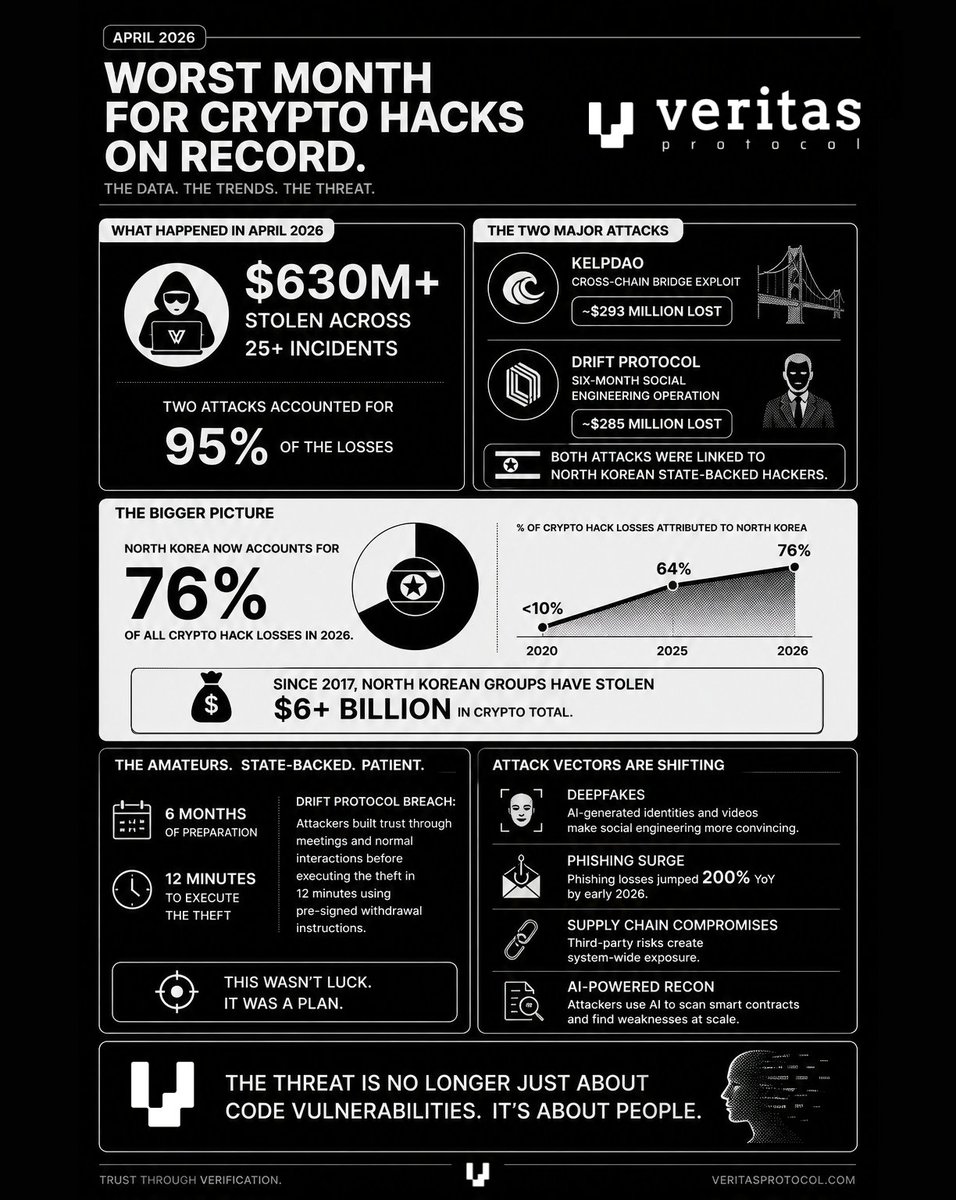
April 2026 was the worst month for crypto hacks on record.
Here's what happened:
- Over $630 million stolen across 25+ incidents
- Two attacks accounted for 95% of the losses
- KelpDAO lost ~$293 million through a cross-chain bridge exploit
- Drift Protocol lost ~$285 million after a six-month social engineering operation
- Both attacks were linked to North Korean state-backed hackers
The bigger picture is concerning.
North Korea now accounts for 76% of all crypto hack losses in 2026. That's up from 64% in 2025 and under 10% in 2020. Since 2017, North Korean groups have stolen over $6 billion in crypto total.
These are not amateur operations. The Drift Protocol breach took six months of preparation. Attackers built trust through meetings and normal interactions before executing the theft in 12 minutes using pre-signed withdrawal instructions.
The attack vectors are also shifting.
Deepfakes, phishing and supply chain compromises will drive the next wave of major exploits. Phishing losses alone jumped 200% year over year by early 2026. Attackers now use AI to generate convincing deepfakes and scan smart contracts for weaknesses automatically.
The threat is no longer just about code vulnerabilities. It's about people.
HOW TO PROTECT YOURSELF:
1. NEVER run keyboard commands (Win+R, PowerShell, Terminal) to "verify" a CAPTCHA. Real CAPTCHAs only require clicks.
2. If a Web3 recruiter forces you off professional platforms onto Telegram for the entire process, be highly skeptical.
3. Check WHOIS data. A company claiming "9+ years of experience" on a domain registered last week is a scam.
This is just one example of a broader campaign targeting builders in our space.
Please RT to warn other Web3 frens currently looking for work.
Stay safe out there and always verify who you are talking to. 🛡️
🚨 SCAM ALERT: Over the past few days, our team has received multiple reports of highly coordinated fake job offers targeting Web3 professionals.
We are breaking down one specific case - operating under the name "Criptoro" (@CriptoroGlobal) - to show you exactly how these scams work and how to avoid them. 🧵👇
They appear to be impersonating a legitimate, older Spanish crypto company called Criptoro (https://t.co/nRiNwEkuvW, registered in 2019).
The scammers copied the names and photos of the real founders onto their fake .biz site to make the operation look credible.